~1 min
Average Reply Time
~1 hour
To Be Matched With A Tutor
30 Min Trial
75% Find Their Tutor On The 1st Trial
$20-35+/hr
Premium Yet Affordable Learning
Hire The Best Logic gates Tutor




Most students don’t fail logic gates because they’re bad at maths. They fail because nobody showed them how to trace through a truth table when the output doesn’t match what they expect.
Logic Gates Tutor Online
Logic gates are the fundamental building blocks of digital circuits, implementing Boolean functions such as AND, OR, NOT, NAND, NOR, XOR, and XNOR. They are studied across undergraduate electrical engineering, computer engineering, and digital electronics courses worldwide.
MEB provides 1:1 online tutoring and homework help in 2800+ advanced subjects, including logic gates. Whether you’re searching for a logic gates tutor near me or need someone who can work through Karnaugh maps and combinational circuit design with you live on screen, MEB’s tutors are matched to your exact course, syllabus, and timeline. Find your electrical engineering tutor and get started the same day.
- 1:1 online sessions tailored to your specific course or syllabus
- Expert-verified tutors with subject-specific knowledge in digital logic and circuit theory
- Flexible time zones — US, UK, Canada, Australia, Gulf
- Structured learning plan built after a diagnostic session
- Ethical homework and assignment guidance — you understand before you submit
52,000+ students across the US, UK, Canada, Australia, and the Gulf have used MEB since 2008 — including students in Electrical Engineering subjects like logic gates, digital electronics, and circuit analysis.
Source: My Engineering Buddy, 2008–2025.
How Much Does a Logic Gates Tutor Cost?
Logic gates tutoring at MEB starts at $20–$40/hr for most undergraduate and pre-university levels. Not sure if it’s worth it? Start with the $1 trial — 30 minutes of live 1:1 tutoring or one homework question explained in full, no registration required.
| Level / Need | Typical Rate | What’s Included |
|---|---|---|
| Standard (most levels) | $20–$35/hr | 1:1 sessions, homework guidance |
| Advanced / Specialist | $35–$70/hr | Expert tutor, VLSI and HDL depth |
| $1 Trial | $1 flat | 30 min live session or 1 homework question |
Tutor slots fill quickly during end-of-semester exam periods — particularly for digital electronics and embedded systems modules. Book early if your assessment is within four weeks.
WhatsApp MEB for a quick quote — average response time under 1 minute.
Who This Logic Gates Tutoring Is For
Logic gates sits at the foundation of every digital systems course, yet it trips up a surprising number of students who are strong in calculus but unfamiliar with Boolean reasoning. If the problem isn’t the maths — it’s the logic — this is for you.
- First and second year electrical or computer engineering undergraduates struggling with combinational and sequential logic
- Students retaking after a failed first attempt at a digital systems or digital electronics module
- Students with a university conditional offer depending on this grade
- Students 4–6 weeks from an exam with significant gaps still to close — Karnaugh maps, flip-flops, finite state machines
- Graduate students revisiting logic gate fundamentals before tackling FPGA design or VLSI
- Parents watching a child’s confidence drop alongside their digital circuits grade
Students come from courses at MIT, Georgia Tech, University of Toronto, Imperial College London, TU Delft, and the University of Melbourne — among many others. The tutor adapts to whatever textbook and exam format your course uses.
Need help urgently? The $1 trial gets you into a session today.
1:1 Tutoring vs Self-Study vs AI vs YouTube vs Online Courses
Self-study works if you’re disciplined, but logic gate problems require someone to catch the exact step where your Boolean simplification breaks down. AI tools give fast explanations but can’t watch you trace a circuit and diagnose where you went wrong. YouTube is good for gate-level overviews and stops completely when you’re stuck on a specific K-map grouping. Online courses move at a fixed pace with no way to slow down on the topics that actually cost marks. 1:1 tutoring with MEB is live, calibrated to your course’s specific gate types and assessment format, and corrects errors the moment they appear — not after you’ve already submitted.
Outcomes: What You’ll Be Able To Do in Logic Gates
After working with an MEB logic gates tutor, you’ll be able to construct and simplify Boolean expressions using De Morgan’s theorems, analyze multi-gate combinational circuits by tracing outputs through each stage, apply Karnaugh map grouping rules to minimise logic expressions with up to five variables, explain the functional difference between NAND-only and NOR-only implementations, and present complete truth tables for sequential circuits including SR, JK, and D flip-flops with confidence under exam conditions.
Based on feedback from 40,000+ sessions collected by MEB from 2022 to 2025, 58% of students improved by one full grade after approximately 20 hours of 1:1 tutoring in subjects like logic gates. A further 23% achieved at least a half-grade improvement.
Source: MEB session feedback data, 2022–2025.
Supporting a student through logic gates? MEB works directly with parents to set up sessions, track progress, and keep coursework on schedule. WhatsApp MEB — average response time is under a minute, 24/7.

What We Cover in Logic Gates (Syllabus / Topics)
Track 1: Boolean Algebra and Gate Fundamentals
- AND, OR, NOT, NAND, NOR, XOR, XNOR — truth tables and circuit symbols
- Boolean algebra laws: identity, complement, associativity, De Morgan’s theorems
- Sum of products (SOP) and product of sums (POS) forms
- Logic gate equivalences and universal gate implementations
- Fan-in, fan-out, propagation delay, and noise margins
- CMOS vs TTL logic families — voltage levels and compatibility
Textbooks used in this track include Morris Mano’s Digital Design, Floyd’s Digital Fundamentals, and Roth and Kinney’s Fundamentals of Logic Design.
Track 2: Combinational Logic Design
- Karnaugh maps (2, 3, 4, and 5 variable) — prime implicants and essential prime implicants
- Quine-McCluskey method for larger variable counts
- Half adder, full adder, and ripple carry adder circuits
- Multiplexers, demultiplexers, encoders, and decoders
- Comparators, parity generators, and ALU building blocks
- Hazard analysis in combinational circuits — static and dynamic hazards
- Simulation using Logisim, Multisim, or similar tools — get help with Multisim tutoring
Common textbook references: Wakerly’s Digital Design: Principles and Practices and Tocci’s Digital Systems: Principles and Applications.
Track 3: Sequential Logic and Finite State Machines
- SR, D, JK, and T flip-flops — characteristic equations and timing diagrams
- Synchronous vs asynchronous sequential circuits
- Registers, shift registers, and counters (ripple, synchronous, modulo-N)
- Moore and Mealy state machines — state diagrams, state tables, next-state logic
- State minimisation techniques
- Introduction to HDL-level gate description — link to VHDL tutoring and Verilog tutoring
Textbooks include Mano and Ciletti’s Logic and Computer Design Fundamentals and Harris and Harris’s Digital Design and Computer Architecture.
At MEB, we’ve found that students who struggle with Karnaugh maps almost always have the same gap — they group cells correctly but miss the prime implicant that spans a corner. One targeted session on that specific error closes most of the confusion permanently.
What a Typical Logic Gates Session Looks Like
The tutor opens by checking the previous topic — usually Boolean simplification or a specific K-map problem the student flagged. From there, the session moves to the current challenge: often a combinational circuit design problem or a sequential logic timing diagram. The tutor writes out each step on a digital pen-pad, visible in real time over Google Meet, while the student works through the same problem on their end. When the student’s output doesn’t match the expected result, the tutor traces back through the gate-by-gate logic to find exactly where the error entered. The session closes with a specific practice task — two or three K-map problems or a small state machine to complete before the next session — and the next topic is noted so both sides can prepare.
How MEB Tutors Help You with Logic Gates (The Learning Loop)
Diagnose: In the first session, the tutor identifies exactly where the gap is — whether that’s Boolean simplification rules, K-map grouping errors, flip-flop characteristic equations, or state machine construction. Not a general “weak in digital” label. A specific, actionable gap map.
Explain: The tutor works through live problems on a digital pen-pad, writing out Boolean expressions, drawing gate circuits, and stepping through truth tables step by step. You see the reasoning, not just the answer.
Practice: You attempt the next problem with the tutor present. No moving on until you can produce the correct output independently — whether that’s a minimised SOP expression or a complete state transition table.
Feedback: Every error is corrected at the point it appears. The tutor explains not just what went wrong, but which rule was misapplied and why that costs marks in an assessed context. Get digital circuit help that covers exactly this kind of targeted correction.
Plan: After each session, the tutor sets the next topic in sequence and adjusts pacing based on your exam date. If you have three weeks to your digital systems exam, the plan looks different from a student doing ongoing coursework support.
Sessions run over Google Meet. The tutor uses a digital pen-pad or iPad with Apple Pencil. Before your first session, share your course syllabus or module outline, a recent homework attempt you got wrong, and your exam or submission date. The first session is diagnostic — the tutor covers your most urgent gap first, then builds the sequence from there. Start with the $1 trial — 30 minutes of live tutoring that also serves as your first diagnostic.
Students consistently tell us that the moment logic gates clicks is when they stop memorising truth tables and start seeing the Boolean rule behind each gate. That shift usually happens in a single focused session — and it changes how they approach the whole digital circuits course.
Tutor Match Criteria (How We Pick Your Tutor)
Not every electronics tutor is a logic gates specialist. Here’s what MEB checks before matching.
Subject depth: Tutors are matched to your level — pre-university digital electronics, first-year undergraduate digital systems, or advanced courses covering HDL and FPGA implementation. Exam board and syllabus fit are verified before the first session.
Tools: Every tutor uses Google Meet with a digital pen-pad or iPad plus Apple Pencil — so circuit drawing and Boolean derivation happen live on screen, not described verbally.
Time zone: Matched to your region. US, UK, Gulf, Canada, and Australia are all covered with tutors available across time zones — including late evenings and weekends.
Goals: Whether you need to pass a resit, close specific gaps before finals, or build up to FPGA design tutoring, the tutor is matched to that specific aim — not assigned generically.
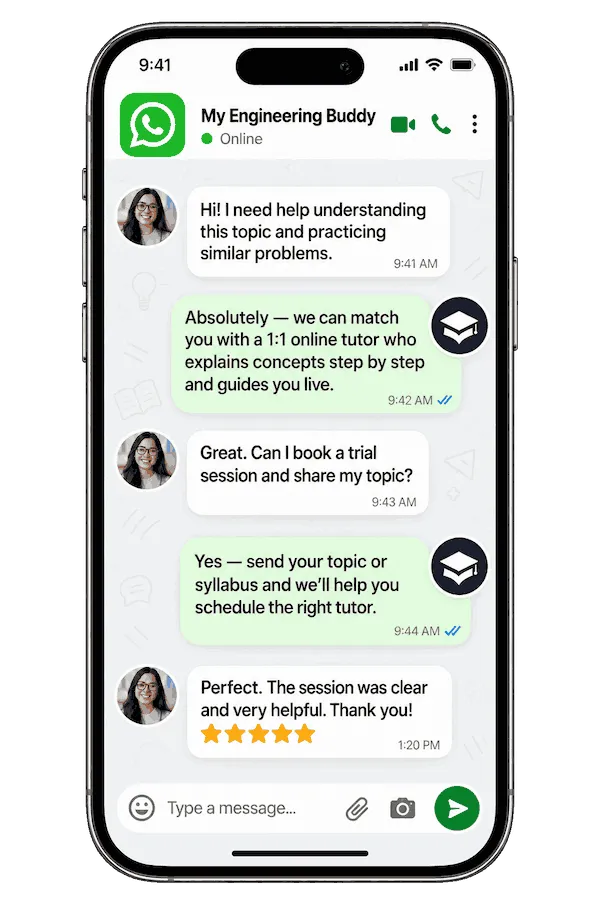
Unlike platforms where you fill out a form and wait, MEB responds in under a minute, 24/7. Tutor match takes under an hour. The $1 trial means you test before you commit. Everything runs over WhatsApp — no logins, no intake forms.
Study Plans (Pick One That Matches Your Goal)
After the diagnostic session, your tutor builds a specific sequence. Most students fall into one of three plans: a catch-up plan (1–3 weeks) for students with a gap to close before an exam — covering Boolean fundamentals, K-maps, and combinational circuits in fast succession; an exam prep plan (4–8 weeks) that works through the full digital logic syllabus with past paper practice built in from week three; or ongoing weekly support aligned to your module timetable, covering each topic as your lecturer introduces it so nothing accumulates. The tutor adjusts the sequence after the first session based on where your real gaps are, not where the textbook assumes you should be.
Pricing Guide
Logic gates tutoring at MEB runs $20–$40/hr for most undergraduate and pre-university levels. Graduate-level work or specialist topics — VLSI-level gate design, HDL implementation, advanced FPGA — can reach up to $100/hr depending on tutor background and timeline.
Rate factors include your course level, topic complexity, how close your exam is, and tutor availability. Peak exam periods — typically April to May and November to December — see higher demand and faster slot fill.
For students targeting top engineering programmes or professional certifications in digital design, tutors with industry or research backgrounds in semiconductor and integrated circuit design are available at higher rates. Share your specific goal and MEB will match the tier to your ambition.
Start with the $1 trial — 30 minutes, no registration, no commitment. WhatsApp MEB for a quick quote.
MEB has served students in digital electronics, logic design, and embedded systems across 80+ countries since 2008 — with tutors available across every major time zone, 24/7.
Source: My Engineering Buddy, 2008–2025.
FAQ
Is logic gates hard?
For students coming from calculus-heavy courses, yes — the shift to Boolean reasoning feels unfamiliar. The rules are not complicated, but applying them to multi-gate circuits with minimisation requirements takes deliberate practice with feedback. Most students find it clicks faster than expected once the underlying logic structure is clear.
How many sessions are needed?
Students with isolated gaps — K-maps, flip-flop equations — typically need 3–6 sessions. Students who need to cover the full logic gates syllabus before an exam usually need 10–15 hours. The diagnostic session clarifies this early so you’re not guessing.
Can you help with homework and assignments?
MEB tutoring is guided learning — you understand the work, then submit it yourself. The tutor explains the method, works through similar problems with you, and checks your reasoning. See our Academic Integrity policy and Why MEB page for full details on what we help with and what we don’t.
Will the tutor match my exact syllabus or exam board?
Yes. When you contact MEB, share your course name, institution, and the specific topics you’re covering. Tutors are matched to your module content — whether that’s a UK A Level digital electronics component, a US undergraduate digital systems course, or a specific university module using a named textbook.
What happens in the first session?
The tutor runs a short diagnostic — asking you to work through a Boolean simplification or K-map problem while they observe. This identifies your exact gap within 15–20 minutes. The rest of the session covers your most urgent topic. Nothing is wasted on content you already know.
Is online tutoring as effective as in-person?
For logic gates, online is often better. Circuit diagrams, truth tables, and K-map groupings are drawn live on a digital pen-pad visible to both tutor and student. The student can save the session annotations. There’s no whiteboard erasure mid-explanation.
What’s the difference between NAND and NOR as universal gates — and why does it matter for my exam?
Both NAND and NOR can implement any Boolean function on their own, which makes them universal gates. Exam questions frequently ask you to convert an AND-OR circuit to NAND-only or NOR-only form. Understanding the De Morgan equivalence behind each conversion is what earns full marks — not just memorising the gate symbol.
Do logic gates topics appear in FPGA and embedded systems courses?
Yes — always. FPGA design, embedded systems tutoring, and HDL programming all assume solid logic gate foundations. Students who skip gate-level understanding hit a hard wall when they reach synthesis tools and timing constraints. Fixing the logic gates gap first makes every downstream course easier.
Can I get logic gates help at midnight?
Yes. MEB operates 24/7 via WhatsApp. If you message at midnight before a morning exam, the team responds within a minute and works to get you matched or into a session as fast as possible. Tutor availability does vary by time slot — earlier notice means more options.
What if I don’t understand my tutor’s explanation style?
Tell MEB immediately via WhatsApp. Tutor reassignment is handled fast — usually within the hour. The $1 trial exists partly for this reason: you evaluate fit before any larger commitment. If the explanation style doesn’t work for you, the solution is a different tutor, not a different platform.
How do I get started?
Message MEB on WhatsApp — you’ll get a response in under a minute. Share your course, exam date, and the topics giving you trouble. MEB matches you with a verified tutor, usually within the hour. Your first session is the $1 trial: 30 minutes live or one problem fully explained.
How do I find a logic gates tutor in my city?
You don’t need to. MEB tutors work entirely online over Google Meet — available to students in London, New York, Toronto, Dubai, Sydney, and everywhere in between. Time zone matching is handled at booking. Location is never a constraint.
Trust & Quality at My Engineering Buddy
Every MEB tutor goes through a subject-specific screening process — not a generic interview. For logic gates, that means demonstrating live problem-solving across Boolean algebra, K-map minimisation, and sequential circuit design before being accepted. Tutors hold degrees in electrical engineering, computer engineering, or closely related fields, and many have industry experience in digital design or VLSI design tutoring. Ongoing session feedback is reviewed to maintain quality. Rated 4.8/5 across 40,000+ verified reviews on Google.
MEB tutoring is guided learning — you understand the work, then submit it yourself. For full details on what we help with and what we don’t, read our Academic Integrity policy and Why MEB.
MEB has been running since 2008, serving 52,000+ students across the US, UK, Canada, Australia, Gulf, and Europe in 2,800+ subjects. Within Electrical Engineering, that includes logic gates, digital signal processing tutoring, integrated circuits tutoring, and dozens of adjacent subjects across the electronics and digital design stack.
Try your first session for $1 — 30 minutes of live 1:1 tutoring or one homework question explained in full. No registration. No commitment. WhatsApp MEB now and get matched within the hour.
Explore Related Subjects
Students studying logic gates often also need support in:
- Analog circuits
- Basic electronics
- Microprocessors
- Semiconductor devices
- Signals and systems
- Microcontrollers
- Computer hardware
From Boolean algebra to finite state machines — MEB logic gates tutors cover every layer of the digital logic stack, matched to your exact course and exam format.
Source: My Engineering Buddy, 2008–2025.
Next Steps
Before your first session, have ready: your exam board and syllabus or course outline, a recent past paper attempt or homework you struggled with, and your exam or submission date. The tutor handles the rest.
- Share your exam board, hardest topic (K-maps? flip-flops? state machines?), and current timeline
- Share your availability and time zone
- MEB matches you with a verified logic gates tutor — usually within 24 hours
The first session starts with a diagnostic so every minute is used on what actually needs fixing.
Visit www.myengineeringbuddy.com for more on how MEB works.
WhatsApp to get started or email [email protected].
Reviewed by Subject Expert
This page has been carefully reviewed and validated by our subject expert to ensure accuracy and relevance.