




~1 min
Average Reply Time
~1 hour
To Be Matched With A Tutor
30 Min Trial
75% Find Their Tutor On The 1st Trial
$20-35+/hr
Premium Yet Affordable Learning
Hire The Best IB Computer science HL/SL Tutor

Most IB Computer Science students hit the same wall: the Internal Assessment eats their revision time, Paper 1 abstract thinking catches them off guard, and HL Option topics feel like a separate course nobody prepared them for.
IB Computer Science HL/SL Tutor Online
IB Computer Science HL/SL is an International Baccalaureate Diploma Programme course covering algorithms, data structures, programming, computer organisation, and networks, equipping students with both theoretical understanding and practical coding skills assessed at Higher or Standard Level.
Finding a qualified IB Computer Science HL/SL tutor near me matters more than most students expect — the course combines abstract computational thinking with real programming tasks and a substantial Internal Assessment project, and no textbook alone bridges that gap. MEB connects you with 1:1 IB tutoring across the full Diploma Programme, with tutors who know the exact syllabus, the HL Option distinctions, and what IB examiners reward. Start with the $1 trial — 30 minutes, no forms, no wait.
- 1:1 online sessions aligned to the IB Computer Science HL/SL syllabus (First Assessment 2014 and 2025 update)
- Expert-verified tutors with CS degrees and IB-specific subject knowledge
- Flexible time zones — US, UK, Canada, Australia, Gulf
- Structured learning plan built after a diagnostic session
- Ethical homework and IA guidance — you understand the work, then submit it yourself
52,000+ students across the US, UK, Canada, Australia, and the Gulf have used MEB since 2008 — including students in IB subjects like IB Computer Science HL/SL, IB Mathematics: Analysis and Approaches, and IB Physics HL/SL.
Source: My Engineering Buddy, 2008–2025.
How Much Does an IB Computer Science HL/SL Tutor Cost?
Most IB Computer Science sessions run $20–$40/hr depending on level, topic complexity, and tutor experience. HL Option depth and IA project work may sit toward the higher end. The $1 trial gives you 30 minutes of live 1:1 tutoring — no registration, no commitment.
| Level / Need | Typical Rate | What’s Included |
|---|---|---|
| SL — core topics | $20–$35/hr | 1:1 sessions, homework guidance, past paper practice |
| HL — core + Option topics | $30–$50/hr | Expert tutor, HL Option depth, IA project support |
| $1 Trial | $1 flat | 30 min live session or one homework question explained in full |
Tutor availability tightens fast in the April–May exam window and during IA submission periods. Book early if your deadline is within eight weeks.
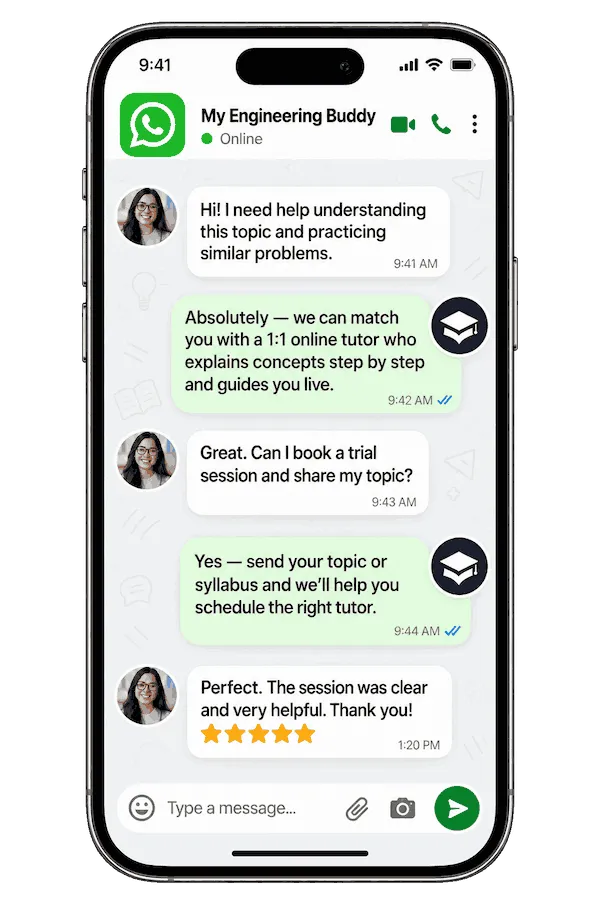
WhatsApp MEB for a quick quote — average response time under 1 minute.
Who This IB Computer Science HL/SL Tutoring Is For
This isn’t a course where reading the textbook twice gets you a 7. IB Computer Science rewards students who can switch between abstract theory and working code — and most students need structured help to do both well.
- SL students struggling with object-oriented programming concepts like inheritance and polymorphism
- HL students who need to get their Option topic (OOP, Databases, Web Science, or Modelling and Simulation) under control before exam season
- Students with a university conditional offer depending on this grade — particularly those targeting computing, engineering, or data science programmes
- Students 4–6 weeks from exams with Paper 1 abstract thinking and Paper 2 programming still not where they need to be
- Students whose Internal Assessment is behind schedule and needs a clear plan from this week forward
- Parents watching a student’s confidence in programming drop exam session after exam session
MEB tutors have helped students heading to programmes at institutions including MIT, Imperial College London, ETH Zurich, the University of Toronto, the University of Melbourne, NYU, and McGill. The $1 trial is a low-risk way to find out if 1:1 IB Computer Science HL/SL tutoring is what’s missing.
1:1 Tutoring vs Self-Study vs AI vs YouTube vs Online Courses
Self-study works if you’re disciplined — but IB Computer Science Paper 1 questions require a specific way of thinking that self-study rarely builds on its own. AI tools answer syntax questions fast but can’t diagnose why you keep dropping marks on Section B. YouTube covers sorting algorithms clearly but stops the moment you hit a question you’ve never seen before. Online courses move at a fixed pace with no room to slow down on recursion if recursion is where you’re losing points. 1:1 tutoring with MEB is live, calibrated to your exact IB syllabus and Option topic, and corrects your reasoning errors in the session — not after the exam.
Outcomes: What You’ll Be Able To Do in IB Computer Science HL/SL
After working with an MEB tutor, students consistently report being able to solve multi-step Paper 1 trace questions without freezing, analyse algorithm efficiency using Big-O notation with enough confidence to write it in an exam, model class hierarchies and explain inheritance chains clearly in Paper 2, write and debug Java or pseudocode solutions to problems they haven’t seen before, and apply computational thinking to the System Design extended response questions that separate 6s from 7s. These aren’t vague outcomes — they’re the specific skills that IB examiners test and that most students arrive without having fully built.
Supporting a student through IB Computer Science HL/SL? MEB works directly with parents to set up sessions, track progress, and keep the Internal Assessment on schedule. WhatsApp MEB — average response time is under a minute, 24/7.
Based on feedback from 40,000+ sessions collected by MEB from 2022 to 2025, 58% of students improved by one full grade after approximately 20 hours of 1:1 tutoring in subjects like IB Computer Science HL/SL. A further 23% achieved at least a half-grade improvement.
Source: MEB session feedback data, 2022–2025.
Students consistently tell us that IB Computer Science Paper 1 feels like a logic exam disguised as a computing exam. The students who improve fastest are those who stop trying to memorise past paper answers and start practising the underlying reasoning on fresh problems — with a tutor who can tell them exactly where their thinking breaks down.
What We Cover in IB Computer Science HL/SL (Syllabus / Topics)

The IB Computer Science course is assessed through Paper 1 (short-answer and extended response, all candidates), Paper 2 (case study, all candidates), Paper 3 (HL only, Option topic), and the Internal Assessment (dossier/solution, 30% of final grade). The breakdown below follows the current IB CS syllabus structure.
| Assessment Component | Description | Weighting (SL / HL) |
|---|---|---|
| Paper 1 | Short-answer and extended response — core topics | 45% / 40% |
| Paper 2 | Case study — unseen real-world computing scenario | 25% / 20% |
| Paper 3 (HL only) | Option topic — OOP, Databases, Web Science, or Modelling and Simulation | — / 20% |
| Internal Assessment | Solution and dossier — self-directed programming project | 30% / 20% |
Track 1: Core Computational Thinking and Systems
- Thinking abstractly, thinking ahead, thinking procedurally, thinking concurrently
- System design: requirements analysis, design, testing, maintenance
- Computer organisation: CPU, memory hierarchy, secondary storage
- Networks: protocols, topology, VPN, wireless standards
- Data representation: binary, hexadecimal, two’s complement, ASCII, Unicode
- Social and ethical issues in computing — exam mark scheme expectations
Key references: IB Computer Science Course Companion (Wainwright, Fulton, Garrido, Dos Santos — Oxford University Press); Computer Science: An Interdisciplinary Approach (Sedgewick & Wayne).
Track 2: Algorithms, Data Structures and Programming
- Pseudocode and Java syntax — IB pseudocode conventions tested in Paper 1
- Arrays, linked lists, stacks, queues, trees, binary search trees
- Sorting algorithms: bubble, selection, insertion — trace tables and efficiency
- Searching algorithms: linear and binary search — worst/best case analysis
- Recursion — identifying recursive solutions and tracing execution
- Object-oriented programming: encapsulation, inheritance, polymorphism
- Algorithm complexity and Big-O notation
Key references: IB Computer Science Course Companion (Oxford); Introduction to Algorithms (Cormen, Leiserson, Rivest, Stein — 4th ed.).
Track 3: HL Option Topics and Internal Assessment
- Option A — Object-Oriented Programming: advanced class design, design patterns, polymorphism at depth
- Option B — Modelling and Simulation: discrete event simulation, stochastic models, Monte Carlo methods
- Option C — Web Science: distributed systems, graph theory applied to the web, semantic web
- Option D — Databases: ER modelling, SQL queries, normalisation (1NF–3NF), transaction management
- Internal Assessment: planning the product, criteria A–E, common examiner docking points
- Case study preparation for Paper 2 — annotating unseen material efficiently
Key references: IB CS Option-specific notes (InThinking IB CS platform); Database System Concepts (Silberschatz, Korth, Sudarshan — 7th ed.) for Option D.
Platforms, Tools & Textbooks We Support
IB Computer Science tutoring at MEB covers the tools students actually use. Tutors work with you across Java IDEs (IntelliJ IDEA, BlueJ, Eclipse), Python environments where relevant, and the IB-standard pseudocode notation used in Paper 1. For Option D students, SQL practice uses SQLite and MySQL. IA project students get support regardless of the language or platform they’ve chosen for their product. Sessions run on Google Meet with a digital pen-pad for live code annotation and diagram work.
- Java (IntelliJ IDEA, BlueJ, Eclipse)
- Python (for algorithmic practice and Option B simulation)
- SQL / SQLite / MySQL (Option D — Databases)
- IB pseudocode notation (Paper 1 and 2 conventions)
- Google Meet + digital pen-pad (all sessions)
- Draw.io / Lucidchart (UML class diagrams, ER diagrams)
What a Typical IB Computer Science HL/SL Session Looks Like
The tutor opens by checking the previous session’s topic — usually a pseudocode trace exercise or a class diagram the student was asked to complete independently. From there, the session moves into the live problem: if it’s a Paper 1 Section B question on binary trees, the tutor works through the first part on screen using the pen-pad, narrating the logic step by step. The student then attempts the next part while the tutor watches — not just checking the answer but asking why each step was taken. If it’s IA work, the session focuses on a specific criterion, reviewing the student’s draft against the mark descriptors and identifying exactly what’s missing. The session closes with one focused practice task — a past paper question or a short coding exercise — and the tutor notes the next topic so the student arrives prepared.
A common pattern our tutors observe is that IB Computer Science students can write code that works but can’t explain it in exam conditions — and Paper 1 is almost entirely explanation. The fix is practicing verbal and written reasoning about code, not writing more code.
How MEB Tutors Help You with IB Computer Science HL/SL (The Learning Loop)
Diagnose: In the first session, the tutor identifies whether the student’s gaps are conceptual (can’t trace a recursive call), procedural (knows the theory but loses marks on pseudocode syntax), or strategic (doesn’t know how to allocate time across Paper 1 sections). These are different problems with different fixes.
Explain: The tutor works through a live example on screen — a linked list insertion, a database normalisation problem, or a Section B algorithm question — using a digital pen-pad to annotate each step. The student sees the reasoning, not just the answer.
Practice: The student attempts the next problem while the tutor is present. No moving on until the student can do it without prompting. This is where most self-study breaks down.
Feedback: The tutor goes through every error — not just marking it wrong but explaining which mark the student would have lost and why, using actual IB mark scheme language.
Plan: At the end of each session, the tutor sets a specific task and flags the next topic. Progress is tracked across sessions so nothing gets revisited unnecessarily.
Sessions run on Google Meet. The tutor uses a digital pen-pad or iPad with Apple Pencil for code annotation, trace tables, and diagram work. Before the first session, share your syllabus level (HL or SL), your Option topic if applicable, and one past paper question or IA extract you’ve struggled with. The first session is diagnostic — it tells both you and the tutor exactly where to spend the next ten hours.
Start with the $1 trial — 30 minutes of live tutoring that also serves as your first diagnostic.
At MEB, tutors don’t just cover topics — they identify the specific exam skill gap behind each wrong answer, whether that’s trace table execution, pseudocode syntax, or Section B extended response structure in IB Computer Science HL/SL.
Source: My Engineering Buddy tutoring methodology, 2008–2025.
Tutor Match Criteria (How We Pick Your Tutor)
Not every strong programmer makes a strong IB CS tutor. MEB matches on specifics, not general ability.
Subject depth: Tutors are matched to your level (HL or SL) and your specific Option topic. A tutor covering Option D Databases is not the same as one covering Option B Modelling and Simulation.
Tools: Every tutor runs sessions on Google Meet with a digital pen-pad or iPad and Apple Pencil — essential for annotating pseudocode and drawing data structure diagrams live.
Time zone: Matched to your region — US, UK, Gulf, Canada, or Australia. Late-evening slots are available for most regions.
Goals: Whether the priority is IA project completion, Paper 1 abstract thinking, Paper 3 Option depth, or closing a grade gap in six weeks, the tutor is matched to that specific goal — not assigned generically.
Unlike platforms where you fill out a form and wait, MEB responds in under a minute, 24/7. Tutor match takes under an hour. The $1 trial means you test before you commit. Everything runs over WhatsApp — no logins, no intake forms.
Study Plans (Pick One That Matches Your Goal)
After the first diagnostic session, the tutor maps a specific sequence. Three patterns cover most students: a catch-up plan (1–3 weeks) for students who are behind on core topics or IA drafts and need to close gaps fast before a deadline; an exam prep plan (4–8 weeks) structured around the May or November exam window, working through Paper 1 past papers, Paper 2 case study preparation, and HL Paper 3 Option content in a deliberate sequence; and a weekly support plan for students who want consistent help throughout the year, aligned to school scheme of work and coursework deadlines. The tutor adjusts the sequence after each session based on what’s actually sticking.
Pricing Guide
IB Computer Science HL/SL tutoring at MEB starts at $20/hr for SL core topics. HL sessions, especially those covering Option topic depth or IA project work, typically run $30–$50/hr. For students targeting competitive computing or engineering programmes where a 7 in IB CS carries real weight, tutors with professional software development or academic research backgrounds are available at higher rates — share your specific goal and MEB matches the tier to your situation.
Rate factors include level (HL vs SL), topic complexity (Option D SQL vs core algorithms), timeline urgency, and tutor availability during peak exam periods in April–May and October–November.
Start with the $1 trial — 30 minutes, no registration, no commitment. WhatsApp MEB for a quick quote.
Try your first session for $1 — 30 minutes of live 1:1 tutoring or one homework question explained in full. No registration. No commitment. WhatsApp MEB now and get matched within the hour.
FAQ
Is IB Computer Science HL/SL hard?
IB Computer Science is considered one of the more demanding Group 4/5 options. HL is harder than most students expect — Paper 3 Option topics cover university-level depth, and the Internal Assessment requires independent project design and documentation under strict IB criteria.
How many sessions are needed?
Students catching up on one or two topics typically need 4–6 sessions. Students covering HL Option content from scratch or rebuilding their IA from an early stage usually need 12–20 sessions over 6–10 weeks. The diagnostic session gives a clearer number.
Can you help with homework and assignments?
Yes — MEB tutoring is guided learning. The tutor explains the concept and works through a similar example with you. You then complete the task yourself. This applies to homework, IA drafts, and past paper practice. See our Academic Integrity policy and Why MEB page for full details on what we help with and what we don’t.
Will the tutor match my exact syllabus or exam board?
Yes. IB Computer Science is administered by the IB directly — there are no multiple exam boards to navigate. Tutors are matched to your level (HL or SL) and your specific Option topic, so the sessions cover exactly what appears on your papers.
What happens in the first session?
The first session is a diagnostic. The tutor asks you to attempt a short task — usually a pseudocode trace or a past paper question — and uses your response to identify exactly where the gaps are. From there, a session sequence is mapped around your exam date or IA deadline.
Is online tutoring as effective as in-person?
For IB Computer Science, online tutoring is arguably better suited — code is written and annotated on screen, trace tables are drawn live with a pen-pad, and past paper PDFs are shared directly in the session. There’s no whiteboard or printed resource that in-person delivers better.
What’s the difference between IB Computer Science HL and SL?
HL students sit an additional Paper 3 covering one of four Option topics (OOP, Databases, Web Science, or Modelling and Simulation) and complete more hours of study. The Internal Assessment word count and complexity expectations also differ. HL is assessed on more content at greater depth than SL.
How do I approach the Internal Assessment in IB Computer Science?
The IA is a software product and accompanying dossier assessed on five criteria (A–E). Most students lose marks on Criterion A (planning) and Criterion E (evaluation). MEB tutors work through the IA criteria one by one, reviewing drafts against the IB mark descriptors and identifying exactly where marks are being left on the table.
Can I get IB Computer Science help at midnight?
Yes. MEB operates 24/7 via WhatsApp. Tutors across time zones cover late-night slots for students in the US, UK, Gulf, and Australia. Response time averages under a minute — message MEB any time and you’ll have a tutor confirmed within the hour.
Do you help with IB Computer Science Paper 2 case study preparation?
Yes. Paper 2 releases a case study in advance and tests it under exam conditions. MEB tutors work through annotation strategies for the pre-released material, practise the question types that appear on Paper 2, and help students build structured answers for the extended response questions the case study demands.
How do I get started?
Message MEB on WhatsApp, share your level (HL or SL), Option topic if applicable, and exam date. MEB matches you with a verified IB CS tutor — usually within an hour. The first session is the $1 trial: 30 minutes of live tutoring or one question explained in full.
What if I don’t like my assigned tutor?
Tell MEB on WhatsApp and a replacement is arranged, typically within the same day. No paperwork, no extended process. The $1 trial exists precisely to make this decision low-risk before you commit to a longer session block.
Trust & Quality at My Engineering Buddy
Every MEB tutor goes through subject-specific screening before taking a session. For IB Computer Science, that means verified knowledge of the current syllabus, the HL Option topics, IA criteria, and the pseudocode conventions tested in Paper 1 — not just general programming ability. Tutors are evaluated through a live demo session and reviewed continuously based on student feedback. Rated 4.8/5 across 40,000+ verified reviews on Google.
MEB tutoring is guided learning — you understand the work, then submit it yourself. For full details on what we help with and what we don’t, read our Academic Integrity policy and Why MEB.
MEB has been serving students across the US, UK, Canada, Australia, Gulf, and Europe since 2008 — across 2,800+ subjects including IB Computer Science HL/SL and closely related IB courses. Students working on IB AI & Machine Learning HL/SL tutoring, IB Digital Society HL/SL help, and IB Design Technology HL/SL tutoring regularly work alongside IB CS students, and MEB’s tutor pool covers all three.
MEB has matched students with tutors across IB Computer Science HL/SL, IB Mathematics, IB Physics, and 2,800+ other subjects — with tutor confirmation typically within an hour of first contact, 24/7.
Source: My Engineering Buddy, 2008–2025.
At MEB, we’ve found that IB Computer Science students who arrive with a specific question — “why do I keep losing marks on trace tables?” or “how do I structure Criterion A?” — progress faster than those who ask for a general review. The more specific your question, the faster we close the gap.
Explore Related Subjects
Students studying IB Computer Science HL/SL often also need support in:
- IB Mathematics HL/SL
- IB Mathematics: Applications and Interpretation HL/SL
- IB Extended Essay
- IB Theory of Knowledge
- IB Physics HL/SL
- IB Chemistry HL/SL
- IB Economics HL/SL
Next Steps
Getting started takes about two minutes.
- Share your level (HL or SL), Option topic if applicable, and exam or IA deadline
- Share your availability and time zone
- MEB matches you with a verified IB CS tutor — usually within an hour
- The first session starts with a diagnostic so every minute counts
Before your first session, have ready: your syllabus level and Option topic, a recent past paper attempt or a piece of IA work you’ve been stuck on, and your exam date or IA submission deadline. The tutor handles the rest.
Visit www.myengineeringbuddy.com for more on how MEB works.
WhatsApp to get started or email [email protected].
Reviewed by Subject Expert
This page has been carefully reviewed and validated by our subject expert to ensure accuracy and relevance.



