




~1 min
Average Reply Time
~1 hour
To Be Matched With A Tutor
30 Min Trial
75% Find Their Tutor On The 1st Trial
$20-35+/hr
Premium Yet Affordable Learning
Most students who struggle with Philosophical Logic don’t have a reasoning problem. They have a notation problem — and no one has walked them through it slowly, step by step.
Philosophical Logic Tutor Online
Philosophical Logic is the formal study of inference, argument structure, and logical systems — including propositional logic, predicate logic, and modal logic — equipping students to analyse, construct, and evaluate rigorous arguments.
MEB offers 1:1 online tutoring and academic guidance in 2,800+ advanced subjects, including Philosophy and its most technical branch: Philosophical Logic. Whether you’re wrestling with natural deduction, struggling with quantifier scope, or preparing for a logic exam, a Philosophical Logic tutor near me — available online, any time zone — is the fastest way through. Sessions are matched to your syllabus, your course level, and your specific gaps.
- 1:1 online sessions tailored to your course or syllabus
- Expert verified tutors with subject-specific knowledge in formal logic systems
- Flexible time zones — US, UK, Canada, Australia, Gulf
- Structured learning plan built after a diagnostic session
- Ethical academic guidance — you understand before you submit
52,000+ students across the US, UK, Canada, Australia, and the Gulf have used MEB since 2008 — including students in Philosophy subjects like Philosophical Logic, Symbolic Logic, and Analytic Philosophy.
Source: My Engineering Buddy, 2008–2025.
How Much Does a Philosophical Logic Tutor Cost?
Most Philosophical Logic tutoring sessions run $20–$40/hr depending on level and syllabus complexity. Graduate-level or specialist modal logic work can reach up to $100/hr. The $1 trial gives you 30 minutes of live 1:1 tutoring or a full explanation of one homework question — no registration required.
| Level / Need | Typical Rate | What’s Included |
|---|---|---|
| Standard (undergraduate intro) | $20–$35/hr | 1:1 sessions, homework guidance |
| Advanced / Specialist (modal, predicate) | $35–$100/hr | Expert tutor, graduate-level depth |
| $1 Trial | $1 flat | 30 min live session or 1 homework question |
Tutor availability tightens during end-of-semester and exam periods. Booking early secures your preferred time slot.
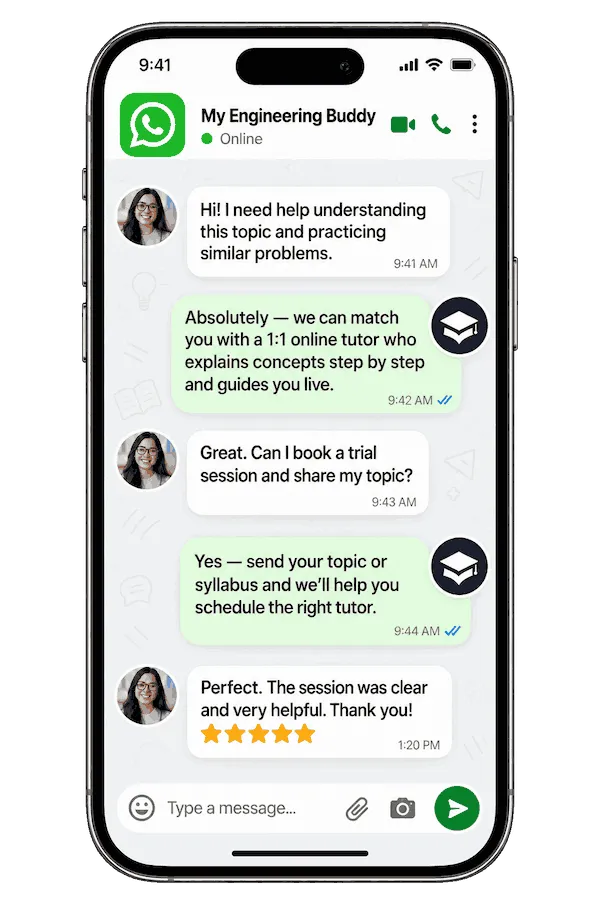
WhatsApp MEB for a quick quote — average response time under 1 minute.
Who This Philosophical Logic Tutoring Is For
Philosophical Logic sits in an awkward gap — it looks like philosophy but demands mathematical precision. Students fall behind fast when the notation becomes unfamiliar. This tutoring is built for anyone caught in that gap.
- Undergraduates in philosophy, mathematics, linguistics, or cognitive science encountering formal logic for the first time
- Graduate students whose research methodology depends on modal, epistemic, or deontic logic
- Students retaking after a failed first attempt at a formal logic course
- Students with a conditional university offer depending on passing their logic module
- Students who understand the arguments in plain language but lose marks the moment symbolic notation appears
- Parents watching a student’s confidence drop alongside their grades in a required logic course
MEB tutors have worked with students at institutions including Harvard, Oxford, Cambridge, MIT, the University of Toronto, the University of Melbourne, NYU, and UCL — across introductory and advanced logic courses.
Whether you need help with propositional tableaux, Fitch-style proofs, or the semantics of possible-worlds models, a dedicated online Philosophical Logic tutor keeps you from falling further behind.
1:1 Tutoring vs Self-Study vs AI vs YouTube vs Online Courses
Self-study works if your notation is already clean — but most students don’t know where their proofs are actually going wrong. AI tools can generate truth tables fast; they can’t spot the step where your reasoning slipped or explain why that inference rule doesn’t apply here. YouTube covers propositional logic reasonably well at the introductory level and stops short the moment you hit predicate calculus or modal semantics. Online courses move at a fixed pace — no one waits while you’re still unsure about universal instantiation. 1:1 tutoring with MEB is live, calibrated to your exact syllabus, and corrects errors in the moment — the kind of correction that changes how you approach every proof after it.
Outcomes: What You’ll Be Able To Do in Philosophical Logic
After consistent 1:1 sessions, students can construct valid proofs using natural deduction and sequent calculus, analyse argument validity in both propositional and first-order predicate logic, and apply Kripke semantics to evaluate modal claims about necessity and possibility. You’ll be able to write rigorous symbolic translations of ordinary-language arguments, identify formal fallacies at the step level rather than just by intuition, and present a complete formal proof without gaps that cost marks. These aren’t abstract ambitions — they’re the specific skills your assessments are testing.
Based on feedback from 40,000+ sessions collected by MEB from 2022 to 2025, 58% of students improved by one full grade after approximately 20 hours of 1:1 tutoring in subjects like Philosophical Logic. A further 23% achieved at least a half-grade improvement.
Source: MEB session feedback data, 2022–2025.
Supporting a student through Philosophical Logic? MEB works directly with parents to set up sessions, track progress, and keep coursework on schedule. WhatsApp MEB — average response time is under a minute, 24/7.
What We Cover in Philosophical Logic (Syllabus / Topics)

Track 1: Propositional and Predicate Logic
- Truth tables, logical connectives, and tautology testing
- Formal proof methods: natural deduction, Fitch notation, and sequent calculus
- Validity, soundness, and consistency in propositional systems
- First-order predicate logic: quantifiers, variables, and scope
- Universal and existential instantiation and generalisation rules
- Translating natural-language arguments into formal notation
- Interpretations, models, and formal semantics
Core texts include Hurley’s A Concise Introduction to Logic, Barwise and Etchemendy’s Language, Proof and Logic, and Chiswell and Hodges’s Mathematical Logic.
Track 2: Modal, Epistemic, and Deontic Logic
- Possible-worlds semantics and Kripke frames
- Necessity and possibility operators: box and diamond
- Accessibility relations and the T, S4, S5 modal systems
- Epistemic logic: knowledge, belief, and the KK thesis
- Deontic logic: obligation, permission, and normative reasoning
- Temporal and conditional logic at introductory graduate level
Key texts include Hughes and Cresswell’s A New Introduction to Modal Logic and Fitting and Mendelsohn’s First-Order Modal Logic.
Track 3: Metalogic, Argumentation Theory, and Applied Logic
- Completeness and soundness proofs for formal systems
- Gödel’s incompleteness theorems — conceptual and formal treatment
- Argumentation schemes, defeasible reasoning, and informal fallacies
- Relevance logic and paraconsistent logic fundamentals
- Logic in philosophy of language: reference, meaning, and truth
- Applications of logic to Philosophy of Science and Epistemology
Recommended texts include Mendelson’s Introduction to Mathematical Logic and Walton’s Argumentation Schemes.
Students consistently tell us that the hardest part of Philosophical Logic isn’t the concepts — it’s converting a clear argument in your head into a valid formal proof on paper. That gap between intuition and notation is exactly where a good tutor pays off fastest.
What a Typical Philosophical Logic Session Looks Like
The tutor opens by checking the previous session’s practice problem — usually a natural deduction proof or a modal semantics exercise the student attempted independently. From there, the session moves to the student’s current sticking point: this might be quantifier scope errors in predicate logic, an unresolved question about universal instantiation, or building a Kripke model for a specific modal formula. The tutor works through the problem live using a digital pen-pad, narrating each step and explaining why each inference rule applies. The student then attempts a parallel problem while the tutor watches and intervenes at the exact moment a wrong move appears — not after the proof is already broken. The session closes with one specific practice task and a note on what the next session will address.
How MEB Tutors Help You with Philosophical Logic (The Learning Loop)
Diagnose: In the first session, the tutor identifies whether the gap is in notation fluency, proof strategy, semantic understanding, or all three. A student who writes valid truth tables but can’t complete a natural deduction proof has a different problem from one who understands the argument but can’t symbolise it correctly.
Explain: The tutor works through problems live — using a digital pen-pad to annotate proofs step by step, showing not just what the correct move is but why the inference rule justifies it. No abstraction without a concrete example.
Practice: The student attempts the next problem while the tutor is present. This is not homework. This is supervised practice where errors get caught before they become habits.
Feedback: The tutor explains each wrong step precisely — not “that’s incorrect” but “you applied universal instantiation here before eliminating the existential quantifier, which isn’t permitted in this system.” That specificity is what moves grades.
Plan: Each session ends with a clear next topic, a specific practice task, and a checkpoint for the session after that. Students always know where they stand.
Sessions run over Google Meet. The tutor uses a digital pen-pad or iPad with Apple Pencil to work through proofs visually. Before your first session, share your syllabus or course outline, a recent proof attempt or homework you couldn’t complete, and your exam or assignment date. Whether you need a quick catch-up before an exam, structured revision over 4–8 weeks, or ongoing weekly support through the semester, the tutor maps the session plan after the first diagnostic.
Start with the $1 trial — 30 minutes of live tutoring that also serves as your first diagnostic.
Try your first session for $1 — 30 minutes of live 1:1 tutoring or one homework question explained in full. No registration. No commitment. WhatsApp MEB now and get matched within the hour.
Tutor Match Criteria (How We Pick Your Tutor)
Not every philosophy tutor can teach formal logic. MEB matches on four criteria.
Subject depth: Tutors are vetted specifically for the logic systems they cover — propositional, predicate, modal — and for the level at which they teach (intro undergraduate through graduate research).
Tools: Every tutor uses Google Meet with a digital pen-pad or iPad and Apple Pencil. Philosophical Logic cannot be taught effectively through a chat window.
Time zone: Matched to your region — US, UK, Canada, Australia, Gulf — so sessions don’t happen at 3am.
Goals: Whether you need exam pass marks, a solid grasp of modal logic for a dissertation, or help with a specific proof method, the match reflects your actual objective.
Unlike platforms where you fill out a form and wait, MEB responds in under a minute, 24/7. Tutor match takes under an hour. The $1 trial means you test before you commit. Everything runs over WhatsApp — no logins, no intake forms.
Pricing Guide
Philosophical Logic tutoring runs $20–$40/hr for most undergraduate-level sessions. Graduate-level work covering metalogic, Gödel’s theorems, or advanced modal systems runs higher — up to $100/hr depending on tutor background and topic complexity. Rate factors include level, syllabus depth, timeline, and tutor availability.
For students targeting graduate programmes at Oxford, Cambridge, NYU, or MIT where formal logic is a foundational requirement, tutors with research backgrounds in mathematical logic or philosophy of language are available at higher rates — share your specific goal and MEB will match the tier to your ambition.
Demand increases sharply during end-of-semester assessment periods. Booking early is the practical move.
Start with the $1 trial — 30 minutes, no registration, no commitment. WhatsApp MEB for a quick quote.
At MEB, we’ve found that students who treat their first logic session as a diagnostic — rather than just asking about a single problem — make faster progress in the sessions that follow. The tutor needs to see how you think, not just what you got wrong.
FAQ
Is Philosophical Logic hard?
It’s hard in a specific way. The ideas are often accessible; the formal notation is not. Students who are strong in standard philosophy courses sometimes struggle more than those with a maths background. The gap closes quickly with targeted, step-by-step instruction.
How many sessions are needed?
Most students covering a single logic system — propositional or predicate — need 8–12 hours to move from confusion to exam-ready. Graduate students covering modal or metalogic typically need 15–25 hours depending on starting level and assessment complexity.
Can you help with homework and assignments?
MEB tutoring is guided learning — you understand the work, then submit it yourself. The tutor explains the proof method or the semantic concept; you complete and submit the work. See our Academic Integrity policy and Why MEB page for full details on what we help with and what we don’t.
Will the tutor match my exact syllabus or exam board?
Yes. Share your course outline or module handbook before the first session. Tutors are matched to your specific logic system — Fitch-style vs Hilbert-style proofs, for example — and to your institution’s assessment format where that information is available.
What happens in the first session?
The tutor runs a short diagnostic: a proof attempt or symbolisation task that reveals where your reasoning breaks down. From there, the session moves into direct instruction on your sharpest gap. You leave with a specific practice task and a plan for the next session.
Is online tutoring as effective as in-person for Philosophical Logic?
Yes — and for formal logic specifically, the digital pen-pad often works better than a whiteboard. The tutor annotates proofs step by step on screen, and the student can follow each inference rule in real time. Sessions are recorded on request for later review.
Can I get Philosophical Logic help at midnight?
Yes. MEB operates across time zones and tutors are available late-night US, early-morning UK, and standard Gulf hours. WhatsApp MEB at any hour — average response time is under a minute regardless of when you message.
What if I don’t like my assigned tutor?
Tell MEB via WhatsApp. Tutor reassignment is straightforward and happens within hours, not days. The $1 trial is specifically designed to let you evaluate the tutor match before spending anything significant.
What’s the difference between Philosophical Logic and Symbolic Logic?
Symbolic Logic typically covers propositional and predicate calculus at the introductory level. Philosophical Logic goes further — modal systems, epistemic and deontic logic, metalogic, and the philosophical implications of formal systems. Many courses use both terms; check your syllabus to confirm scope.
Do I need a maths background to succeed in Philosophical Logic?
A maths background helps with proof fluency but isn’t required. Many strong students come from philosophy, linguistics, or computer science backgrounds. The tutor establishes which formal skills you already have in the first session and builds from there.
Can MEB help with logic components embedded in philosophy dissertations or theses?
Yes. Graduate students using formal logic frameworks — modal logic for possible-worlds arguments, deontic logic for normative ethics, or formal epistemology — regularly work with MEB tutors on the technical sections of dissertations. Bring the chapter or section in question to the first session.
How do I get started?
Three steps: WhatsApp MEB, get matched with a verified Philosophical Logic tutor within the hour, then start your $1 trial — 30 minutes of live tutoring or one full homework question explained. No forms, no registration.
Trust & Quality at My Engineering Buddy
Every MEB tutor goes through subject-specific screening before taking a session. That includes a live demo evaluation, review of academic and professional credentials, and ongoing performance monitoring based on student feedback. Tutors covering Philosophical Logic are vetted specifically on formal proof systems, semantic frameworks, and the logic sub-disciplines they claim to teach — not just general philosophy. Rated 4.8/5 across 40,000+ verified reviews on Google.
MEB tutoring is guided learning — you understand the work, then submit it yourself. For full details on what we help with and what we don’t, read our Academic Integrity policy and Why MEB.
MEB has served 52,000+ students across the US, UK, Canada, Australia, the Gulf, and Europe in 2,800+ subjects since 2008. Philosophy is one of our strongest subject families — students regularly come to us for help with Critical Thinking tutoring, Metaphysics help, and Philosophy of Language tutoring alongside their logic coursework. Our tutoring methodology is built around diagnostic-first sessions and structured feedback loops — not generic content delivery.
Our experience across thousands of sessions shows that students who share their actual assignment or proof attempt before the first session — rather than a vague description of the topic — cover more ground and leave with clearer next steps. Bring the real problem.
Explore Related Subjects
Students studying Philosophical Logic often also need support in:
- Ethics
- Meta-Ethics
- Ontology
- Moral Philosophy
- Philosophy of Religion
- Continental Philosophy
- Ancient Philosophy
Next Steps
When you message MEB, share your exam board or course name, the specific topic or proof type giving you the most trouble, and your exam or assignment deadline. Include your time zone so the match is practical from the first session.
- Have your syllabus or course outline ready — or a recent proof attempt you couldn’t complete
- Note your exam or submission date so the tutor can set a realistic session plan
- MEB matches you with a verified Philosophical Logic tutor, typically within 24 hours
The first session begins with a diagnostic. Every minute after that is used on the gaps that actually matter for your assessment.
Visit www.myengineeringbuddy.com for more on how MEB works.
WhatsApp to get started or email [email protected].
Reviewed by Subject Expert
This page has been carefully reviewed and validated by our subject expert to ensure accuracy and relevance.




