




~1 min
Average Reply Time
~1 hour
To Be Matched With A Tutor
30 Min Trial
75% Find Their Tutor On The 1st Trial
$20-35+/hr
Premium Yet Affordable Learning
Regulatory frameworks change. Exam questions don’t forgive gaps. Most Banking Law and Practice students fail not on the big concepts — but on the fine print of lending rules and statutory interpretation.
Banking Law and Practice Tutor Online
Banking Law and Practice covers the legal frameworks governing banking operations, including lending, deposits, negotiable instruments, regulatory compliance, and central bank oversight, equipping students to apply statutory rules in financial and commercial contexts.
If you’re searching for a Banking Law and Practice tutor near me, MEB connects you with verified 1:1 online tutors across all major law programmes — LLB, LLM, professional banking qualifications, and undergraduate finance modules. Our law tutoring covers everything from foundational banking statutes to advanced regulatory compliance. One diagnostic session identifies exactly where your gaps are — and every session after that closes them.
- 1:1 online sessions tailored to your exact syllabus and course level
- Expert verified tutors with subject-specific knowledge in banking regulation, lending law, and financial compliance
- Flexible time zones — US, UK, Canada, Australia, Gulf
- Structured learning plan built after a diagnostic session
- Ethical homework and assignment guidance — you understand the work, then submit it yourself
52,000+ students across the US, UK, Canada, Australia, and the Gulf have used MEB since 2008 — including students in Law subjects like Banking Law and Practice, Business Law, and Economic and Commercial Law.
Source: My Engineering Buddy, 2008–2025.
How Much Does a Banking Law and Practice Tutor Cost?
Most Banking Law and Practice tutoring sessions run $20–$40/hr. Advanced regulatory or LLM-level work reaches up to $100/hr. The $1 trial gets you 30 minutes of live tutoring or one full homework question explained — no registration required.
| Level / Need | Typical Rate | What’s Included |
|---|---|---|
| Standard (most levels) | $20–$35/hr | 1:1 sessions, homework guidance |
| Advanced / Specialist | $35–$100/hr | Expert tutor, regulatory depth, LLM-level |
| $1 Trial | $1 flat | 30 min live session or 1 homework question |
Tutor availability tightens significantly in the weeks before law exams and coursework deadlines. Book early to secure your preferred time slot.
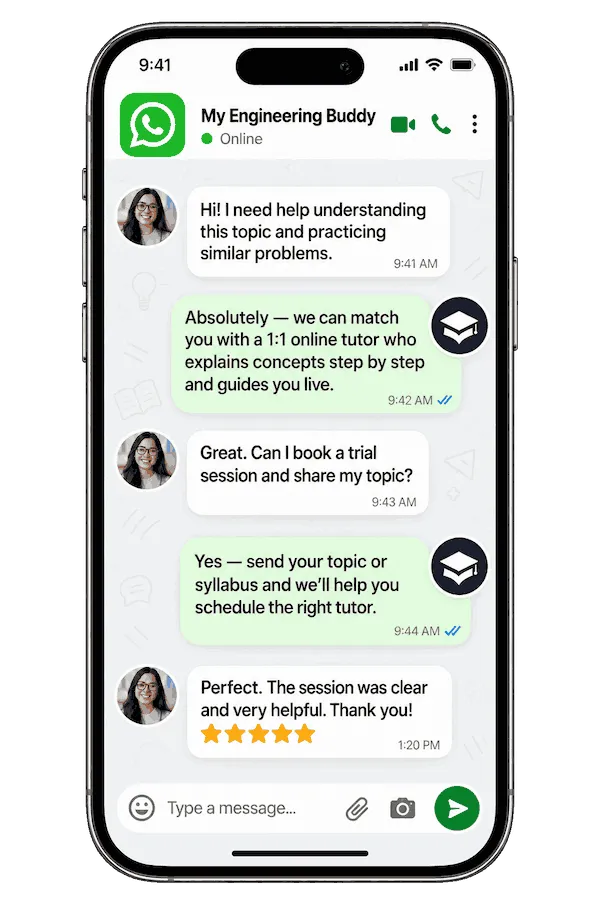
WhatsApp MEB for a quick quote — average response time under 1 minute.
Who This Banking Law and Practice Tutoring Is For
Banking Law and Practice sits at the intersection of contract law, regulatory compliance, and financial practice. Most students find it manageable until the statutory interpretation questions hit — then progress stalls fast.
- LLB and LLM students whose Banking Law modules cover the Banking Act, Basel frameworks, or Consumer Credit regulation
- Undergraduate finance students whose programmes require a banking law component
- Students retaking after a failed first attempt at a banking law paper
- Students with a university conditional offer depending on this grade
- Professionals in banking or compliance studying for a qualification that includes a legal component
- Parents watching a student’s confidence drop alongside their grades in a law subject that feels abstract and text-heavy
Students across the US, UK, Canada, Australia, and the Gulf — from universities including King’s College London, University of Toronto, NYU, ANU, and the University of Amsterdam — have worked with MEB tutors on exactly this material.
If you need structured legal studies tutoring alongside your banking law coursework, MEB covers that too. The $1 trial is the lowest-risk way to find out whether 1:1 tutoring is right for you.
1:1 Tutoring vs Self-Study vs AI vs YouTube vs Online Courses
Self-study works if you’re disciplined, but Banking Law and Practice requires applying statutory rules to novel fact patterns — and a textbook won’t tell you where your reasoning breaks down. AI tools give fast definitions but can’t diagnose why your statutory interpretation is consistently off. YouTube covers lending basics well, then stops when the question gets specific. Online courses move at a fixed pace regardless of whether you’ve actually understood the Consumer Credit Act section you just covered. A 1:1 Banking Law and Practice tutor from MEB works through the exact cases and statutes on your syllabus, corrects your reasoning in the moment, and doesn’t move on until the logic sticks.
Outcomes: What You’ll Be Able To Do in Banking Law and Practice
After consistent 1:1 sessions, students can analyze lending agreements against the Consumer Credit Act and identify points of non-compliance. They can apply the rules on negotiable instruments — bills of exchange, promissory notes — to problem questions with confidence. Students learn to explain the regulatory role of central banks and how Basel III capital requirements work in practice. They can write structured legal arguments on bank customer duties and the banker-customer relationship. They can present a clear account of the legal consequences of bank insolvency and depositor protection under relevant statutory frameworks.
Based on feedback from 40,000+ sessions collected by MEB from 2022 to 2025, 58% of students improved by one full grade after approximately 20 hours of 1:1 tutoring in subjects like Banking Law and Practice. A further 23% achieved at least a half-grade improvement.
Source: MEB session feedback data, 2022–2025.
At MEB, we’ve found that Banking Law and Practice students who struggle with problem questions almost always share the same underlying issue: they’ve memorised the statute but haven’t practised applying it to novel fact patterns. One session spent working through a single case study — step by step, out loud — fixes more than three hours of re-reading the textbook.
What We Cover in Banking Law and Practice (Syllabus / Topics)

Track 1: The Banker-Customer Relationship and Deposit Law
- Formation of the banking contract and its implied terms
- Duty of confidentiality — Tournier v National Provincial and Union Bank of England and its exceptions
- Duty of care in banking transactions and advice
- Types of deposit accounts and legal rules governing them
- Deposit protection schemes — FDIC (US), FSCS (UK), and equivalent frameworks
- Termination of the banker-customer relationship
Core texts: Ellinger, Lomnicka and Hare, Ellinger’s Modern Banking Law (5th ed.); Hudson, The Law of Finance.
Track 2: Lending, Security, and Negotiable Instruments
- Types of bank lending — overdrafts, term loans, revolving credit facilities
- Consumer credit regulation — the Consumer Credit Act 1974 (UK) and equivalent US statutes
- Legal charges, mortgages, and pledges as security for loans
- Bills of exchange, cheques, and promissory notes under the Bills of Exchange Act
- Forgery, unauthorized payment, and bank liability
- Insolvency of borrowers and bank remedies
Core texts: Penn, Shea and Arora, The Law Relating to Domestic Banking; Hapgood, Paget’s Law of Banking.
Track 3: Regulatory Frameworks and Financial Compliance
- The role of central banks — Bank of England, Federal Reserve, ECB
- Basel III capital adequacy and liquidity requirements
- Anti-money laundering (AML) obligations and the FATF framework
- Know Your Customer (KYC) requirements and their legal basis
- Financial Services regulation — FCA/PRA (UK), OCC/FDIC/Fed (US)
- Cross-border banking and jurisdictional issues
- Data protection obligations specific to banking institutions
Core texts: Cranston, Principles of Banking Law (3rd ed.); Blair and Walker, Financial Markets and Exchanges Law. For current regulatory updates, the Institute of Directors publishes governance and compliance resources relevant to banking practitioners.
Students consistently tell us that the regulatory track — Basel III, AML obligations, KYC — feels like a separate subject from the private law content. The tutors who work well in Banking Law and Practice are the ones who can show how those two worlds connect: how a regulatory breach in AML also triggers civil liability in the banker-customer relationship.
What a Typical Banking Law and Practice Session Looks Like
The tutor opens by checking the previous topic — usually a specific statute or case, such as the banker’s duty of confidentiality under Tournier or the rules on forged cheques. From there, the session moves into the current problem. If the student is working through a lending law problem question, the tutor and student work through the fact pattern together on screen: identifying the relevant statute, applying the legal test step by step, and flagging where the student’s reasoning diverges from what an examiner expects. The tutor uses a digital pen-pad to annotate the problem in real time. The student then attempts a parallel question with the tutor present — no safety net, but with immediate correction. The session closes with a specific practice task set for before the next meeting, and the next topic is confirmed so the student can read ahead. Get legal research help between sessions if the reading load is running ahead of the tutoring schedule.
How MEB Tutors Help You with Banking Law and Practice (The Learning Loop)
Diagnose: In the first session, the tutor identifies whether the student’s problems are with statutory interpretation, case application, regulatory memory, or exam technique. These are four different issues — and they need four different fixes.
Explain: The tutor works through live problem questions using a digital pen-pad, showing exactly how a model answer reasons through a fact pattern — not just what the answer is, but why each step follows from the statute or precedent.
Practice: The student attempts a similar problem with the tutor present. No hints unless the student asks. The goal is to surface where independent reasoning breaks down before the exam does it instead.
Feedback: The tutor goes through the student’s attempt step by step — naming the exact point where marks would be lost and why. For administrative law tutoring or Banking Law, the difference between a pass and a distinction often comes down to one paragraph of legal reasoning.
Plan: At the end of every session, the tutor sets the next topic and confirms the sequence. If an exam is six weeks out, the plan maps every remaining session to a specific syllabus area.
Sessions run on Google Meet. The tutor uses a digital pen-pad or iPad with Apple Pencil. Before the first session, share your exam board or course outline, and one piece of work you struggled with — a past paper question, an essay that was marked down, or a topic you keep avoiding. The first session starts there. Start with the $1 trial — 30 minutes of live tutoring that also serves as your first diagnostic.
MEB has served 52,000+ students since 2008 across 2,800+ subjects. The tutoring methodology — diagnose, explain, practice, feedback, plan — is the same whether you’re working through a Banking Law problem question or a regulatory compliance case study.
Source: My Engineering Buddy, 2008–2025.
Try your first session for $1 — 30 minutes of live 1:1 tutoring or one homework question explained in full. No registration. No commitment. WhatsApp MEB now and get matched within the hour.
Tutor Match Criteria (How We Pick Your Tutor)
Not every law tutor can teach Banking Law and Practice. Here’s what MEB checks.
Subject depth: Tutors are matched on the specific level and syllabus — LLB, LLM, professional banking qualification, or undergraduate finance module. A tutor covering LLM-level regulatory compliance has different credentials from one covering first-year banking law basics.
Tools: Every tutor uses Google Meet and a digital pen-pad or iPad with Apple Pencil — essential for annotating problem questions and statutes in real time.
Time zone: Matched to your region — US, UK, Gulf, Canada, or Australia. Late-night sessions are available. Unlike platforms where you fill out a form and wait, MEB responds in under a minute, 24/7. Tutor match takes under an hour. The $1 trial means you test before you commit. Everything runs over WhatsApp — no logins, no intake forms.
Goals: Whether you need to pass a resit, hit a distinction, understand the regulatory material for a professional role, or get consistent homework support through the semester — the match criteria account for it.
Study Plans (Pick One That Matches Your Goal)
For Banking Law and Practice, the right plan depends on how much time you have and what’s at stake. A catch-up plan (1–3 weeks) works for students with specific statutory or case-law gaps to close before a paper. Exam prep (4–8 weeks) gives enough time to work through every major topic systematically — problem questions, essay technique, and regulatory frameworks. Weekly support runs through the semester, aligned to coursework deadlines and class progression. The legal theory tutor or banking law tutor builds the specific session sequence after the first diagnostic — not before.
Pricing Guide
Banking Law and Practice tutoring starts at $20/hr for standard undergraduate-level sessions. Graduate, LLM, and specialist regulatory topics run $40–$100/hr depending on tutor expertise and topic complexity. Rates also depend on the student’s timeline — urgent turnaround before a deadline or resit typically commands a premium.
For students targeting LLM programmes at institutions like UCL, LSE, Georgetown, or the University of Melbourne, tutors with professional backgrounds in banking regulation or financial compliance are available at higher rates — share your specific goal and MEB will match the tier to your ambition.
Availability tightens in April–May and November–December when law exam seasons peak across UK and US institutions. Start with the $1 trial — 30 minutes, no registration, no commitment. WhatsApp MEB for a quick quote.
FAQ
Is Banking Law and Practice hard?
It’s demanding because it combines private law concepts with a dense layer of financial regulation. Students who struggle most are those who try to memorise rules without practising application to fact patterns. With regular problem-question practice, the structure becomes clear.
How many sessions are needed?
Students closing specific gaps before an exam typically need 6–12 sessions. Those working through a full semester of Banking Law alongside coursework benefit from weekly sessions. The tutor gives a clearer estimate after the first diagnostic session.
Can you help with homework and assignments?
MEB tutoring is guided learning — you understand the work, then submit it yourself. The tutor explains the statute, works through the reasoning with you, and checks that your analysis is sound. See our Academic Integrity policy and Why MEB page for full details on what we help with and what we don’t.
Will the tutor match my exact syllabus or exam board?
Yes. Banking Law and Practice varies significantly between jurisdictions — UK Consumer Credit Act, US banking statutes, Basel frameworks, and local regulatory regimes each require different coverage. Share your course outline or exam board when you contact MEB and the match is made accordingly.
What happens in the first session?
The tutor runs a short diagnostic — usually a problem question or a topic review — to identify where your understanding breaks down. The rest of the session addresses the most urgent gap. You leave with a clear sense of what the next sessions will cover and in what order.
Is online tutoring as effective as in-person?
For a text-heavy subject like Banking Law and Practice, online tutoring is particularly well-suited. The tutor can annotate statutes and case summaries on screen in real time, share documents, and work through problem questions with the same precision as a face-to-face session.
What’s the difference between Banking Law and Commercial Law — and do I need help with both?
Banking Law focuses on the specific legal rules governing banks, lending, deposits, and financial regulation. Commercial and civil law covers broader transactional law including contracts and agency. Many Banking Law modules draw on both — a tutor familiar with your specific programme can clarify the overlap and fill gaps in either area.
Can I get Banking Law and Practice help at midnight or on weekends?
Yes. MEB tutors are available across time zones — US, UK, Gulf, Australia — which means late-night or weekend sessions are regularly available. WhatsApp MEB and request your preferred time; matching usually happens within the hour.
What if I don’t understand the regulatory content — Basel III, AML, KYC?
Regulatory frameworks are the section where most Banking Law students lose marks. The tutor breaks down Basel III capital requirements, AML obligations, and KYC rules in plain terms first, then shows how exam questions test them. It’s one of the most commonly requested topics in MEB’s law sessions.
Do you offer help with Banking Law dissertation or LLM research?
MEB tutors can support research planning, literature review strategy, and argument structuring for LLM dissertations touching on banking regulation, financial law, or comparative banking frameworks. Get legal research tutoring support alongside your dissertation work. Share your research question when you contact MEB.
How do I get started?
WhatsApp MEB with your course level, exam board or university, and the topic or deadline you’re working toward. MEB matches you with a verified tutor — usually within 24 hours. The first session is a $1 trial: 30 minutes of live tutoring or one full question explained.
Trust & Quality at My Engineering Buddy
Every MEB tutor goes through a subject-specific screening process: degree verification, a live demo session evaluated by an experienced reviewer, and ongoing monitoring based on student feedback after every session. Tutors covering Banking Law and Practice are assessed on their knowledge of relevant statutes, regulatory frameworks, and problem-question technique — not just general legal knowledge. Rated 4.8/5 across 40,000+ verified reviews on Google.
MEB tutoring is guided learning — you understand the work, then submit it yourself. For full details on what we help with and what we don’t, read our Academic Integrity policy and Why MEB.
MEB has been running since 2008, serving 52,000+ students across the US, UK, Canada, Australia, the Gulf, and Europe in 2,800+ subjects. Law is one of our strongest subject families — from Banking Law and Practice to constitutional law tutoring and intellectual property law tutoring. See our tutoring methodology for a full breakdown of how sessions are structured.
A common pattern our tutors observe is that Banking Law and Practice students arrive believing the subject is mostly memorisation. It isn’t. The marks are in the application — taking a set of facts, selecting the right statutory provisions, and reasoning through them in sequence. That skill is teachable. It just takes practice under real conditions.
MEB’s law tutors cover everything from first-year LLB modules through to LLM-level regulatory law — with subject-specific vetting, real exam board alignment, and a $1 trial so you test the fit before you invest.
Source: My Engineering Buddy, 2008–2025.
Explore Related Subjects
Students studying Banking Law and Practice often also need support in:
Next Steps
Share your exam board or university course code, the topic or statute causing the most trouble, and your exam or submission date. Share your time zone and available hours. MEB matches you with a verified Banking Law and Practice tutor — usually within 24 hours. The first session starts with a diagnostic so every minute is used on what actually needs fixing.
Before your first session, have ready:
- Your course outline, exam board, or university syllabus
- A recent past paper attempt, essay, or problem question you struggled with
- Your exam date or coursework deadline
The tutor handles the rest. Visit www.myengineeringbuddy.com for more on how MEB works.
WhatsApp to get started or email [email protected].
Reviewed by Subject Expert
This page has been carefully reviewed and validated by our subject expert to ensure accuracy and relevance.




