




~1 min
Average Reply Time
~1 hour
To Be Matched With A Tutor
30 Min Trial
75% Find Their Tutor On The 1st Trial
$20-35+/hr
Premium Yet Affordable Learning
Most students hit a wall in computational linguistics somewhere between parsing algorithms and neural language models. The theory made sense in lectures. The implementation didn’t.
Computational Linguistics Tutor Online
Computational linguistics applies formal linguistic theory to the design and analysis of algorithms that process human language, equipping students to build systems for parsing, generation, machine translation, and speech recognition.
MEB connects you with a 1:1 online computational linguistics tutor who has worked inside the actual problem sets — formal grammars, probabilistic models, sequence labelling, and the rest. If you’ve searched for a computational linguistics tutor near me and found mostly generic computer science tutors, MEB is different: our tutors specialise in the linguistics-meets-NLP intersection. As part of our broader linguistics tutoring offering, computational linguistics sits at the technical frontier. Sessions run 1:1, online, around your schedule — US, UK, Canada, Australia, or the Gulf.
- 1:1 online sessions tailored to your course syllabus or research track
- Expert-verified tutors with subject-specific computational linguistics knowledge
- Flexible time zones — matched to US, UK, Canada, Australia, Gulf
- Structured learning plan built after a diagnostic session
- Ethical academic guidance — you understand the work before you submit
52,000+ students across the US, UK, Canada, Australia, and the Gulf have used MEB since 2008 — including students in Linguistics subjects like computational linguistics, psycholinguistics, and syntax.
Source: My Engineering Buddy, 2008–2025.
How Much Does a Computational Linguistics Tutor Cost?
Most sessions run $20–$40/hr. Graduate-level and research-focused work — transformer architectures, formal semantics, advanced corpus methods — can reach up to $100/hr depending on tutor depth and timeline. The $1 trial gets you 30 minutes of live 1:1 tutoring or a full explanation of one homework question before you commit to anything.
| Level / Need | Typical Rate | What’s Included |
|---|---|---|
| Undergraduate (most levels) | $20–$40/hr | 1:1 sessions, homework guidance |
| Graduate / Research-level | $40–$100/hr | Expert tutor, NLP depth, thesis support |
| $1 Trial | $1 flat | 30 min live session or 1 homework question |
Availability tightens around semester deadlines and end-of-term project submissions. Early booking gets you the best match.
WhatsApp MEB for a quick quote — average response time under 1 minute.
Who This Computational Linguistics Tutoring Is For
Computational linguistics sits at the edge of three disciplines — linguistics, computer science, and statistics — and students regularly find that their programme assumes fluency in all three simultaneously. Most don’t have it. That’s exactly where 1:1 help lands.
- Undergraduate linguistics students tackling their first NLP or corpus methods module
- Computer science students who need the formal grammar and syntax theory their coding instincts can’t replace
- Students with a university conditional offer depending on this grade
- Graduate and PhD students building models for dissertation research — parsing, coreference, speech
- Students 4–6 weeks from an exam with significant gaps still to close in probabilistic models or evaluation metrics
- Masters students in computational linguistics, NLP, or cognitive science needing support with homework and assignment deadlines across multiple modules
Students come from programmes at universities including MIT, Stanford, Edinburgh, Johns Hopkins, UCL, Cambridge, Amsterdam, and Carnegie Mellon — among many others.
1:1 Tutoring vs Self-Study vs AI vs YouTube vs Online Courses
Self-study works if you’re disciplined, but computational linguistics has enough moving parts — formal grammars, statistical models, evaluation frameworks — that gaps compound fast without feedback. AI tools give fast explanations but can’t diagnose why your CKY parser is producing wrong parses. YouTube covers the high-level NLP pipeline well and stops cold when you’re stuck on a specific weighted finite-state transducer problem. Online courses are structured but fixed-pace, with no tutor to catch the exact step where your reasoning breaks. 1:1 tutoring with MEB is live, calibrated to your actual course and codebase, and corrects errors in the moment — including the conceptual ones you didn’t know you had.
Outcomes: What You’ll Be Able To Do in Computational Linguistics
After focused 1:1 sessions, you’ll be able to apply formal grammar rules to parse ambiguous sentences correctly, model language using n-gram and probabilistic context-free grammars, implement named entity recognition and sequence labelling with confidence, explain the architecture choices behind modern neural language models, and write and evaluate your own corpus annotation schemes. These aren’t abstract capabilities — they map directly to the problem sets, exams, and dissertation chapters that determine your grade.
Based on feedback from 40,000+ sessions collected by MEB from 2022 to 2025, 58% of students improved by one full grade after approximately 20 hours of 1:1 tutoring in subjects like computational linguistics. A further 23% achieved at least a half-grade improvement.
Source: MEB session feedback data, 2022–2025.
Supporting a student through computational linguistics? MEB works directly with parents to set up sessions, track progress, and keep coursework on schedule. WhatsApp MEB — average response time is under a minute, 24/7.
At MEB, we’ve found that students who struggle with computational linguistics almost always have the same gap: they understand linguistic theory or they understand programming, but they haven’t built the bridge between the two. That bridge is exactly what 1:1 sessions are for.
What We Cover in Computational Linguistics (Syllabus / Topics)

Formal Language Theory and Parsing
- Regular expressions and finite-state automata
- Context-free grammars (CFG) and parse trees
- CKY and Earley parsing algorithms
- Dependency grammar and constituency analysis
- Weighted and probabilistic context-free grammars (PCFGs)
- Morphological analysis and finite-state transducers
Core texts include Jurafsky & Martin’s Speech and Language Processing (3rd ed.) and Manning & Schütze’s Foundations of Statistical Natural Language Processing.
Statistical and Neural NLP Methods
- N-gram language models and smoothing techniques
- Hidden Markov Models (HMMs) for part-of-speech tagging
- Maximum entropy and logistic regression classifiers
- Word embeddings: Word2Vec, GloVe, fastText
- Transformer architecture and attention mechanisms
- Fine-tuning pre-trained models (BERT, GPT-family)
- Evaluation metrics: BLEU, F1, perplexity, accuracy
Texts include Goldberg’s Neural Network Methods for Natural Language Processing and Eisenstein’s Introduction to Natural Language Processing.
Corpus Linguistics and Annotation
- Corpus design, sampling, and representativeness
- Annotation schemes: POS tags, named entities, coreference
- Inter-annotator agreement (Cohen’s kappa, Krippendorff’s alpha)
- Concordance tools: AntConc, Sketch Engine
- Collocations, frequency distributions, and keyness analysis
- Ethical issues in corpus construction and data sourcing
Texts include McEnery & Hardie’s Corpus Linguistics: Method, Theory and Practice and Biber et al.’s Corpus Linguistics: Investigating Language Structure and Use.
What a Typical Computational Linguistics Session Looks Like
The tutor opens by checking where you landed on the previous topic — say, your attempt at implementing a bigram language model or your parse tree for a centre-embedded sentence. From there, you work through new material on screen together: the tutor might walk through a CKY parse step-by-step using a digital pen-pad, then hand it back to you to replicate with a different grammar. If it’s a coding session, you share your screen; the tutor spots exactly where the logic breaks and explains it — not just the fix, but why. By the end, you have a concrete practice task: annotate a short corpus segment, implement a specific classifier, or re-derive a grammar rule from scratch. The next topic is already noted before the session closes.
How MEB Tutors Help You with Computational Linguistics (The Learning Loop)
Diagnose: In the first session, the tutor establishes where your knowledge actually is — not where you think it is. For most computational linguistics students, this surfaces either a gap in formal grammar foundations or a gap in the statistical intuitions behind probabilistic models. Sometimes both.
Explain: The tutor works through problems live — a parse tree derivation, a Viterbi decoding walkthrough, a feature engineering decision — using a digital pen-pad so you can see the reasoning unfold in real time, not just the answer.
Practice: You attempt the next problem with the tutor present. Not after the session. During it. That’s when the real errors surface.
Feedback: Step-by-step error correction. The tutor identifies exactly which step broke — whether it’s a base case in your dynamic programming implementation or a misapplied grammar rule — and explains why that specific error costs marks.
Plan: Each session ends with a clear next step: a specific algorithm to implement, a set of sentences to annotate, or a past exam question to attempt before the next meeting. Progress is tracked session to session.
Sessions run over Google Meet. The tutor uses a digital pen-pad or iPad with Apple Pencil for worked examples. Before your first session, share your course syllabus or module guide, a recent problem set or homework you struggled with, and your exam or submission deadline. The first session handles the rest. Whether you need a quick catch-up before an exam, structured revision over 4–8 weeks, or ongoing weekly support through the semester, the tutor maps the session plan after the first diagnostic.
Start with the $1 trial — 30 minutes of live tutoring that also serves as your first diagnostic.
Students consistently tell us that the moment things click in computational linguistics is when someone shows them the maths and the grammar working together on the same problem — not in separate lectures. One session with the right tutor can do what three weeks of solo study couldn’t.
Tutor Match Criteria (How We Pick Your Tutor)
Not every linguistics or NLP tutor is the right fit for every student. Here’s what we match on.
Subject depth: Tutors are matched to your specific track — formal/theoretical computational linguistics, applied NLP, corpus methods, or research-level work. A tutor covering transformer architectures won’t be sent to a student who needs finite-state transducer theory.
Tools: All tutors work over Google Meet with a digital pen-pad or iPad and Apple Pencil — essential for walking through parse trees and algorithm derivations live.
Time zone: Matched to your region — US, UK, Canada, Australia, Gulf. No 3am sessions unless you want them.
Goals: Whether you’re aiming for exam marks, dissertation research support, or applied linguistics academic guidance, the tutor’s background is matched to that specific goal.
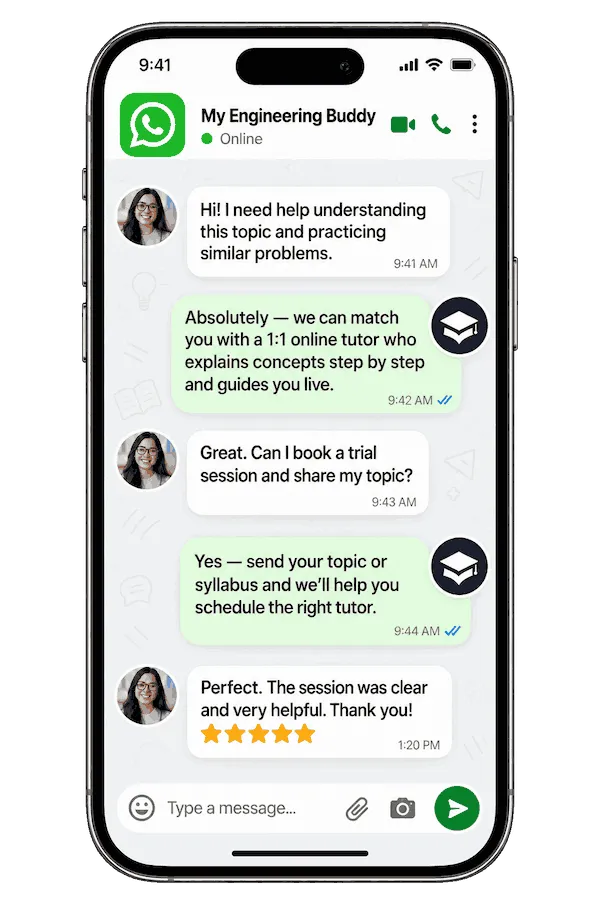
Unlike platforms where you fill out a form and wait, MEB responds in under a minute, 24/7. Tutor match takes under an hour. The $1 trial means you test before you commit. Everything runs over WhatsApp — no logins, no intake forms.
Pricing Guide
Standard undergraduate computational linguistics sessions run $20–$40/hr. Graduate-level work — dissertation support, advanced NLP modelling, formal semantics — runs higher, up to $100/hr for specialist tutor profiles. Rate factors include course level, topic complexity, your timeline, and tutor availability.
Availability tightens around semester end and major project deadlines. Book early if your deadline is within four weeks.
For students targeting research positions or graduate programmes at top computational linguistics departments, tutors with active research or industry NLP backgrounds are available at higher rates — share your specific goal and MEB will match the tier to your ambition.
Start with the $1 trial — 30 minutes, no registration, no commitment. WhatsApp MEB for a quick quote.
FAQ
Is computational linguistics hard?
Yes, for most students. It combines formal grammar, probability theory, algorithm design, and programming — often in a single module. The difficulty usually spikes at parsing algorithms and probabilistic models. Structured 1:1 help at those specific points makes a measurable difference.
How many sessions do I need?
Students with one or two specific gaps typically need 4–8 sessions. Students building from a weak foundation across an entire semester typically work with MEB for 12–20 sessions. The tutor sets a realistic timeline after the first diagnostic.
Can you help with homework and assignments?
Yes. MEB tutoring is guided learning — you understand the work, then submit it yourself. See our Academic Integrity policy and Why MEB page for full details on what we help with and what we don’t.
Will the tutor match my exact syllabus or exam board?
Yes. Before matching, MEB asks for your university, module code or course name, and current topic. Tutors are selected based on that specific syllabus — not a generic computational linguistics overview.
What happens in the first session?
The tutor runs a short diagnostic: a few targeted questions or a problem to attempt. This identifies exactly where your understanding breaks. The session then covers the most urgent gap first, with a plan for subsequent sessions outlined before you close.
Is online tutoring as effective as in-person?
For computational linguistics, often more so. Screen sharing, live code review, and pen-pad derivations on Google Meet replicate the whiteboard experience — plus you can share your actual code and error outputs directly in the session.
Can I get computational linguistics help at midnight or at weekends?
Yes. MEB operates 24/7 across time zones. WhatsApp response time averages under a minute. Tutor availability varies by time zone, but students in the Gulf, Australia, and the US West Coast regularly book late-night or early-morning sessions without issue.
What if I don’t get along with my assigned tutor?
Tell MEB on WhatsApp and a replacement is arranged — usually within the same day. The $1 trial is specifically designed to let you assess fit before committing to a full session package.
Do you offer help with NLP programming tasks — Python, NLTK, spaCy?
Yes. Many computational linguistics students need help bridging the theory-to-code gap. Tutors can work through Python implementations using NLTK, spaCy, Hugging Face Transformers, or your university’s specific tools — sharing your screen in session.
What’s the difference between computational linguistics and NLP — and does it affect which tutor I get?
Computational linguistics tends to emphasise formal linguistic theory and cognitive modelling; NLP emphasises engineering applications and machine learning. Many courses blend both. MEB asks about your specific module before matching — so the tutor’s background fits your actual course, not just the label.
How do I get started?
WhatsApp MEB, share your course details and hardest topic, and you’ll be matched with a tutor — usually within an hour. The first session starts with a $1 trial: 30 minutes live or one question explained in full. Three steps: WhatsApp → matched → start.
A common pattern our tutors observe is that computational linguistics students spend hours re-reading lecture slides on algorithms they never fully understood the first time. One focused session on the actual derivation — not the slides — usually unsticks it permanently.
Trust & Quality at My Engineering Buddy
Every MEB tutor goes through subject-specific screening before taking a session. That means a live demo evaluation, degree and credential verification, and ongoing review based on student feedback. Tutors covering computational linguistics are assessed on formal grammar theory, statistical NLP methods, and practical implementation — not just general linguistics or general computer science. Rated 4.8/5 across 40,000+ verified reviews on Google.
MEB tutoring is guided learning — you understand the work, then submit it yourself. For full details on what we help with and what we don’t, read our Academic Integrity policy and Why MEB.
MEB has served 52,000+ students across the US, UK, Canada, Australia, Gulf, and Europe since 2008, covering 2,800+ subjects. Within Linguistics, that includes phonetics tutoring, semantics help, and discourse analysis tutoring — alongside the full computational linguistics track. Every subject follows the same tutor vetting process. Read more about MEB’s tutoring methodology and how sessions are structured.
Try your first session for $1 — 30 minutes of live 1:1 tutoring or one homework question explained in full. No registration. No commitment. WhatsApp MEB now and get matched within the hour.
The ACM Digital Library documents the rapid growth of computational linguistics research — a field whose core concepts now appear across computer science, cognitive science, and linguistics degree programmes worldwide.
Source: ACM Digital Library.
Explore Related Subjects
Students studying computational linguistics often also need support in:
- Bilingualism
- Historical linguistics
- Morphology (linguistics)
- Orthography
- Phonology
- Pragmatics
- Sociolinguistics
Next Steps
Before your first session, have ready: your course syllabus or module guide, a recent homework problem or past paper question you struggled with, and your exam or submission deadline. The tutor handles the rest.
- Share your exam board or university module, your hardest topic, and your current timeline
- Share your availability and time zone
- MEB matches you with a verified computational linguistics tutor — usually within 24 hours
- First session starts with a diagnostic so every minute is used well
Visit www.myengineeringbuddy.com for more on how MEB works.
WhatsApp to get started or email [email protected].
Reviewed by Subject Expert
This page has been carefully reviewed and validated by our subject expert to ensure accuracy and relevance.




