




~1 min
Average Reply Time
~1 hour
To Be Matched With A Tutor
30 Min Trial
75% Find Their Tutor On The 1st Trial
$20-35+/hr
Premium Yet Affordable Learning
Hire The Best Nuclear Engineering Tutor

Reactor design problems at 11 PM. Your textbook gives four pages of neutron flux equations and zero worked examples.
Nuclear Engineering Tutor Online
Nuclear engineering applies principles of nuclear physics and thermodynamics to design reactors, manage radioactive materials, and develop radiation safety systems. It spans energy generation, medical physics, and defence applications at undergraduate and graduate level.
If you’re searching for a Nuclear Engineering tutor near me, MEB offers 1:1 online tutoring and homework help in Nuclear Engineering — matched to your syllabus, your course level, and your exam timeline. Our engineering tutoring platform has served 52,000+ students since 2008. The tutor comes to you. The sessions are live. Progress is measurable.
- 1:1 online sessions tailored to your university module or graduate course
- Expert-verified tutors with degrees and research experience in nuclear engineering
- Flexible time zones — US, UK, Canada, Australia, Gulf covered
- Structured learning plan built after a diagnostic first session
- Ethical homework and assignment guidance — you understand the work, then submit it yourself
52,000+ students across the US, UK, Canada, Australia, and the Gulf have used MEB since 2008 — including students in Engineering subjects like Nuclear Engineering, Chemical Engineering, and Mechanical Engineering.
Source: My Engineering Buddy, 2008–2025.
How Much Does a Nuclear Engineering Tutor Cost?
Rates start at $20–$40/hr for most undergraduate modules. Graduate and specialist topics — reactor physics, Monte Carlo neutron transport, radiation shielding design — run $50–$100/hr depending on tutor background and timeline pressure. The $1 trial gives you 30 minutes of live tutoring before you commit to anything further.
| Level / Need | Typical Rate | What’s Included |
|---|---|---|
| Undergraduate (most modules) | $20–$40/hr | 1:1 sessions, homework guidance |
| Graduate / Advanced Specialist | $50–$100/hr | Expert tutor, niche depth, research support |
| $1 Trial | $1 flat | 30 min live session or 1 homework question explained |
Tutor availability tightens during end-of-semester assessment periods. Book early if you’re approaching a reactor design project deadline or qualifying exam.
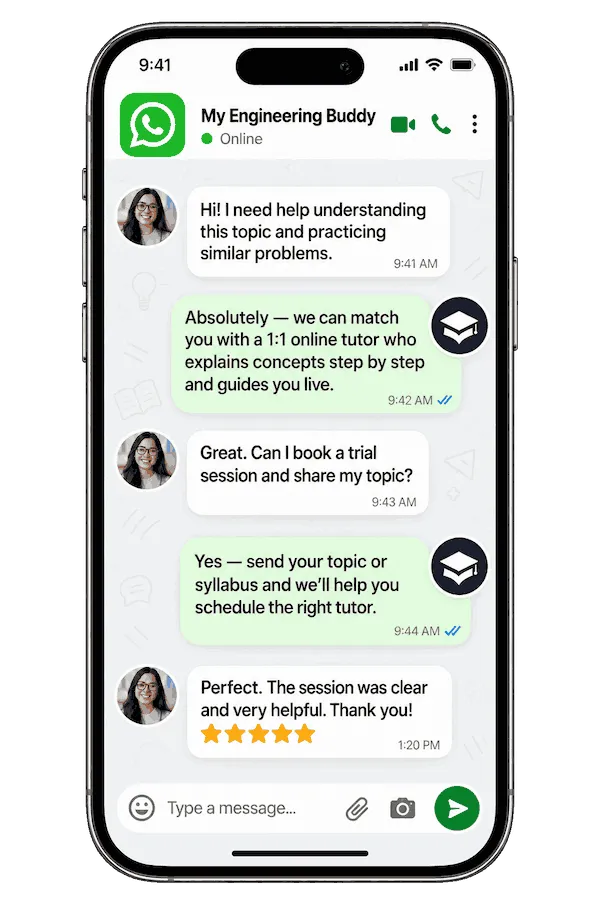
WhatsApp MEB for a quick quote — average response time under 1 minute.
Who This Nuclear Engineering Tutoring Is For
Nuclear engineering draws students from physics, chemistry, and mechanical backgrounds — and the jump to reactor theory, neutronics, and radiation transport often hits harder than expected. MEB works with students at every stage where that gap appears.
- Undergraduate students struggling with neutron diffusion equations or thermodynamic reactor cycles
- Graduate students working through Monte Carlo methods, fuel cycle analysis, or radiation shielding coursework
- Students retaking a module after a failed first attempt — particularly in nuclear reactor theory or nuclear materials
- Masters and PhD candidates needing structured support for qualifying exams or thesis chapters
- Students at MIT, Georgia Tech, University of Michigan, Penn State, Imperial College, University of Manchester, or ETH Zürich working through demanding nuclear engineering programmes
- Parents supporting an undergraduate whose grades in reactor physics or thermodynamics have started sliding
The $1 trial is a practical starting point — 30 minutes with a verified tutor who already knows the syllabus.
1:1 Tutoring vs Self-Study vs AI vs YouTube vs Online Courses
Self-study works if you’re disciplined, but nuclear engineering problems — particularly neutron transport and criticality calculations — require feedback, not just reading. AI tools give fast equation explanations but cannot diagnose why your specific flux calculation keeps collapsing. YouTube covers PWR vs BWR overviews well; it stops when you need to derive the four-factor formula from scratch. Online courses move at a fixed pace with no adaptation to your exam board or thesis committee’s expectations. 1:1 tutoring with MEB is live, calibrated to your exact module and assessment structure, and corrects calculation errors in the moment they happen — which in nuclear engineering is where marks are actually lost.
Outcomes: What You’ll Be Able To Do in Nuclear Engineering
After a structured series of sessions, students typically solve neutron diffusion and transport problems with confidence, analyze reactor criticality conditions using the six-factor formula, model heat transfer in reactor cores under steady-state and transient conditions, explain radiation interaction mechanisms for alpha, beta, and gamma sources, and apply shielding calculations using half-value layer and buildup factor methods. These are the capabilities that appear directly on undergraduate exams and graduate qualifying papers — not abstract goals.
Based on feedback from 40,000+ sessions collected by MEB from 2022 to 2025, 58% of students improved by one full grade after approximately 20 hours of 1:1 tutoring in subjects like Nuclear Engineering. A further 23% achieved at least a half-grade improvement.
Source: MEB session feedback data, 2022–2025.
At MEB, we’ve found that nuclear engineering students who bring a recent problem set to the first session — even an unsolved one — make faster progress than students who start with theory review. The tutor can locate exactly where the reasoning breaks down within 20 minutes.
What We Cover in Nuclear Engineering (Syllabus / Topics)

Nuclear Reactor Physics and Neutronics
- Neutron moderation, slowing-down theory, and thermal flux distributions
- Four-factor formula and six-factor formula for reactor criticality
- One-group and two-group neutron diffusion theory
- Reactor kinetics — prompt and delayed neutrons, inhour equation
- Xenon and samarium poisoning in operating reactors
- Reactor control systems — reactivity worth and shutdown margins
- Monte Carlo neutron transport methods (MCNP, OpenMC)
Core texts include Lamarsh and Baratta’s Introduction to Nuclear Engineering, Duderstadt and Hamilton’s Nuclear Reactor Analysis, and Bell and Glasstone’s Nuclear Reactor Theory.
Thermal-Hydraulics and Reactor Systems
- Single-phase and two-phase heat transfer in reactor cores
- Pressurised water reactors (PWR), boiling water reactors (BWR), and CANDU systems
- Reactor coolant system design and primary loop thermodynamics
- Departure from nucleate boiling (DNB) and critical heat flux
- Loss-of-coolant accident (LOCA) analysis and emergency core cooling
- Codes and tools: RELAP, TRACE, CATHARE
Standard references include Todreas and Kazimi’s Nuclear Systems volumes and Incropera’s Fundamentals of Heat and Mass Transfer.
Radiation Protection, Shielding, and Nuclear Materials
- Interaction of radiation with matter — photoelectric effect, Compton scattering, pair production
- Dose, dose equivalent, and effective dose calculations
- Gamma and neutron shielding design — buildup factors, half-value layers
- Nuclear fuel cycle: enrichment, fabrication, reprocessing, waste management
- Radiation damage in structural materials — swelling, embrittlement
- Regulatory frameworks — NRC (US), ONR (UK), IAEA safety standards
Key texts: Turner’s Atoms, Radiation, and Radiation Protection and Was’s Fundamentals of Radiation Materials Science.
What a Typical Nuclear Engineering Session Looks Like
The tutor opens by checking where the previous topic ended — usually neutron flux boundary conditions or a heat transfer derivation that wasn’t fully resolved. From there, the session moves to the student’s current problem: working through a criticality calculation or a LOCA scenario on a shared digital whiteboard in Google Meet. The tutor uses a digital pen-pad to annotate each step; the student replicates the method and explains their reasoning aloud. If the reasoning slips — common in multi-group diffusion problems — the tutor catches it at the equation level, not after a full page of wrong working. The session closes with two or three practice problems set for before the next meeting, and the next topic — often reactor kinetics or shielding geometry — is flagged so the student can skim the relevant chapter first.
How MEB Tutors Help You with Nuclear Engineering (The Learning Loop)
Diagnose: In the first session, the tutor identifies exactly where understanding breaks down — whether that’s the mathematics of diffusion theory, physical intuition about reactor behaviour, or unit handling in radiation dose calculations. This shapes every session that follows.
Explain: The tutor works through problems live using a digital pen-pad, narrating every step. For nuclear engineering, this matters most in derivations — students often memorise the four-factor formula without understanding which term changes under what reactor condition.
Practice: The student attempts the next problem with the tutor present. This is where gaps that don’t show up in passive reading become visible — particularly in thermal-hydraulics and shielding geometry.
Feedback: The tutor gives step-by-step error correction, including why a specific approach costs marks in written exams or qualifying papers. In nuclear engineering, sign errors in criticality equations and incorrect boundary conditions are the two most common failure points.
Plan: After each session, the tutor sets the next topic, flags prerequisite gaps to revisit, and tracks progress toward the student’s stated goal — exam pass, grade improvement, or qualifying exam clearance.
Sessions run on Google Meet with a digital pen-pad or iPad and Apple Pencil. Before the first session, share your course syllabus or module outline, a recent problem set you’ve attempted, and your exam or submission date. The tutor builds the session sequence from there. Whether you need a quick catch-up before finals, structured revision over six weeks, or ongoing weekly support through the semester, the plan is built after the diagnostic — not before it.
Start with the $1 trial — 30 minutes of live tutoring that also serves as your first diagnostic session.
Students consistently tell us that nuclear engineering clicked for them not when they re-read the textbook, but when a tutor asked them to explain the physics out loud and they couldn’t. That moment of friction is where the real session starts.
Tutor Match Criteria (How We Pick Your Tutor)
Every Nuclear Engineering tutor in MEB’s network is matched on four criteria before a session is confirmed.
Subject depth: The tutor holds a degree in nuclear engineering, nuclear physics, or a directly adjacent field. For graduate-level work, MEB prioritises tutors with research or industry experience in the specific sub-area — reactor safety, fuel cycle, or radiation measurement.
Tools: All tutors use Google Meet with a digital pen-pad or iPad and Apple Pencil. Live annotation is not optional in a subject where equation layout is half the problem.
Time zone: Matched to the student’s region — US Eastern through Pacific, UK, Gulf, Canada, and Australia all covered.
Goals: The match accounts for whether you need exam-score improvement, conceptual depth in a specific topic, homework guidance, or research-level support for a thesis chapter on neutronics or fuel performance.
Unlike platforms where you fill out a form and wait, MEB responds in under a minute, 24/7. Tutor match takes under an hour. The $1 trial means you test before you commit. Everything runs over WhatsApp — no logins, no intake forms.
Study Plans (Pick One That Matches Your Goal)
The tutor builds a specific session sequence after the diagnostic. Three patterns come up most often: a catch-up plan (1–3 weeks) for students who have fallen behind on reactor theory or thermodynamics with an exam close; an exam prep block (4–8 weeks) with structured topic progression and past-paper practice; and ongoing weekly support aligned to semester deadlines and coursework submissions. Tell MEB your exam date or module deadline and the tutor maps the plan from there.
Pricing Guide
Most undergraduate Nuclear Engineering modules are covered at $20–$40/hr. Graduate coursework, qualifying exam prep, and specialist topics like Monte Carlo transport or advanced fuel cycle analysis run $50–$100/hr. Rate factors include course level, topic complexity, how much lead time there is, and tutor availability.
For students targeting positions at national laboratories (Argonne, Oak Ridge, UKAEA) or graduate programmes at top nuclear engineering schools, tutors with prior research or industry backgrounds are available at higher rates — share your specific goal and MEB matches the tier to your target.
Availability tightens during end-of-semester periods and around qualifying exam windows. Start with the $1 trial — 30 minutes, no registration, no commitment. WhatsApp MEB for a quick quote.
MEB has been operating since 2008 — long enough to see which gaps in nuclear engineering courses reliably cost students grades, and which textbook chapters tutors consistently have to rebuild from first principles in the first session.
Source: My Engineering Buddy, 2008–2025.
Try your first session for $1 — 30 minutes of live 1:1 tutoring or one homework question explained in full. No registration. No commitment. WhatsApp MEB now and get matched within the hour.
FAQ
Is Nuclear Engineering hard?
Yes — it combines advanced mathematics, quantum mechanics, thermodynamics, and materials science. Students who struggle most are usually missing fluency in differential equations or physical intuition about particle behaviour. Those gaps are fixable with targeted 1:1 work, usually within a few sessions.
How many sessions are needed?
Students with a specific exam topic to cover typically need 4–8 sessions. Those rebuilding from a failed module or preparing for a qualifying exam usually work over 10–20 sessions. The tutor sets a realistic estimate after the diagnostic first session.
Can you help with homework and assignments?
MEB tutoring is guided learning — you understand the work, then submit it yourself. The tutor explains the method, works through an analogous example, and checks your reasoning. See our Academic Integrity policy and Why MEB page for full details on what we help with and what we don’t.
Will the tutor match my exact syllabus or exam board?
Yes. Share your university, module code, and course outline when you contact MEB. Tutors are matched on syllabus fit — whether that’s an NRC-aligned US programme, an ONR-framework UK course, or an IAEA-curriculum international programme.
What happens in the first session?
The tutor runs a short diagnostic — asking you to work through a problem or explain a concept while they observe. From that, they identify the specific gaps and build a session plan. No time is spent on topics you already have under control.
Is online tutoring as effective as in-person?
For nuclear engineering, yes. The digital pen-pad replicates the whiteboard experience exactly. Students working through neutron transport derivations or heat transfer calculations report no meaningful difference in quality compared to face-to-face sessions.
What is the difference between PWR and BWR tutoring focus areas?
PWR courses emphasise primary loop thermodynamics, pressuriser design, and steam generator analysis. BWR courses focus more on two-phase flow, void coefficient effects, and jet pump operation. MEB tutors are matched to whichever reactor type your specific module or thesis covers.
Can MEB help with MCNP or OpenMC simulation assignments?
Yes. Tutors with Monte Carlo transport experience can walk through geometry definition, material cards, tally setup, and results interpretation in MCNP and OpenMC. Bring your input file and the output you can’t explain — that’s the fastest way to use the session.
Can I get Nuclear Engineering help late at night or on weekends?
Yes. MEB operates 24/7. Students in the US, Gulf, and Australia regularly book sessions outside standard business hours. WhatsApp response time is typically under a minute regardless of when you message.
Do you offer group Nuclear Engineering sessions?
MEB specialises in 1:1 sessions — not group tutoring. The diagnostic, pacing, and problem selection are all calibrated to one student’s gaps. Group formats don’t allow that level of adjustment, which is why MEB doesn’t offer them.
How do I get started?
WhatsApp MEB, share your module or exam focus and your timeline, and MEB matches you with a verified nuclear engineering tutor — usually within an hour. The first session is the $1 trial: 30 minutes live, or one full homework question explained step by step.
Trust & Quality at My Engineering Buddy
Every MEB tutor goes through a subject-specific vetting process: degree verification, a live demonstration session evaluated by an experienced reviewer, and ongoing quality checks based on student session feedback. Tutors covering graduate-level nuclear engineering — reactor safety analysis, fuel cycle chemistry, radiation measurement — are additionally screened for research or industry experience in those sub-areas. Rated 4.8/5 across 40,000+ verified reviews on Google. For mechanical engineering tutoring and adjacent subjects, the same screening standard applies.
MEB tutoring is guided learning — you understand the work, then submit it yourself. For full details on what we help with and what we don’t, read our Academic Integrity policy and Why MEB.
MEB has operated since 2008 across the US, UK, Canada, Australia, the Gulf, and Europe — covering 2,800+ subjects. Engineering is one of the largest subject areas on the platform, with particular depth in chemical engineering help, electrical engineering tutoring, and materials science and engineering tutoring alongside Nuclear Engineering. The platform’s 18-year operating history means tutors have seen how course structures and exam demands have shifted — and what consistently works.
MEB has matched tutors to students in Nuclear Engineering, power plant engineering, and petroleum engineering since 2008 — verified tutors, live sessions, no waiting lists.
Source: My Engineering Buddy, 2008–2025.
Explore Related Subjects
Students studying Nuclear Engineering often also need support in:
- Aerospace Engineering
- Biomedical Engineering
- Civil Engineering
- Industrial Engineering
- Systems Engineering
- Mechatronics
- Metallurgical Engineering
Next Steps
Before your first session, have ready: your university module code and syllabus (or course outline), a recent problem set or homework you struggled with, and your exam or submission deadline. The tutor handles the rest.
- Share your exam board or module focus, hardest topic, and current timeline
- Share your availability and time zone
- MEB matches you with a verified nuclear engineering tutor — usually within 24 hours
The first session starts with a diagnostic so every minute is used on the gaps that actually matter.
Visit www.myengineeringbuddy.com for more on how MEB works.
WhatsApp to get started or email [email protected].
Reviewed by Subject Expert
This page has been carefully reviewed and validated by our subject expert to ensure accuracy and relevance.




