Hire Verified & Experienced
Signal Processing Tutors
4.8/5 40K+ session ratings collected on the MEB platform



Hire The Best Signal Processing Tutor
Top Tutors, Top Grades. Without The Stress!
52,000+ Happy Students From Various Universities






How Much For Private 1:1 Tutoring & Hw Help?
Private 1:1 Tutoring and HW help Cost $20 – 35 per hour* on average.
Your Fourier transform marks keep falling — and watching more lectures isn’t fixing it.
Signal Processing Tutor Online
Signal Processing is the mathematical analysis and manipulation of signals — audio, images, biomedical waveforms, and more — using techniques such as Fourier transforms, digital filters, convolution, and spectral analysis. A Signal Processing tutor helps students move from formula memorisation to applied problem-solving across undergraduate and graduate engineering courses.
MEB provides 1:1 online tutoring and homework help across 2,800+ advanced subjects — and Signal Processing is one of the highest-demand areas we cover. If you’ve searched for a Signal Processing tutor near me and found nothing that fits your exact syllabus, MEB matches you within the hour. Sessions are structured, tutor-led, and calibrated to your course — whether that’s a second-year EE module, a graduate DSP course, or a specialised biomedical signals unit. One diagnostic session shows exactly where the gaps are.
- 1:1 online sessions tailored to your specific course and syllabus
- Expert, verified tutors with subject-specific Signal Processing knowledge
- Flexible time zones — US, UK, Canada, Australia, Gulf
- Structured learning plan built after a diagnostic session
- Ethical homework and assignment guidance — you understand before you submit
52,000+ students across the US, UK, Canada, Australia, and the Gulf have used MEB since 2008 — across 2,800+ subjects, from AP Calculus to A Level Music Technology to Data Science.
Source: My Engineering Buddy, 2008–2025.
How Much Does a Signal Processing Tutor Cost?
Most Signal Processing tutoring sessions run $20–$40/hr. Graduate-level or highly specialised topics — sparse signal recovery, wavelet theory, compressive sensing — can reach $70–$100/hr depending on tutor expertise. The $1 trial gets you 30 minutes of live 1:1 tutoring or one full homework question explained — before you commit to anything.
| Level / Need | Typical Rate | What’s Included |
|---|---|---|
| Undergraduate (most levels) | $20–$40/hr | 1:1 sessions, homework guidance |
| Graduate / Specialist | $40–$100/hr | Expert tutor, advanced DSP depth |
| $1 Trial | $1 flat | 30 min live session or 1 homework question |
Tutor availability tightens significantly around finals and end-of-semester project deadlines. Book early if you’re working to a fixed date.
WhatsApp MEB for a quick quote — average response time under 1 minute.
Who This Signal Processing Tutoring Is For
Signal Processing sits at the intersection of mathematics and real-world engineering — and most students hit the same wall: the theory looks manageable until the problem sets arrive. MEB tutoring suits students at any stage who need more than a textbook and a prayer.
- Undergraduate EE, ECE, or BME students covering DSP as a core module
- Graduate students working through advanced topics like adaptive filtering or stochastic signals
- Students retaking a failed Signal Processing unit with a GPA-dependent outcome at stake
- Students with a thesis or capstone project involving signal analysis who need targeted support
- Students 4–6 weeks from finals with Fourier, Z-transforms, or filter design still to consolidate
- Faculty or researchers needing a refresher on specific DSP methods for a new project
Students come to MEB from programmes at MIT, Georgia Tech, Imperial College London, ETH Zurich, University of Toronto, TU Delft, and UNSW — among many others. The tutor adapts to your department’s notation and expected depth, not a generic syllabus.
1:1 Tutoring vs Self-Study vs AI Tools
Self-study works for motivated students — but Signal Processing has a particular trap: you can follow a derivation line by line and still not know how to apply it to a filter design problem you haven’t seen before. Without someone to catch that gap, you repeat the same errors on every problem set. AI tools generate explanations quickly, but they cannot watch you attempt a convolution problem, spot where your index notation breaks down, and correct it in real time with a worked annotated example. For Signal Processing specifically, that live annotated back-and-forth — where a tutor draws the pole-zero plot as you discuss it — is the part no chatbot replicates. MEB gives you the online flexibility of both alternatives, with a structured feedback loop calibrated to your exact course and assessment format.
Outcomes: What You’ll Be Able To Do in Signal Processing
After working through sessions with an MEB tutor, students consistently report being able to apply the Discrete Fourier Transform to real data sequences without losing track of indexing, analyze filter stability using pole-zero plots in the Z-domain, model linear time-invariant systems using convolution and impulse response characterisation, explain the trade-offs between FIR and IIR filter designs for a given specification, and solve spectral analysis problems involving windowing, leakage, and resolution that typically appear in written exams and lab reports.
Based on feedback from 40,000+ sessions collected by MEB from 2022 to 2025, 58% of students improved by one full grade after approximately 20 hours of 1:1 tutoring in a single subject. A further 23% achieved at least a half-grade improvement.
Source: MEB session feedback data, 2022–2025.
What We Cover in Signal Processing (Syllabus / Topics)

Foundations of Signals and Systems
- Continuous-time and discrete-time signal classification
- Linear time-invariant (LTI) systems — properties and representation
- Convolution in time and frequency domains
- Impulse response and system stability analysis
- Fourier Series and Continuous-Time Fourier Transform (CTFT)
- Sampling theorem, aliasing, and reconstruction (Nyquist criterion)
Core texts include Oppenheim & Willsky’s Signals and Systems and Haykin & Van Veen’s Signals and Systems — tutors work from whichever edition your course uses.
Digital Signal Processing (DSP)
- Discrete Fourier Transform (DFT) and Fast Fourier Transform (FFT)
- Z-transform — bilateral, unilateral, region of convergence
- FIR and IIR digital filter design (windowing, Parks-McClellan, bilinear transform)
- Pole-zero analysis and frequency response characterisation
- Spectral analysis — windowing functions, resolution, leakage effects
- Multirate signal processing: decimation and interpolation
- Adaptive filters — LMS and RLS algorithms
Standard references: Proakis & Manolakis Digital Signal Processing and Oppenheim & Schafer Discrete-Time Signal Processing — your tutor matches the edition and notation your department specifies.
Biomedical and Applied Signal Processing
- ECG, EEG, and EMG signal acquisition and preprocessing
- Noise reduction and artifact removal in physiological signals
- Time-frequency analysis — Short-Time Fourier Transform, wavelet transforms
- Feature extraction for classification and pattern recognition
- Signal processing in biomedical signal processing and medical imaging applications
- Introduction to compressive sensing and sparse signal recovery
Relevant texts include Rangayyan’s Biomedical Signal Analysis and Sörnmo & Laguna’s Bioelectrical Signal Processing in Cardiac and Neurological Applications.
At MEB, we’ve found that students who struggle with Fourier analysis almost always have the same underlying issue: they’re trying to memorise transform pairs rather than understanding what the transform is actually doing to the signal. Once a tutor demonstrates this visually — drawing the spectrum as the signal changes — the formula starts to make sense on its own.
What a Typical Signal Processing Session Looks Like
The session opens with a quick check on the previous topic — usually filter design or Z-transform problems that were assigned for independent practice. The tutor asks the student to attempt one problem on screen while sharing their working. From there, the session focuses on wherever the reasoning breaks down: for most students at the undergraduate level, that’s the pole-zero diagram or the DFT indexing conventions. The tutor annotates directly on a digital pen-pad, walks through the solution step by step, then asks the student to replicate a similar problem while explaining each step aloud. The session closes with two or three practice questions at exam difficulty and a clear note on which topic opens next time.
How MEB Tutors Help You with Signal Processing (The Learning Loop)
Diagnose: In the first session, the tutor asks you to work through one or two representative problems — a convolution question and a filter specification, typically. This shows exactly which concepts are solid and where the gaps sit, rather than guessing from a syllabus list.
Explain: The tutor introduces or re-explains the target concept using live worked examples, annotated on screen with a digital pen-pad. For Signal Processing, that usually means drawing waveforms, spectrum plots, and pole-zero diagrams as the explanation unfolds — not just equations.
Practice: You attempt a problem with the tutor present. The tutor does not jump in immediately — they let you work, then observe where the reasoning slows or goes wrong. That distinction matters.
Feedback: The tutor works back through your attempt step by step, identifying exactly where the error occurred and why it would cost marks. In Signal Processing, this is often a sign error in a transform, an incorrect region of convergence, or a missed normalisation factor.
Plan: Every session ends with a short note on what to practise before next time and which topic follows in the sequence. The tutor tracks your progression across sessions and adjusts the pace as needed.
All sessions run over Google Meet. The tutor uses a digital pen-pad or iPad with Apple Pencil for annotation — share your course outline or a recent problem set before the first session, and the tutor comes prepared. Start with the $1 trial — 30 minutes of live tutoring that also serves as your first diagnostic. Whether you need a quick catch-up before an exam, structured revision over 4–8 weeks, or ongoing weekly support through the semester, the tutor maps the session plan after the first diagnostic.
Tutor Match Criteria (How We Pick Your Tutor)
Not every Signal Processing tutor is the right fit for every student. MEB matches on five specific criteria.
Subject depth: Tutors are matched to your exact level — second-year undergraduate DSP is a different beast from a graduate course in stochastic signal processing. The tutor must have covered your specific topics, not just the subject area in general.
Tools: All Signal Processing sessions use Google Meet with screen sharing and digital pen-pad annotation. For students working on MATLAB or Python-based signal processing coursework, tutors use live screen sharing and code walkthroughs alongside the theory.
Time zone: MEB covers all major time zones — New York, Los Angeles, Chicago, London, Dubai, Toronto, Sydney, Melbourne, and across Europe. Evening and weekend sessions are available.
Learning style: Calibrated from the first session. Some students need the derivation before the application; others need to see a worked example first. The tutor reads that quickly and adjusts.
Communication: Clear English, adapted to your level of formality and your department’s notation. No generic explanations that could have come from a textbook you already have.
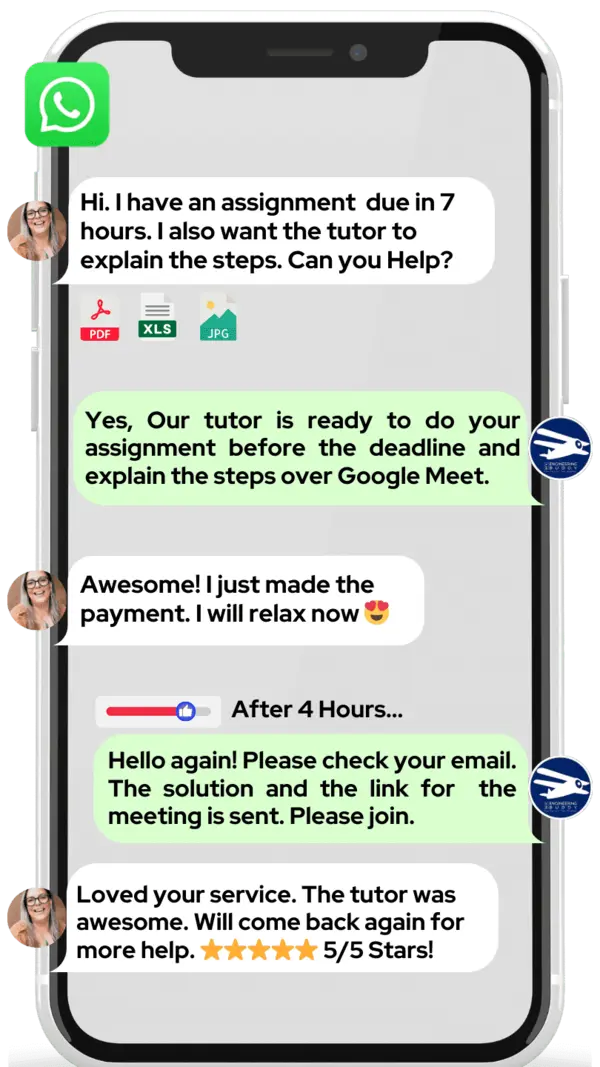
Unlike platforms where you fill out a form and wait, MEB responds in under a minute, 24/7. Tutor match takes under an hour. The $1 trial means you test before you commit. Everything runs over WhatsApp — no logins, no intake forms.
Study Plans (Pick One That Matches Your Goal)
Once the diagnostic is done, your tutor builds a session sequence around one of three tracks. Catch-up (1–3 weeks): for students behind on a specific module with an imminent deadline — the tutor prioritises the highest-yield topics and works backwards from the exam date. Exam prep (4–8 weeks): structured revision covering every assessed component, with past paper practice woven in from week two. Weekly support: ongoing sessions aligned to your semester schedule, covering new content as your course progresses and revisiting problem areas before assessments.
Pricing Guide
Signal Processing tutoring starts at $20/hr for standard undergraduate-level content. Graduate and specialised topics — adaptive filtering, sparse reconstruction, biomedical signal analysis — typically run $40–$100/hr depending on tutor background and topic complexity. Rate factors include your level, the specific topic depth required, your timeline, and tutor availability. Slots fill quickly during finals season and end-of-semester project weeks.
For students targeting research programmes, doctoral work, or industry roles requiring deep DSP expertise, tutors with professional signal processing and research backgrounds are available at higher rates — share your specific goal and MEB will match the tier to your ambition.
Start with the $1 trial — 30 minutes, no registration, no commitment. WhatsApp MEB for a quick quote.
FAQ
Is Signal Processing hard?
It has a steep entry point — especially around Fourier analysis and Z-transforms. Most students find it manageable once they understand what the mathematics is actually doing, rather than treating transforms as formulas to memorise. A tutor accelerates that switch significantly.
How many sessions are needed?
Students with specific exam gaps typically need 8–15 sessions. Those seeking ongoing support through a full semester usually work with a tutor weekly. The diagnostic session in week one gives a clearer estimate for your specific situation.
Can you help with homework and assignments?
Yes — the tutor explains the method and works through the reasoning with you, so you understand before you submit your own work. MEB tutoring is guided learning — you understand the work, then submit it yourself. For full details on what we help with and what we don’t, read our Academic Integrity policy and Why MEB.
Will the tutor match my exact syllabus or exam board?
Yes. Before matching, MEB asks for your course outline, institution, and specific topics. The tutor is selected based on that information — not a generic DSP curriculum. Notation differences between departments are flagged and addressed from the first session.
What happens in the first session?
The tutor runs a short diagnostic — usually two or three problems covering different topic areas. This identifies exactly where your understanding is solid and where it needs work. The rest of the session and all future sessions are planned from that baseline.
Is online tutoring as effective as in-person?
For Signal Processing specifically, the pen-pad annotation over Google Meet replicates a whiteboard session closely. Students working on MATLAB or Python problems share screens in real time. Most students report the online format removes travel friction without losing any of the interaction quality.
Can I get Signal Processing help at midnight?
Yes. MEB operates across all time zones, and WhatsApp responses average under a minute regardless of when you message. Tutors in overlapping time zones with your location mean late-night sessions before a deadline are a genuine option, not an exception.
What if I don’t like my assigned tutor?
Tell MEB after the first session — or during it. A replacement is arranged within the hour. The $1 trial exists specifically so you can assess fit before investing in a full session block. No pressure, no penalty for switching.
Do you help with MATLAB or Python-based signal processing coursework?
Yes. Tutors cover MATLAB signal processing toolbox work and Python-based DSP using NumPy, SciPy, and related libraries. Live screen sharing means the tutor can step through your code and explain each function alongside the underlying theory.
How do I get started?
Three steps: WhatsApp MEB with your course details → get matched with a verified tutor, usually within the hour → start your $1 trial (30 minutes live or one question explained in full). No registration required. No upfront commitment beyond one dollar.
Students at MIT, Georgia Tech, Imperial College, ETH Zurich, and TU Delft all work with MEB tutors — because syllabus-specific support matters more than generic DSP explanations found in any textbook.
Source: My Engineering Buddy, 2008–2025.
Trust & Quality at My Engineering Buddy
Every MEB tutor goes through a structured screening process: subject knowledge assessment, a live demo session evaluated by an MEB reviewer, and ongoing review based on student feedback. Tutors hold relevant degrees and, for specialist areas like biomedical signal processing tutoring, professional or research experience in the field. Rated 4.8/5 across 40,000+ verified reviews on Google.
MEB tutoring is guided learning — you understand the work, then submit it yourself. For full details on what we help with and what we don’t, read our Academic Integrity policy and Why MEB.
MEB has served 52,000+ students across the US, UK, Canada, Australia, the Gulf, and Europe in 2,800+ subjects since 2008. Beyond Signal Processing, students come to us for neural engineering tutoring, medical imaging help, and 1:1 computational biology tutoring — all under the same verified-tutor standard. Visit www.myengineeringbuddy.com to see the full subject range and MEB’s approach.
Students consistently tell us that the biggest shift happens not when they get the right answer, but when they can explain why a different approach would fail. That’s the marker MEB tutors look for — and it’s when we know a student is genuinely prepared for an exam, not just a specific question type.
Explore Related Subjects
Students studying Signal Processing often also need support in:
Next Steps
Getting started takes less than two minutes. Before your first session, have ready:
- Your course outline or syllabus (or the specific topics you’re stuck on)
- A recent problem set or homework question you struggled with
- Your exam or assignment deadline date
Share your availability and time zone — MEB matches you with a verified Signal Processing tutor, usually within 24 hours. The first session begins with a diagnostic so every minute is used on what actually needs work.
Try your first session for $1 — 30 minutes of live 1:1 tutoring or one homework question explained in full. No registration. No commitment. WhatsApp MEB now and get matched within the hour.
For more on the MEB process, visit www.myengineeringbuddy.com — or reach out directly: WhatsApp to get started or email meb@myengineeringbuddy.com.
Reviewed by Subject Expert
This page has been carefully reviewed and validated by our subject expert to ensure accuracy and relevance.