Hire Verified & Experienced
VCE Physics Tutors
4.8/5 40K+ session ratings collected on the MEB platform



Hire The Best VCE Physics Tutor
Top Tutors, Top Grades. Without The Stress!
52,000+ Happy Students From Various Universities



How Much For Private 1:1 Tutoring & Hw Help?
Private 1:1 Tutoring and HW help Cost $20 – 35 per hour* on average.
Most students who struggle with VCE Physics don’t have a knowledge gap — they have a feedback gap. No one has caught the exact moment the reasoning breaks down.
VCE Physics Tutor Online
VCE Physics is a senior secondary subject administered by the Victorian Curriculum and Assessment Authority (VCAA) in Australia, covering mechanics, electromagnetism, waves, and modern physics, equipping students for university STEM entry.
MEB provides 1:1 online tutoring and homework help in 2800+ advanced subjects — including a dedicated VCE stream covering every scored unit. If you’ve searched for a VCE Physics tutor near me, you’ve found the right place. Every session is built around the VCAA syllabus, your current Unit, and the exact question types you’re dropping marks on. One tutor. Your pace. Real progress.
- 1:1 online sessions tailored to VCAA Units 1–4 and your specific study score target
- Expert-verified tutors with demonstrated VCE Physics subject knowledge
- Flexible time zones — US, UK, Canada, Australia, Gulf
- Structured learning plan built after a diagnostic session
- Ethical homework and assignment guidance — you understand before you submit
52,000+ students across the US, UK, Canada, Australia, and the Gulf have used MEB since 2008 — including students in VCE subjects like VCE Biology, VCE Psychology, and VCE Chemistry, alongside VCE Physics.
Source: My Engineering Buddy, 2008–2025.
How Much Does a VCE Physics Tutor Cost?
Most VCE Physics tutoring sessions run at $20–$40/hr. Tutors with specialist experience in Units 3 & 4 or intensive exam-prep delivery sit at the higher end. The $1 trial gives you 30 minutes of live 1:1 tutoring — no registration, no commitment.
Availability tightens significantly in the six weeks before VCAA exams. If you’re planning ahead for October–November, lock in your tutor early.
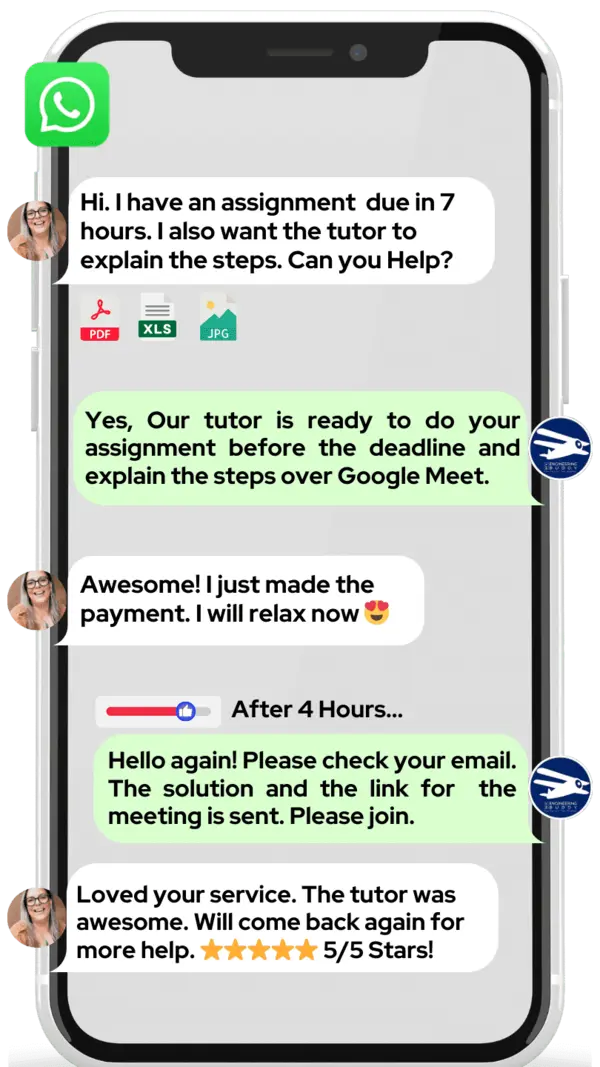
WhatsApp MEB for a quick quote — average response time under 1 minute.
Who This VCE Physics Tutoring Is For
VCE Physics draws students from Year 11 right through to the final SAC and written exam in Year 12. The challenge isn’t always the physics itself — it’s applying it under timed conditions with the exact terminology VCAA rewards.
- Year 11 students starting Units 1 & 2 who want a solid foundation before the scored years
- Year 12 students targeting a study score above 35 for competitive university entry
- Students with a university conditional offer depending on their VCE Physics study score
- Students preparing for SACs and needing structured revision with practice questions
- Students 4–6 weeks from the VCAA written exam with specific topic gaps still to close
- Parents watching a child’s confidence drop alongside their marks — MEB works directly with parents to set up sessions, track progress, and keep SAC deadlines on schedule. WhatsApp MEB — average response time is under a minute, 24/7.
Students aiming for engineering, medicine, or physics at universities like the University of Melbourne, Monash, UNSW, the University of Sydney, and ANU typically need a strong VCE Physics result. MEB tutors understand what those course prerequisites look like in practice.
1:1 Tutoring vs Self-Study vs AI vs YouTube vs Online Courses
Self-study works if you’re disciplined — but VCE Physics punishes partial understanding in ways a textbook answer key doesn’t catch. AI tools explain concepts quickly but can’t watch you attempt a projectile motion problem and catch where your vector decomposition went wrong. YouTube is useful for overviews of topics like electromagnetic induction, but it stops the moment your specific SAC question doesn’t match the example. Online courses are structured but move at a fixed pace that ignores your actual gaps. 1:1 tutoring with MEB is live, calibrated to VCAA Units 3 & 4 specifically, and corrects errors in the moment — before they cost marks on the day.
Outcomes: What You’ll Be Able To Do in VCE Physics
After consistent sessions with a VCE Physics tutor online, students can solve multi-step projectile and circular motion problems without reverting to formula guessing. They can apply Newton’s laws and energy conservation across connected body systems — the type that appear in Section B of the written exam. Students learn to analyse and interpret data from practical investigations in line with VCAA’s scientific methodology requirements. They can explain electromagnetic phenomena — including Faraday’s law and motor effect — with the precision the marking guide demands. And they can model wave behaviour, including diffraction and interference, using both quantitative reasoning and clear written justification.
Based on feedback from 40,000+ sessions collected by MEB from 2022 to 2025, 58% of students improved by one full grade after approximately 20 hours of 1:1 tutoring in subjects like VCE Physics. A further 23% achieved at least a half-grade improvement.
Source: MEB session feedback data, 2022–2025.
At MEB, we’ve found that the students who improve fastest in VCE Physics aren’t always the ones who study the most hours — they’re the ones who get corrective feedback early enough to stop practising the wrong method. One session catching a sign error in force diagrams can be worth three weeks of solo revision.
What We Cover in VCE Physics (Syllabus / Topics)
Unit 1 & 2 — Foundations (Thermodynamics, Waves, Motion)
- Heat, temperature, and thermodynamic principles
- Wave properties: frequency, wavelength, amplitude, speed
- Light and sound — reflection, refraction, resonance
- Introduction to motion: kinematics in one and two dimensions
- Electric circuits: current, voltage, resistance, and power
- Nuclear physics basics and radioactive decay
Core texts: Heinemann Physics 11 (Burrows et al.), Nelson Physics Units 1 & 2 (Tacon et al.). VCAA study design is the primary reference for all SAC and exam alignment.
Unit 3 — Motion and Electromagnetism
- Newton’s laws applied to connected and circular motion systems
- Gravitational fields and orbital mechanics
- Electric fields, potential, and charged particle motion
- Magnetic fields: force on current-carrying conductors and moving charges
- Electromagnetic induction: Faraday’s law, Lenz’s law, AC generation
- Transformers and transmission of electrical energy
- DC and AC circuits — power, impedance, and RMS values
Core texts: Heinemann Physics 12 (Burrows et al.), Cambridge VCE Physics Units 3 & 4 (de Jong et al.). Past VCAA written exams used throughout.
Unit 4 — Waves, Light, and Modern Physics
- Wave-particle duality — photoelectric effect and de Broglie wavelength
- Light as a wave: diffraction, interference, and Young’s double-slit experiment
- Special relativity: time dilation, length contraction, mass-energy equivalence
- Nuclear reactions: fission, fusion, and binding energy calculations
- The Standard Model — quarks, leptons, and fundamental forces (overview)
- Practical investigation design, data analysis, and scientific report writing
Core texts: Heinemann Physics 12, Nelson Physics Units 3 & 4 (Tacon et al.). Exam Worked Solutions booklets (VCAA) used for Section B strategy.
| Assessment Component | Description | Typical Weighting |
|---|---|---|
| School-Assessed Coursework (SACs) | Practical investigation + data analysis tasks within school | ~20% (Units 3 & 4 combined) |
| Written Examination (VCAA) | Section A: multiple choice; Section B: short and extended response | ~80% |
| Study Score | Scaled ATAR contribution — scored 0–50, state-moderated | Reported as scaled study score |
VCAA publishes the Physics study design and past exam papers at the Victorian Curriculum and Assessment Authority website — the authoritative source for all syllabus, SAC, and exam requirements.

What a Typical VCE Physics Session Looks Like
The tutor opens by checking the previous session’s topic — usually something from Unit 3 like circular motion or electromagnetic induction — to see what stuck and what didn’t. From there, you and the tutor work through two or three problems on screen: often a Section B-style extended response question where the reasoning needs to be written out, not just calculated. The tutor uses a digital pen-pad to annotate force diagrams or field line sketches in real time. You replicate the method or explain the reasoning back in your own words — that step catches errors that silent reading never does. At the end, you get a specific practice task: three past-paper questions on the same topic, due before the next session. The next topic is named before you close the call.
How MEB Tutors Help You with VCE Physics (The Learning Loop)
Diagnose: In the first session, the tutor identifies exactly where reasoning breaks down — not just which topic is weak, but which step inside that topic. A student might know Faraday’s law but consistently get the direction of induced current wrong under pressure. That’s what gets targeted.
Explain: The tutor works through a live problem using a digital pen-pad — annotating diagrams, writing out the full solution logic, and narrating each step. No shortcuts. No “you can see that…” jumps.
Practice: You attempt the next problem with the tutor present. Not after the session. During it. That’s when the gap between understanding and doing becomes visible.
Feedback: Errors are corrected step by step, with the tutor explaining not just the right answer but why a particular mistake costs marks on the VCAA marking guide. Students leave knowing what the examiner is actually looking for.
Plan: Each session ends with a clear next step — which topic comes next, what to practise independently, and how that fits the SAC or exam timeline. No vague “keep revising.” A named task.
Sessions run over Google Meet. The tutor uses a digital pen-pad or iPad with Apple Pencil. Before your first session, share your current Unit, a recent SAC result or practice paper attempt, and your exam date. The first session covers a diagnostic sweep of your weakest topic and sets the plan from there. Start with the $1 trial — 30 minutes of live tutoring that also serves as your first diagnostic.
Students consistently tell us that the moment they stop losing marks on Section B isn’t when they learn more content — it’s when they learn to write physics answers the way VCAA rewards them. That’s a skill. It takes deliberate practice with feedback, not more reading.
Tutor Match Criteria (How We Pick Your Tutor)
Not every physics tutor knows VCE. MEB matches on four criteria.
Subject depth: Tutors are matched to your specific Unit (1–2 or 3–4), the VCAA study design version in use, and the exam components you’re preparing for — SAC, written exam, or both.
Tools: All VCE Physics tutors use Google Meet with a digital pen-pad or iPad plus Apple Pencil — essential for live diagram work and vector problem annotation.
Time zone: Matched to your region. Australian students get tutors available in AEST/AEDT windows without early-morning compromises.
Goals: Whether you’re targeting a study score above 40, closing a specific SAC gap, or building exam technique for Section B extended response — the match reflects your actual goal, not a generic profile.
Unlike platforms where you fill out a form and wait, MEB responds in under a minute, 24/7. Tutor match takes under an hour. The $1 trial means you test before you commit. Everything runs over WhatsApp — no logins, no intake forms.
Study Plans (Pick One That Matches Your Goal)
After the diagnostic, the tutor builds the session sequence around one of three modes. Catch-up (1–3 weeks): students with a SAC coming up or a specific topic gap that needs closing fast. Exam prep (4–8 weeks): structured revision working through VCAA past papers, Section B technique, and topic-by-topic consolidation ahead of the written exam. Weekly support: ongoing sessions aligned to the school’s teaching sequence and SAC calendar, so nothing catches you off guard. The tutor maps the exact sequence after the first session — not before, because the diagnostic changes what the plan needs to be.
A common pattern our tutors observe is that students doing VCE Physics weekly support from Term 3 onward arrive at the November exam having already worked through every VCAA past paper under timed conditions — with corrections. That’s a different kind of exam confidence.
Source: My Engineering Buddy, 2008–2025.
Pricing Guide
VCE Physics tutoring starts at $20/hr for Units 1 & 2 support and runs to $40/hr for Units 3 & 4 exam preparation with an experienced tutor. Tutors with a physics research or university lecturing background — relevant for students targeting study scores above 45 — are available at higher rates up to $100/hr.
Rate factors: Unit level, topic complexity (modern physics and electromagnetism typically sit higher), timeline urgency, and tutor availability. Availability drops sharply in October as the VCAA exam window approaches.
For students targeting the University of Melbourne, Monash, or UNSW engineering and science programmes, tutors with professional research backgrounds are available at higher rates — share your study score target and MEB will match the right tier.
Start with the $1 trial — 30 minutes, no registration, no commitment. WhatsApp MEB for a quick quote.
FAQ
Is VCE Physics hard?
It’s consistently rated one of the more demanding VCE subjects — particularly Units 3 & 4, where electromagnetism, modern physics, and extended-response exam technique all combine. The content is manageable with structured support; the difficulty is applying it under VCAA exam conditions.
How many sessions are needed?
Most students see clear improvement in SAC performance after 8–10 sessions targeting their weakest units. Students preparing for the full VCAA written exam typically engage over 15–25 sessions across Term 3 and early Term 4. The diagnostic session clarifies the number.
Can you help with homework and assignments?
MEB tutoring is guided learning — you understand the work, then submit it yourself. Tutors work through the method with you, explain the physics, and help you structure your response. See our Academic Integrity policy and Why MEB page for full details on what we help with and what we don’t.
Will the tutor match my exact syllabus or exam board?
Yes. All VCE Physics tutors work specifically to the current VCAA study design for Physics. They know the SAC structure, the written exam format, and the exact terminology the marking guides reward. You won’t be matched with a tutor using an incompatible syllabus.
What happens in the first session?
The tutor runs a diagnostic — usually a mix of topic questions and a past-paper extract — to identify where reasoning breaks down. By the end of the 30-minute $1 trial or first full session, you’ll have a clear picture of which topics to prioritise and in what order.
Is online tutoring as effective as in-person?
For VCE Physics specifically, yes — because the work is screen-shareable. Diagrams, calculations, and annotations happen live on a shared digital canvas. Most MEB students report they can ask questions more freely online than in a classroom or face-to-face tutoring setting.
What’s the difference between the VCE Physics SAC and the written exam, and can you help with both?
SACs are school-based and include practical investigation reports and data analysis tasks — completed at your school, teacher-assessed. The written exam is VCAA-set in November. MEB tutors cover both: SAC preparation, investigation design, and full written exam technique for Sections A and B.
How does the VCE Physics study score get calculated?
Your raw school assessment and written exam scores are combined, then statistically moderated by VCAA to produce a study score out of 50. Most students are unaware that the moderation process adjusts school marks based on how your cohort performed on the exam. Understanding this means exam performance is disproportionately important — a tutor focused on exam technique pays off.
Can I get VCE Physics help late at night or on weekends?
Yes. MEB tutors operate across multiple time zones and are available seven days a week, including evenings. Australian students commonly book weekend sessions and late-weeknight slots in Term 3 and Term 4. WhatsApp MEB at any hour — you’ll typically have a response within a minute.
What if I don’t connect with my assigned tutor?
Request a change over WhatsApp. MEB will match you with a different tutor — usually within the same day. There’s no form to fill out and no penalty. The $1 trial is specifically designed so you can test the match before committing to full sessions.
How do I get started?
Three steps: WhatsApp MEB, tell the team your Unit, your school’s current topic, and your exam or SAC date. You’ll be matched with a tutor within the hour. The first session starts with a diagnostic and is available for $1 — 30 minutes live or one question explained in full.
Trust & Quality at My Engineering Buddy
Every MEB tutor goes through a subject-specific vetting process — not a generic interview. For VCE Physics, that means demonstrating working knowledge of VCAA study design alignment, SAC structure, and written exam technique before being matched with any student. Tutors hold relevant university degrees and are assessed via a live demo session before joining. Ongoing performance is tracked through session feedback. Rated 4.8/5 across 40,000+ verified reviews on Google.
MEB tutoring is guided learning — you understand the work, then submit it yourself. For full details on what we help with and what we don’t, read our Academic Integrity policy and Why MEB.
MEB has been running since 2008 and has served 52,000+ students across the US, UK, Canada, Australia, Gulf, and Europe — across 2,800+ subjects. In the VCE stream, that includes students needing VCE Biology tutoring, VCE Psychology help, and VCE Economics tutoring alongside Physics. The MEB tutoring methodology is built around diagnostic-first sessions and structured feedback loops — not generic lesson delivery.
Explore Related Subjects
Students studying VCE Physics often also need support in:
- VCE Accounting
- VCE Geography
- VCE Global Politics
- VCE English Language
- VCE Philosophy
- VCE Media
- VCE Literature
Next Steps
Getting started takes two minutes. Before your first session, have ready:
- Your current Unit (1–2 or 3–4) and the topic your school is teaching now
- A recent SAC result, practice paper, or a specific question you’ve been stuck on
- Your SAC or VCAA exam date — or your school’s assessment schedule if you have it
Share your availability and time zone over WhatsApp. MEB matches you with a verified VCE Physics tutor — usually within 24 hours, often within the hour. The first session starts with a diagnostic so every minute is used well. The tutor handles the session plan from there.
Visit www.myengineeringbuddy.com for more on how MEB works.
WhatsApp to get started or email meb@myengineeringbuddy.com.
Try your first session for $1 — 30 minutes of live 1:1 tutoring or one homework question explained in full. No registration. No commitment. WhatsApp MEB now and get matched within the hour.
A common pattern our tutors observe is students arriving at the VCAA exam having memorised formulas but never having practised writing a full extended-response answer under time pressure. Section B is where study scores are won or lost — and it’s entirely trainable.
Reviewed by Subject Expert
This page has been carefully reviewed and validated by our subject expert to ensure accuracy and relevance.