




~1 min
Average Reply Time
~1 hour
To Be Matched With A Tutor
30 Min Trial
75% Find Their Tutor On The 1st Trial
$20-35+/hr
Premium Yet Affordable Learning
Most students who fail their first international tax assignment didn’t misread the rules — they applied the wrong country’s framework to the wrong transaction.
International Taxation Tutor Online
International Taxation covers the rules governing cross-border income flows, tax treaties, transfer pricing, and residency — studied at graduate and professional levels. An International Taxation tutor helps students apply these frameworks accurately across real treaty and case scenarios.
Finding a qualified International Taxation tutor near me used to mean expensive local consultants or generic tutoring platforms with no subject depth. MEB connects you directly with a verified expert — someone who knows the OECD Model Convention, Subpart F rules, and BEPS action plans, not just tax theory. Whether you’re working through a graduate tax law course, preparing for a professional exam, or untangling a specific treaty question, your tutor builds sessions around your exact material.
- 1:1 online sessions tailored to your exact course, syllabus, or case study
- Verified tutors with graduate-level subject knowledge in international tax law and policy
- Flexible time zones — US, UK, Canada, Australia, Gulf, Europe
- Structured learning plan built after a diagnostic session
- Ethical homework and assignment guidance — you understand the analysis, then submit it yourself
52,000+ students across the US, UK, Canada, Australia, and the Gulf have used MEB since 2008 — across 2,800+ subjects, from AP Calculus to A Level Music Technology to Data Science.
Source: My Engineering Buddy, 2008–2025.
How Much Does an International Taxation Tutor Cost?
Most International Taxation tutoring sessions run $30–$60/hr, reflecting the graduate-level complexity of treaty analysis, OECD frameworks, and transfer pricing. The $1 trial gets you 30 minutes of live tutoring or one full question explained before you commit to anything.
| Level / Need | Typical Rate | What’s Included |
|---|---|---|
| Graduate coursework (LLM, MBA) | $30–$60/hr | 1:1 sessions, assignment guidance, case analysis |
| Advanced / Professional Exam Prep | $60–$100/hr | Expert tutor, exam-specific practice, treaty drills |
| $1 Trial | $1 flat | 30 min live session or one full homework question |
Tutor availability tightens significantly in the final weeks before exam season. Book early if you have a hard deadline.
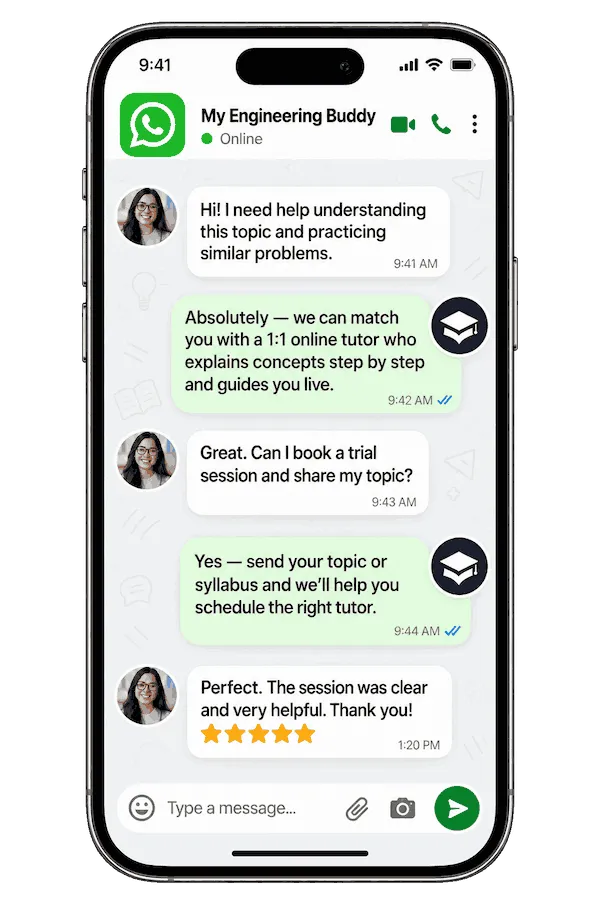
WhatsApp MEB for a quick quote — average response time under 1 minute.
Who This International Taxation Tutoring Is For
International tax sits at the intersection of law, policy, and finance. It’s taught differently across LLM programs, MBA concentrations, and professional qualifications — and the content rarely maps neatly onto a single textbook. Students who struggle here usually aren’t struggling with tax as a concept; they’re struggling with how frameworks interact across jurisdictions.
- LLM and JD students working through treaty interpretation, residency rules, or source-of-income analysis at institutions such as NYU, Georgetown, King’s College London, or Melbourne Law School
- MBA students covering international tax in finance or accounting concentrations at schools such as Wharton, London Business School, or INSEAD
- Students retaking a failed international tax module and needing to close specific gaps before the resit
- Candidates preparing for professional exams with an international tax component, including CPA, ATT, CTA, or ADIT
- Graduate students with a dissertation or research paper touching on BEPS, double taxation, or transfer pricing who need structured academic guidance
- Finance and accounting professionals returning to study who need to bridge theory and applied treaty knowledge
1:1 Tutoring vs Self-Study vs AI Tools
Self-study works up to a point — the OECD Model Convention and national commentary are publicly available, and motivated students read widely. But international tax is built on exceptions, treaty overrides, and jurisdiction-specific deviations that are easy to miss when there’s no one to check your reasoning. AI tools can summarise the OECD guidelines or explain Subpart F at a surface level, but they cannot walk through your specific fact pattern, flag where your treaty analysis has gone wrong, or apply the correct tie-breaker rule to the scenario on your assignment. Real-time human instruction matters here precisely because the errors in international tax are usually not definitional — they’re structural, in how a student frames the analysis. MEB gives you online flexibility with a feedback loop calibrated to your exact course material and exam format.
Outcomes: What You’ll Be Able To Do in International Taxation
After working with an International Taxation tutor at MEB, you’ll be able to apply the OECD Model Convention’s residence and source rules to multi-party cross-border transactions. You’ll analyze permanent establishment exposure under Articles 5 and 7 with confidence. Explain the interaction between domestic anti-avoidance rules and bilateral tax treaties in specific country pairs. Solve transfer pricing scenarios using the arm’s length standard across the five OECD-recognised methods. Write structured tax opinion memoranda that identify the correct treaty article, apply it to the facts, and reach a defensible conclusion under time pressure.
Based on feedback from 40,000+ sessions collected by MEB from 2022 to 2025, 58% of students improved by one full grade after approximately 20 hours of 1:1 tutoring in a single subject. A further 23% achieved at least a half-grade improvement.
Source: MEB session feedback data, 2022–2025.
Try your first session for $1 — 30 minutes of live 1:1 tutoring or one homework question explained in full. No registration. No commitment. WhatsApp MEB now and get matched within the hour.
What We Cover in International Taxation (Syllabus / Topics)
MEB tutors cover the full scope of international tax as taught in LLM, JD, MBA, and professional certification programmes. Sessions are built around your specific course outline, not a generic syllabus.

Tax Treaties and the OECD Model Convention
- Structure and interpretation of bilateral tax treaties
- Residence rules under Article 4 and tie-breaker provisions
- Permanent establishment: Articles 5 and 7, agency PE, digital PE
- Withholding taxes on dividends, interest, and royalties (Articles 10–12)
- Methods for eliminating double taxation: exemption vs credit (Articles 23A and 23B)
- The UN Model Convention and how it differs from the OECD approach
- Treaty shopping, limitation on benefits, and principal purpose test
Core texts include Klaus Vogel on Double Taxation Conventions, the OECD Model Tax Convention on Income and on Capital (updated commentary), and Dagan’s International Tax Law.
Transfer Pricing
- The arm’s length standard under Article 9 and OECD Chapter I guidelines
- The five transfer pricing methods: CUP, cost-plus, resale price, TNMM, profit split
- Comparability analysis and functional analysis frameworks
- Intangibles: DEMPE functions and the post-BEPS approach under Chapter VI
- Advance pricing agreements and dispute resolution mechanisms
- Country-by-country reporting obligations under BEPS Action 13
Key references include the OECD Transfer Pricing Guidelines for Multinational Enterprises and Tax Administrations (2022 edition) and Feinschreiber’s Transfer Pricing Methods.
BEPS, Anti-Avoidance, and US International Tax Rules
- BEPS project: 15 action plans, their status, and implementation across jurisdictions
- Pillar One and Pillar Two — global minimum tax framework (15%)
- US Subpart F income, GILTI, FDII, and BEAT rules post-TCJA 2017
- CFC regimes across the UK, EU, Australia, Canada, and Gulf states
- Domestic anti-avoidance rules and treaty override scenarios
- EU state aid cases and their impact on MNE tax planning
Recommended reading includes Bittker and Lokken’s Federal Taxation of Income, Estates and Gifts and the IBFD’s Global Tax Treaty Commentaries.
What a Typical International Taxation Session Looks Like
Your tutor opens by checking where you got stuck on the previous topic — often the interaction between treaty residence rules and domestic sourcing provisions. From there, you work through a live fact pattern together: the tutor annotates the relevant treaty articles on screen, walks through the analysis step by step using a digital pen-pad, and asks you to apply the same logic to a modified scenario before moving on. If you’re working on a transfer pricing problem, the tutor will run through the functional analysis framework with you, identify which method applies and why, and then have you draft the reasoning in your own words. The session ends with one or two targeted practice questions and a note on which treaty articles or BEPS action plans to review before next time.
How MEB Tutors Help You with International Taxation (The Learning Loop)
Diagnose: In the first session, the tutor identifies exactly where the breakdown is — whether it’s treaty interpretation, PE analysis, transfer pricing method selection, or applying BEPS rules to a specific fact pattern. Not a general assessment. A specific one.
Explain: The tutor works through a problem live using a digital pen-pad, showing the full analytical sequence — which article, which test, which outcome, and why — rather than just giving you the answer.
Practice: You attempt a parallel problem while the tutor watches. This is where most learning happens. Errors surface immediately rather than weeks later in marked work.
Feedback: The tutor goes through every step of your attempt — not just the conclusion but the structure of the analysis, the order of the arguments, and the exact points where marks would be lost in an exam or assignment.
Plan: At the end of each session, the tutor sets a specific task — one treaty to re-read, one past question to attempt, one BEPS action plan to summarise — and notes what the next session will cover. Progress is tracked.
Sessions run over Google Meet with a digital pen-pad or iPad and Apple Pencil for annotating treaty text and working through scenarios. Before your first session, send your course outline, the assignment or past paper you’ve been working on, and your deadline. Start with the $1 trial — 30 minutes of live tutoring that also serves as your first diagnostic.
At MEB, we’ve found that international tax students make the most progress when they stop trying to memorise rules and start practising treaty analysis on real fact patterns — even imperfect attempts with tutor correction outperform passive re-reading by a wide margin.
Tutor Match Criteria (How We Pick Your Tutor)
Not every tax tutor knows international tax. MEB matches on criteria that actually matter for this subject.
Subject depth: Tutors hold graduate-level qualifications in tax law, international law, or accounting — LLM, JD, or CTA-equivalent. They know the difference between the OECD and UN models, and they’ve worked through BEPS implementation in specific jurisdictions.
Tools: Every session uses Google Meet with a digital pen-pad or iPad and Apple Pencil for annotating treaty articles and working through problems in real time.
Time zone: MEB covers New York, Los Angeles, Chicago, London, Dubai, Toronto, Sydney, Melbourne, and all major European time zones — including evenings and weekends.
Learning style: The tutor calibrates pace and depth from the first session. Some students need conceptual grounding first; others are exam-ready and need case-by-case drilling.
Communication: Clear, direct English adapted to graduate academic register — appropriate for LLM assignments and professional exam answers alike.
Goals: Whether you need to pass a resit, finish an assignment, or build systematic knowledge across a full course, the tutor structures sessions accordingly.
Unlike platforms where you fill out a form and wait, MEB responds in under a minute, 24/7. Tutor match takes under an hour. The $1 trial means you test before you commit. Everything runs over WhatsApp — no logins, no intake forms.
Study Plans (Pick One That Matches Your Goal)
If you’re two weeks out from a resit, the tutor focuses on your weakest treaty topics and high-yield exam questions — fast and targeted. For a structured 4–8 week exam prep plan, sessions follow the syllabus in sequence with practice questions built in throughout. Ongoing weekly support tracks your coursework calendar, picking up new topics as your module progresses. After the diagnostic session, the tutor maps the exact sequence for your situation. No generic plans.
Pricing Guide
International Taxation tutoring starts at $30/hr for most graduate coursework and rises to $60–$100/hr for niche specialist topics, professional exam preparation, or research-level support. Rate depends on the complexity of the material, the level of the course, your timeline, and tutor availability.
For students targeting top LLM programmes, professional certifications such as the ADIT or CTA, or roles at Big Four firms and international tax practices, tutors with professional advisory and research backgrounds are available at higher rates — share your specific goal and MEB will match the tier to your need.
Start with the $1 trial — 30 minutes, no registration, no commitment. WhatsApp MEB for a quick quote.
FAQ
Is International Taxation hard?
It’s genuinely difficult. The rules interact across multiple jurisdictions, and the same transaction can produce different outcomes depending on which treaty applies. Most students find treaty interpretation and transfer pricing the steepest parts. A good tutor makes the structure visible, which is most of the battle.
How many sessions do I need?
For a specific assignment or exam question, two to four sessions is typical. For a full module or exam prep across multiple topics, most students work with their tutor weekly across four to eight weeks. The diagnostic in the first session makes this clearer.
Can you help with homework and assignments in International Taxation?
Yes — the tutor works through the analysis with you, explains the reasoning, and helps you understand what a complete answer looks like. You write and submit your own work. MEB tutoring is guided learning — you understand the work, then submit it yourself. For full details on what we help with and what we don’t, read our Academic Integrity policy and Why MEB.
Will the tutor match my exact syllabus or exam board?
Yes. MEB asks for your course outline, institution, and assessment format before matching you. Whether your course follows the OECD framework, US federal international tax rules, EU tax law, or a hybrid approach, the tutor is matched to that specific content.
What happens in the first session?
The tutor reviews your course outline, any assignment or past paper you’ve shared, and asks you a few targeted questions. From that, they identify the specific gaps and map out the session sequence. The first session is both diagnostic and productive — you’ll cover real content.
Is online tutoring as effective as in-person for International Taxation?
For a subject that works primarily with text — treaty articles, case law, OECD guidelines — online annotation and screen-based work is at least as effective as in-person. The digital pen-pad lets tutors annotate treaty text in real time, which is arguably more precise than whiteboard work.
Can I get help with International Taxation at midnight or over a weekend?
Yes. MEB operates 24/7. WhatsApp response typically comes in under a minute regardless of time. Tutors are available across US, UK, Gulf, and Australian time zones, including evenings and weekends — useful when assignment deadlines don’t keep office hours.
Do you cover BEPS and Pillar Two specifically?
Yes. Tutors cover the full BEPS project — all 15 action plans — as well as Pillar One and Pillar Two implementation, GILTI, FDII, and BEAT under the US TCJA. If your course covers a specific BEPS action plan in depth, tell MEB and the tutor will be matched accordingly.
What if I don’t connect with my assigned tutor?
Tell MEB via WhatsApp and a new tutor is matched — usually within the hour. There’s no process to follow, no form to fill out. It’s a direct message and MEB handles the rest. The $1 trial exists specifically so you can test the fit before committing to a full rate.
How do I get started?
Message MEB on WhatsApp. You’ll be matched with a verified International Taxation tutor, usually within the hour. The $1 trial covers 30 minutes of live tutoring or one full question explained from start to finish. No registration. No commitment. Three steps: WhatsApp, get matched, start your trial.
Trust & Quality at My Engineering Buddy
Every MEB tutor goes through subject-specific screening — not a general skills test. For International Taxation, that means demonstrating working knowledge of treaty interpretation, transfer pricing methodology, and BEPS implementation, not just broad tax awareness. Tutors are evaluated through a live demo session before being accepted, and ongoing session feedback determines whether they continue on the platform. Rated 4.8/5 across 40,000+ verified reviews on Google.
MEB tutoring is guided learning — you understand the work, then submit it yourself. For full details on what we help with and what we don’t, read our Academic Integrity policy. Our tutoring methodology explains the diagnostic-to-practice structure used across all subjects.
MEB has served 52,000+ students in the US, UK, Canada, Australia, Gulf, and Europe across 2,800+ subjects since 2008. Students working through related areas often get support with corporate taxation tutoring, transfer pricing help, and tax law tutoring alongside their international tax coursework.
MEB has operated since 2008. That’s 17 years of tutor screening, session feedback, and syllabus tracking across 2,800+ subjects — in every major time zone, at every academic level, from first-year undergraduate to doctoral research.
Source: My Engineering Buddy, 2008–2025.
Students consistently tell us that the biggest shift happens when they stop reading around international tax and start working through structured fact patterns with someone who can immediately tell them where the analysis breaks down and exactly why.
Explore Related Subjects
Students studying International Taxation often also need support in:
- Taxation
- Tax Accounting
- Income Tax Accounting
- International Financial Reporting Standards (IFRS)
- International Accounting Standards (IAS)
- Advanced Auditing Techniques
- Financial Reporting
Next Steps
Getting started takes about two minutes. Here’s what to have ready before your first session:
- Your course outline or exam syllabus — and the specific module or topic giving you trouble
- A recent assignment attempt, past paper question, or homework problem you struggled with
- Your exam date or submission deadline, and your available time slots
MEB matches you with a verified International Taxation tutor — usually within 24 hours, often within the hour. The first session starts with a diagnostic so no time is spent on material you already know.
Visit www.wto.org for reference on international trade and tax treaty frameworks. For everything on how MEB works, visit www.myengineeringbuddy.com.
WhatsApp to get started or email [email protected].
A common pattern our tutors observe is that students who share a specific past paper attempt before the first session make faster progress than those who arrive without one — the diagnostic starts before the session does.
Source: My Engineering Buddy tutor feedback, 2022–2025.
Reviewed by Subject Expert
This page has been carefully reviewed and validated by our subject expert to ensure accuracy and relevance.




