~1 min
Average Reply Time
~1 hour
To Be Matched With A Tutor
30 Min Trial
75% Find Their Tutor On The 1st Trial
$20-35+/hr
Premium Yet Affordable Learning
Hire The Best Corporate Taxation Tutor



Most students lose marks on deferred tax and transfer pricing — not because they didn’t study, but because nobody showed them the logic step by step.
Corporate Taxation Tutor Online
Corporate taxation covers the rules, calculations, and reporting obligations that determine how companies are taxed on their profits. Studied at undergraduate and postgraduate level, it equips students to apply tax codes, compute liabilities, and advise on compliance — skills central to accounting and finance careers.
MEB provides 1:1 online tutoring and homework help across 2,800+ advanced subjects. If you’ve searched for a Corporate Taxation tutor near me, you’re in the right place — our tutors work with students across US, UK, Canada, Australia, and the Gulf, covering everything from deferred tax accounting to international tax treaties. Sessions are structured around your course, not a generic curriculum.
- 1:1 online sessions tailored to your university course or professional syllabus
- Expert verified tutors with subject-specific knowledge in corporate and business taxation
- Flexible time zones — US, UK, Canada, Australia, Gulf covered
- Structured learning plan built after a diagnostic session
- Ethical homework and assignment guidance — you understand the work before you submit it
52,000+ students across the US, UK, Canada, Australia, and the Gulf have used MEB since 2008 — across 2,800+ subjects, from AP Calculus to A Level Music Technology to Data Science.
Source: My Engineering Buddy, 2008–2025.
How Much Does a Corporate Taxation Tutor Cost?
Most Corporate Taxation tutoring sessions run $20–$40/hr. Graduate-level or specialist topics — transfer pricing, international tax, or deferred tax modelling — can reach up to $100/hr depending on tutor background. A $1 trial gets you 30 minutes of live 1:1 tutoring or one homework question explained in full.
| Level / Need | Typical Rate | What’s Included |
|---|---|---|
| Undergraduate (most courses) | $20–$35/hr | 1:1 sessions, homework guidance |
| Graduate / Specialist | $40–$100/hr | Expert tutor, advanced topics |
| $1 Trial | $1 flat | 30 min live session or 1 homework question |
Tutor availability tightens during end-of-semester exam periods. Book early if your submission or exam date is within six weeks.
WhatsApp MEB for a quick quote — average response time under 1 minute.
Who This Corporate Taxation Tutoring Is For
Corporate taxation draws students from accounting, finance, law, and business programmes. The material is technical, jurisdiction-specific, and often poorly explained in lectures. These are the students MEB tutors most often.
- Undergraduate accounting or finance students whose corporate tax module is heavier than expected
- Students with a university conditional offer depending on this grade — and weeks, not months, to close the gap
- Postgraduate students working through advanced tax law, international structures, or consolidated group tax computations
- Students preparing for professional exams at bodies such as ACCA, CPA Australia, ICAEW, or CFA Institute where taxation forms a major component
- Students who need tax accounting homework help aligned to their exact course textbook and assessment criteria
- Parents supporting an undergraduate student whose grade in this module affects their degree classification
Students at programmes such as London School of Economics, University of Toronto, University of Melbourne, NYU Stern, ESADE, and Maastricht University have all used MEB for corporate tax support.
1:1 Tutoring vs Self-Study vs AI Tools
Self-study works for straightforward topics, but corporate taxation involves layered rules — thin capitalisation, CFC provisions, deferred tax recognition — where reading the same paragraph twice rarely fixes the gap. AI tools can define terms quickly, but they cannot watch you attempt a group relief computation, spot where your logic breaks, and correct it live on screen. They also cannot tell you which exam board’s approach your university follows, or why a particular mark scheme awards partial credit the way it does. An online Corporate Taxation tutor trained on your specific syllabus does all of that in real time — and the feedback lands differently when a person is walking you through it rather than generating text at you.
Outcomes: What You’ll Be Able To Do in Corporate Taxation
After structured sessions with an MEB tutor, students can apply the current-year and deferred tax computation process accurately under both GAAP and IFRS frameworks. They can analyse group structures to identify available loss relief and explain the conditions that restrict it. Students learn to model the tax impact of financing decisions — debt vs equity, thin capitalisation limits, interest deductibility rules. They can write coherent advice-style answers for exam questions on anti-avoidance provisions, transfer pricing documentation requirements, and controlled foreign corporation rules. And they present their workings in a format that earns marks, not just reaches the right number.
Supporting a student through Corporate Taxation? MEB works directly with parents to set up sessions, track progress, and keep coursework on schedule. WhatsApp MEB — average response time is under a minute, 24/7.
Based on feedback from 40,000+ sessions collected by MEB from 2022 to 2025, 58% of students improved by one full grade after approximately 20 hours of 1:1 tutoring in a single subject. A further 23% achieved at least a half-grade improvement.
Source: MEB session feedback data, 2022–2025.
What We Cover in Corporate Taxation (Syllabus / Topics)

Track 1: Corporate Tax Computation and Compliance
- Taxable profit vs accounting profit — permanent and temporary differences
- Current tax calculation: rate application, reliefs, and adjusted trading profit
- Deferred tax assets and liabilities under IAS 12 and ASC 740
- Loss relief — carry-forward, carry-back, group relief provisions
- Capital allowances: writing-down allowances, annual investment allowance
- Corporation tax return preparation and filing obligations
Core texts include Taxation: Finance Act by Alan Melville and South-Western Federal Taxation by Young, Persellin, and Nellen — confirm the edition your course specifies.
Track 2: International and Group Taxation
- Controlled foreign corporation (CFC) rules and attribution of income
- Transfer pricing: arm’s length principle, documentation standards, OECD guidelines
- Thin capitalisation and interest deductibility limits (BEPS Action 4)
- Double tax treaties: relief methods, permanent establishment definitions
- Tax consolidation and group payment elections
- Pillar Two global minimum tax (15%) — basics and scope
- Get international taxation tutoring if your course covers cross-border structures in depth
Useful references include International Taxation in a Nutshell by Mindy Herzfeld and the NBER working paper series on corporate tax policy and multinational profit shifting.
Track 3: Tax Accounting and Reporting
- Effective tax rate (ETR) analysis and reconciliation disclosures
- Uncertain tax positions and FIN 48 / IFRIC 23 provisions
- Tax provision process: current and deferred components
- Valuation allowances on deferred tax assets
- Tax footnote disclosures in annual reports
- Students covering reporting standards also benefit from IFRS tutoring
Key texts include Intermediate Accounting by Kieso, Weygandt, and Warfield and Accounting for Income Taxes by PwC’s Viewpoint guide.
At MEB, we’ve found that corporate taxation clicks fastest when students stop memorising rules and start tracing the cash. Once a student can explain why a deferred tax liability arises on an accelerated depreciation difference — without looking at their notes — everything else follows from that logic.
What a Typical Corporate Taxation Session Looks Like
The tutor opens by checking the previous topic — usually deferred tax recognition or a group relief computation the student attempted between sessions. They pull up the student’s working on screen. From there, the session moves to the current problem: often a multi-part exam question involving thin capitalisation or a CFC attribution calculation. The tutor uses a digital pen-pad to annotate the question, walks through the statutory logic step by step, then hands control back. The student replicates the working and explains each figure aloud. The tutor corrects silently at first, then explains the error if the student can’t find it. The session closes with a specific practice task — two past exam questions on the same topic — and the next topic flagged: usually transfer pricing documentation or the Pillar Two GloBE rules.
How MEB Tutors Help You with Corporate Taxation (The Learning Loop)
Diagnose: In the first session, the tutor asks you to attempt a short tax computation from scratch — no notes. This shows exactly where the logic breaks: whether it’s at the temporary difference stage, at loss relief ordering, or at the ETR reconciliation. That diagnosis sets the session sequence.
Explain: The tutor works through a representative problem live, using a digital pen-pad. Every line of a tax computation has a reason. The tutor states it, connects it to the statutory rule, and checks whether the student can repeat the reasoning — not just copy the number.
Practice: The student attempts the next problem while the tutor watches. No interruptions until the student signals they’re stuck or completes the working. Real exam pressure, real feedback.
Feedback: The tutor identifies each error, explains what mark scheme logic penalises it, and shows the correction. “You got the right liability but for the wrong reason” is a common finding — and it matters for exam technique.
Plan: At the end of each session, the tutor logs what was covered, what still needs work, and what to attempt before next time. Students who follow this sequence close gaps faster than those who re-read lecture slides.
Sessions run over Google Meet with a digital pen-pad or iPad and Apple Pencil for annotating workings. Before your first session, share your course outline or module guide. The first session covers your diagnostic and the highest-priority topic — usually deferred tax or whichever component carries the most exam marks. Start with the $1 trial — 30 minutes of live tutoring that also serves as your first diagnostic.
Students consistently tell us that the moment they understand deferred tax isn’t a cash movement but a timing difference in recognition — the rest of the tax provision stops feeling arbitrary. That shift usually happens in one well-run session, not a semester of reading.
Tutor Match Criteria (How We Pick Your Tutor)
Not every tutor who knows tax is the right fit for your course. Here’s what MEB checks before matching.
Subject depth: The tutor must have direct experience with your level — undergraduate, postgraduate, or professional exam — and your jurisdiction’s tax rules (US federal, UK corporation tax, Australian company tax, EU frameworks).
Tools: All sessions use Google Meet. The tutor uses a digital pen-pad or iPad and Apple Pencil for annotating computations in real time — essential for tax workings where column layout matters.
Time zone: Tutors are matched across New York, Los Angeles, London, Dubai, Toronto, Sydney, and Melbourne time zones, including evenings and weekends.
Learning style: Calibrated from the first session — some students need the rule stated before the example; others need the example first. The tutor adjusts after seeing you attempt one problem.
Communication: Clear English, adapted to your level. No jargon without explanation. No assumption you’ve already understood the prerequisite.
Goals: Whether your target is exam pass, homework completion, or conceptual depth for dissertation research, the tutor shapes the session accordingly. Students needing broader support can also get online taxation tutoring covering related areas alongside corporate tax.
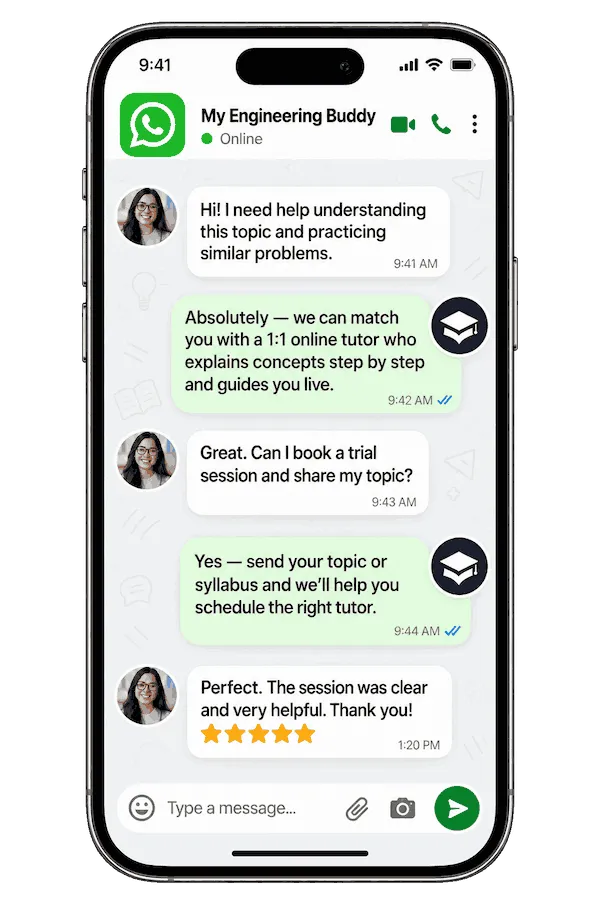
Unlike platforms where you fill out a form and wait, MEB responds in under a minute, 24/7. Tutor match takes under an hour. The $1 trial means you test before you commit. Everything runs over WhatsApp — no logins, no intake forms.
Study Plans (Pick One That Matches Your Goal)
After the diagnostic, the tutor builds a specific session sequence. Three common structures: a catch-up plan covering the highest-priority gaps in 1–3 weeks before a submission deadline; an exam prep plan running 4–8 weeks through topic-by-topic revision with past paper practice; or ongoing weekly support aligned to your semester schedule, keeping pace with new lecture content as it lands. The plan is rebuilt if your exam date changes or a new topic proves harder than expected.
Pricing Guide
Corporate Taxation tutoring starts at $20/hr for most undergraduate-level courses. Advanced topics — group tax, transfer pricing, international structures, tax provision modelling — typically run $40–$100/hr depending on tutor depth and timeline pressure.
Rate factors include: topic complexity, your level of study, how quickly you need results, and tutor availability. Rates tighten during peak exam periods when demand is highest.
For students targeting Big Four advisory roles, postgraduate tax programmes, or professional certification bodies such as ACCA or ICAEW, tutors with professional tax practice backgrounds are available at higher rates — share your specific goal and MEB will match the tier to your target.
Start with the $1 trial — 30 minutes, no registration, no commitment. WhatsApp MEB for a quick quote.
FAQ
Is Corporate Taxation hard?
It depends on your prior accounting background. Students who are comfortable with accruals accounting usually find the computation logic manageable. The international layer — CFCs, transfer pricing, treaty application — is where most find it genuinely difficult without structured help.
How many sessions do I need?
Students with specific exam gaps typically need 6–12 sessions. Those building from a weak foundation across a full semester often use 15–20 hours total. The diagnostic session sets a more precise estimate once the tutor has seen your current level.
Can you help with homework and assignments?
Yes — MEB tutors explain the concepts and guide your reasoning so you can complete the work yourself. MEB tutoring is guided learning — you understand the work, then submit it yourself. For full details on what we help with and what we don’t, read our Academic Integrity policy and Why MEB.
Will the tutor match my exact syllabus or exam board?
Yes. MEB matches tutors to your specific course, jurisdiction, and assessment format — whether that’s a UK university corporate tax module, a US federal tax course using a named textbook, or an ACCA/ICAEW paper. Share your module guide at booking and the tutor prepares accordingly.
What happens in the first session?
The tutor asks you to attempt a short problem — unaided — to locate exactly where your understanding breaks. That diagnostic takes about 15 minutes. The remainder of the session covers the highest-priority topic identified. No time is spent on material you’ve already mastered.
Is online tutoring as effective as in-person?
For computational subjects like corporate tax, yes. The digital pen-pad replicates whiteboard annotation. Students see the tutor work through a computation line by line, then replicate it on screen. The feedback loop is identical to sitting next to someone — and sessions can happen at midnight if needed.
Can I get Corporate Taxation help at midnight or on weekends?
Yes. MEB operates 24/7. Tutors are available across all major time zones, including evenings and weekends. WhatsApp MEB at any hour — the average first response is under one minute, and tutor matching typically takes under an hour.
What if I don’t get on with my assigned tutor?
Request a different tutor via WhatsApp. No forms, no explanation required. MEB will match you with someone else, usually within the hour. The $1 trial exists precisely so you can test the match before committing to a full package.
Do you cover transfer pricing specifically, or only basic corporate tax?
Both. MEB has tutors covering transfer pricing documentation, the arm’s length standard, OECD BEPS guidelines, and country-by-country reporting. Students needing this depth often also use transfer pricing tutoring as a standalone subject.
How do I get started?
Three steps: WhatsApp MEB with your course and timeline, get matched with a verified tutor in under an hour, then start your $1 trial — 30 minutes of live tutoring or one homework question explained in full. No registration. No upfront commitment beyond one dollar.
MEB tutors work across 2,800+ advanced subjects — from Financial Reporting and IFRS to Transfer Pricing and International Tax — matching each student to a tutor who knows their specific course, not just the general subject area.
Source: My Engineering Buddy, 2008–2025.
Trust & Quality at My Engineering Buddy
Every MEB tutor goes through subject-specific vetting: a credentials check, a live demo session evaluated for explanation quality, and an ongoing review process based on student feedback after each session. Tutors hold degrees in accounting, finance, tax law, or related fields — many have professional practice experience at advisory firms or in-house tax teams. Rated 4.8/5 across 40,000+ verified reviews on Google.
MEB tutoring is guided learning — you understand the work, then submit it yourself. For full details on what we help with and what we don’t, read our Academic Integrity policy and Why MEB.
MEB has served 52,000+ students across the US, UK, Canada, Australia, the Gulf, and Europe since 2008 — across 2,800+ subjects. Students needing support beyond corporate tax often use MEB for financial accounting tutoring, auditing homework help, and financial reporting tutoring. See MEB’s tutoring methodology for how sessions are structured across all subjects.
A common pattern our tutors observe is that students who struggle with corporate tax aren’t struggling with tax — they’re struggling with the accounting entries underneath it. Fix the deferred tax journal entry logic first. The rest of the computation falls into place.
Since 2008, MEB has matched students with tutors in over 2,800 subjects — with tutor matching in under an hour, a $1 trial before any commitment, and 24/7 availability across every major time zone.
Source: My Engineering Buddy, 2008–2025.
Explore Related Subjects
Students studying Corporate Taxation often also need support in:
- Tax Law
- Income Tax Accounting
- Advanced Accounting
- Corporate Governance
- Financial Statement Analysis
- Managerial Accounting
- Cost Accounting
Next Steps
Getting started takes under five minutes. Have these ready:
- Your exam board, course outline, or professional certification paper name
- A recent past paper attempt or a homework question you’re stuck on
- Your exam date or submission deadline and your available time slots
MEB matches you with a verified Corporate Taxation tutor — usually within 24 hours, often within the hour. The first session starts with a diagnostic so every minute is used on what you actually need. Visit www.myengineeringbuddy.com for more on how the MEB process works.
WhatsApp to get started or email [email protected].
Reviewed by Subject Expert
This page has been carefully reviewed and validated by our subject expert to ensure accuracy and relevance.