




~1 min
Average Reply Time
~1 hour
To Be Matched With A Tutor
30 Min Trial
75% Find Their Tutor On The 1st Trial
$20-35+/hr
Premium Yet Affordable Learning
Most students don’t fail Children’s Literature because the books are hard. They fail because no one has shown them how to build an argument from a text in under exam conditions.
Children’s Literature Tutor Online
Children’s Literature is the academic study of prose, poetry, and picture books written for young audiences, examined across literary periods, narrative theory, and cultural context, equipping students to analyse texts, evaluate authorial choices, and construct critical arguments.
MEB provides 1:1 online tutoring and academic guidance in 2800+ advanced subjects, including Children’s Literature and the broader field of literature tutoring. Whether you’re stuck on close reading, struggling with essay structure, or need to close gaps fast before a deadline, a Children’s Literature tutor near me — or anywhere online — can make the difference between a muddled paragraph and a well-evidenced argument. MEB tutors have worked through the specific texts and frameworks your course uses, not just the genre in general.
- 1:1 online sessions tailored to your course syllabus and set texts
- Expert-verified tutors with subject-specific knowledge of children’s and YA literature
- Flexible time zones — US, UK, Canada, Australia, Gulf
- Structured learning plan built after a diagnostic session
- Ethical academic guidance — you understand the argument before you submit it
52,000+ students across the US, UK, Canada, Australia, and the Gulf have used MEB since 2008 — including students in Literature subjects like Children’s Literature, Comparative Literature, and Literary Analysis.
Source: My Engineering Buddy, 2008–2025.
How Much Does a Children’s Literature Tutor Cost?
Most Children’s Literature tutoring sessions run $20–$40/hr. Graduate-level or highly specialised work can reach $100/hr. The $1 trial gives you 30 minutes of live 1:1 tutoring or a full explanation of one homework question before you commit to anything further.
| Level / Need | Typical Rate | What’s Included |
|---|---|---|
| Standard (most undergrad levels) | $20–$35/hr | 1:1 sessions, essay and homework guidance |
| Advanced / Graduate-level | $35–$70/hr | Expert tutor, research depth, thesis support |
| $1 Trial | $1 flat | 30 min live session or 1 homework question explained |
Tutor availability tightens around essay submission windows and end-of-semester deadlines. Book early if you’re approaching a crunch point.
WhatsApp MEB for a quick quote — average response time under 1 minute.
Who This Children’s Literature Tutoring Is For
Children’s Literature sits at an intersection that catches students off-guard: it looks approachable because the texts are written for young readers, but the critical frameworks expected at university level are just as demanding as any other literature course. Students often underestimate the analytical rigour required.
- Undergraduates taking a Children’s Literature module as part of an English or Education degree
- Students retaking after a failed first attempt who need to rebuild their essay-writing approach from the ground up
- Students with a university conditional offer depending on this grade
- Graduate students writing a thesis or extended paper on children’s texts, picturebooks, or young adult fiction
- Students struggling to apply theory — Lacanian psychoanalysis, postcolonial critique, ecocriticism — to texts marketed as simple
- Parents watching a child’s confidence drop alongside their grades in a subject everyone assumed would be the easy one
MEB tutors have worked with students at institutions including Oxford, Cambridge, NYU, UCLA, the University of Toronto, the University of Sydney, Durham, and Edinburgh — children’s literature programmes at all of these carry serious academic weight.
At MEB, we’ve found that students who struggle with Children’s Literature essays almost always have the same core issue: they summarise the plot or describe the illustrations instead of building a critical claim. One session spent restructuring a single paragraph usually shifts that habit faster than a semester of written feedback.
1:1 Tutoring vs Self-Study vs AI vs YouTube vs Online Courses
Self-study works if you’re disciplined, but no one tells you when your thesis statement is circular. AI tools generate plausible-sounding literary analysis that is often wrong about specific texts or theoretical nuances. YouTube gives solid genre overviews but stops when you’re stuck on why a particular picturebook’s visual grammar matters to your argument. Online courses move at a fixed pace regardless of whether you’ve actually understood Hollindale’s concept of ideology in children’s books. 1:1 tutoring with MEB is live, calibrated to your exact syllabus and set texts, and corrects your reasoning in the moment — not three days later on a marked essay.
Outcomes: What You’ll Be Able To Do in Children’s Literature
After working with a Children’s Literature tutor through MEB, you’ll be able to analyse how picturebook artists use page turns, white space, and visual perspective to construct meaning independently of the written text. You’ll apply theoretical lenses — including postcolonial critique, gender theory, and ecocriticism — to texts ranging from Beatrix Potter to Malorie Blackman with precision. You’ll write structured close-reading arguments that move from textual evidence to theoretical claim without slipping into summary. You’ll explain how the implied reader functions in children’s texts, and how adults gatekeep reading choices through publishing and reviewing. You’ll present a defensible interpretation of a contested young adult novel under exam or seminar conditions.
Supporting a student through Children’s Literature? MEB works directly with parents to set up sessions, track progress, and keep coursework on schedule. WhatsApp MEB — average response time is under a minute, 24/7.
“Based on feedback from 40,000+ sessions collected by MEB from 2022 to 2025, 58% of students improved by one full grade after approximately 20 hours of 1:1 tutoring in subjects like Children’s Literature. A further 23% achieved at least a half-grade improvement.”
Source: MEB session feedback data, 2022–2025.
What We Cover in Children’s Literature (Syllabus / Topics)
Picture Books, Early Readers, and Visual Narrative
- The grammar of picturebooks: gutter, bleed, page turn, and framing
- Word-image relationships — symmetry, counterpoint, and irony
- Maurice Sendak, Anthony Browne, Shaun Tan: visual storytelling close reading
- The implied child reader and adult assumptions embedded in text
- Peritextual elements: covers, endpapers, dedications, and their meaning
- Ideology and innocence: Hollindale’s framework applied to contemporary texts
Core texts used in this track include Perry Nodelman’s The Hidden Adult, Lawrence Sipe and Sylvia Pantaleo’s Postmodern Picturebooks, and Maria Nikolajeva and Carole Scott’s How Picturebooks Work.
Children’s Fiction, Fantasy, and the Canon
- Golden Age children’s fiction: Carroll, Nesbit, Barrie, and their cultural context
- Secondary world fantasy: Tolkien, Lewis, Le Guin — world-building and ideology
- The school story as a genre: power, hierarchy, and social reproduction
- Animal stories and anthropomorphism in children’s texts
- Series fiction and the economics of children’s publishing
- Postcolonial rereading of canonical children’s texts
- Folklore and fairy tale traditions and their adaptation for child audiences
Recommended reading includes Jack Zipes’s Why Fairy Tales Stick, Kimberley Reynolds’s Children’s Literature: A Very Short Introduction from Oxford University Press, and Maria Nikolajeva’s Power, Voice and Subjectivity in Literature for Young Readers.
Young Adult Fiction, Critical Theory, and Contemporary Issues
- Defining YA: the crossover phenomenon and genre boundaries
- Identity, agency, and the YA protagonist: race, gender, sexuality
- Dystopian YA: The Hunger Games, Divergent, and political allegory
- Trauma narratives and the ethics of representing difficulty for young readers
- Diversity and representation debates in contemporary children’s publishing
- Applying Lacanian psychoanalysis and Foucauldian discourse analysis to YA texts
Tutors draw on Roberta Seelinger Trites’s Disturbing the Universe: Power and Repression in Adolescent Literature, Stephenie Harrison’s work on YA and identity, and course readers from leading English and Education programmes.

What a Typical Children’s Literature Session Looks Like
The tutor opens by checking where you got to last time — say, your attempt at a close reading of Anthony Browne’s use of surrealist imagery in Gorilla. You share your draft paragraph on screen. The tutor reads it, spots where you’ve described the illustration rather than analysed it, and works through the distinction live using a digital pen-pad, annotating the passage directly. Then you try a parallel analysis of a second spread on your own while the tutor watches. You explain your reasoning aloud. The tutor corrects the point where your argument slips from evidence into assertion. By the end of the session, you’ve got a working model for how to build a visual analysis paragraph, a note on the specific theoretical terms your course expects you to use, and a short passage to analyse independently before the next session.
How MEB Tutors Help You with Children’s Literature (The Learning Loop)
Diagnose: In the first session, the tutor identifies exactly where your reading breaks down — whether that’s selecting relevant textual evidence, applying theory correctly, structuring an argument, or understanding the distinction between narrator and implied author in children’s texts.
Explain: The tutor works through a model analysis on the digital pen-pad, annotating a passage in real time. You see how a strong literary claim is built from a textual detail, not from a general impression of the book.
Practice: You attempt the same analytical move on a different passage, with the tutor present. This is where the learning actually happens — not in watching, but in doing it while someone can catch your errors immediately.
Feedback: The tutor explains step by step where your reasoning slipped and why that costs marks. Not just “this is wrong” — but why the examiner or marker would penalise it and what the correct move looks like.
Plan: Each session ends with a specific task — one passage to annotate, one theoretical term to apply, one essay paragraph to draft — and a note of what the next session will cover.
Sessions run over Google Meet. Tutors use a digital pen-pad or iPad and Apple Pencil to annotate texts and model close-reading moves visually. Before your first session, share your course reading list or set texts, any recent essay feedback you’ve received, and your submission or exam date. The first session is also your diagnostic — start with the $1 trial and the tutor will use that 30 minutes to identify your most pressing gaps.
Try your first session for $1 — 30 minutes of live 1:1 tutoring or one homework question explained in full. No registration. No commitment. WhatsApp MEB now and get matched within the hour.
Tutor Match Criteria (How We Pick Your Tutor)
Not every literature tutor knows the specific demands of children’s and YA literature as an academic discipline. Here’s how MEB matches you.
Subject depth: Tutors are matched to your level — undergraduate survey, advanced seminar, or graduate research — and to your specific theoretical or period focus within children’s literature.
Tools: Every tutor uses Google Meet with a digital pen-pad or iPad and Apple Pencil for annotation work on texts.
Time zone: Matched to your region — US Eastern through to Gulf Standard Time, with UK and Australian tutors available through their respective working hours.
Goals: Whether you need essay structure help, theoretical application, close reading fluency, or support with a dissertation chapter, the tutor is briefed on your specific goal before the first session.
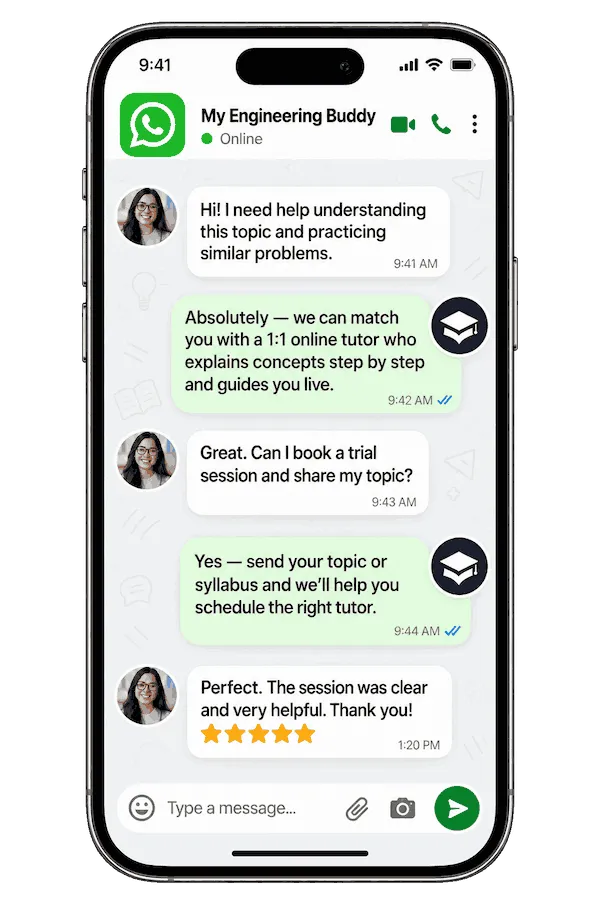
Unlike platforms where you fill out a form and wait, MEB responds in under a minute, 24/7. Tutor match takes under an hour. The $1 trial means you test before you commit. Everything runs over WhatsApp — no logins, no intake forms.
Students who get a tutor matched specifically to their theoretical focus — postcolonial, psychoanalytic, ecocritical — consistently report clearer, more confident essay arguments within three to four sessions.
Source: My Engineering Buddy, tutor match feedback, 2022–2025.
Study Plans (Pick One That Matches Your Goal)
The right plan depends on how much time you have and where the gaps are. A catch-up plan (1–3 weeks) targets the specific essays or seminar presentations you’re failing right now. An exam prep plan (4–8 weeks) builds systematically through the theoretical frameworks and set texts your paper will assess. Ongoing weekly support follows your semester schedule, aligned to submission deadlines for coursework and extended essays on children’s literature. The tutor builds the exact sequence after the first diagnostic — nothing is assumed before that session.
Pricing Guide
Children’s Literature tutoring runs $20–$40/hr for most undergraduate levels. Graduate-level support, dissertation chapter review, and highly specialised theoretical work can reach $100/hr. Rate factors include the level of your course, the complexity of the theoretical frameworks involved, your timeline, and tutor availability.
For students targeting graduate programmes at institutions with strong children’s literature research cultures — or applying for doctoral work in children’s media, education, or literary studies — tutors with postgraduate research backgrounds in the field are available at higher rates. Share your specific goal and MEB will match the tier to your ambition.
Availability tightens significantly in the weeks before essay submission deadlines. Book earlier than you think you need to.
Start with the $1 trial — 30 minutes, no registration, no commitment. WhatsApp MEB for a quick quote.
FAQ
Is Children’s Literature hard?
Harder than most students expect. The texts are written for children, but the critical frameworks expected at degree level — narrative theory, psychoanalysis, postcolonial critique — are as demanding as any other literature course. The gap between reading a picturebook and analysing it academically is where most students struggle.
How many sessions are needed?
Students closing a specific essay gap typically see results in 3–5 sessions. Those building from a weak foundation across a full semester usually benefit from weekly sessions over 8–12 weeks. The tutor maps the plan after the first diagnostic.
Can you help with homework and assignments?
MEB tutoring is guided learning — you understand the argument and the analytical approach, then write and submit your own work. See our Academic Integrity policy and Why MEB page for full details on what we help with and what we don’t.
Will the tutor match my exact syllabus or exam board?
Yes. Before matching, MEB asks for your course details, set texts, and theoretical frameworks. Tutors are selected based on familiarity with your specific reading list and assessment format — not just familiarity with children’s literature as a general field.
What happens in the first session?
The tutor runs a diagnostic: they ask you to explain a recent essay question, walk through your current reading approach, and identify where your analysis breaks down. The session immediately starts addressing those gaps. Nothing is wasted on generic introductions.
Is online tutoring as effective as in-person?
For literature subjects, yes — often more so. Screen sharing, live text annotation with a digital pen-pad, and the ability to pull up passages, theoretical texts, or essay rubrics instantly makes the online format well-suited to close reading work in Children’s Literature.
Can I get Children’s Literature help at midnight or on weekends?
Yes. MEB operates 24/7 across time zones. WhatsApp response time averages under a minute. If you’re facing a 9am submission and it’s 11pm the night before, send a message — tutors are available through the night in at least one region.
What if I don’t click with my assigned tutor?
Tell MEB via WhatsApp and a replacement is arranged, usually within the hour. No forms, no explanations required beyond the basics. The $1 trial exists precisely so you can test the match before paying for full sessions.
What’s the difference between Children’s Literature and Young Adult fiction as academic subjects?
Children’s Literature as a field covers texts from picture books through to YA, with YA increasingly treated as a distinct sub-genre. At degree level, the distinction matters for theoretical framing: implied reader assumptions, power dynamics, and narrative voice differ substantially between books aimed at under-12s and those aimed at teens. Your tutor will clarify what your course expects.
Can a tutor help me with a dissertation or extended essay on a children’s author or text?
Yes. MEB tutors with postgraduate research backgrounds in children’s literature can support dissertation planning, argument development, chapter review, and theoretical framing. Share your working title and reading list when you make contact — the tutor briefed on your project from the start is far more useful than one brought in at draft stage.
Do you cover postcolonial and diversity readings of children’s texts?
Yes. Postcolonial critique of canonical children’s texts — including re-readings of Kipling, Barrie, and Milne — is a major area of contemporary Children’s Literature scholarship. Tutors with this specialisation are available for postcolonial literature tutoring applied specifically to children’s and YA texts.
How do I get started?
Three steps: WhatsApp MEB with your subject, course level, and nearest deadline. MEB matches you with a verified Children’s Literature tutor — usually within 24 hours. Start with the $1 trial — 30 minutes of live tutoring or one homework question explained in full. No commitment beyond that.
Trust & Quality at My Engineering Buddy
Every MEB tutor is screened before being listed — subject knowledge is assessed through a live demo session, not just a CV review. Tutors hold relevant degrees and, for graduate-level work, postgraduate qualifications. Ongoing session feedback is reviewed and tutors with declining ratings are removed. Rated 4.8/5 across 40,000+ verified reviews on Google.
MEB tutoring is guided learning — you understand the work, then submit it yourself. For full details on what we help with and what we don’t, read our Academic Integrity policy and Why MEB.
MEB has served 52,000+ students across the US, UK, Canada, Australia, the Gulf, and Europe in 2,800+ subjects since 2008. Within the Literature category, tutors cover Children’s Literature alongside subjects including literary criticism tutoring, British Literature tutoring, and World Literature help — drawing on the same pool of verified subject specialists.
MEB has operated since 2008 across 2,800+ subjects. In Literature alone, tutors have supported students from early undergraduate survey courses through to doctoral-level research on children’s texts and media.
Source: My Engineering Buddy, 2008–2025.
Students consistently tell us that the moment things shift in Children’s Literature is when they stop treating the subject as easier than “serious” literature and start applying the same analytical rigour they’d bring to a Victorian novel. The texts are written for children. The criticism is not.
Explore Related Subjects
Students studying Children’s Literature often also need support in:
Next Steps
Ready to get started? Here’s what to do.
- Share your course details — set texts, essay question or exam format, and current deadline
- Share your availability and time zone
- MEB matches you with a verified Children’s Literature tutor — usually within 24 hours
- The first session opens with a diagnostic so every minute is spent on work that actually moves your grade
Before your first session, have ready: your syllabus or course reading list, a recent essay with feedback (or the question you’re currently stuck on), and your submission or exam date. The tutor handles the rest.
Visit www.myengineeringbuddy.com for more on how MEB works.
WhatsApp to get started or email [email protected].
Reviewed by Subject Expert
This page has been carefully reviewed and validated by our subject expert to ensure accuracy and relevance.




