




~1 min
Average Reply Time
~1 hour
To Be Matched With A Tutor
30 Min Trial
75% Find Their Tutor On The 1st Trial
$20-35+/hr
Premium Yet Affordable Learning
SymPy is tripping students up in scientific computing courses worldwide — and the error messages don’t explain why.
SymPy Tutor Online
SymPy is a Python library for symbolic mathematics, covering algebra, calculus, differential equations, and matrix operations. It equips students and researchers to perform exact symbolic computation directly in Python without a separate computer algebra system.
Finding a SymPy tutor near me who actually knows the library — not just Python in general — is harder than it sounds. MEB connects you with expert tutors in mathematics and computational subjects who work inside SymPy daily. Whether you are debugging a solve() call, wrestling with symbolic integration, or building a physics simulation, a 1:1 online SymPy tutor cuts through the confusion session by session.
- 1:1 online sessions tailored to your course, project, or research workflow
- Expert verified tutors with hands-on SymPy and Python experience
- Flexible time zones — US, UK, Canada, Australia, Gulf
- Structured learning plan built after a diagnostic session
- Guided project support — we explain, you build
52,000+ students across the US, UK, Canada, Australia, and the Gulf have used MEB since 2008 — including students in Mathematics subjects like SymPy, SciPy, and Computational Mathematics.
Source: My Engineering Buddy, 2008–2025.
How Much Does a SymPy Tutor Cost?
Most SymPy tutoring sessions run $20–$40/hr. Graduate-level work involving custom symbolic solvers, physics engines, or research-grade ODE systems can reach $60–$100/hr. Not sure yet? Start with the $1 trial — 30 minutes live or one problem explained in full.
| Level / Need | Typical Rate | What’s Included |
|---|---|---|
| Undergraduate / Standard | $20–$35/hr | 1:1 sessions, project guidance |
| Advanced / Graduate | $35–$70/hr | Expert tutor, research-level depth |
| $1 Trial | $1 flat | 30 min live session or 1 project question |
Tutor availability tightens around end-of-semester deadlines and coursework submission windows. Book early if your timeline is under two weeks.
WhatsApp MEB for a quick quote — average response time under 1 minute.
Who This SymPy Tutoring Is For
SymPy sits at the intersection of mathematics and programming. Students who struggle are usually strong in one but shaky in the other — or they have never used a computer algebra system before and every result comes back as an unevaluated expression.
- Undergraduate students in engineering, physics, or applied mathematics whose coursework requires symbolic computation in Python
- Graduate and PhD students using SymPy to derive equations, verify analytical results, or automate symbolic steps in research pipelines
- Students whose project or dissertation deadline is approaching with SymPy blocking progress
- Students retaking a computational mathematics or scientific computing module after a failed first attempt
- Researchers and faculty members who need to get results out of SymPy faster without spending days in documentation
- Students at MIT, Stanford, ETH Zurich, Imperial College London, Delft, and similar institutions where Python-based symbolic tools appear in core courses
At MEB, we’ve found that most SymPy confusion traces back to one thing: students treating it like a numerical tool when it is a symbolic one. Getting that distinction clear in the first session usually unlocks the rest of the library.
1:1 Tutoring vs Self-Study vs AI vs YouTube vs Online Courses
Self-study works if you can read documentation fluently and debug your own logic — most students can’t at first. AI tools like ChatGPT generate plausible-looking SymPy code that silently returns wrong results. YouTube covers installation and basic syntax well, but stops when your ODE system won’t simplify. Online courses move at a fixed pace and rarely cover the edge cases that break real assignments. 1:1 tutoring with MEB is live, calibrated to your exact project or course, and catches the specific error in your SymPy expression before you submit it.
Outcomes: What You’ll Be Able To Do in SymPy
After working with an online SymPy tutor, you will solve symbolic differential equations and interpret the closed-form output correctly. You will apply simplify(), apart(), and trigsimp() to reduce expressions that previously came back unreadable. You will model physical systems — spring-mass, circuit equations, beam deflection — using SymPy’s mechanics module and verify results against numerical methods. You will explain your symbolic derivations in coursework and presentations without relying on black-box outputs. You will write clean, reproducible SymPy scripts that integrate with NumPy and SciPy in a single workflow.
Based on feedback from 40,000+ sessions collected by MEB from 2022 to 2025, 58% of students improved by one full grade after approximately 20 hours of 1:1 tutoring in subjects like SymPy. A further 23% achieved at least a half-grade improvement.
Source: MEB session feedback data, 2022–2025.

What We Cover in SymPy (Syllabus / Topics)
Core Symbolic Mathematics
- Symbolic variables, expressions, and assumptions (symbols(), assume())
- Algebraic simplification: simplify(), expand(), factor(), cancel()
- Symbolic differentiation and integration with diff() and integrate()
- Limit evaluation and series expansion: limit(), series()
- Equation solving: solve(), solveset(), nonlinsolve()
- Polynomial manipulation and root finding
Recommended texts: SymPy Tutorial (official documentation), Effective Computation in Physics by Scopatz and Huff.
Differential Equations and Applied Mathematics
- Ordinary differential equations: dsolve(), classification, boundary conditions
- Systems of ODEs and phase plane analysis
- Partial differential equations with pdsolve()
- Laplace and Fourier transforms via laplace_transform() and fourier_transform()
- Integral equations and Green’s functions
- Connecting SymPy solutions to numerical analysis and scipy.integrate
Recommended texts: Ordinary Differential Equations by Tenenbaum and Pollard, Mathematical Methods for Physics and Engineering by Riley, Hobson, and Bence.
Linear Algebra, Matrices, and Physics Applications
- Matrix construction, determinants, eigenvalues, and eigenvectors
- Symbolic matrix operations and decompositions (LU, QR, Cholesky)
- Tensor expressions with SymPy’s tensor module
- Classical mechanics with sympy.physics.mechanics
- Quantum mechanics operators with sympy.physics.quantum
- Code generation: lambdify(), printing to LaTeX and C
Recommended texts: Classical Mechanics by Goldstein, Introduction to Linear Algebra by Strang.
Students consistently tell us that the moment SymPy clicks is when they stop fighting the output and start reading it. A tutor who can explain what an unevaluated integral actually means — and why SymPy left it that way — saves hours of frustration.
What a Typical SymPy Session Looks Like
The tutor opens by checking the previous topic — usually a dsolve() result the student couldn’t verify or a simplification that returned an unexpected form. From there, the student shares their screen and walks through their current script. The tutor uses a digital pen-pad to annotate the symbolic steps alongside the code: why expand() before factor(), how to set assumptions on symbols to prevent imaginary outputs, what ics parameter does in dsolve(). The student rewrites a section of the script while explaining each line aloud. By the end, a specific practice task is set — typically a new ODE boundary value problem or a matrix diagonalisation to complete before next session — and the next topic is noted.
How MEB Tutors Help You with SymPy (The Learning Loop)
Diagnose: In the first session, the tutor runs a short diagnostic — asking you to solve a symbolic expression or walk through a recent error. This reveals whether the gap is in Python fundamentals, mathematical understanding, or SymPy-specific syntax.
Explain: The tutor works through a live problem using a digital pen-pad, showing each symbolic step and the corresponding SymPy function. You see the mathematics and the code at the same time, not separately.
Practice: You attempt a parallel problem with the tutor present. No copy-pasting from the worked example — you reconstruct the logic yourself. The tutor watches for where you hesitate.
Feedback: Errors are corrected step by step. The tutor explains not just what went wrong but why — whether that is a missing assumption on a symbol, an incorrect simplification order, or a misread output from dsolve().
Plan: At the end of each session, the tutor sets the next topic and a concrete task. Progress is tracked session to session, not just week to week.
Sessions run over Google Meet with a digital pen-pad or iPad and Apple Pencil. Before your first session, have your course outline or project brief ready, along with any SymPy scripts you’ve already written and the error output or unexpected results you’re seeing. Start with the $1 trial — 30 minutes of live tutoring that also serves as your first diagnostic.
Our experience across thousands of sessions shows that SymPy errors almost always have a mathematical root — not just a Python one. Tutors who only know programming miss half the problem.
Source: My Engineering Buddy, 2008–2025.
Try your first session for $1 — 30 minutes of live 1:1 tutoring or one homework question explained in full. No registration. No commitment. WhatsApp MEB now and get matched within the hour.
Tutor Match Criteria (How We Pick Your Tutor)
Not every mathematician knows SymPy. Not every Python developer knows the mathematics behind it. MEB matches on both.
Subject depth: Tutors are matched to your specific use case — undergraduate symbolic algebra, graduate ODE systems, physics mechanics, or research-level code generation. A tutor covering differential equations help will also know dsolve() and its edge cases.
Tools: Every tutor uses Google Meet with a digital pen-pad or iPad and Apple Pencil — essential for annotating symbolic steps alongside live code.
Time zone: Matched to your region — US, UK, Gulf, Canada, Australia — so sessions don’t start at 2am.
Goals: Whether you need to pass a module exam, finish a dissertation chapter, or build a working symbolic solver, the tutor is matched to that specific output.
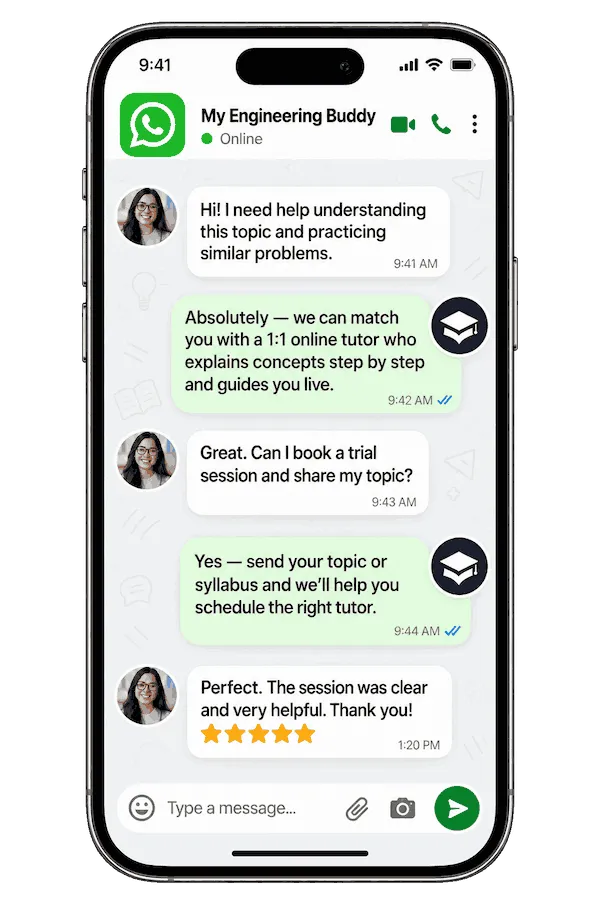
Unlike platforms where you fill out a form and wait, MEB responds in under a minute, 24/7. Tutor match takes under an hour. The $1 trial means you test before you commit. Everything runs over WhatsApp — no logins, no intake forms.
Pricing Guide
SymPy tutoring starts at $20/hr for undergraduate-level sessions. Graduate and research-level work — custom symbolic solvers, mechanics modules, quantum operator algebra — runs $60–$100/hr depending on depth and tutor specialisation.
Rate factors: your level, the complexity of the topic, how tight your deadline is, and tutor availability in your time zone.
For students targeting roles at quantitative research firms, doctoral programmes, or positions requiring advanced scientific computing, tutors with research and industry backgrounds are available at higher rates — share your goal and MEB matches the tier.
Availability is limited during end-of-semester crunch periods. Book before the deadline pressure hits.
Start with the $1 trial — 30 minutes, no registration, no commitment. WhatsApp MEB for a quick quote.
FAQ
Is SymPy hard to learn?
SymPy is manageable if your mathematical foundations are solid. The library is intuitive for simple algebra and calculus. Difficulty rises sharply when working with ODEs, assumptions, and simplification strategies — these are where most students stall without 1:1 SymPy tutoring support.
How many sessions will I need?
Most students working on a specific project or module need 4–8 sessions. Research-level work or building a SymPy-based simulation from scratch typically takes 10–15 sessions. Your tutor maps this out after the first diagnostic.
Can you help with projects and portfolio work?
Yes — MEB tutoring is guided learning. The tutor explains the logic, you write and submit the code yourself. MEB does not complete or submit work on your behalf. See our Academic Integrity policy and Why MEB page for full details on what we help with and what we don’t.
Will the tutor match my exact course or project requirements?
Yes. Share your course outline, project brief, or research context when you message MEB. Tutors are matched to your specific SymPy application — not assigned generically. Physics mechanics, engineering ODE systems, and pure symbolic algebra each need a different tutor profile.
What happens in the first session?
The tutor runs a short diagnostic — reviewing your existing code, a recent error output, or a problem you couldn’t simplify. From that, they build the session plan. You won’t spend 30 minutes on background the tutor could have read in your brief.
Are online SymPy sessions as effective as in-person?
For a tool-based subject like SymPy, online is often better. Screen sharing, live code annotation with a digital pen-pad, and working directly inside a Jupyter notebook together are cleaner online than leaning over a single laptop in a library.
Can I get SymPy help at midnight or on weekends?
Yes. MEB operates 24/7 across time zones. Message on WhatsApp at any hour — average response time is under a minute. Sessions can often be arranged same-day, including evenings and weekends, depending on tutor availability in your region.
What if I don’t like my assigned tutor?
Tell MEB after the first session. You will be matched with a different tutor — no friction, no form. The $1 trial exists precisely so you can assess fit before committing to a regular schedule. No session fee beyond the trial is charged until you confirm.
How do I get started?
Three steps: WhatsApp MEB, describe your course or project and current sticking point, then get matched with a verified tutor — usually within an hour. Your first session is the $1 trial: 30 minutes live or one problem explained in full. No registration required.
Does SymPy work for symbolic computation in physics and engineering, not just pure maths?
Yes — and this is one of SymPy’s strongest use cases. The sympy.physics.mechanics and sympy.physics.quantum modules handle Lagrangian mechanics, Hamiltonian systems, and quantum operator algebra symbolically. Tutors cover these modules specifically, not just the core algebra functions.
What is the difference between SymPy and SciPy — and do I need both?
SymPy handles symbolic computation — exact algebraic results. SciPy handles numerical computation — floating-point approximations. Most applied courses and research workflows need both: SymPy to derive and verify analytical expressions, SciPy to compute numerical solutions. MEB tutors cover the handoff between the two, including lambdify() for converting symbolic expressions to numerical functions.
Trust & Quality at My Engineering Buddy
Every MEB tutor goes through a subject-specific screening process: application review, a live demo session evaluated by a senior tutor, and ongoing feedback tracking tied to student outcomes. For SymPy, that means verified knowledge of the library’s core modules, demonstrated ability to explain symbolic mathematics at the board level, and familiarity with the Python ecosystem it sits inside. Rated 4.8/5 across 40,000+ verified reviews on Google.
MEB tutoring is guided learning — you understand the work, then submit it yourself. For full details on what we help with and what we don’t, read our Academic Integrity policy and Why MEB.
MEB has served 52,000+ students across the US, UK, Canada, Australia, the Gulf, and Europe since 2008, covering 2,800+ subjects. In Mathematics — from calculus tutoring to partial differential equations help to applied computational tools like SymPy — MEB tutors hold degrees in mathematics, physics, and engineering from institutions where these tools are part of core curricula. Subject-specific vetting is not optional at MEB. It is the only way the 4.8/5 rating holds across 40,000+ sessions.
A common pattern our tutors observe is that students who arrive thinking they have a Python problem leave realising it was a mathematics problem. SymPy makes that distinction visible — and fixable.
Source: My Engineering Buddy, 2008–2025.
Explore Related Subjects
Students studying SymPy often also need support in:
- SageMath
- Maple Software
- Mathematical Modeling
- Applied Mathematics
- Laplace Transform
- Fourier Analysis
- Mathematical Optimization
Next Steps
When you message MEB, have these ready:
- Your course outline, project brief, or research description
- A recent SymPy script, error message, or problem you couldn’t resolve
- Your deadline or exam date and your time zone
MEB matches you with a verified SymPy tutor — usually within 24 hours, often within the hour. The first session starts with a diagnostic so every minute is used on what you actually need.
Visit www.myengineeringbuddy.com for more on how MEB works.
WhatsApp to get started or email [email protected].
Reviewed by Subject Expert
This page has been carefully reviewed and validated by our subject expert to ensure accuracy and relevance.




