~1 min
Average Reply Time
~1 hour
To Be Matched With A Tutor
30 Min Trial
75% Find Their Tutor On The 1st Trial
$20-35+/hr
Premium Yet Affordable Learning
Most students hitting a wall in Smart Grid aren’t confused about electricity — they’re lost the moment SCADA meets demand response meets renewable integration.
Smart Grid Tutor Online
A Smart Grid is an electricity network that uses digital communication, sensors, and automation to monitor and manage power flow in real time, enabling two-way energy exchange, demand response, and integration of distributed renewable sources.
MEB offers 1:1 online tutoring and homework help in 2800+ advanced subjects — including Smart Grid, at undergraduate and postgraduate level. Whether you’re working through Electrical Engineering modules, a standalone Smart Grid elective, or a research project on grid modernisation, finding a Smart Grid tutor near me online means you get live, calibrated help without geography getting in the way. Tutors work from your course materials, not a generic script.
- 1:1 online sessions built around your exact syllabus and course level
- Expert-verified tutors with specific experience in power systems and grid technologies
- Flexible time zones — US, UK, Canada, Australia, Gulf
- Structured learning plan built after a diagnostic session
- Ethical homework and assignment guidance — you understand the work, then submit it yourself
52,000+ students across the US, UK, Canada, Australia, and the Gulf have used MEB since 2008 — including students in Electrical Engineering subjects like Smart Grid, Power Systems, and Control Systems.
Source: My Engineering Buddy, 2008–2025.
How Much Does a Smart Grid Tutor Cost?
Rates start at $20–$40/hr for most undergraduate Smart Grid modules. Graduate-level and niche grid topics — SCADA integration, microgrid design, grid cybersecurity — run higher, up to $100/hr. The $1 trial gets you 30 minutes of live tutoring or one full homework question explained, before you commit to anything.
| Level / Need | Typical Rate | What’s Included |
|---|---|---|
| Standard (most undergrad levels) | $20–$35/hr | 1:1 sessions, homework guidance |
| Advanced / Specialist (MSc, research) | $35–$100/hr | Expert tutor, niche depth |
| $1 Trial | $1 flat | 30 min live session or 1 homework question |
Tutor availability tightens around semester finals and spring exam periods — early booking gets you the best match. WhatsApp MEB for a quick quote — average response time under 1 minute.
Who This Smart Grid Tutoring Is For
Smart Grid sits at the intersection of power engineering, communications, and data systems. Students come from electrical engineering, energy systems, and computer engineering programmes — and the cross-disciplinary load catches many off-guard.
- Undergraduate students in electrical or energy engineering struggling with AMI, SCADA, or demand response modules
- MSc and PhD students working on grid stability, microgrid modelling, or renewable integration research
- Students 4–6 weeks from an exam with significant gaps still to close in load flow analysis or protection systems
- Students with a coursework or project submission deadline approaching and unclear on MATLAB/Simulink grid modelling
- Engineers in the field upskilling in smart metering, IoT-enabled grid systems, or energy storage integration
- Students at universities including MIT, Georgia Tech, Imperial College London, TU Delft, University of Waterloo, ETH Zurich, and UNSW looking for subject-specific support beyond office hours
If you’re not sure the $1 trial is worth it — it is. Thirty minutes with a tutor who knows your specific topic will tell you more than three more hours alone with the textbook.
1:1 Tutoring vs Self-Study vs AI vs YouTube vs Online Courses
Self-study works if you’re disciplined, but Smart Grid has too many moving parts — SCADA, AMI, demand response, protection coordination — for gaps to stay small for long. AI tools explain concepts quickly but can’t watch you work through a load flow problem and catch where your reasoning breaks. YouTube covers grid overviews well; it stops dead when you’re stuck on a specific stability equation. Online courses give structure but run at a fixed pace regardless of whether you’ve understood transient stability. With a 1:1 Smart Grid tutor online, the session is live, calibrated to your exact course, and corrects your errors the moment they appear — not after you’ve submitted.
Outcomes: What You’ll Be Able To Do in Smart Grid
After working with an MEB Smart Grid tutor, students consistently describe a cleaner mental map of how the grid actually functions — not just in theory, but as a system with moving parts. You’ll be able to analyze two-way power flow and explain why it complicates traditional protection schemes. You’ll apply demand response models to real load profiles and solve for optimal dispatch. You’ll model microgrid behaviour under islanding conditions and present findings with the precision an exam or dissertation marker expects. Solve SCADA-based fault detection scenarios with confidence. Work through AMI data communication architectures without losing the thread between layers.
Based on feedback from 40,000+ sessions collected by MEB from 2022 to 2025, 58% of students improved by one full grade after approximately 20 hours of 1:1 tutoring in subjects like Smart Grid. A further 23% achieved at least a half-grade improvement.
Source: MEB session feedback data, 2022–2025.
Try your first session for $1 — 30 minutes of live 1:1 tutoring or one homework question explained in full. No registration. No commitment. WhatsApp MEB now and get matched within the hour.
What We Cover in Smart Grid (Syllabus / Topics)

Track 1: Grid Architecture and Communication Infrastructure
- Smart Grid components: AMI, HAN, NAN, WAN layers
- SCADA systems — architecture, RTUs, master station communication
- Communication protocols: DNP3, IEC 61850, Modbus
- Cyber-physical systems integration in energy networks
- Grid cybersecurity: attack vectors, intrusion detection, NERC CIP standards
- Data management and analytics from smart meters
Recommended texts: Smart Grid: Fundamentals of Design and Analysis by James Momoh; Electric Power Systems by Weedy, Cory, Jenkins et al.
Track 2: Power Flow, Control, and Stability
- Load flow analysis — Newton-Raphson and Gauss-Seidel methods
- Transient and voltage stability in interconnected systems
- Demand response: price-based and incentive-based mechanisms
- Optimal power flow (OPF) formulations and solvers
- Frequency regulation and automatic generation control (AGC)
- Fault analysis and protection coordination in smart networks
- MATLAB/Simulink and PSCAD modelling for power system analysis
Recommended texts: Power System Analysis by Stevenson and Grainger; Power Systems Analysis by Hadi Saadat.
Track 3: Distributed Energy Resources and Storage
- Distributed generation: solar PV, wind, and combined heat and power (CHP)
- Microgrid design — grid-connected and islanded operation modes
- Energy storage integration: batteries, flywheels, pumped hydro
- Vehicle-to-grid (V2G) technology and bi-directional charging
- Renewable intermittency: forecasting, curtailment, grid balancing
- Virtual power plants and aggregation models
Recommended texts: Renewable Energy Integration by Lawrence Jones; Microgrid Technology and Engineering Application by Chen and Duan.
At MEB, we’ve found that Smart Grid students who bring a specific unsolved problem to the first session — a SCADA diagram they can’t parse, a stability equation they keep getting wrong — make faster progress than those who arrive with a general “I need help” request. Specificity lets the tutor go straight to the gap.
What a Typical Smart Grid Session Looks Like
The tutor opens by checking where the previous topic — say, Newton-Raphson load flow — landed. Did it click, or are there still steps that feel mechanical rather than understood? From there, the session moves into live problem-solving: the student and tutor work through a demand response optimisation or a microgrid islanding scenario together on screen, with the tutor using a digital pen-pad to annotate the power system diagram in real time. The student replicates the reasoning step by step — not watches it happen. If the fault analysis is coming up next week, the tutor names it before logging off and sets a concrete practice problem to attempt before the next session. Nothing is left vague.
How MEB Tutors Help You with Smart Grid (The Learning Loop)
Diagnose: In the first session, the tutor identifies exactly where understanding breaks down — whether that’s the communication layer of AMI, the maths behind optimal power flow, or a general gap in power system operation and control that’s making everything harder.
Explain: The tutor works through live examples using a digital pen-pad — never just talking at you. SCADA architectures get drawn out. Stability margin calculations get stepped through with your numbers, not textbook numbers.
Practice: You attempt the next problem with the tutor present. Not after the session. Not for homework. Right now, while the explanation is fresh and errors can be caught immediately.
Feedback: Every wrong step gets a direct explanation — not just “that’s incorrect” but why it’s incorrect and what the correct reasoning looks like. Students working on power system protection coordination problems particularly benefit from this — mistakes in protection logic are subtle and hard to self-diagnose.
Plan: The tutor maps the next 2–3 sessions before logging off. Topic sequence, specific weak areas to revisit, and what to prepare. No guessing what to study next.
Sessions run on Google Meet. The tutor uses a digital pen-pad or iPad with Apple Pencil for live annotation. Before your first session, share your course syllabus or module outline, any recent assignment or exam question you struggled with, and your exam or submission date. The first session covers a diagnostic and at least one full topic — you won’t spend the hour on admin. Start with the $1 trial — 30 minutes of live tutoring that also serves as your first diagnostic.
Students consistently tell us that the Learning Loop — diagnose, explain, practice, feedback, plan — is what separates MEB from simply watching a recorded lecture again. Live correction in the moment is what changes the grade.
Source: My Engineering Buddy internal student feedback summary, 2024.
Tutor Match Criteria (How We Pick Your Tutor)
Not every electrical engineering tutor knows Smart Grid. MEB matches on four criteria specifically.
Subject depth: Tutors must demonstrate working knowledge of Smart Grid at the level you’re studying — undergraduate load flow is different from postgraduate microgrid research. Verified against their academic and professional background.
Tools: Every Smart Grid tutor uses Google Meet with a digital pen-pad or iPad and Apple Pencil. Live annotation is non-negotiable for power systems work — static slides don’t cut it for fault diagrams or SCADA architectures.
Time zone: Matched to your region — US, UK, Gulf, Canada, or Australia. You won’t be doing a 2am session because MEB only has one tutor available.
Goals: Exam score improvement, conceptual depth in grid communications, homework completion, or dissertation/research support — the tutor is matched to your actual goal, not a generic “Smart Grid” category.
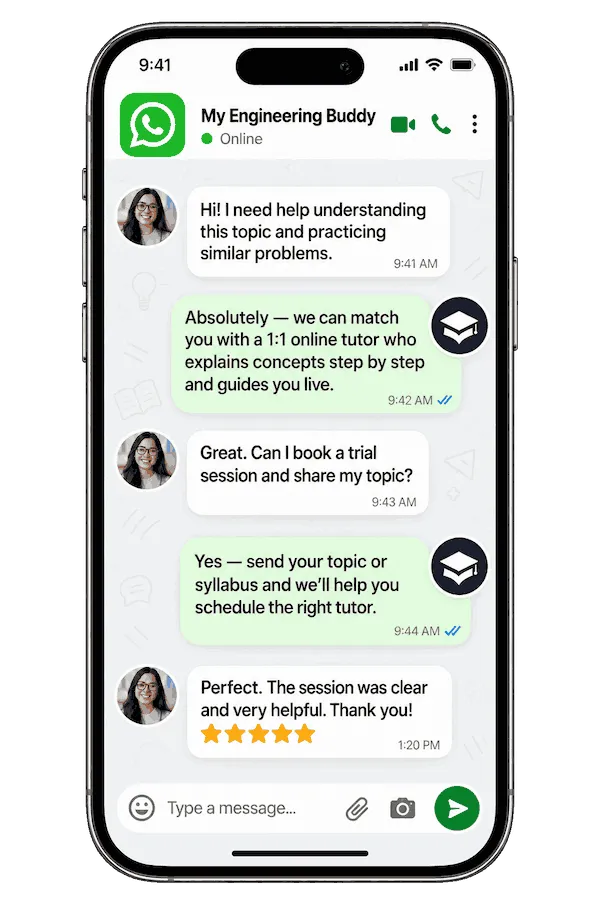
Unlike platforms where you fill out a form and wait, MEB responds in under a minute, 24/7. Tutor match takes under an hour. The $1 trial means you test before you commit. Everything runs over WhatsApp — no logins, no intake forms.
Study Plans (Pick One That Matches Your Goal)
After the diagnostic, the tutor builds a specific session sequence — not a generic revision calendar. Three common plans: Catch-up (1–3 weeks) for students behind on load flow, SCADA, or demand response with an exam approaching fast; Exam prep (4–8 weeks) for structured topic-by-topic revision across the full Smart Grid syllabus; Weekly support for ongoing help aligned to semester coursework and project deadlines. The tutor sets the sequence; you focus on the work.
Pricing Guide
Most Smart Grid sessions run $20–$40/hr. Graduate-level research support — microgrid modelling, grid cybersecurity, energy storage system design — goes up to $100/hr depending on tutor specialisation. Rate factors include your level, topic complexity, how tight your timeline is, and tutor availability.
For students targeting top programmes in power systems or energy engineering at institutions like MIT, TU Delft, or Imperial, tutors with professional grid industry or research backgrounds are available at higher rates — share your specific goal and MEB will match the tier to your ambition.
Availability tightens sharply around semester finals. Book early if you have a fixed exam date. Start with the $1 trial — 30 minutes, no registration, no commitment. WhatsApp MEB for a quick quote.
Our experience across thousands of sessions shows that students who treat the $1 trial as a proper first session — with a real problem ready to work through — get matched faster and start making progress in the first 30 minutes. It’s not a demo. It’s session one.
FAQ
Is Smart Grid hard?
It’s demanding because it combines power engineering, communication systems, control theory, and data analytics. Students comfortable in one area often hit a wall in another — especially where SCADA, IEC 61850, or microgrid stability modelling is involved. Targeted 1:1 help addresses the specific gap rather than reviewing everything.
How many sessions are needed?
For a specific exam topic or assignment, 2–4 sessions is a common range. For full module support across a semester, weekly sessions work best. The tutor sets a realistic plan after the first diagnostic — no one-size answer applies to Smart Grid given how differently courses are structured.
Can you help with homework and assignments?
Yes. MEB tutoring is guided learning — you understand the work, then submit it yourself. The tutor explains the method, works through a similar problem with you, then you complete the actual submission. See our Academic Integrity policy and Why MEB page for full details on what we help with and what we don’t.
Will the tutor match my exact syllabus or exam board?
Yes. Smart Grid is taught differently across universities — some emphasise SCADA and cybersecurity, others focus on renewable integration and microgrid design. Share your course outline and the tutor is matched to your specific module content, not a generic Smart Grid topic list.
What happens in the first session?
The tutor reviews your course outline and any work you’ve shared in advance. The session begins with a short diagnostic — 10–15 minutes — to identify your strongest and weakest areas. From there, at least one full topic is covered with live worked examples. You leave with a clear next step.
Is online tutoring as effective as in-person?
For Smart Grid, yes. Power system diagrams, SCADA architectures, and load flow calculations work well on screen with a digital pen-pad — arguably better than a whiteboard because you can zoom, annotate, and save the session notes. Students in the US, UK, Gulf, and Australia consistently report equivalent outcomes to in-person sessions.
Can I get Smart Grid help at midnight?
Yes. MEB operates 24/7. WhatsApp response averages under a minute at most hours. Tutors span multiple time zones, so late-night sessions for students in the US, Gulf, or Australia are standard — not an exception. Share your preferred time and MEB matches accordingly.
What if I don’t like my assigned tutor?
Request a different match immediately via WhatsApp. No forms, no waiting period, no awkward conversation. MEB re-matches, usually within an hour. The $1 trial exists partly for this reason — you test the fit before committing to a block of sessions.
What’s the difference between SCADA and AMI, and which should I focus on first?
SCADA (Supervisory Control and Data Acquisition) manages real-time control of grid operations; AMI (Advanced Metering Infrastructure) handles two-way communication between utilities and endpoints. Most Smart Grid courses cover both, but exam weighting varies. Your tutor will identify which your syllabus prioritises and sequence accordingly.
Does MEB cover MATLAB/Simulink modelling for Smart Grid projects?
Yes. Many Smart Grid assignments and dissertations require simulation of power flow, microgrid behaviour, or demand response in MATLAB/Simulink or PSCAD. MEB tutors experienced in PSCAD and simulation tools are available — share your project brief when you make contact.
How do I get started?
Three steps: WhatsApp MEB, share your course details and exam date, and get matched with a verified Smart Grid tutor — usually within an hour. The $1 trial is your first session: 30 minutes live or one homework question explained in full. No registration required.
Trust & Quality at My Engineering Buddy
Every MEB tutor goes through subject-specific screening — not a generic platform sign-up. For Smart Grid, that means verified academic or professional background in power systems, grid communications, or energy engineering. Tutors complete a live demo evaluation before being placed with any student, and ongoing session feedback triggers reviews if ratings drop. Rated 4.8/5 across 40,000+ verified reviews on Google. MEB has been running since 2008 — 18 years of student outcomes, not a startup making promises.
MEB tutoring is guided learning — you understand the work, then submit it yourself. For full details on what we help with and what we don’t, read our Academic Integrity policy and Why MEB.
MEB serves students in the US, UK, Canada, Australia, the Gulf, and Europe across 2,800+ subjects — from Electrical Engineering and Smart Grid to closely related areas like power electronics tutoring and energy storage systems help. Whether your focus is grid modernisation, distributed generation, or demand response, there’s a tutor matched to your specific course. Read more about how our tutoring methodology works.
MEB has served 52,000+ students since 2008 across Electrical Engineering and adjacent fields. The platform was built for advanced subjects — not school maths — and Smart Grid is exactly the kind of multi-disciplinary, high-stakes module it was designed for.
Source: My Engineering Buddy, 2008–2025.
Explore Related Subjects
Students studying Smart Grid often also need support in:
- Power Generation
- Power Transmission Systems
- Electrical Machines
- Internet of Things (IoT)
- Sensors and Actuators
- Distributed Control Systems (DCS)
- Battery Technology
- Photovoltaic Cells / Solar Energy
Next Steps
Before your first session, have ready:
- Your course syllabus or module outline (or the specific topic you’re stuck on)
- A recent assignment, past paper question, or homework problem you struggled with
- Your exam date or submission deadline
The tutor handles the rest. Share your availability and time zone when you make contact — MEB matches you with a verified Smart Grid tutor, usually within 24 hours. The first session starts with a diagnostic so every minute is used on what actually matters.
Visit www.myengineeringbuddy.com for more on how MEB works. Or go straight to WhatsApp to get started or email [email protected].
Reviewed by Subject Expert
This page has been carefully reviewed and validated by our subject expert to ensure accuracy and relevance.