

Hire Verified & Experienced
Circuit Design Tutors
4.8/5 40K+ session ratings collected on the MEB platform



Hire The Best Circuit Design Tutor
Top Tutors, Top Grades. Without The Stress!





52,000+ Happy Students From Various Universities






How Much For Private 1:1 Tutoring & Hw Help?
Private 1:1 Tutoring and HW help Cost $20 – 35 per hour* on average.
Most students don’t fail Circuit Design because the subject is impossible. They fail because they hit one concept — op-amp feedback, BJT biasing, or AC load line analysis — and never fully recovered before the exam.
Circuit Design Tutor Online
Circuit Design is the process of creating electronic circuits to perform specific functions — covering component selection, topology design, simulation, and PCB layout. It equips students to build and analyse analog, digital, and mixed-signal systems.
MEB offers 1:1 online Electrical Engineering tutoring that includes expert help with Circuit Design — from first-year fundamentals to graduate-level IC design. If you searched for a Circuit Design tutor near me, MEB’s online sessions are a direct replacement: same depth, live on screen, without the commute. Your tutor is matched to your exact course, exam board, and current gap.
- 1:1 online sessions tailored to your course syllabus and exam board
- Expert-verified tutors with hands-on circuit design and simulation experience
- Flexible time zones — US, UK, Canada, Australia, Gulf, Europe
- Structured learning plan built after a first-session diagnostic
- Ethical homework and assignment guidance — you understand the work before you submit
How Much Does a Circuit Design Tutor Cost?
Most Circuit Design tutoring sessions run $20–$40/hr. Graduate-level or highly specialised topics — IC layout, RF circuit design, mixed-signal simulation — can reach $100/hr. The $1 trial gets you 30 minutes of live tutoring or one full homework question explained, so you can assess the tutor before spending anything.
| Level / Need | Typical Rate | What’s Included |
|---|---|---|
| Standard (most undergrad levels) | $20–$35/hr | 1:1 sessions, homework guidance |
| Advanced / Specialist (IC, RF, VLSI) | $35–$100/hr | Expert tutor, niche depth, simulation support |
| $1 Trial | $1 flat | 30 min live session or 1 homework question explained |
Tutor availability tightens around semester finals and submission deadlines — particularly in November and April. Book early if you’re on a fixed timeline.
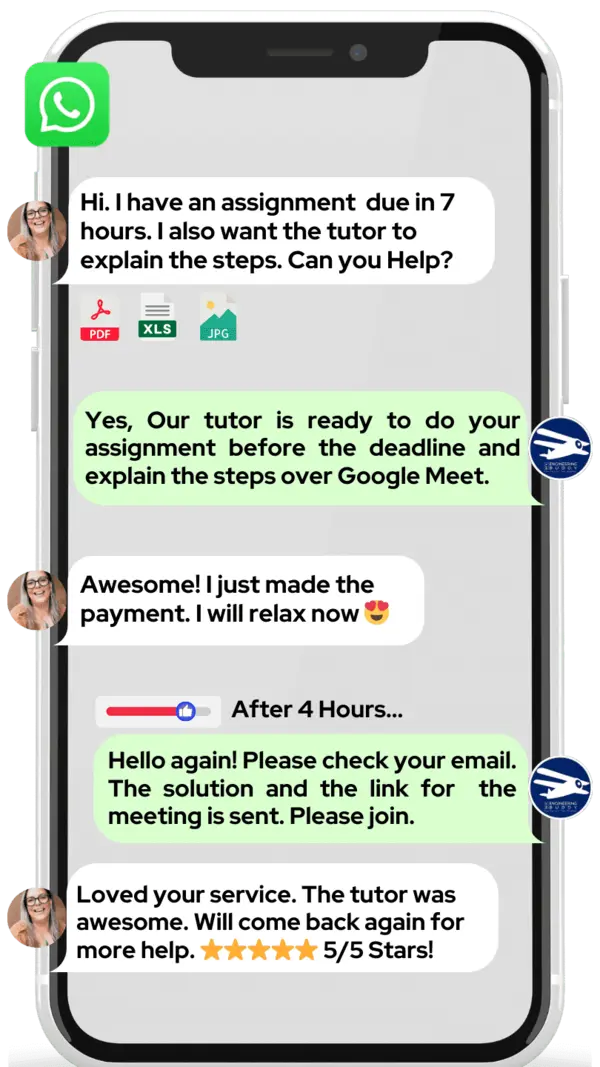
WhatsApp MEB for a quick quote — average response time under 1 minute.
52,000+ students across the US, UK, Canada, Australia, and the Gulf have used MEB since 2008 — including students in Electrical Engineering subjects like Circuit Design, Analog Electronics, and Electronic Circuit Design.
Source: My Engineering Buddy, 2008–2025.
Who This Circuit Design Tutoring Is For
Circuit Design sits at the intersection of theory and real hardware decisions. Most students hit trouble not at the theory stage, but when they have to translate a specification into a working schematic — and the tutor’s job starts exactly there.
- Undergraduates in Electrical Engineering, Electronics, or Computer Engineering struggling with analog or digital circuit modules
- Graduate students working on IC design, mixed-signal circuits, or RF front-end projects
- Students retaking after a failed first attempt — gaps in biasing, Thevenin analysis, or filter design are common
- Students with a university conditional offer depending on their EE module grade
- Students 4–6 weeks from an exam with significant topics still to cover — BJT amplifiers, op-amp configurations, or MOSFET switching circuits
- Parents watching a child’s confidence drop alongside their grades in an Electrical Engineering programme
Students come from universities across the US, UK, Canada, Australia, and the Gulf — including MIT, Imperial College London, University of Toronto, UNSW, and TU Delft. The tutor is matched to your specific institution’s syllabus where possible.
Start with the $1 trial — 30 minutes of live tutoring that also serves as your first diagnostic.
1:1 Tutoring vs Self-Study vs AI vs YouTube vs Online Courses
Self-study works if you’re disciplined and the gaps are small — but circuit design problems require feedback the moment your approach goes wrong. AI tools give fast explanations but can’t watch you attempt a biasing problem and catch the error mid-step. YouTube is strong for conceptual overviews and rarely covers the specific question on your assignment. Online courses move at a fixed pace and won’t slow down for your weakest topic. With MEB, a live tutor works through your exact schematic or simulation problem on screen, corrects your reasoning in real time, and adapts the next 20 minutes based on what you just got wrong. For Circuit Design specifically, that live correction loop is the difference between a circuit that works on paper and one you can actually build and defend.
Outcomes: What You’ll Be Able To Do in Circuit Design
After working with an MEB Circuit Design tutor, you’ll be able to analyse multi-stage amplifier circuits using small-signal models, design and simulate active and passive filters to a given frequency specification, apply Thevenin and Norton equivalents to reduce complex networks, explain MOSFET and BJT operating regions under DC and AC conditions, and present a complete circuit design — from spec to schematic to simulation output — with confidence in an exam or viva setting. These are specific competencies, not general improvements.
Based on feedback from 40,000+ sessions collected by MEB from 2022 to 2025, 58% of students improved by one full grade after approximately 20 hours of 1:1 tutoring in subjects like Circuit Design. A further 23% achieved at least a half-grade improvement.
Source: MEB session feedback data, 2022–2025.
Try your first session for $1 — 30 minutes of live 1:1 tutoring or one homework question explained in full. No registration. No commitment. WhatsApp MEB now and get matched within the hour.
What We Cover in Circuit Design (Syllabus / Topics)

Track 1: Analog Circuit Design
- BJT and MOSFET biasing — DC operating point, load line analysis
- Small-signal models — hybrid-pi, T-model, common-emitter and common-source amplifiers
- Frequency response — Bode plots, dominant pole approximation, bandwidth
- Operational amplifier circuits — inverting, non-inverting, differentiator, integrator, comparator
- Active and passive filter design — Butterworth, Chebyshev, first and second order topologies
- Feedback theory — negative feedback types, stability, gain-bandwidth product
- Oscillator circuits — Colpitts, Hartley, Wien bridge
Key references: Sedra & Smith Microelectronic Circuits; Razavi Design of Analog CMOS Integrated Circuits; Gray, Hurst, Lewis & Meyer Analysis and Design of Analog Integrated Circuits.
Track 2: Digital Circuit Design
- Logic families — CMOS, TTL, propagation delay, noise margins, fan-out
- Combinational circuits — multiplexers, decoders, adders, comparators
- Sequential circuits — flip-flops, latches, counters, state machines
- Timing analysis — setup time, hold time, clock skew
- Digital circuit simulation using Multisim or LTspice
- HDL-based design using VHDL or Verilog
- FPGA implementation and timing constraints
Key references: Wakerly Digital Design; Mano & Ciletti Digital Design; Brown & Vranesic Fundamentals of Digital Logic with VHDL Design.
Track 3: Mixed-Signal and IC-Level Design
- ADC and DAC architectures — successive approximation, delta-sigma, R-2R ladder
- Phase-locked loops — VCO, phase detector, loop filter design
- CMOS layout fundamentals — transistor sizing, matching, parasitic extraction
- Simulation with LTspice or Cadence Virtuoso
- Noise analysis — thermal noise, flicker noise, noise figure
- Power supply design — LDO regulators, switching converters, efficiency trade-offs
Key references: Razavi RF Microelectronics; Allen & Holberg CMOS Analog Circuit Design; Hastings The Art of Analog Layout.
Platforms, Tools & Textbooks We Support
Circuit Design is inseparable from simulation tools. MEB tutors work across the full stack of industry-standard and academic platforms, so sessions are built around what your course actually uses — not a generic whiteboard walkthrough.
- LTspice — SPICE simulation, transient and AC analysis
- Cadence Virtuoso — schematic entry, layout, PVT simulation
- Multisim — mixed analog/digital simulation, interactive components
- PSpice — circuit simulation for Orcad-based workflows
- Advanced Design System (ADS) — RF and microwave circuit design
- MATLAB/Simulink — signal-level modelling and control integration
- KiCad and Altium — PCB schematic and layout
- Quartus Prime / Vivado — FPGA-based digital circuit implementation
What a Typical Circuit Design Session Looks Like
The tutor opens by checking the previous session’s topic — say, the frequency response of a common-source amplifier. They ask you to walk through your Bode plot derivation before touching anything new. If you stall at the dominant pole calculation, that’s where the session pivots. The tutor picks up a digital pen-pad and works through the small-signal model live — annotating the circuit, labelling nodes, deriving the transfer function step by step. You replicate the same derivation independently while the tutor watches for where your algebra or sign convention breaks. The session closes with one unseen problem: design a second-order low-pass filter to 3 dB at 10 kHz. The next session will open with your attempt at it.
At MEB, we’ve found that the students who improve fastest in Circuit Design are the ones who stop trying to memorise configurations and start deriving everything from the small-signal model up. It takes two or three sessions to build the habit. After that, new topologies stop feeling like new problems.
How MEB Tutors Help You with Circuit Design (The Learning Loop)
Diagnose: In the first session, the tutor identifies exactly which part of the circuit design chain breaks down for you — whether it’s DC biasing, AC analysis, simulation interpretation, or the translation from a spec to a working topology. Symptoms like “I don’t understand op-amps” almost always point to a more specific upstream gap.
Explain: The tutor works through a fully solved problem using a digital pen-pad on screen — every step visible, every decision narrated. For Circuit Design, this usually means deriving the operating point, drawing the small-signal equivalent, and computing the gain before touching the simulation.
Practice: You attempt a parallel problem while the tutor watches. In circuit work, errors usually show up in the KVL/KCL setup or in the sign convention — catching these live, rather than after a failed assignment submission, is the point.
Feedback: The tutor walks back through your attempt and shows exactly where the error entered and why it propagated. This is not “you got it wrong” — it’s “here’s the moment your model of the circuit diverged from what the circuit actually does.”
Plan: Each session ends with a named topic for next time and a specific practice task. Progress is tracked explicitly — not left to the student to self-assess.
Sessions run on Google Meet with a digital pen-pad or iPad and Apple Pencil for live circuit annotation. Before your first session, have your course syllabus or module outline, a recent problem set or past paper question you struggled with, and your exam date or assignment deadline. The first session covers a diagnostic problem and builds the first three-session plan. Start with the $1 trial — 30 minutes of live 1:1 tutoring that doubles as your diagnostic.
Students consistently tell us that the moment Circuit Design clicks is when they stop treating each amplifier topology as a separate thing to memorise and start seeing every configuration as a variation of the same small-signal model. That shift usually happens in session three or four.
Source: My Engineering Buddy tutor observations, 2008–2025.
Tutor Match Criteria (How We Pick Your Tutor)
Not every Electronics graduate can tutor Circuit Design at graduate level. Here’s what MEB screens for.
Subject depth: Tutors are matched to your exact level — first-year analog fundamentals, advanced IC design, or RF front-end work. Exam board and syllabus alignment are checked before the match is confirmed.
Tools: Every Circuit Design tutor uses Google Meet with a digital pen-pad or iPad and Apple Pencil. Simulation tool proficiency (LTspice, Cadence, Multisim, ADS) is verified at onboarding.
Time zone: Matched to your region — US, UK, Gulf, Canada, or Australia — so sessions don’t require a 6 AM alarm.
Goals: Whether you need help with a specific homework problem, exam preparation, or a research-level circuit design project, the tutor’s background is matched accordingly.
Unlike platforms where you fill out a form and wait, MEB responds in under a minute, 24/7. Tutor match takes under an hour. The $1 trial means you test before you commit. Everything runs over WhatsApp — no logins, no intake forms.
Study Plans (Pick One That Matches Your Goal)
After the first diagnostic session, the tutor builds a specific plan based on your timeline. Catch-up (1–3 weeks): rapid triage of the biggest gaps — typically biasing, small-signal analysis, and filter design — before an upcoming submission or test. Exam prep (4–8 weeks): structured topic progression through the full syllabus, with past-paper practice built into each session. Weekly support: ongoing sessions aligned to your lecture schedule, keeping homework and coursework on track each week. The sequence is set after the diagnostic — not before.
A common pattern our tutors observe is that students who book for “one session before the exam” actually need three: one to find the gap, one to close it, and one to practise under exam conditions. Plan for that sequence and the outcome improves significantly.
Pricing Guide
Circuit Design tutoring starts at $20/hr for standard undergraduate content. Advanced topics — CMOS IC design, RF circuits, mixed-signal simulation, FPGA implementation — run $35–$100/hr depending on tutor experience and timeline urgency. Rate factors include level, topic complexity, and how quickly you need sessions.
For students targeting roles at semiconductor companies, RF hardware teams, or graduate research positions, MEB has tutors with active industry and research backgrounds available at higher rates. Share your specific goal and MEB will match the right tier.
Availability tightens during finals periods — particularly December and May in North America, and May–June in the UK and Australia. Book early if you’re on a fixed exam date.
Start with the $1 trial — 30 minutes, no registration, no commitment. WhatsApp MEB for a quick quote.
FAQ
Is Circuit Design hard?
It’s demanding because it requires both theoretical analysis and design intuition. Most students find DC biasing and small-signal analysis manageable with practice, but frequency response, feedback stability, and mixed-signal topics create real difficulty without guided support.
How many sessions are needed?
Students with one or two specific gaps typically need 4–6 sessions. Those preparing for a full exam or working through an entire module usually benefit from 10–20 hours across a semester. The tutor builds a session plan after the first diagnostic.
Can you help with homework and assignments?
Yes. MEB tutoring is guided learning — you understand the work, then submit it yourself. If you’re stuck on a biasing problem or a filter design question, the tutor explains the method so you can complete and submit the work independently. See our Academic Integrity policy and Why MEB page for full details on what we help with and what we don’t.
Will the tutor match my exact syllabus or exam board?
Yes. Before the match is confirmed, MEB checks your course outline, institution, and level. Tutors are assigned based on syllabus fit — not just broad subject knowledge. If your module uses a specific simulation tool, that’s also factored in.
What happens in the first session?
The tutor opens with a diagnostic problem to locate your exact gaps — not a general chat. Based on what surfaces, they outline the first three-session plan. The session covers at least one full worked example relevant to your current module or upcoming exam.
Is online tutoring as effective as in-person?
For Circuit Design, often more so. The tutor’s pen-pad annotations are clearer than most whiteboards, simulation tools run directly in the shared session, and the recording can be reviewed afterward. Students in the US, UK, and Gulf consistently report strong progress in online-only formats.
Can you help with LTspice and Cadence Virtuoso simulations?
Yes. MEB tutors are proficient in LTspice, Cadence Virtuoso, Multisim, PSpice, and ADS. If your assignment requires a working simulation alongside your schematic analysis, the tutor works through both in the same session.
What’s the difference between Circuit Analysis and Circuit Design tutoring?
Circuit Analysis tutoring focuses on analysing existing circuits — applying KVL, KCL, Thevenin, and Norton methods. Circuit Design tutoring goes further: you start from a specification and build the circuit. Both are covered, and many students need support across both skills simultaneously.
Can I get Circuit Design help late at night or on weekends?
Yes. MEB operates 24/7 and has tutors across US, UK, Gulf, and Australian time zones. If you’re working on a submission due at midnight or a Sunday morning exam panic, WhatsApp MEB and a tutor match typically happens within the hour.
Do you offer help with PCB design alongside circuit design?
Yes. If your course or project requires moving from schematic to PCB Design — including layout rules, design rule checks, and gerber file preparation — MEB tutors can cover that alongside the circuit design work itself.
How do I get started?
Start with the $1 trial — 30 minutes of live tutoring or one full homework question explained. Three steps: WhatsApp MEB, get matched to a verified Circuit Design tutor, start your trial session. Most students are matched within an hour.
What if I need help with analog IC design at graduate level?
MEB has tutors with postgraduate and industry backgrounds in analog IC design, including CMOS amplifier design, bandgap references, and PLLs. Share your course level and specific topic, and MEB will confirm tutor availability before you commit to any sessions.
Trust & Quality at My Engineering Buddy
Every MEB Circuit Design tutor goes through subject-specific screening: a live demo session evaluated against a technical rubric, verification of academic credentials and relevant industry or research experience, and an ongoing review process based on student feedback. Rated 4.8/5 across 40,000+ verified reviews on Google — that rating is maintained by removing tutors who fall below standard, not by averaging them in.
MEB tutoring is guided learning — you understand the work, then submit it yourself. For full details on what we help with and what we don’t, read our Academic Integrity policy and Why MEB.
MEB has been running since 2008 and now serves 52,000+ students across the US, UK, Canada, Australia, the Gulf, and Europe in 2,800+ subjects. Electrical Engineering is one of the largest subject areas on the platform — including Analog Circuits tutoring, Signals and Systems help, and Power Electronics tutoring, alongside Circuit Design. If your course spans multiple modules, MEB can match you with a tutor who covers the full range.
Our experience across thousands of sessions shows that the biggest predictor of improvement in Circuit Design isn’t prior knowledge — it’s how quickly the student gets feedback on their first real attempt at a design problem. One session can reset the trajectory entirely.
Source: My Engineering Buddy tutor observations, 2008–2025.
Students consistently tell us that by session three or four in Circuit Design, they’ve stopped asking “what formula do I use?” and started asking “what does this circuit actually need to do?” That’s the shift. It’s the difference between passing and understanding.
Explore Related Subjects
Students studying Circuit Design often also need support in:
- Analog Signal Processing
- Analog Communication
- Semiconductor Devices
- Microelectronics
- Operational Amplifiers
- Integrated Circuits (IC)
- VLSI Design
- FPGA Design
Next Steps
Getting started takes under a minute. Here’s what to do:
- Share your exam board or course syllabus, your hardest current topic, and your exam or submission date
- Share your time zone and available hours — morning, evening, or weekend
- MEB matches you with a verified Circuit Design tutor — usually within a few hours
- Your first session opens with a diagnostic so every minute is used on what actually matters
Before your first session, have ready:
- Your course outline or module syllabus
- A recent assignment, past paper question, or problem set you struggled with
- Your exam date or coursework deadline — the tutor builds around it from session one
Visit www.myengineeringbuddy.com for more on how MEB works.
WhatsApp to get started or email meb@myengineeringbuddy.com.
Reviewed by Subject Expert
This page has been carefully reviewed and validated by our subject expert to ensure accuracy and relevance.

