




Hire The Best Insurance Tutor
Top Tutors, Top Grades. Without The Stress!

52,000+ Happy Students From Various Universities



How Much For Private 1:1 Tutoring & Hw Help?
Private 1:1 Tutoring and HW help Cost $20 – 35 per hour* on average.
Most students who fail Insurance don’t lack effort — they hit a wall on loss models, policy structures, or actuarial math and have no one to walk them through it live.
Insurance Tutor Online
Insurance is the study of risk transfer, indemnity principles, underwriting, policy structures, and actuarial mathematics. It equips students to analyse risk exposure, price policies, and apply regulatory frameworks across personal, commercial, and life insurance products.
MEB provides 1:1 online tutoring and homework help in 2,800+ advanced subjects — including Insurance. Whether you’re working through an undergraduate risk management module, a professional certification, or a finance elective with an insurance component, an insurance tutor near me from MEB is matched to your exact syllabus, your level, and your deadline. One session can move a stuck concept from confusion to clarity.
- 1:1 online sessions tailored to your course syllabus or exam board
- Expert-verified tutors with subject-specific knowledge in insurance, actuarial science, and risk
- Flexible time zones — US, UK, Canada, Australia, Gulf
- Structured learning plan built after a diagnostic session
- Ethical homework and assignment guidance — you understand before you submit
52,000+ students across the US, UK, Canada, Australia, and the Gulf have used MEB since 2008 — including students in Finance subjects like Insurance, credit risk tutoring, and investment analysis help.
Source: My Engineering Buddy, 2008–2025.
How Much Does an Insurance Tutor Cost?
Most Insurance tutoring sessions run $20–$40/hr. Graduate-level actuarial content or professional certification prep can reach $60–$100/hr depending on tutor specialisation. The $1 trial gets you 30 minutes of live tutoring or one homework question explained in full — no registration needed.
| Level / Need | Typical Rate | What’s Included |
|---|---|---|
| Standard (undergrad / intro courses) | $20–$35/hr | 1:1 sessions, homework guidance |
| Advanced / Actuarial / Professional Cert | $40–$100/hr | Expert tutor, exam-specific depth |
| $1 Trial | $1 flat | 30 min live session or 1 homework question |
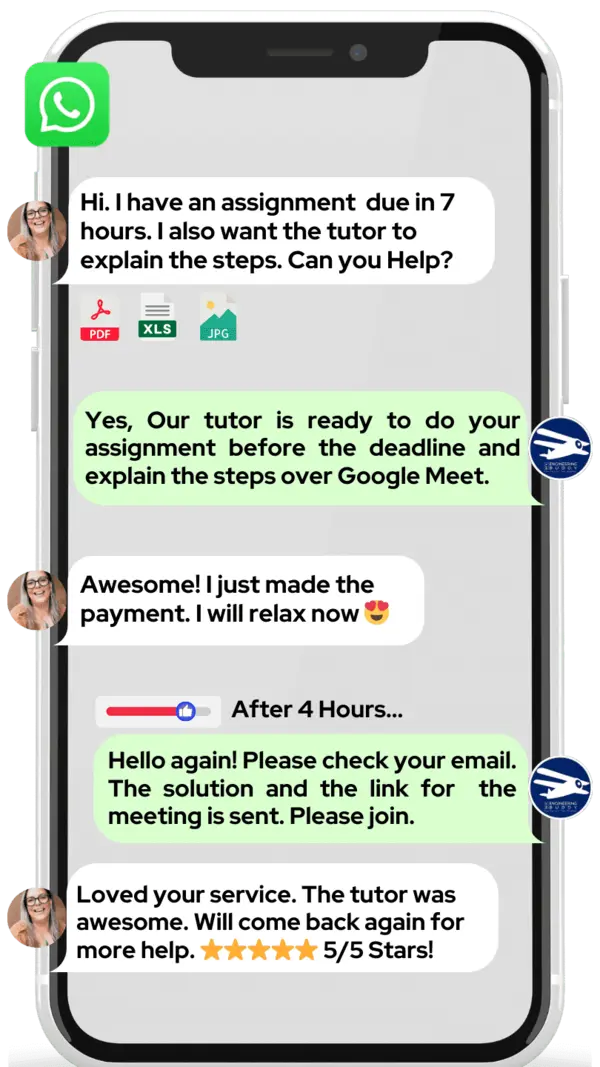
Tutor availability tightens significantly in the weeks before finals and professional exam windows. WhatsApp MEB for a quick quote — average response time under 1 minute.
Who This Insurance Tutoring Is For
Insurance sits at the crossroads of finance, law, mathematics, and probability. Most students find it harder than it looks on paper — especially when concepts like expected loss, policy exclusions, or reinsurance structures collide in a single assignment.
- Undergraduate students in risk management, finance, or actuarial science courses
- Students retaking after a failed first attempt on an insurance or risk module
- Students with a university conditional offer depending on this grade
- Graduate students working through insurance economics or financial regulation coursework
- Students sitting professional insurance certifications — CPCU, CII, or similar — with exam prep needs
- Parents watching a child’s confidence drop alongside their grades in a finance-heavy programme
Students at universities including the University of Wisconsin–Madison, Cass Business School (Bayes), Temple University, Georgia State University, and the University of Toronto have used MEB for insurance-related coursework and exam prep.
Start with the $1 trial if you’re not sure whether MEB fits your level — 30 minutes is enough to find out.
1:1 Tutoring vs Self-Study vs AI vs YouTube vs Online Courses
Self-study works if you’re disciplined, but insurance concepts like loss development triangles or subrogation don’t reveal their logic in a textbook paragraph. AI tools give fast definitions — they can’t spot why your premium calculation is off by a factor. YouTube covers the overview of indemnity or moral hazard well enough; it stops when you hit your specific policy structure problem. Online courses move at a fixed pace with no adjustment for where you’re actually stuck. With a 1:1 Insurance tutor from MEB, the session is live, calibrated to your exact module, and corrects your reasoning in real time — not after you’ve already submitted.
Outcomes: What You’ll Be Able To Do in Insurance
After working with an online Insurance tutor, you’ll be able to apply the law of large numbers and probability distributions to model expected losses accurately. You’ll analyse policy structures — including exclusions, riders, and coverage limits — and explain their financial logic. You’ll solve problems involving premium calculation, loss ratios, and combined ratios for property-casualty lines. You’ll present reinsurance arrangements, including quota share and excess-of-loss treaties, with confidence. You’ll write exam answers that distinguish between moral hazard and adverse selection with precise, mark-earning clarity.
Based on feedback from 40,000+ sessions collected by MEB from 2022 to 2025, 58% of students improved by one full grade after approximately 20 hours of 1:1 tutoring in subjects like Insurance. A further 23% achieved at least a half-grade improvement.
Source: MEB session feedback data, 2022–2025.
Supporting a student through Insurance? MEB works directly with parents to set up sessions, track progress, and keep coursework on schedule. WhatsApp MEB — average response time is under a minute, 24/7.
What We Cover in Insurance (Syllabus / Topics)

Risk, Probability & Actuarial Foundations
- Probability distributions used in loss modelling: normal, Poisson, exponential
- Expected value, variance, and standard deviation applied to insurance claims
- Loss development triangles and IBNR (Incurred But Not Reported) reserves
- Frequency–severity models and aggregate loss distributions
- Mortality tables, life expectancy, and net premium calculations
- Credibility theory and the Bühlmann model
Core texts include Klugman, Panjer & Willmot’s Loss Models: From Data to Decisions and Bowers et al.’s Actuarial Mathematics.
Policy Structures, Underwriting & Risk Transfer
- Principles of insurance: indemnity, insurable interest, utmost good faith, subrogation
- Property and casualty insurance — coverage components, exclusions, conditions
- Life insurance products: term, whole life, universal, variable
- Health insurance structures: deductibles, copays, coinsurance, out-of-pocket maxima
- Underwriting criteria, risk classification, and premium rate determination
- Adverse selection, moral hazard, and mechanisms to control them
- Reinsurance structures: quota share, surplus share, excess-of-loss treaties
Standard references include Rejda & McNamara’s Principles of Risk Management and Insurance and Harrington & Niehaus’s Risk Management and Insurance.
Insurance Regulation, Economics & Financial Analysis
- State-level and federal regulatory frameworks in the US; Lloyd’s and FCA frameworks in the UK
- Solvency II requirements and risk-based capital standards
- Loss ratios, expense ratios, and combined ratio analysis
- Insurance pricing and rate-making methodology
- Financial statements for insurance companies — statutory vs GAAP accounting
- Role of insurance in capital markets: catastrophe bonds and insurance-linked securities
Useful supplementary reading includes Cummins & Weiss’s work on insurance market economics and the Wharton School finance faculty research on systemic risk and insurance.
At MEB, we’ve found that students who struggle with insurance almost always have a gap in probability basics — not in insurance itself. Fix the foundation and the policy-level concepts click within two or three sessions.
What a Typical Insurance Session Looks Like
The tutor opens by checking your last topic — say, your attempt at a combined ratio problem or a question on adverse selection from a previous homework. You share your working on screen. The tutor uses a digital pen-pad to walk through the correct approach step by step, marking exactly where your logic broke down — whether that’s the expense ratio formula, the allocation of IBNR, or the difference between gross and net premiums. You replicate the method on a similar problem while the tutor watches. The session closes with a specific practice task — three loss-ratio problems or a policy comparison exercise — and the next topic flagged for your following session. Sixty minutes. No filler.
How MEB Tutors Help You with Insurance (The Learning Loop)
Diagnose: In the first session, the tutor asks two or three targeted questions to find where your understanding actually breaks down — not where you think it does. For insurance students, the gap is usually in probability modelling or in distinguishing similar-sounding policy mechanisms.
Explain: The tutor works through a live example using a digital pen-pad — showing how a loss development triangle fills in, or how subrogation rights flow through a claim. No slides. No pre-recorded video. Live, responsive explanation.
Practice: You attempt the next problem while the tutor watches. This is where most tutoring platforms skip a step. You do the work — the tutor doesn’t take over.
Feedback: The tutor tells you exactly which step failed and why marks would be lost. “Your combined ratio is wrong because you divided net premiums instead of earned premiums” is more useful than “close, but check your formula.”
Plan: Before the session ends, the tutor maps the next two topics and sets a short task. Accountability is built in. Progress is tracked session by session.
Sessions run on Google Meet with a digital pen-pad or iPad and Apple Pencil. Before your first session, have your syllabus or course outline ready, plus one piece of work you’ve already attempted and found difficult. That’s what the first diagnostic works from. Start with the $1 trial — 30 minutes of live tutoring that also serves as your first diagnostic.
Students consistently tell us that the moment things change in insurance is when they stop trying to memorise definitions and start solving problems out loud. The tutor’s job is to force that shift as early as session one.
Tutor Match Criteria (How We Pick Your Tutor)
Not every finance tutor knows insurance well. MEB screens specifically for subject depth, not just general finance knowledge.
Subject depth: The tutor must demonstrate working knowledge of your specific insurance module — whether that’s actuarial mathematics, property-casualty underwriting, or insurance regulation and solvency frameworks. Exam board and syllabus fit is confirmed before the match.
Tools: Every Insurance tutor works on Google Meet with a digital pen-pad or iPad and Apple Pencil — required, not optional.
Time zone: Matched to your region. US, UK, Gulf, Canada, Australia — sessions available across all major time zones, including late evening and weekend slots.
Goals: The match accounts for what you actually need — exam score improvement, conceptual clarity, quantitative analysis help, or ongoing homework support through a semester.
Unlike platforms where you fill out a form and wait, MEB responds in under a minute, 24/7. Tutor match takes under an hour. The $1 trial means you test before you commit. Everything runs over WhatsApp — no logins, no intake forms.
Study Plans (Pick One That Matches Your Goal)
After the first diagnostic, the tutor builds a session sequence specific to your timeline. A catch-up plan (1–3 weeks) closes specific topic gaps before an exam. An exam prep plan (4–8 weeks) runs structured revision through all tested components — loss models, policy structures, regulation, and financial analysis — in order of exam weight. Weekly support runs alongside your semester, aligned to coursework deadlines and assignment submission dates. The tutor adjusts the sequence after each session based on what’s holding you back.
Pricing Guide
Insurance tutoring runs $20–$40/hr for most undergraduate and introductory graduate modules. Actuarial content, professional certification prep (CPCU, CII, ACII), and niche specialist topics can reach $100/hr. Rate factors include your level, how soon your exam is, and tutor specialisation.
For students targeting actuarial careers or roles at major insurers, Lloyd’s syndicates, or reinsurance firms, tutors with professional underwriting and actuarial backgrounds are available at higher rates — share your specific goal and MEB will match the tier to your ambition.
Availability shrinks fast in the four weeks before finals and professional exam sittings. Start with the $1 trial — 30 minutes, no registration, no commitment. WhatsApp MEB for a quick quote.
Insurance sits inside one of the most technically demanding areas of finance — overlapping with law, probability, and accounting. Students who get 1:1 support consistently close gaps faster than those relying on lecture recordings alone.
Source: My Engineering Buddy, 2008–2025.
Try your first session for $1 — 30 minutes of live 1:1 tutoring or one homework question explained in full. No registration. No commitment. WhatsApp MEB now and get matched within the hour.
FAQ
Is Insurance hard?
Harder than most students expect. The concepts — indemnity, adverse selection, loss modelling — are individually manageable, but insurance courses combine probability, law, and financial accounting simultaneously. Students who struggle usually hit that intersection unprepared.
How many sessions are needed?
For a specific exam topic or single assignment, two to three sessions often close the gap. For full-module support across a semester, weekly sessions of 60–90 minutes are typical. The tutor estimates your required sessions after the first diagnostic.
Can you help with homework and assignments?
Yes — MEB tutoring is guided learning. The tutor explains the method and works through similar examples with you. You understand the work, then submit it yourself. See our Academic Integrity policy and Why MEB page for full details on what we help with and what we don’t.
Will the tutor match my exact syllabus or exam board?
Yes. Before matching, MEB confirms which course, textbook, or certification you’re working toward. Whether that’s a US university risk management module, a UK CII qualification, or an actuarial exam prep track, the tutor is matched to that specific content.
What happens in the first session?
The tutor runs a short diagnostic — usually two or three targeted questions covering topics you’ve already studied. This identifies your actual gaps versus perceived ones. The rest of the session begins working through your most pressing need. No time wasted on review you don’t need.
Is online tutoring as effective as in-person?
For insurance specifically, yes — and often better. The digital pen-pad allows the tutor to annotate loss tables, draw policy flowcharts, and mark up premium calculations live on screen. Students typically find this clearer than watching someone write on a whiteboard across a room.
What’s the difference between the CPCU and CII qualifications, and can MEB help with both?
The CPCU (Chartered Property Casualty Underwriter) is a US-based professional designation; the CII (Chartered Insurance Institute) qualifications are UK-based. Both test underwriting, risk, and policy knowledge. MEB has tutors with experience in both tracks — specify yours when you contact MEB.
Can you help with the actuarial exam components of insurance courses?
Yes. Actuarial mathematics within insurance courses — including probability distributions, loss models, and credibility theory — is a common request. For full SOA or CAS actuarial exam prep beyond a course module, mention this when contacting MEB so the right tutor level is matched.
Do you offer group Insurance sessions?
MEB’s standard format is 1:1 only. Group sessions are not offered. The 1:1 structure is the reason sessions can be calibrated to your specific syllabus, timeline, and gap — something group formats cannot replicate.
Can I get Insurance help at midnight or on weekends?
Yes. MEB operates across time zones 24/7. Late-night and weekend slots are available, particularly for students in the Gulf, Australia, and across North America. Response time on WhatsApp averages under one minute regardless of when you contact.
How do I find an insurance tutor if I’m not in the US?
MEB serves students in the UK, Canada, Australia, UAE, Qatar, Germany, and 30+ other countries. Time zone and regional syllabus matching is part of the standard process — not an add-on. WhatsApp MEB with your location and course details.
How do I get started?
WhatsApp MEB with your subject, exam or assignment deadline, and your biggest current gap. You’re matched with a verified Insurance tutor — usually within the hour. First session starts with a $1 trial: 30 minutes live, or one question explained in full.
Trust & Quality at My Engineering Buddy
Every MEB tutor goes through a subject-specific screening process — not a generic interview. Applicants submit academic credentials, complete a live demo session evaluated by a subject lead, and are accepted only if their Insurance knowledge meets the standard for the level they’re covering. Rated 4.8/5 across 40,000+ verified reviews on Google. Ongoing session feedback is used to remove tutors who slip below standard — this isn’t a one-time check.
MEB tutoring is guided learning — you understand the work, then submit it yourself. For full details on what we help with and what we don’t, read our Academic Integrity policy and Why MEB.
MEB has served 52,000+ students since 2008 across the US, UK, Canada, Australia, the Gulf, and Europe — covering 2,800+ subjects across Finance, including Insurance and closely related areas like risk management tutoring and financial economics help. The platform runs entirely over WhatsApp and Google Meet — no account creation, no intake delay.
MEB has operated since 2008 — long enough to have seen every version of the insurance curriculum change, every exam board revision, and every way a student can get stuck on a combined ratio problem at 11pm before a deadline.
Source: My Engineering Buddy, 2008–2025.
Explore Related Subjects
Students studying Insurance often also need support in:
- Alternative Investments
- Asset Management
- Capital Asset Pricing Model (CAPM)
- Derivatives Pricing
- Fixed Income Securities
- Portfolio Management
- Valuation
Next Steps
Share your exam board or course outline, the component you’re most stuck on, and your current deadline. Share your time zone and availability. MEB matches you with a verified Insurance tutor — usually within 24 hours. The first session starts with a diagnostic so every minute is used effectively.
Before your first session, have ready:
- Your syllabus or course outline (or the name of your textbook and module)
- A recent past paper attempt or homework question you found difficult
- Your exam or assignment deadline date
The tutor handles the rest. Visit www.myengineeringbuddy.com for more on how MEB works.
WhatsApp to get started or email meb@myengineeringbuddy.com.
Reviewed by Subject Expert
This page has been carefully reviewed and validated by our subject expert to ensure accuracy and relevance.

