Hire Verified & Experienced
Securities Analysis Tutors
4.8/5 40K+ session ratings collected on the MEB platform



Hire The Best Securities Analysis Tutor
Top Tutors, Top Grades. Without The Stress!
52,000+ Happy Students From Various Universities



How Much For Private 1:1 Tutoring & Hw Help?
Private 1:1 Tutoring and HW help Cost $20 – 35 per hour* on average.
Most students don’t fail Securities Analysis because they’re not smart enough. They fail because no one showed them how to read a 10-K, build a DCF, or interpret a P/E ratio under exam conditions.
Securities Analysis Tutor Online
Securities analysis is the evaluation of financial instruments — equities, bonds, and derivatives — using fundamental and technical methods to assess value, risk, and return potential. It equips students to make evidence-based investment decisions within structured financial frameworks.
MEB offers 1:1 online tutoring and homework help in Securities Analysis, covering everything from equity valuation models to fixed income analysis and portfolio construction. If you’ve searched for a Securities Analysis tutor near me, MEB works across every time zone — US, UK, Canada, Australia, and the Gulf — with verified tutors who know the subject at the level your course demands. Sessions start with a diagnostic, so every hour you spend goes toward closing the gaps that matter. One session can shift how you read a balance sheet. Twenty sessions can shift your grade.
- 1:1 online sessions tailored to your exact course syllabus and exam board
- Expert-verified tutors with CFA, MBA, or finance faculty backgrounds
- Flexible scheduling across US, UK, Canada, Australia, and Gulf time zones
- Structured learning plan built after a first-session diagnostic
- Ethical homework and assignment guidance — you understand the work before you submit it
52,000+ students across the US, UK, Canada, Australia, and the Gulf have used MEB since 2008 — including students in Finance subjects like Securities Analysis, Investment Analysis, and Portfolio Management.
Source: My Engineering Buddy, 2008–2025.
How Much Does a Securities Analysis Tutor Cost?
Most Securities Analysis tutoring sessions run between $20 and $40 per hour. Graduate-level or CFA-track work with specialist tutors can reach up to $100/hr. Not sure if it’s worth it? Start with the $1 trial — 30 minutes of live tutoring or one homework question explained in full, no registration required.
| Level / Need | Typical Rate | What’s Included |
|---|---|---|
| Undergraduate (most courses) | $20–$35/hr | 1:1 sessions, homework guidance, model walkthroughs |
| Graduate / CFA-track / Specialist | $35–$100/hr | Expert tutor, advanced valuation, niche depth |
| $1 Trial | $1 flat | 30 min live session or one full homework question explained |
Tutor availability tightens considerably during semester finals and CFA exam windows. Book early if you’re working to a fixed deadline.
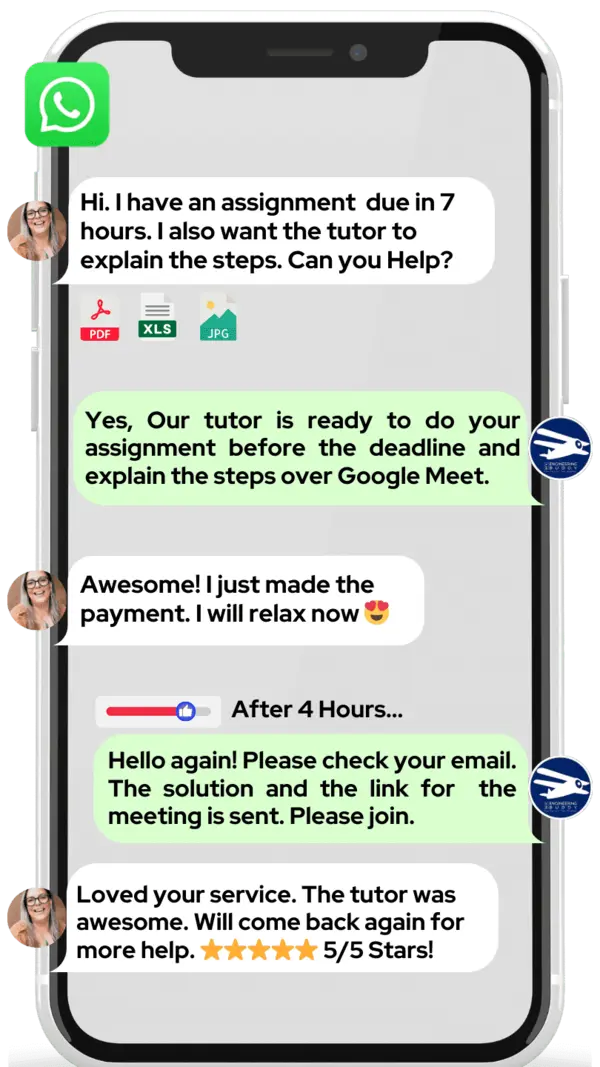
WhatsApp MEB for a quick quote — average response time under 1 minute.
Who This Securities Analysis Tutoring Is For
Securities Analysis sits at the intersection of accounting, economics, and financial theory. Students struggle not because the concepts are abstract, but because the course demands they apply several frameworks simultaneously under time pressure. MEB tutoring is built around that exact challenge.
- Undergraduate finance students working through equity valuation, ratio analysis, or fixed income pricing for the first time
- MBA and MSc Finance students tackling advanced portfolio theory, derivatives, or multi-factor models
- CFA Level I, II, or III candidates who need to close gaps in equity analysis, financial statement analysis, or ethics before exam day
- Students retaking after a failed first attempt — particularly those who lost marks on DCF modelling or bond duration calculations
- Students with a university conditional offer depending on their finance module grade this semester
- Parents supporting a child through a finance degree at schools like NYU Stern, LSE, Warwick Business School, HEC Paris, University of Toronto, or the University of Melbourne
Students preparing for CFA exams at institutions affiliated with the CFA Institute Research Foundation will find MEB tutors familiar with the curriculum structure and ethical standards framework tested across all three levels.
1:1 Tutoring vs Self-Study vs AI vs YouTube vs Online Courses
Self-study works if you’re disciplined, but Securities Analysis rewards practice with feedback — ratio analysis errors compound silently. AI tools explain concepts fast but can’t watch you misread a cash flow statement and correct you live. YouTube covers DCF basics well; it stops when your professor’s model diverges from the standard template. Online courses move at a fixed pace with no room for the question you’re actually stuck on. With MEB, a tutor watches you work through an equity screen in real time, spots where your assumptions break down, and corrects the reasoning — not just the answer. That’s the gap the other formats don’t close.
Outcomes: What You’ll Be Able To Do in Securities Analysis
After working with an MEB Securities Analysis tutor, you’ll be able to build and defend a discounted cash flow model from scratch, analyze financial statements to identify earnings quality issues and red flags, apply the CAPM and multi-factor models to estimate required returns, explain the relationship between bond duration, convexity, and interest rate risk, and present a structured equity research pitch with a clear buy, sell, or hold rationale. These are the outputs your assessments and employers will test — not abstract theory.
Based on feedback from 40,000+ sessions collected by MEB from 2022 to 2025, 58% of students improved by one full grade after approximately 20 hours of 1:1 tutoring in subjects like Securities Analysis. A further 23% achieved at least a half-grade improvement.
Source: MEB session feedback data, 2022–2025.
Supporting a student through Securities Analysis? MEB works directly with parents to set up sessions, track progress, and keep coursework on schedule. WhatsApp MEB — average response time is under a minute, 24/7.

What We Cover in Securities Analysis (Syllabus / Topics)
Fundamental Analysis and Equity Valuation
- Financial statement analysis: income statement, balance sheet, cash flow statement
- Ratio analysis: liquidity, profitability, leverage, and efficiency ratios
- Discounted cash flow (DCF) modelling: free cash flow projections and terminal value
- Relative valuation: P/E, EV/EBITDA, P/B, and comparable company analysis
- Earnings quality: accruals, revenue recognition, and accounting red flags
- Dividend discount models (DDM): Gordon Growth and multi-stage variants
- Equity research report structure and investment thesis writing
Core texts include Security Analysis by Graham and Dodd, Financial Statement Analysis by Penman, and Equity Asset Valuation from the CFA Institute curriculum.
Fixed Income and Debt Securities
- Bond pricing: coupon, yield to maturity, current yield, and yield spreads
- Duration and convexity: interest rate sensitivity and immunisation strategies
- Credit risk assessment: ratings frameworks, default probability, and spread analysis
- Structured products: mortgage-backed securities, asset-backed securities basics
- Yield curve analysis: term structure theories and their applications
- Fixed income securities tutoring for students covering the full CFA Level I fixed income module
Key references: Fixed Income Mathematics by Fabozzi, Bond Markets, Analysis, and Strategies by Fabozzi and Mann, and CFA Institute fixed income readings.
Portfolio Theory and Risk
- Modern Portfolio Theory (MPT): efficient frontier, diversification, and covariance
- Capital Asset Pricing Model: beta estimation, security market line, alpha
- Multi-factor models: Fama-French three-factor and Carhart four-factor frameworks
- Performance measurement: Sharpe ratio, Treynor ratio, Jensen’s alpha
- Risk-adjusted return frameworks and performance measurement tutoring
- Derivatives basics: options, futures, and hedging strategies as applied to portfolio management
Texts commonly used: Investments by Bodie, Kane, and Marcus; Modern Portfolio Theory and Investment Analysis by Elton, Gruber, and Brown.
At MEB, we’ve found that Securities Analysis students lose the most marks not on theory questions, but on applied modelling tasks where one wrong assumption cascades through an entire valuation. The tutor’s job is to catch that error at step two, not at the final answer.
What a Typical Securities Analysis Session Looks Like
The tutor opens by checking the previous topic — usually something like a DCF the student attempted independently or a ratio analysis problem from a past assignment. From there, the session moves into live work: the student shares their screen or the tutor uses a digital pen-pad to walk through an equity valuation side by side, covering line items like EBIT margin assumptions, working capital movements, or bond yield calculations in real time. If the student misread a footnote in the financial statements or applied the wrong discount rate, the tutor flags it immediately and explains why it matters to the final output. The session closes with a specific practice task — typically a comparable company analysis or a bond duration problem — and the tutor notes the next topic in sequence before signing off.
How MEB Tutors Help You with Securities Analysis (The Learning Loop)
Diagnose: In the first session, the tutor works through a short assessment — a valuation problem or a ratio analysis — to identify exactly where understanding breaks down. Is it accounting mechanics? Discount rate selection? Model structure? The gap shapes every session that follows.
Explain: The tutor works through live problems using a digital pen-pad, building models from scratch in real time. No pre-recorded lectures. No slides. The explanation is calibrated to what the student didn’t follow, not what the textbook covers next.
Practice: The student attempts the next problem with the tutor present. This matters more than the explanation — Securities Analysis is a skill that requires repetition under conditions that simulate exam pressure, not passive listening.
Feedback: Every error gets a step-by-step breakdown. The tutor identifies not just what went wrong, but at which decision point the reasoning diverged. That specificity is what closes marks gaps in assignments and exams.
Plan: At the end of each session, the tutor logs progress, sets the next task, and maps the topics remaining before the exam or assignment deadline. Students working toward investment management roles or CFA qualification benefit from a sequence that links Securities Analysis content to practical application.
Sessions run on Google Meet. The tutor uses a digital pen-pad or iPad with Apple Pencil to annotate models and work through calculations visibly. Before your first session, share your course outline or syllabus, a recent piece of work you found difficult, and your exam or submission date. The first session covers the diagnostic and the first substantive gap — expect to leave with something concrete you can practise independently.
Start with the $1 trial — 30 minutes of live tutoring that also serves as your first diagnostic.
Students consistently tell us that the shift happens when they stop reading about DCF models and start building one with someone who can catch their assumptions live. Passive study and active work are not the same thing. The gap between them is where grades are won or lost.
Tutor Match Criteria (How We Pick Your Tutor)
Not every finance tutor can cover Securities Analysis at graduate or CFA level. MEB matches on specifics.
Subject depth: Tutors are vetted for the exact level you’re studying — undergraduate ratio analysis, MSc portfolio theory, or CFA Level II equity valuation are different demands. The match reflects that.
Tools: Every tutor works on Google Meet with a digital pen-pad or iPad and Apple Pencil. No whiteboards photographed on a phone.
Time zone: Tutors are matched to your region — US, UK, Gulf, Canada, or Australia — so sessions happen at hours that work for your schedule, not just the tutor’s.
Goals: Exam score improvement, conceptual depth, homework completion, dissertation support — the match accounts for what you’re actually trying to achieve, including whether you’re working toward a role in investment banking or asset management and need applied fluency, not just pass marks.
Unlike platforms where you fill out a form and wait, MEB responds in under a minute, 24/7. Tutor match takes under an hour. The $1 trial means you test before you commit. Everything runs over WhatsApp — no logins, no intake forms.
Study Plans (Pick One That Matches Your Goal)
Catch-up (1–3 weeks): for students with specific gaps — a failed valuation model, a weak fixed income block — that need closing before an assignment or exam deadline. Exam prep (4–8 weeks): structured revision covering all testable components, with past paper practice and model-building sessions built into the sequence. Weekly support: ongoing sessions aligned to lecture pace and coursework deadlines, running across the full semester. The tutor sets the specific sequence after the first diagnostic — no two students follow the same plan, because no two students have the same gaps.
Pricing Guide
Securities Analysis tutoring runs from $20 to $40 per hour for most undergraduate and early graduate courses. Specialist tutors for CFA Level II/III, advanced derivatives, or quantitative equity strategies are available up to $100/hr. Rate factors include level, topic complexity, your timeline, and tutor availability in your region.
Availability tightens significantly during CFA exam windows (typically February/May/August) and semester finals. If you have a fixed date, booking ahead is worth it.
For students targeting roles at top-tier asset managers, hedge funds, or investment banks — or aiming for CFA charterholder status — tutors with direct industry or research backgrounds are available at higher rates. Share your specific goal and MEB will match the tier to your ambition.
Start with the $1 trial — 30 minutes, no registration, no commitment. WhatsApp MEB for a quick quote.
FAQ
Is Securities Analysis hard?
It’s demanding because it combines accounting mechanics, financial theory, and applied modelling — and tests all three simultaneously. Most students find DCF construction and fixed income pricing the steepest curves. With a tutor working through these live, the difficulty drops fast.
How many sessions are needed?
Students with one or two specific gaps — a failed valuation model or a weak fixed income block — often see measurable improvement in 4–6 sessions. A full-semester support plan or CFA prep typically runs 15–25 sessions, depending on starting level and exam date.
Can you help with homework and assignments?
MEB tutoring is guided learning — you understand the work, then submit it yourself. The tutor explains the method, works through a similar problem with you, and checks your reasoning. See our Academic Integrity policy and Why MEB page for full details on what we help with and what we don’t.
Will the tutor match my exact syllabus or exam board?
Yes. Before matching, MEB asks for your course outline, institution, and any exam board details. Whether you’re on a CFA curriculum, a university finance module, or an MBA programme at a specific school, the tutor is matched to that exact specification — not a generic finance syllabus.
What happens in the first session?
The tutor runs a short diagnostic — typically a valuation or ratio analysis problem — to identify precisely where your understanding breaks down. From there, the session moves into substantive work on the first real gap. You leave with something specific to practise before the next session.
Is online tutoring as effective as in-person?
For Securities Analysis, yes. The tutor uses a digital pen-pad to annotate financial models and work through calculations in real time on Google Meet. Students working on DCF models, bond pricing, or portfolio construction find the screen-sharing and annotation tools more effective than a physical whiteboard.
What’s the difference between CFA Level I, II, and III Securities Analysis content — and can MEB help with all three?
Level I tests conceptual understanding across asset classes — equity, fixed income, derivatives basics. Level II is heavily application-focused, with item sets built around financial statement analysis and equity valuation models. Level III shifts toward portfolio construction and performance evaluation. MEB tutors cover all three levels, matched by level-specific expertise.
Can MEB help with the equity research component of a university finance course, not just the theory?
Yes. Many undergraduate and MBA programmes require a full equity research report — covering company analysis, valuation, and an investment recommendation. MEB tutors help students structure the report, stress-test the model assumptions, and sharpen the investment thesis. The work remains entirely the student’s own.
Do you offer group Securities Analysis sessions?
MEB sessions are 1:1 only. Group sessions introduce a fixed pace and reduce the time spent on each student’s specific gaps — the opposite of what MEB is built to do. Every session is calibrated entirely to one student’s syllabus, current level, and exam date.
Can I get Securities Analysis help at midnight or over weekends?
Yes. MEB operates 24/7 and tutors are available across time zones. Students in the US, Gulf, and Australia regularly book late-night or weekend sessions. WhatsApp MEB at any hour and expect a response within a minute.
How do I find a Securities Analysis tutor in my city?
MEB tutoring is fully online — city location doesn’t affect tutor quality or availability. Students in New York, London, Dubai, Toronto, and Sydney all access the same verified tutor pool. Search location doesn’t limit your options; time zone preference does, and MEB matches for that.
How do I get started?
Start with the $1 trial — 30 minutes of live tutoring or one homework question explained in full. Three steps: WhatsApp MEB, get matched to a verified Securities Analysis tutor within the hour, then run your first diagnostic session.
Trust & Quality at My Engineering Buddy
Every MEB tutor goes through a multi-stage screening process: subject knowledge assessment, a live demo session evaluated by MEB’s academic team, and an ongoing review cycle based on student feedback. Tutors covering Securities Analysis hold relevant qualifications — CFA designation, finance-focused postgraduate degrees, or direct industry experience in equity research, asset management, or investment banking. Rated 4.8/5 across 40,000+ verified reviews on Google.
MEB tutoring is guided learning — you understand the work, then submit it yourself. For full details on what we help with and what we don’t, read our Academic Integrity policy and Why MEB.
MEB has been serving students across the US, UK, Canada, Australia, Gulf, and Europe since 2008 — across 2,800+ subjects. Finance subjects are among the most in-demand on the platform, with students regularly seeking help in quantitative finance tutoring, derivatives pricing help, and CAPM tutoring alongside their core Securities Analysis coursework. The platform’s subject depth means a student can move from foundational ratio analysis in one session to advanced multi-factor modelling in the next — without switching providers.
A common pattern our tutors observe is that students who arrive thinking they have a “maths problem” in Securities Analysis actually have a conceptual gap in how accounting flows into a valuation model. Fixing the concept fixes the maths. Not the other way around.
Explore Related Subjects
Students studying Securities Analysis often also need support in:
- Alternative Investments
- Business Valuation, Corporate Restructuring & Insolvency
- Credit Risk
- Financial Economics
- Mergers & Acquisitions (M&A)
- Private Equity
- Valuation
Next Steps
When you WhatsApp MEB, have the following ready:
- Your course outline or exam board (or CFA level), and the topic you’re stuck on
- A recent past paper attempt, homework problem, or assignment you struggled with
- Your exam or submission date, and your available time zones for sessions
MEB matches you with a verified Securities Analysis tutor — usually within 24 hours, often within the hour. The first session starts with a diagnostic so every minute of your time is used toward the gaps that matter most.
Visit www.myengineeringbuddy.com for more on how MEB works.
WhatsApp to get started or email meb@myengineeringbuddy.com.
Reviewed by Subject Expert
This page has been carefully reviewed and validated by our subject expert to ensure accuracy and relevance.