Hire Verified & Experienced
Analog Electronics Tutors
4.8/5 40K+ session ratings collected on the MEB platform



Hire The Best Analog Electronics Tutor
Top Tutors, Top Grades. Without The Stress!
52,000+ Happy Students From Various Universities





How Much For Private 1:1 Tutoring & Hw Help?
Private 1:1 Tutoring and HW help Cost $20 – 35 per hour* on average.
Analog Electronics is one of those subjects where the gap between understanding the theory and solving a real circuit problem can feel enormous — and a single missed concept in week two compounds into five failed problem sets by week six.
Analog Electronics Tutor Online
Analog Electronics is the study of continuous-signal circuits — including diodes, transistors, op-amps, and amplifiers — equipping students to design, analyze, and troubleshoot real-world electronic systems used in communications, instrumentation, and signal processing.
MEB provides 1:1 online tutoring and homework help in Electrical Engineering and its core subjects, including Analog Electronics. If you’ve searched for an Analog Electronics tutor near me and want someone who knows your exact syllabus — not a generalist who guesses — MEB matches you with a verified subject specialist within the hour. Sessions run over Google Meet with a digital pen-pad, so working through BJT biasing or op-amp frequency response feels as direct as a whiteboard.
- 1:1 online sessions tailored to your course syllabus — whether undergraduate, graduate, or professional level
- Expert verified tutors with specific experience in analog circuit analysis and design
- Flexible time zones — US, UK, Canada, Australia, Gulf, and Europe
- Structured learning plan built after a diagnostic session that identifies your exact gaps
- Ethical homework and assignment guidance — you understand the work, then submit it yourself
52,000+ students across the US, UK, Canada, Australia, and the Gulf have used MEB since 2008 — including students in Electrical Engineering subjects like Analog Electronics, Circuit Analysis, and Semiconductor Devices.
Source: My Engineering Buddy, 2008–2025.
How Much Does an Analog Electronics Tutor Cost?
Most Analog Electronics tutoring sessions run $20–$40/hr. Graduate-level or highly specialized topics — IC design, RF amplifier analysis, Cadence Virtuoso simulation — can reach $60–$100/hr. Start with the $1 trial: 30 minutes of live 1:1 tutoring or one homework question explained in full, no registration required.
| Level / Need | Typical Rate | What’s Included |
|---|---|---|
| Standard undergraduate | $20–$35/hr | 1:1 sessions, homework guidance |
| Advanced / Graduate | $35–$70/hr | Expert tutor, niche circuit depth |
| $1 Trial | $1 flat | 30 min live session or 1 homework question |
Tutor availability tightens significantly around end-of-semester exam windows. Book early if you’re within six weeks of finals.
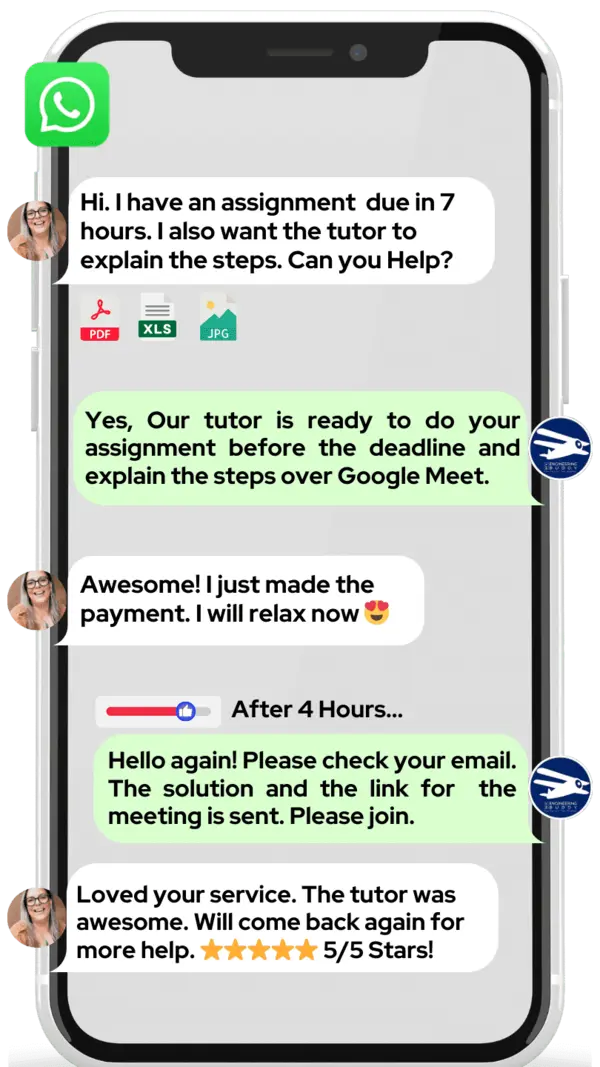
WhatsApp MEB for a quick quote — average response time under 1 minute.
Who This Analog Electronics Tutoring Is For
Analog Electronics tutoring at MEB covers everyone from students hitting their first transistor bias circuit to engineers revisiting filter design for a graduate research project. If the course is moving faster than your understanding, this is exactly the right time to get support.
- Undergraduate EE or ECE students struggling with BJT and MOSFET amplifier analysis
- Students retaking after a failed first attempt in an Analog Electronics or Circuits course
- Students with a university conditional offer depending on passing this course
- Graduate students who need to fill foundational gaps before tackling mixed-signal or VLSI design
- Students 4–6 weeks from finals with op-amp stability, feedback theory, or frequency response still unclear
- Parents watching a child’s confidence drop alongside their grades in a first-year circuits course
Students at institutions including MIT, Georgia Tech, University of Michigan, Imperial College London, University of Toronto, ETH Zurich, and the University of Sydney have used MEB for Analog Electronics support. If your programme is at a similar level, MEB tutors know the depth expected.
At MEB, we’ve found that most Analog Electronics students don’t fail because they lack ability — they fail because one early concept, usually small-signal modeling or DC biasing, wasn’t fully resolved before the course moved on. One targeted session can close a gap that’s been compounding for weeks.
1:1 Tutoring vs Self-Study vs AI vs YouTube vs Online Courses
Self-study works if you’re disciplined, but analog circuits require you to catch your own errors — and that’s exactly where most students get stuck. AI tools can explain a concept quickly but can’t watch you set up a load line wrong and correct it in real time. YouTube is great for overviews of common amplifier topologies, but stops the moment your specific problem diverges from the video’s example. Online courses move at a fixed pace with no adjustment for where you personally lost the thread. With a 1:1 Analog Electronics tutor from MEB, the session is calibrated to your exact course, your exact mistake, and your exact exam board — correcting errors before they become habits.
Outcomes: What You’ll Be Able To Do in Analog Electronics
After working with an online Analog Electronics tutor through MEB, you’ll be able to analyze BJT and MOSFET amplifier circuits using small-signal models without guessing at the approach. You’ll solve multi-stage amplifier gain problems, apply Thevenin equivalents to complex networks, and explain why a feedback configuration affects bandwidth the way it does. You’ll model op-amp circuits for real applications — active filters, comparators, instrumentation amplifiers — and present your reasoning clearly in an exam or lab report context. Students who complete structured sessions stop second-guessing their circuit intuition.
Based on feedback from 40,000+ sessions collected by MEB from 2022 to 2025, 58% of students improved by one full grade after approximately 20 hours of 1:1 tutoring in subjects like Analog Electronics. A further 23% achieved at least a half-grade improvement.
Source: MEB session feedback data, 2022–2025.
Supporting a student through Analog Electronics? MEB works directly with parents to set up sessions, track progress, and keep coursework on schedule. WhatsApp MEB — average response time is under a minute, 24/7.
Try your first session for $1 — 30 minutes of live 1:1 tutoring or one homework question explained in full. No registration. No commitment. WhatsApp MEB now and get matched within the hour.
What We Cover in Analog Electronics (Syllabus / Topics)

Track 1: Semiconductor Devices and Biasing
- Diode operation, models, and rectifier circuits
- BJT structure, operating regions, and DC biasing configurations
- MOSFET operation — enhancement vs depletion mode, biasing, and load lines
- Small-signal models: hybrid-pi and T-models for BJT and MOSFET
- Biasing stability, Q-point design, and thermal considerations
- Introduction to Integrated Circuits and device matching in ICs
Key references: Sedra & Smith Microelectronic Circuits; Neamen Microelectronics: Circuit Analysis and Design; Razavi Fundamentals of Microelectronics.
Track 2: Amplifier Analysis and Frequency Response
- Common-emitter, common-base, and common-collector amplifier configurations
- Common-source and common-gate MOSFET amplifier stages
- Multi-stage amplifier gain, input/output impedance analysis
- Frequency response: low- and high-frequency models, Miller approximation
- Bode plots and bandwidth estimation for amplifier stages
- Differential amplifiers and operational amplifier internal structure
- Current mirrors and active loads
Key references: Boylestad & Nashelsky Electronic Devices and Circuit Theory; Sedra & Smith Microelectronic Circuits; Razavi Design of Analog CMOS Integrated Circuits.
Track 3: Feedback, Op-Amp Circuits, and Filters
- Negative feedback topologies: series-shunt, shunt-series, and their effect on gain and impedance
- Stability analysis: gain margin, phase margin, Nyquist criterion
- Op-amp ideal and non-ideal characteristics: offset voltage, slew rate, CMRR, PSRR
- Op-amp circuit applications: inverting/non-inverting amplifiers, integrators, differentiators, comparators
- Active filter design: Butterworth, Chebyshev, Sallen-Key topologies
- Oscillator circuits: Wien bridge, phase-shift, LC oscillators
- Analog signal processing applications in instrumentation and communications
Key references: Razavi Design of Analog CMOS Integrated Circuits; Franco Design with Operational Amplifiers and Analog Integrated Circuits; Horowitz & Hill The Art of Electronics.
Platforms, Tools & Textbooks We Support
Analog Electronics courses at most universities involve simulation alongside theory. MEB tutors are familiar with the tools your course likely uses, so sessions don’t slow down when you switch from paper analysis to simulation.
- LTspice — DC operating point, transient, and AC analysis of analog circuits
- Multisim — circuit simulation and virtual oscilloscope work
- PSpice — industry-standard SPICE simulation for amplifier and filter circuits
- Cadence Virtuoso — schematic entry and simulation for IC-level analog design
- MATLAB — for frequency response plots, Bode analysis, and filter transfer functions
- MIT OpenCourseWare — Feedback Systems course materials, freely available for supplementary reference
What a Typical Analog Electronics Session Looks Like
The tutor opens by checking where you left off — usually the small-signal equivalent circuit or the frequency response derivation from the previous session. You share your screen or a photo of the problem. Working through a common-emitter amplifier gain calculation, the tutor writes step-by-step on a digital pen-pad while you follow on Google Meet. When you make an error in applying the Miller approximation, it gets caught immediately and corrected with a brief explanation of why the standard shortcut breaks in that circuit configuration. You then replicate the approach on a similar problem while the tutor observes. The session closes with a specific practice task — two more amplifier problems from your textbook — and the next topic, op-amp stability margins, is flagged so you arrive prepared.
How MEB Tutors Help You with Analog Electronics (The Learning Loop)
Diagnose: In the first session, the tutor works through a short problem set with you — not to test you, but to identify exactly where your reasoning breaks down. For most Analog Electronics students, it’s either the DC biasing approach or the transition to small-signal analysis. Everything that follows is built around those gaps.
Explain: The tutor works through problems live on a digital pen-pad — drawing circuit models, annotating Bode plots, deriving gain expressions step by step. No pre-recorded slides. The explanation adjusts based on where you lose the thread.
Practice: You attempt a problem with the tutor present. Not after the session. During it. That’s when errors surface, and that’s when they get fixed before they become habits.
Feedback: Each mistake is traced back to its root. If you set up the small-signal model wrong, the tutor shows you exactly which assumption failed and why — not just the corrected answer. That’s what changes exam performance.
Plan: At the end of every session, the tutor notes what’s solid, what needs one more pass, and what the next session will cover. You don’t come back to re-explain where you are — the plan carries that forward.
Sessions run on Google Meet. The tutor uses a digital pen-pad or iPad with Apple Pencil to draw circuits and work equations in real time. Before your first session, share your course syllabus or textbook chapter, one problem you couldn’t fully solve, and your exam or assignment deadline. The first session doubles as your diagnostic. Start with the $1 trial — 30 minutes of live tutoring that functions as that diagnostic and costs you nothing beyond a dollar.
Students consistently tell us that the shift happens when they stop trying to memorise circuit results and start building them from first principles in every session. The tutor’s job is to make first-principles reasoning feel natural — not intimidating.
Tutor Match Criteria (How We Pick Your Tutor)
MEB doesn’t assign the first available tutor. The match is built around four criteria.
Subject depth: The tutor has direct experience with your specific course level — whether that’s a first-year circuits module, a graduate-level analog IC design course, or anything between. Syllabus fit matters. A tutor who has taught BJT amplifier analysis at undergraduate level and analog CMOS design at graduate level are different matches for different students.
Tools: The tutor works comfortably in the simulation environment your course uses — LTspice, Multisim, PSpice, or Cadence Virtuoso — and can support you through lab simulations during the session itself.
Time zone: Matched to your region — US, UK, Gulf, Canada, or Australia — so sessions happen at hours that don’t require either party to be awake at 3am.
Goals: Exam score, homework completion, conceptual depth for research, or just passing a resit. The goal shapes the session structure from the first meeting.
Unlike platforms where you fill out a form and wait, MEB responds in under a minute, 24/7. Tutor match takes under an hour. The $1 trial means you test before you commit. Everything runs over WhatsApp — no logins, no intake forms.
MEB has been matching students with verified Analog Electronics tutors since 2008 — across undergraduate EE programmes, graduate analog IC design courses, and electronic circuit design modules in 30+ countries.
Source: My Engineering Buddy, 2008–2025.
Study Plans (Pick One That Matches Your Goal)
After your diagnostic session, the tutor builds a specific sequence. Three common structures: a catch-up plan covering your biggest gaps over 1–3 weeks before a deadline; a structured exam prep plan running 4–8 weeks with weekly topic progression through amplifiers, feedback, and filters; or ongoing weekly support aligned to your semester schedule and assignment due dates. The tutor decides the sequence — you focus on doing the work.
Pricing Guide
Standard Analog Electronics tutoring runs $20–$40/hr for most undergraduate levels. Graduate-level topics — analog IC design, Cadence Virtuoso-based coursework, advanced filter synthesis — can run $60–$100/hr depending on tutor background and session complexity. Rate factors include your course level, topic, how close your exam date is, and tutor availability.
Availability tightens sharply in the four weeks before end-of-semester exams. If you’re in that window, reach out now rather than next week.
For students targeting roles in semiconductor design, RF engineering, or IC development at companies like Qualcomm, Texas Instruments, or Intel, tutors with relevant industry backgrounds are available at higher rates — share your specific goal and MEB will match the tier to your ambition.
Start with the $1 trial — 30 minutes, no registration, no commitment. WhatsApp MEB for a quick quote.
FAQ
Is Analog Electronics hard?
Yes — it’s consistently ranked among the most challenging undergraduate EE modules. The combination of device physics, circuit analysis techniques, and frequency-domain thinking requires several concepts to work together simultaneously. Most students hit a wall at small-signal modeling or feedback stability. Those specific gaps are exactly what MEB tutors target first.
How many sessions are needed?
Students closing one or two topic gaps typically need 4–6 sessions. A full semester of support — covering devices, amplifiers, feedback, and filters — usually runs 15–25 sessions depending on course pace and starting level. The tutor gives you a clearer estimate after the first diagnostic session.
Can you help with homework and assignments?
MEB tutoring is guided learning — you understand the work, then submit it yourself. The tutor explains the approach, works through the method, and checks your reasoning. See our Academic Integrity policy and Why MEB page for full details on what we help with and what we don’t.
Will the tutor match my exact syllabus or exam board?
Yes. Before matching, MEB asks for your university, course name, and textbook. Tutors are matched to your specific syllabus — not to a generic “Analog Electronics” curriculum. Students on Sedra & Smith courses get different treatment than those using Razavi or Boylestad.
What happens in the first session?
The tutor runs a short diagnostic — a few targeted problems to identify where your understanding breaks down. No judgment, no test pressure. The rest of the session covers your most urgent topic, and the tutor maps a plan for what follows. You leave with a clear next step.
Is online tutoring as effective as in-person?
For circuit analysis and analog design work, yes. The digital pen-pad replicates whiteboard interaction on Google Meet. Students who struggled with in-person group tutorials often find 1:1 online sessions faster — there’s no waiting for others, and every minute is on your specific problem.
What’s the difference between Analog Electronics and Digital Electronics — and can I get help with both?
Analog Electronics covers continuous-signal circuits: amplifiers, filters, oscillators, and real-world device behavior. Digital Electronics deals with logic-level switching and binary signal processing. Many EE programmes require both. MEB tutors cover either or both within the same session structure if your course integrates them.
Do MEB tutors help with LTspice or Multisim simulations as part of homework?
Yes. Simulation assignments are common in Analog Electronics courses. Tutors can walk through LTspice AC analysis, transient simulations, and component parameter setup during the session. The explanation focuses on why the simulation behaves as it does — not just how to click through the software.
Can I get Analog Electronics help at midnight or on weekends?
Yes. MEB operates across time zones and tutors are available late evenings and weekends. WhatsApp response time averages under a minute, 24/7. For late-night bookings, share your time zone and preferred hours when you make contact.
What if I don’t like my assigned tutor?
Request a change via WhatsApp. MEB will match you with a different tutor — no forms, no waiting period. The $1 trial is designed partly so you can assess the match before committing to full sessions. Fit matters, and MEB won’t hold you to a tutor who isn’t working for you.
How do I get started?
Three steps: WhatsApp MEB, get matched with a verified Analog Electronics tutor within the hour, then start your $1 trial — 30 minutes of live tutoring or one homework question explained in full. No registration, no upfront commitment beyond a dollar.
Can I get help with op-amp stability and compensation techniques specifically?
Yes. Op-amp stability — phase margin, gain margin, frequency compensation, and preventing oscillation in closed-loop configurations — is one of the most commonly requested Analog Electronics topics. Tutors cover Miller compensation, lead-lag networks, and two-stage op-amp design in detail.
Trust & Quality at My Engineering Buddy
Every MEB tutor goes through subject-specific screening before their first session — a live demo evaluation, degree verification, and review of their experience with the specific course level they’ll be teaching. Rated 4.8/5 across 40,000+ verified reviews on Google. Ongoing session feedback is used to maintain standards, not just to collect ratings. Tutors who consistently perform in the top tier on a subject like Analog Circuits or Signals and Systems are prioritised for new student matches in those areas.
MEB tutoring is guided learning — you understand the work, then submit it yourself. For full details on what we help with and what we don’t, read our Academic Integrity policy and Why MEB.
MEB has served 52,000+ students across the US, UK, Canada, Australia, Gulf, and Europe since 2008 — across 2,800+ subjects. Electrical Engineering is one of the highest-demand categories on the platform, with Analog Communication and Power Electronics among the most frequently requested alongside Analog Electronics. Sessions are delivered by tutors with engineering degrees and, in many cases, industry backgrounds in semiconductor, RF, or IC design. See our tutoring methodology for how sessions are structured.
A common pattern our tutors observe is that students arrive thinking they need to cover the entire syllabus again. Usually, they don’t. They need three or four specific concepts resolved properly — and once those are solid, the rest of the material falls into place faster than expected.
Explore Related Subjects
Students studying Analog Electronics often also need support in:
- Basic Electronics
- Digital Signal Processing
- Microelectronics
- VLSI Design
- Network Theory
- Electromagnetic Field Theory
- Control Systems
- Microwave Engineering
MEB covers 2,800+ advanced subjects — if your programme includes Embedded Systems, Digital Communications, or PCB Design alongside Analog Electronics, MEB tutors cover those modules too.
Source: My Engineering Buddy, 2008–2025.
Next Steps
Before your first session, have ready: your course syllabus or textbook chapter, a recent homework problem or past exam question you couldn’t fully solve, and your assignment or exam deadline date. The tutor handles everything from there.
- Share your course name, university, and which topics are giving you the most trouble
- Share your availability and time zone
- MEB matches you with a verified Analog Electronics tutor — usually within the hour
The first session starts with a diagnostic so every minute is on something that actually moves your grade. Visit www.myengineeringbuddy.com for more on how MEB works.
WhatsApp to get started or email meb@myengineeringbuddy.com.
Reviewed by Subject Expert
This page has been carefully reviewed and validated by our subject expert to ensure accuracy and relevance.