~1 min
Average Reply Time
~1 hour
To Be Matched With A Tutor
30 Min Trial
75% Find Their Tutor On The 1st Trial
$20-35+/hr
Premium Yet Affordable Learning
Civil procedure nearly failed your moot. You knew the law — but you didn’t know which court, which form, or which deadline applied.
Civil Procedure Tutor Online
Civil procedure governs the rules and processes by which civil claims are initiated, managed, and resolved in court. It covers jurisdiction, pleadings, service of process, discovery, motions, trial procedure, and appeals across common law and civil law systems.
Finding a reliable civil procedure tutor near me online used to mean sifting through generic platforms with no subject-specific screening. MEB offers 1:1 online tutoring and homework help in civil procedure — matched to your course, your jurisdiction, and your exam structure. Whether you’re covering the Federal Rules of Civil Procedure, the Civil Procedure Rules (CPR) in England and Wales, or a comparative procedure module at postgraduate level, a law tutor from MEB works through your exact syllabus from session one. Most students notice sharper clarity on procedural stages and case management rules within the first few sessions.
- 1:1 online sessions tailored to your course syllabus and jurisdiction
- Expert-verified tutors with academic and practitioner backgrounds in civil litigation
- Flexible time zones — US, UK, Canada, Australia, Gulf
- Structured learning plan built after a diagnostic session
- Ethical homework and assignment guidance — you understand the work, then submit it yourself
52,000+ students across the US, UK, Canada, Australia, and the Gulf have used MEB since 2008 — including students in Law subjects like Civil Procedure, Criminal Procedure, and Law of Evidence.
Source: My Engineering Buddy, 2008–2025.
How Much Does a Civil Procedure Tutor Cost?
Civil procedure tutoring at MEB starts at $20–$40/hr for most undergraduate and postgraduate levels. Specialist tutors with litigation or judicial practice backgrounds are available at higher rates. Try the $1 trial first — 30 minutes of live tutoring or one full homework question explained.
| Level / Need | Typical Rate | What’s Included |
|---|---|---|
| Undergraduate (LLB / JD 1L–2L) | $20–$35/hr | 1:1 sessions, homework guidance |
| Graduate / LLM / Bar Prep | $35–$70/hr | Expert tutor, jurisdiction-specific depth |
| $1 Trial | $1 flat | 30 min live session or 1 homework question |
Tutor availability tightens significantly in the weeks before law school finals and bar examination windows. Book early if your deadline is within four weeks.
WhatsApp MEB for a quick quote — average response time under 1 minute.
Who This Civil Procedure Tutoring Is For
Civil procedure is one of the most technically demanding first-year law courses — not because the concepts are abstract, but because the rules interact with each other in ways that only become clear through worked examples. This tutoring is built for students who need that clarity fast.
- 1L and 2L students at US law schools struggling with jurisdiction, pleading standards, or discovery rules under the FRCP
- LLB students in the UK working through CPR Part 36 offers, case management conferences, and costs rules
- LLM and postgraduate students on comparative civil procedure modules
- Students retaking after a failed first attempt — whether a final exam or a moot problem they couldn’t map procedurally
- Students with a conditional offer to a graduate programme depending on their current civil procedure grade
- Parents supporting a law student who is losing ground on procedural rules while keeping up with substantive courses
Students have come to MEB from programmes at Harvard Law, University College London, Osgoode Hall, Melbourne Law School, and the University of Toronto, among others. The tutor covers whatever jurisdiction and course structure you’re on.
At MEB, we’ve found that civil procedure students often know the underlying law cold — it’s the procedural sequencing that trips them. A student who can argue negligence may not know whether to file a 12(b)(6) or wait for summary judgment. That gap is exactly what 1:1 sessions are designed to close, one decision point at a time.
1:1 Tutoring vs Self-Study vs AI vs YouTube vs Online Courses
Self-study works if you’re disciplined, but civil procedure has no feedback loop — you won’t know you’ve misread the pleading standard until the exam. AI tools give fast definitions but can’t work through a multi-party jurisdiction problem with you in real time. YouTube covers overview concepts well and stops the moment your question gets jurisdiction-specific. Online courses are structured but fixed-pace with no room for your specific exam board or professor’s approach. 1:1 tutoring with MEB is live, calibrated to your exact FRCP or CPR syllabus, and corrects procedural reasoning errors the moment they appear — not three days later when you get your paper back.
Outcomes: What You’ll Be Able To Do in Civil Procedure
After working with a civil procedure tutor at MEB, you’ll be able to analyze subject matter jurisdiction and personal jurisdiction in multi-defendant federal cases without a flowchart. You’ll apply Rule 12 defenses correctly and explain why a motion to dismiss differs from a motion for summary judgment in both standard and timing. You’ll write a coherent statement of claim or complaint that satisfies Twombly/Iqbal plausibility or CPR Part 16 requirements, depending on your jurisdiction. You’ll also present a case management timeline that accounts for discovery obligations, pre-trial disclosure, and costs exposure — skills that show up directly in problem questions and moots.
Based on feedback from 40,000+ sessions collected by MEB from 2022 to 2025, 58% of students improved by one full grade after approximately 20 hours of 1:1 tutoring in subjects like Civil Procedure. A further 23% achieved at least a half-grade improvement.
Source: MEB session feedback data, 2022–2025.
Try your first session for $1 — 30 minutes of live 1:1 tutoring or one homework question explained in full. No registration. No commitment. WhatsApp MEB now and get matched within the hour.
What We Cover in Civil Procedure (Syllabus / Topics)

Track 1: US Federal Civil Procedure (FRCP)
- Subject matter jurisdiction — federal question, diversity, and supplemental jurisdiction
- Personal jurisdiction — minimum contacts, purposeful availment, and long-arm statutes
- Pleading standards — Rule 8, Rule 12(b)(6), Twombly and Iqbal plausibility
- Discovery — Rule 26 disclosures, interrogatories, depositions, and proportionality limits
- Summary judgment under Rule 56 — burden of proof, non-movant obligations
- Class actions under Rule 23 — certification requirements, commonality, predominance
- Appeals — final judgment rule, interlocutory appeals, and mandamus
Core texts include Glannon’s Civil Procedure: Examples & Explanations, Friedenthal, Kane & Miller’s Civil Procedure, and Yeazell & Schwartz’s Civil Procedure.
Track 2: English Civil Procedure (CPR)
- Overriding objective and active case management under CPR Part 1 and Part 3
- Pre-action protocols and the consequences of non-compliance
- Statements of case — particulars of claim, defence, counterclaim (CPR Parts 15–16)
- Part 36 offers — procedure, costs consequences, and tactical use
- Interim remedies — freezing injunctions, search orders, and interim injunctions
- Small claims, fast track, and multi-track allocation
- Costs and costs management orders under CPR Parts 44–47
Core texts include Sime’s A Practical Approach to Civil Procedure, Andrews on Civil Processes, and the Civil Procedure Rules (White Book or Green Book editions).
Track 3: Comparative and Postgraduate Civil Procedure
- Adversarial vs inquisitorial systems — structural differences and evidential implications
- Transnational litigation — Brussels I Regulation (Recast), Hague Service Convention
- Enforcement of foreign judgments and recognition principles
- Arbitration and its relationship to civil court procedure
- Access to justice — legal aid frameworks, conditional fee arrangements, costs rules
- Procedural harmonisation in EU and international civil justice
Relevant texts include Zuckerman on Civil Procedure, Andrews’ Principles of Civil Procedure, and selected articles from the Oxford Journal of Legal Studies.
What a Typical Civil Procedure Session Looks Like
The tutor opens by checking the previous topic — say, whether the student correctly mapped personal jurisdiction under International Shoe or applied the Bristol-Myers Squibb specific jurisdiction test. From there, the session moves to the student’s current problem: a multi-party FRCP scenario or a CPR Part 36 costs question. The tutor uses a digital pen-pad to annotate the procedural flowchart in real time — showing where jurisdiction fails, where the pleading falls short of Twombly, or why the claimant’s statement of case would be struck under CPR 3.4. The student then replicates the analysis on a fresh problem, talking through their reasoning out loud so the tutor can catch the moment the logic breaks. The session closes with a specific practice task — usually one unseen problem question — and a note of the next topic to cover, whether that’s class action certification, discovery proportionality, or interim injunction procedure.
How MEB Tutors Help You with Civil Procedure (The Learning Loop)
Diagnose: In the first session, the tutor asks you to walk through a jurisdiction problem or draft a procedural timeline from a case summary. That five-minute exercise tells them exactly where your reasoning breaks — whether it’s at service of process, at the motion stage, or at the costs rules.
Explain: The tutor works through a live problem on the digital pen-pad — not a lecture, a worked answer. You see the decision tree built step by step: which rule applies, why, and what the court would actually do with a defective pleading.
Practice: You attempt the next problem while the tutor watches. The goal isn’t a right answer — it’s catching the moment your procedural logic diverges from the rule.
Feedback: The tutor marks each step, not just the conclusion. In civil procedure exams, marks go to process. A student who reaches the right outcome by wrong reasoning still loses points — the tutor closes that gap specifically.
Plan: Every session ends with the next topic queued and a realistic estimate of how many sessions sit between you and exam readiness. No vague reassurance.
Sessions run on Google Meet. The tutor uses a digital pen-pad or iPad with Apple Pencil. Before your first session, share your course outline or exam syllabus, a recent problem question you couldn’t structure, and your exam or submission date. Whether you need a quick catch-up before a final, structured revision over four to six weeks, or ongoing weekly support through the semester, the tutor maps the session plan after the first diagnostic. Start with the $1 trial — 30 minutes of live tutoring that also serves as your first diagnostic.
Students consistently tell us that civil procedure clicks when they stop trying to memorise rules and start reasoning through procedural sequences the way a judge would. That shift — from rule-recall to applied procedural logic — is what the learning loop is designed to produce.
Tutor Match Criteria (How We Pick Your Tutor)
Not every law tutor knows civil procedure. MEB matches on specifics.
Subject depth: Tutors are matched to your jurisdiction — FRCP, CPR, or comparative — and your level, from 1L through LLM. A tutor covering Bar prep civil procedure and one covering a UK CPR module are not interchangeable.
Tools: All tutors use Google Meet and a digital pen-pad or iPad with Apple Pencil for live annotation of procedural maps and court forms.
Time zone: Matched to your region — US, UK, Gulf, Canada, Australia — so sessions run when you’re actually available to think.
Goals: Whether you’re targeting exam scores, conceptual depth on a specific doctrine like personal jurisdiction, or structured support through a moot, the tutor is briefed before session one.
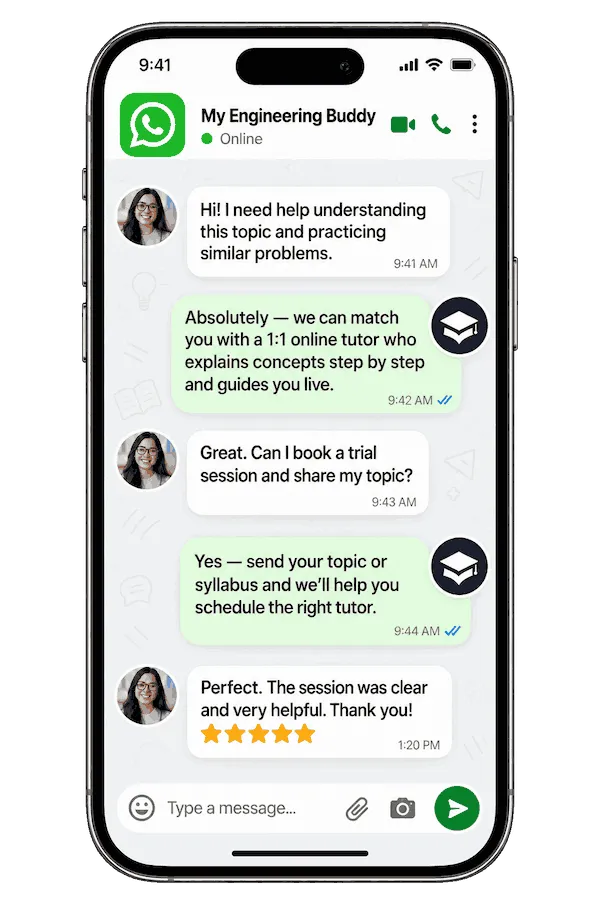
Unlike platforms where you fill out a form and wait, MEB responds in under a minute, 24/7. Tutor match takes under an hour. The $1 trial means you test before you commit. Everything runs over WhatsApp — no logins, no intake forms.
Pricing Guide
Civil procedure tutoring rates at MEB run $20–$40/hr for most undergraduate and taught postgraduate students. Tutors with practitioner backgrounds — barristers, solicitors, or former judicial clerks — are available at higher rates up to $100/hr for students targeting competitive programmes or clerkship applications.
Rate factors include your level, the jurisdiction you’re studying, the complexity of your current topic, and how close your deadline is. Availability from specialist litigation tutors tightens in the weeks before law school finals and bar exam windows — book early if you’re within four weeks of your date.
For students targeting clerkships, LLM programmes at top law schools, or the Bar, tutors with professional litigation and judicial practice backgrounds are available at higher rates — share your specific goal and MEB will match the tier to your target.
Start with the $1 trial — 30 minutes, no registration, no commitment. WhatsApp MEB for a quick quote.
FAQ
Is civil procedure hard?
Yes, for most law students. The rules are dense, jurisdiction-specific, and highly interconnected. Personal jurisdiction alone generates more exam errors than almost any other first-year topic. The difficulty isn’t abstract — it’s procedural sequencing under time pressure.
How many sessions are needed?
Students covering a single gap — say, Rule 12 motions or Part 36 costs — often need three to five sessions. Semester-long support typically runs eight to twelve sessions, depending on course pace and the student’s starting point.
Can you help with homework and assignments?
Yes. MEB tutoring is guided learning — you understand the work, then submit it yourself. See our Academic Integrity policy and Why MEB page for full details on what we help with and what we don’t. The tutor explains the procedural reasoning; you write and submit your own answer.
Will the tutor match my exact syllabus or exam board?
Yes. MEB matches on jurisdiction and course structure — FRCP for US law schools, CPR for English programmes, or comparative procedure for postgraduate modules. Share your course outline when you first contact us.
What happens in the first session?
The tutor runs a short diagnostic — usually a jurisdiction or pleading problem — to identify where your reasoning breaks. From that point, the session covers your most pressing topic. No time wasted on material you already know.
Is online tutoring as effective as in-person?
For civil procedure, yes. The pen-pad annotation on Google Meet replicates a whiteboard session. Students working through procedural flowcharts and case management timelines find the visual annotation at least as useful as in-person, often more so because the session can be recorded.
What’s the difference between the Federal Rules of Civil Procedure and the CPR — and can MEB cover both?
The FRCP governs US federal courts; the CPR governs civil litigation in England and Wales. They differ significantly in pleading standards, disclosure obligations, and costs rules. MEB has tutors for both systems, and for comparative modules that cover both simultaneously.
Can a civil procedure tutor help me prepare for Bar exam civil procedure questions?
Yes. The Multistate Bar Examination tests civil procedure under federal rules. MEB tutors familiar with MBE format work through timed practice questions, identify recurring error patterns, and cover the jurisdiction and joinder rules that appear most frequently on the exam.
What if I’m struggling specifically with personal jurisdiction after Bristol-Myers Squibb?
That’s a common sticking point. The tutor works through the specific/general jurisdiction distinction, the BMS ruling’s narrowing effect on mass tort litigation, and how to apply the analysis to problem questions — including which facts trigger which test.
How do I get started?
Start with the $1 trial — 30 minutes of live tutoring or one problem question explained in full. WhatsApp MEB, get matched to a civil procedure tutor within the hour, and begin your trial session. Three steps: message, match, start.
Can I get civil procedure help at short notice — including evenings or weekends?
Yes. MEB operates 24/7 across time zones. Most tutor matches happen within one hour of your first message. If your moot is tomorrow or your exam is in three days, send a WhatsApp now and a tutor will be confirmed the same day.
Do you offer help with civil procedure problem questions specifically, not just theory?
Problem question technique is one of the most requested focuses. The tutor works through IRAC structure applied to procedural facts — identifying which rules apply, in what order, and how to present the analysis under exam time pressure. Theory without application doesn’t pass civil procedure exams.
Trust & Quality at My Engineering Buddy
Every MEB tutor goes through subject-specific screening: a live demonstration session, review of academic and professional credentials, and an ongoing feedback review after every student session. Tutors covering civil procedure hold law degrees — LLB, JD, or LLM — and many have practitioner or academic experience in civil litigation, courts, or legal education. Rated 4.8/5 across 40,000+ verified reviews on Google. For an online civil law tutor or specialist procedural support, MEB’s vetting process goes deeper than most platforms.
MEB tutoring is guided learning — you understand the work, then submit it yourself. For full details on what we help with and what we don’t, read our Academic Integrity policy and Why MEB.
MEB has served 52,000+ students across the US, UK, Canada, Australia, Gulf, and Europe since 2008 — across 2,800+ subjects. Law is one of MEB’s strongest subject areas. Students come for help with constitutional law tutoring, tort law help, and procedural law tutoring alongside civil procedure, often working across multiple subjects in the same semester. MEB’s tutoring methodology is detailed at our tutoring methodology page.
Since 2008, MEB has matched students to subject-specific tutors — not generalists. In civil procedure, that means tutors who know the difference between a Rule 12(b)(1) and a Rule 12(b)(6) before session one begins.
Source: My Engineering Buddy, 2008–2025.
A common pattern our tutors observe is that students treat civil procedure like a statutory course — trying to memorise the rules in sequence. That approach breaks down fast on a problem question. The better method is decision-tree thinking: what’s the procedural posture, what does the rule require at this stage, what happens if the party misses this step?
Explore Related Subjects
Students studying Civil Procedure often also need support in:
Next Steps
Before your first session, have ready: your exam board and syllabus (or course outline), a recent problem question or assignment you struggled with, and your exam or submission date. The tutor handles the rest.
- Share your jurisdiction, hardest procedural topic, and current timeline
- Share your availability and time zone
- MEB matches you with a verified civil procedure tutor — usually within an hour
First session starts with a diagnostic so every minute is used well. Visit www.myengineeringbuddy.com for more on how MEB works.
WhatsApp to get started or email [email protected].
Reviewed by Subject Expert
This page has been carefully reviewed and validated by our subject expert to ensure accuracy and relevance.