




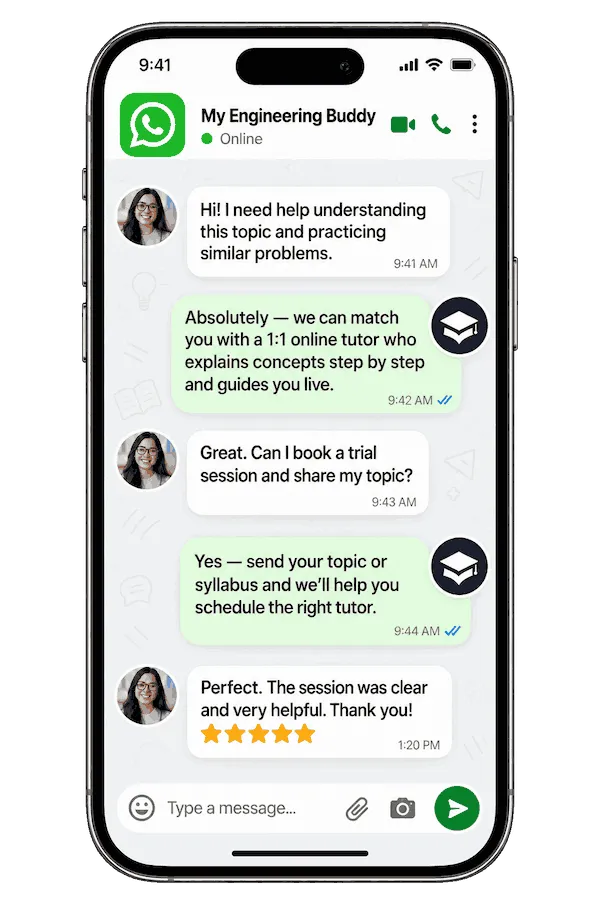
~1 min
Average Reply Time
~1 hour
To Be Matched With A Tutor
30 Min Trial
75% Find Their Tutor On The 1st Trial
$20-35+/hr
Premium Yet Affordable Learning
Most students who struggle with Criminal Procedure Code don’t lack intelligence — they lack a tutor who can walk them through arrest procedures, bail applications, and evidentiary rules without turning it into a lecture.
Criminal Procedure Code Tutor Online
Criminal Procedure Code governs the rules and processes by which criminal cases are investigated, prosecuted, and adjudicated in court. It covers arrest, bail, charge, trial procedure, sentencing, and appeals — equipping law students with the procedural framework that operates alongside substantive criminal law.
If you’ve searched for a Criminal Procedure Code tutor near me, MEB offers something better: a verified, subject-specialist tutor online who knows exactly which procedure confuses law students the most. MEB has served law students since 2008 — across 2,800+ subjects, 52,000+ students, US, UK, Canada, Australia, and the Gulf. One 1:1 session on Criminal Procedure Code can close a gap that three hours of solo reading couldn’t.
- 1:1 online sessions tailored to your exact course syllabus and jurisdiction
- Expert verified tutors with law degrees and procedural law experience
- Flexible time zones — US, UK, Canada, Australia, Gulf
- Structured learning plan built after a diagnostic session
- Ethical homework and assignment guidance — you understand before you submit
52,000+ students across the US, UK, Canada, Australia, and the Gulf have used MEB since 2008 — including students in Law subjects like Criminal Procedure Code, Criminal Law tutoring, and Law of Evidence help.
Source: My Engineering Buddy, 2008–2025.
How Much Does a Criminal Procedure Code Tutor Cost?
Most Criminal Procedure Code tutoring sessions run $20–$40/hr. Graduate-level or bar-exam procedural work can reach $100/hr depending on complexity and tutor background. New students can start with the $1 trial — 30 minutes of live tutoring or one full homework question explained in detail.
| Level / Need | Typical Rate | What’s Included |
|---|---|---|
| Undergraduate (most levels) | $20–$35/hr | 1:1 sessions, assignment guidance |
| Graduate / Bar Prep | $35–$100/hr | Expert tutor, jurisdiction-specific depth |
| $1 Trial | $1 flat | 30 min live session or 1 homework question |
Tutor availability tightens significantly in the weeks before law exams and coursework deadlines. Book early if your submission window is close.
WhatsApp MEB for a quick quote — average response time under 1 minute.
Who This Criminal Procedure Code Tutoring Is For
Criminal Procedure Code sits at the intersection of law theory and practical courtroom mechanics. Students who do well in Criminal Law often hit unexpected walls here — because procedure is detailed, jurisdiction-specific, and unforgiving on assessments.
- Undergraduate law students whose Criminal Procedure Code module marks are dragging down their GPA
- Students retaking after a failed first attempt who need a clearer procedural framework fast
- LLM and JD students working through US federal or state criminal procedure for the first time
- Students with a university conditional offer depending on this grade
- Students 4–6 weeks from an exam with significant procedural gaps still to close
- Paralegals and legal professionals seeking structured support for procedural certification
MEB tutors have supported law students at universities including Harvard, NYU, King’s College London, University of Toronto, ANU, University of Melbourne, Monash University, and the University of Amsterdam — all as plain-text context, never implied endorsements.
At MEB, we’ve found that Criminal Procedure Code is one of the most commonly misunderstood law subjects — not because it’s abstract, but because students try to memorise steps without understanding the logic behind each procedural rule. The tutor’s job is to fix that underlying gap, not paper over it.
1:1 Tutoring vs Self-Study vs AI vs YouTube vs Online Courses
Self-study works if you’re disciplined — but procedure requires application to facts, not just reading. AI tools give fast definitions, but they can’t diagnose why you keep misapplying the reasonable suspicion standard. YouTube covers bail hearings at a surface level and stops when you need to walk through a specific problem set. Online courses move at a fixed pace regardless of where your gaps are. With MEB, a Criminal Procedure Code tutor works through your actual case problems live — correcting errors in how you apply exclusionary rules or structure suppression arguments in the moment they happen.
Outcomes: What You’ll Be Able To Do in Criminal Procedure Code
After consistent 1:1 sessions, students can analyze a fact pattern and correctly identify the applicable arrest, search, or seizure standard without prompting. They can apply bail conditions and pre-trial detention rules to realistic scenarios, write structured answers to problem questions on double jeopardy and speedy trial rights, explain the chain of custody requirements for admissible evidence, and present a coherent argument on Fourth or Fifth Amendment grounds in a mock hearing format. These are outcomes with teeth — not vague “confidence” claims.
Based on feedback from 40,000+ sessions collected by MEB from 2022 to 2025, 58% of students improved by one full grade after approximately 20 hours of 1:1 tutoring in subjects like Criminal Procedure Code. A further 23% achieved at least a half-grade improvement.
Source: MEB session feedback data, 2022–2025.
Try your first session for $1 — 30 minutes of live 1:1 tutoring or one homework question explained in full. No registration. No commitment. WhatsApp MEB now and get matched within the hour.
What We Cover in Criminal Procedure Code (Syllabus / Topics)

Pre-Trial Procedure
- Arrest — lawful grounds, warrantless arrest, citizen’s arrest doctrine
- Search and seizure — Fourth Amendment standards, warrant requirements, exceptions
- Interrogation and confessions — Miranda rights, voluntariness, right to counsel
- Bail and pre-trial detention — bail hearings, detention criteria, conditions of release
- Grand jury process and indictment — federal vs state distinctions
- Charging decisions — prosecutorial discretion, plea negotiations, nolle prosequi
- Discovery obligations — Brady material, Jencks Act, defendant disclosure
Key texts: LaFave, Israel, King & Kerr, Criminal Procedure (West Academic); Dressler & Michaels, Understanding Criminal Procedure (LexisNexis).
Trial Procedure and Rights
- Right to speedy trial — constitutional standard, Barker v. Wingo factors
- Right to jury trial — scope, waiver, jury selection (voir dire)
- Double jeopardy — attachment, same-offence test, dual sovereignty doctrine
- Exclusionary rule — fruit of the poisonous tree, good faith exception
- Confrontation Clause — Crawford v. Washington, hearsay interface
- Burden of proof — reasonable doubt standard, shifting burdens in defences
Key texts: Whitebread & Slobogin, Criminal Procedure (Foundation Press); Sklansky, Evidence: Cases, Commentary and Problems (Aspen).
Post-Conviction and Appeals
- Sentencing — guidelines, judicial discretion, Apprendi doctrine
- Appeals — grounds, preservation of error, harmless error doctrine
- Habeas corpus — federal habeas under 28 U.S.C. § 2254, procedural default
- Double jeopardy at sentencing — Blockburger test applications
- Civil procedure overlaps with criminal procedure in forfeiture and civil rights claims
Key texts: Chemerinsky, Criminal Procedure (Aspen); Allen, Stuntz, Hoffmann, Livingston & Leipold, Comprehensive Criminal Procedure (Wolters Kluwer).
What a Typical Criminal Procedure Code Session Looks Like
The tutor opens by checking the previous session’s topic — usually something like suppression motions or the Miranda custody standard — and asking you to explain back what you retained. From there, you and the tutor work through a problem question on screen: maybe a fact pattern involving a warrantless vehicle search and whether the automobile exception applies. The tutor uses a digital pen-pad to annotate the steps of the analysis, and you replicate the reasoning structure in your own words. When you make an error — say, skipping the standing analysis — the tutor catches it before it becomes habit. The session closes with a specific practice task: two unseen fact patterns on the same rule, to be attempted before the next meeting.
How MEB Tutors Help You with Criminal Procedure Code (The Learning Loop)
Diagnose: In the first session, the tutor works through a short fact pattern with you and listens for where your reasoning breaks down — whether that’s confusing the Terry stop standard with full arrest, or misapplying the inevitable discovery exception.
Explain: The tutor walks through the rule, its statutory or constitutional basis, and the leading cases using a digital pen-pad on Google Meet. You see the analysis built step by step — not read from a textbook.
Practice: You attempt an unseen problem with the tutor present. No notes, no prompts after the first reminder. The tutor watches how you structure the answer — issue, rule, application, conclusion — and where you stall.
Feedback: Every error gets a specific correction. Not “that’s wrong” — but “you applied the wrong exception here because you missed the exigent circumstances threshold; here’s why the result changes.” That’s how marks are won back on criminal procedure assessments.
Plan: At the end of each session, the tutor notes what’s solid, what needs one more pass, and which topic comes next. No drifting. No repeating the same topic twice when a new one is overdue.
Sessions run on Google Meet with a digital pen-pad or iPad and Apple Pencil. Before your first session, share your course syllabus or reading list, a recent assignment or problem set you struggled with, and your exam or submission date. The tutor handles the session plan from there. Start with the $1 trial — 30 minutes of live tutoring that also serves as your first diagnostic.
Students consistently tell us that Criminal Procedure Code finally clicks when they stop treating it as a list of rules and start treating it as a decision tree. Every procedural question has a threshold, a standard, and an exception — and the tutor’s role is to make that structure second nature before the exam.
Tutor Match Criteria (How We Pick Your Tutor)
Not every law tutor can teach Criminal Procedure Code. MEB matches on four specific criteria.
Subject depth: The tutor holds a law degree at minimum and has demonstrated command of your specific jurisdiction’s procedural code — US federal, UK PACE, Australian Uniform Evidence Law, or equivalent.
Tools: Every session runs on Google Meet with a digital pen-pad or iPad and Apple Pencil — essential for annotating statutes, drawing procedural flowcharts, and marking up your written answers in real time.
Time zone: Matched to your region — US, UK, Gulf, Canada, or Australia — so sessions don’t require either party to work at 2am.
Goals: Whether you’re targeting exam scores, building conceptual depth in procedural law tutoring, closing a homework gap, or preparing for a moot, the tutor’s approach is calibrated to your actual objective — not a generic law tutoring template.
Unlike platforms where you fill out a form and wait, MEB responds in under a minute, 24/7. Tutor match takes under an hour. The $1 trial means you test before you commit. Everything runs over WhatsApp — no logins, no intake forms.
Study Plans (Pick One That Matches Your Goal)
A Criminal Procedure Code tutor at MEB builds your session sequence after the first diagnostic — but here are the three most common patterns. Catch-up (1–3 weeks): students with an exam approaching and a specific set of procedural rules still unclear — two to three sessions per week, focused tightly on the highest-yield topics. Exam prep (4–8 weeks): systematic coverage of pre-trial, trial, and post-conviction procedure with timed problem practice built in from week three. Weekly support: one session per week running alongside your semester, aligned to lecture topics and coursework deadlines. The tutor adjusts the plan after every session.
Pricing Guide
Criminal Procedure Code tutoring starts at $20/hr for undergraduate-level work. Graduate and bar prep sessions run $35–$100/hr depending on jurisdictional complexity and tutor seniority. Rate factors include course level, how quickly you need results, and tutor availability during peak exam periods — which tightens fast in spring and autumn.
For students targeting top law schools, clerkships, or bar admission in competitive jurisdictions, tutors with former practitioner or judicial clerkship backgrounds are available at higher rates. Share your specific goal and MEB will match the tier to your ambition.
Start with the $1 trial — 30 minutes, no registration, no commitment. WhatsApp MEB for a quick quote.
FAQ
Is Criminal Procedure Code hard?
It’s one of the most detail-heavy law modules — not because the concepts are abstract, but because procedural rules are jurisdiction-specific, exception-heavy, and tested through fact patterns that require precise application. Students who struggle usually need structured problem-solving practice, not more reading.
How many sessions are needed?
Most students see meaningful improvement in 6–10 sessions. Students with a full semester to work through — covering pre-trial, trial, and appellate procedure — typically do 15–20 sessions. The tutor sets a realistic target after the first diagnostic.
Can you help with homework and assignments?
MEB tutoring is guided learning — you understand the work, then submit it yourself. The tutor explains the applicable rule and walks through the analytical structure; you write and submit your own answer. See our Academic Integrity policy and Why MEB page for full details on what we help with and what we don’t.
Will the tutor match my exact syllabus or exam board?
Yes. Before the first session, share your course outline, jurisdiction, and any reading list. MEB matches tutors to your specific procedural code — US federal, UK, Australian, Canadian, or other common law jurisdictions — not a generic criminal law curriculum.
What happens in the first session?
The tutor runs a short diagnostic — usually a fact pattern covering arrest or search and seizure — to find where your reasoning breaks. From there, the session plan is set for subsequent weeks, prioritising the highest-yield gaps first.
Is online tutoring as effective as in-person?
For law subjects, yes — often more so. The digital pen-pad lets the tutor annotate statutes, mark up your problem answers, and draw procedural flowcharts in real time. Most MEB law students report the visual annotation is clearer than anything they got in person.
What’s the difference between Criminal Procedure and Criminal Law, and do I need tutoring in both?
Criminal Law covers the substantive elements of offences — actus reus, mens rea, defences. Criminal Procedure Code covers how the state processes those offences — from arrest through appeal. They’re tested separately. Students often need help with both; MEB tutors each as a distinct subject.
Does US criminal procedure apply to state courts as well as federal courts?
Constitutional procedural protections — Fourth, Fifth, Sixth Amendment rights — apply to states via incorporation through the Fourteenth Amendment. But state procedural codes vary. Your tutor will work specifically with the jurisdiction your course or bar exam targets, whether federal, a specific state, or both.
Can I get Criminal Procedure Code help at midnight or over the weekend?
Yes. MEB operates 24/7 across time zones. WhatsApp MEB at any hour — average response time is under a minute. Sessions can be booked same-day if a tutor is available in your time zone, which is common for US, UK, Gulf, and Australian students.
What if I don’t like my assigned tutor?
Request a switch. MEB does not lock you into a tutor. If the first match isn’t right — wrong jurisdiction focus, wrong teaching pace — WhatsApp MEB and a replacement is arranged, usually within the same day. The $1 trial is specifically designed to test fit before you commit to paid sessions.
How do I find a Criminal Procedure Code tutor in my city?
You don’t need to. All sessions are online via Google Meet. Students in New York, London, Toronto, Sydney, Dubai, and Amsterdam all access the same verified tutor pool. Location is irrelevant — jurisdiction and syllabus match are what matter.
How do I get started?
Three steps: WhatsApp MEB with your course details and jurisdiction, get matched to a verified Criminal Procedure Code tutor within hours, then start your $1 trial — 30 minutes of live tutoring or one homework question fully explained. No registration required.
Trust & Quality at My Engineering Buddy
Every MEB tutor goes through subject-specific screening: a credentials review, a live demo session evaluated by a senior tutor, and ongoing review based on student feedback after every session. For Criminal Procedure Code, that means tutors with law degrees, jurisdiction-specific procedural knowledge, and experience teaching the IRAC structure under exam conditions. Rated 4.8/5 across 40,000+ verified reviews on Google.
MEB tutoring is guided learning — you understand the work, then submit it yourself. For full details on what we help with and what we don’t, read our Academic Integrity policy and Why MEB.
MEB has been serving US, UK, Canadian, Australian, Gulf, and European students since 2008 across 2,800+ subjects. In Law, that includes Criminal Procedure Code, Constitutional Law tutoring, Administrative Law help, and dozens of related procedural and substantive law subjects. The platform has served 52,000+ students. For more on how MEB selects and vets tutors, see our tutoring methodology.
MEB has operated in Law and 2,800+ other subjects since 2008. In that time, the platform has built a tutor pool screened specifically for subject depth, exam board fit, and live teaching ability — not just academic credentials on paper.
Source: My Engineering Buddy, 2008–2025.
Explore Related Subjects
Students studying Criminal Procedure Code often also need support in:
Next Steps
When you WhatsApp MEB, have these ready:
- Your course outline or reading list and the jurisdiction your module covers
- A recent past paper attempt, problem question, or assignment you struggled with
- Your exam or submission deadline and your current availability and time zone
MEB matches you with a verified Criminal Procedure Code tutor — usually within 24 hours, often faster. The first session starts with a diagnostic so every minute is used on what actually matters for your assessment.
Visit www.myengineeringbuddy.com for more on how MEB works.
WhatsApp to get started or email [email protected].
Reviewed by Subject Expert
This page has been carefully reviewed and validated by our subject expert to ensure accuracy and relevance.




