Hire Verified & Experienced
Digital signal processing Tutors
4.8/5 40K+ session ratings collected on the MEB platform



Hire The Best Digital signal processing Tutor
Top Tutors, Top Grades. Without The Stress!


52,000+ Happy Students From Various Universities





How Much For Private 1:1 Tutoring & Hw Help?
Private 1:1 Tutoring and HW help Cost $20 – 35 per hour* on average.
Most students don’t fail DSP because they lack intelligence. They fail because no one ever showed them how the z-transform connects to what a filter actually does in hardware.
Digital Signal Processing Tutor Online
Digital signal processing (DSP) is the mathematical manipulation of discrete-time signals using techniques such as Fourier analysis, filtering, and convolution, equipping students to analyze, design, and implement signal processing systems in software and hardware.
Finding a reliable digital signal processing tutor near me is harder than it sounds — DSP sits at the intersection of mathematics, electronics, and programming, and most tutors cover only one of those legs. MEB’s electrical engineering tutoring network includes tutors who live in all three, drawn from backgrounds in communications engineering, embedded systems, and signal processing research. One outcome students consistently reach: moving from rote formula application to genuine filter design intuition.
- 1:1 online sessions tailored to your exact course, university syllabus, or exam board
- Expert-verified tutors with specific DSP depth — not general engineering generalists
- Flexible time zones — US, UK, Canada, Australia, Gulf covered without scheduling friction
- Structured learning plan built after a diagnostic in the first session
- Ethical homework and assignment guidance — you understand the work before you submit it
52,000+ students across the US, UK, Canada, Australia, and the Gulf have used MEB since 2008 — including students in Electrical Engineering subjects like Digital Signal Processing, Signals and Systems, and Analog Signal Processing.
Source: My Engineering Buddy, 2008–2025.
How Much Does a Digital Signal Processing Tutor Cost?
Most DSP tutoring sessions run $20–$40/hr. Graduate-level or highly specialised topics — adaptive filtering, real-time FPGA implementation, or advanced stochastic signal processing — can reach up to $100/hr. The $1 trial gets you 30 minutes of live 1:1 tutoring or a full explanation of one homework question.
| Level / Need | Typical Rate | What’s Included |
|---|---|---|
| Standard (most undergrad levels) | $20–$35/hr | 1:1 sessions, homework guidance |
| Advanced / Specialist (grad, research) | $35–$100/hr | Expert tutor, niche depth, thesis support |
| $1 Trial | $1 flat | 30 min live session or 1 homework question |
Tutor availability tightens significantly in the final four weeks of a semester. Book early if you have a firm exam or project deadline.
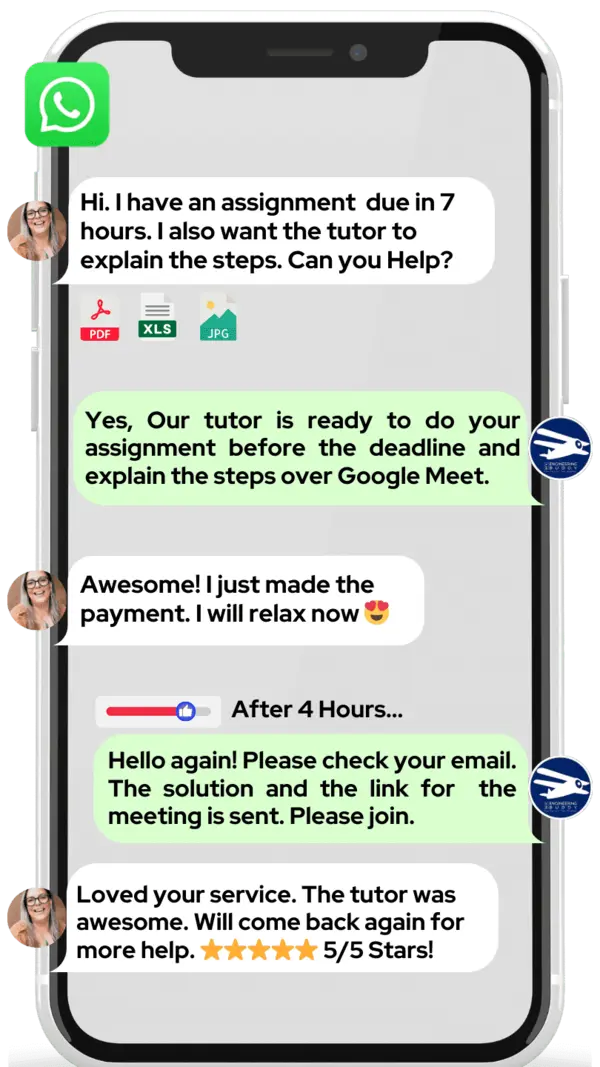
WhatsApp MEB for a quick quote — average response time under 1 minute.
Who This Digital Signal Processing Tutoring Is For
DSP is one of those subjects where a single confusing week can cascade into a lost semester. Whether you’re stuck on the discrete Fourier transform or can’t get your FIR filter design to meet spec, the gap rarely closes on its own.
- Undergraduate electrical, electronics, or computer engineering students hitting the DSP wall mid-semester
- Graduate students whose research touches speech processing, image compression, radar, or biomedical signals
- Students retaking after a failed first attempt who need to rebuild the mathematical foundations properly
- Students with a university conditional offer depending on this grade — and six weeks or fewer to close the gap
- Engineers in industry needing to refresh or extend DSP knowledge for a new role or project
- Students at MIT, Georgia Tech, Imperial College London, ETH Zurich, TU Delft, UT Austin, or Caltech whose DSP courses move fast and offer limited office hours
If your course uses MATLAB, Python with NumPy/SciPy, or a hardware platform for DSP labs, MEB tutors work directly in those environments alongside you.
1:1 Tutoring vs Self-Study vs AI vs YouTube vs Online Courses
Self-study works if you’re disciplined and the textbook makes sense to you — but DSP textbooks like Oppenheim & Schafer or Proakis & Manolakis assume a lot. AI tools give fast answers but can’t watch you make the same z-plane error three times and diagnose why. YouTube is excellent for the DFT overview, but stops when you’re stuck on why your Kaiser window isn’t suppressing the right frequencies. Online courses are structured but paced for an average student, not your specific exam in four weeks. 1:1 DSP tutoring with MEB is live, calibrated to your exact syllabus, and corrects errors the moment they appear — including the ones you didn’t know you were making.
Outcomes: What You’ll Be Able To Do in Digital Signal Processing
Students who work 1:1 with an MEB digital signal processing tutor leave sessions able to do specific things — not just vaguely “understand DSP better.” You’ll be able to analyze discrete-time systems using z-transforms and correctly interpret pole-zero plots to predict stability and frequency response. You’ll be able to design FIR and IIR filters to meet given specifications, choosing between windowing methods and the bilinear transform with confidence. You’ll be able to apply the DFT and FFT algorithm to real signal data and explain what the output means physically. You’ll be able to model and implement sampling, quantization, and reconstruction correctly — and explain aliasing to someone who’s never seen it before. You’ll be able to present your filter design choices in an assignment or exam with clear mathematical justification, not just a working MATLAB plot.
Supporting a student through Digital Signal Processing? MEB works directly with parents to set up sessions, track progress, and keep coursework on schedule. WhatsApp MEB — average response time is under a minute, 24/7.
Based on feedback from 40,000+ sessions collected by MEB from 2022 to 2025, 58% of students improved by one full grade after approximately 20 hours of 1:1 tutoring in subjects like Digital Signal Processing. A further 23% achieved at least a half-grade improvement.
Source: MEB session feedback data, 2022–2025.
What We Cover in Digital Signal Processing (Syllabus / Topics)
Track 1: Discrete-Time Signals and Systems
- Discrete-time signals: sequences, energy, power, and basic operations
- LTI systems: linearity, time-invariance, causality, and BIBO stability
- Convolution sum and its computation by hand and in MATLAB
- Difference equations: recursive and non-recursive forms
- Z-transform: region of convergence, inverse z-transform, and system function
- Pole-zero analysis and frequency response derivation
- DTFT: definition, properties, and relationship to the z-transform
Core texts: Discrete-Time Signal Processing by Oppenheim & Schafer (3rd ed.); Digital Signal Processing by Proakis & Manolakis.
Track 2: Fourier Analysis and the FFT
- DFT: definition, circular convolution, and spectral leakage
- FFT algorithm: decimation-in-time, computational complexity reduction
- Windowing: rectangular, Hanning, Hamming, Blackman, and Kaiser windows
- Short-time Fourier transform (STFT) and time-frequency analysis
- Power spectral density estimation: periodogram and Welch’s method
- Practical FFT implementation issues: zero-padding, frequency resolution
Core texts: DSP First by McClellan, Schafer & Yoder; Understanding Digital Signal Processing by Lyons.
Track 3: Digital Filter Design
- FIR filter design: windowing method, frequency sampling, Parks-McClellan algorithm
- IIR filter design: bilinear transform, impulse invariance, Butterworth and Chebyshev prototypes
- Filter specifications: passband ripple, stopband attenuation, transition width
- Multirate signal processing: decimation, interpolation, and polyphase decomposition
- Fixed-point effects: quantization noise, coefficient rounding, limit cycles
- Real-time DSP implementation on MATLAB, Python (SciPy), or embedded platforms
- Applications: audio equalisation, ECG filtering, communications channel equalisation
Core texts: Digital Signal Processing by Proakis & Manolakis; Multirate Signal Processing by Vaidyanathan.

At MEB, we’ve found that students who struggle with DSP almost always have the same gap: they learned the Fourier transform as a formula to memorise rather than a tool that reveals what a signal is made of. One session spent rebuilding that intuition from scratch usually unlocks the next three topics.
What a Typical Digital Signal Processing Session Looks Like
The tutor opens by checking where you left off — usually the previous session’s topic, say IIR filter design using the bilinear transform. They ask you to walk through one step of the design yourself before touching anything new. Then you move into the session’s main focus: working through specific problems on screen, such as deriving a Butterworth filter’s pole locations or plotting a z-plane diagram for a given transfer function. The tutor uses a digital pen-pad to annotate live — drawing pole-zero plots, sketching frequency responses, writing out difference equations step by step. You replicate the working or explain each step back. The session closes with a concrete practice task — three filter design problems at the level you’ll see in your assignment — and the next topic is noted so both of you arrive prepared.
How MEB Tutors Help You with Digital Signal Processing (The Learning Loop)
Diagnose: In the first session, the tutor asks you to attempt a z-transform problem or sketch a frequency response. What you do — and what you avoid — tells them exactly where the gaps are. Most students have two or three specific misconceptions, not a general lack of ability.
Explain: The tutor works through problems live using a digital pen-pad, narrating every step. They don’t skip algebra. They don’t assume you remember the inverse z-transform from last semester. They build from what you already know.
Practice: You attempt the next problem with the tutor present. Not after the session. Not from a YouTube video later. Right there, while the explanation is still fresh and errors can be caught immediately.
Feedback: The tutor corrects your working step by step — explaining not just what went wrong but why, and how an examiner or course marker would penalise that specific error. This is where most of the actual learning happens.
Plan: At the end of each session, the tutor sets the next topic, identifies what to practise before the next meeting, and adjusts the plan if your exam date or assignment deadline has shifted.
Sessions run over Google Meet. The tutor uses a digital pen-pad or iPad with Apple Pencil for real-time annotation. Before your first session, share your course outline or syllabus, a recent assignment or past paper attempt, and your exam or submission date. The first session covers the diagnostic and your most urgent topic — no warm-up needed. Start with the $1 trial — 30 minutes of live tutoring that also serves as your first diagnostic.
Students consistently tell us that the biggest shift in DSP comes not from more practice problems, but from finally seeing what the math is describing physically — what a pole near the unit circle actually sounds like in an audio filter, or what aliasing looks like in a real sampled signal.
Tutor Match Criteria (How We Pick Your Tutor)
Not every electrical engineer can tutor DSP well. MEB matches on specifics.
Subject depth: Tutors are matched to your exact level — sophomore undergraduate, final-year project, or graduate research — and to your specific syllabus focus, whether that’s communications-oriented DSP, biomedical signal processing, or FPGA implementation.
Tools: Every session uses Google Meet and a digital pen-pad or iPad with Apple Pencil. Tutors working with MATLAB or Python-based DSP courses are matched accordingly.
Time zone: Matched to your region. Students in the US, UK, Gulf, Canada, and Australia are all covered without unreasonable scheduling asks.
Goals: Whether you need exam score improvement, conceptual depth for a research project, digital communications coursework support, or help with a specific DSP assignment, the match reflects your actual objective.
Unlike platforms where you fill out a form and wait, MEB responds in under a minute, 24/7. Tutor match takes under an hour. The $1 trial means you test before you commit. Everything runs over WhatsApp — no logins, no intake forms.
Study Plans (Pick One That Matches Your Goal)
After the diagnostic, the tutor builds the specific session sequence. The three most common structures: a catch-up plan (1–3 weeks) for students who’ve fallen behind on core topics like convolution, z-transforms, or DFT before an upcoming test; an exam prep plan (4–8 weeks) covering the full syllabus systematically with past paper practice built in; and weekly ongoing support for students who want to stay aligned with their course as new topics land each week. The tutor maps the plan after the first session — not before.
Pricing Guide
DSP tutoring starts at $20/hr for standard undergraduate-level work. Graduate-level topics — adaptive signal processing, statistical signal processing, or real-time embedded DSP — typically run $40–$100/hr depending on tutor specialisation and timeline urgency. Rate factors include the level of the course, complexity of the topic, how quickly you need sessions, and tutor availability.
Availability tightens in the final three to four weeks of any semester. If you have a fixed exam or project deadline, earlier booking secures your preferred tutor.
For students targeting graduate programmes at institutions like MIT, Stanford, or Imperial College London where DSP is a core qualifying subject, tutors with research and industry signal processing backgrounds are available at higher rates — share your goal and MEB will match the right tier.
Start with the $1 trial — 30 minutes, no registration, no commitment. WhatsApp MEB for a quick quote.
DSP is consistently ranked among the top three most-failed courses in electrical and computer engineering programmes globally — but it is also one of the subjects where structured 1:1 guidance produces the fastest measurable turnaround, because the gaps are usually specific and fixable.
Source: My Engineering Buddy internal session data, 2022–2025.
Try your first session for $1 — 30 minutes of live 1:1 tutoring or one homework question explained in full. No registration. No commitment. WhatsApp MEB now and get matched within the hour.
FAQ
Is digital signal processing hard?
DSP has a reputation for difficulty because it combines discrete mathematics, linear systems theory, and implementation — often simultaneously. Most students find the mathematics manageable once the intuition behind transforms and filters is built properly, rather than memorised.
How many sessions are needed?
Students closing a specific gap — say, FIR filter design or DFT interpretation — often need 4–6 focused sessions. Students preparing for a full DSP exam typically benefit from 12–20 hours spread across 4–8 weeks, depending on their starting point.
Can you help with homework and assignments?
MEB tutoring is guided learning — you understand the work, then submit it yourself. See our Academic Integrity policy and Why MEB page for full details on what we help with and what we don’t.
Will the tutor match my exact syllabus or exam board?
Yes. Share your course outline, textbook, or university module code when you first contact MEB. Tutors are matched to your specific DSP course — not a generic version of the subject.
What happens in the first session?
The tutor runs a short diagnostic — usually asking you to attempt one or two problems — then identifies your two or three clearest gaps. The rest of the session covers your most urgent topic. You leave with a practice task and a session plan.
Is online tutoring as effective as in-person?
For DSP specifically, online sessions with a digital pen-pad are often more effective than in-person — the tutor can annotate pole-zero plots, FFT outputs, and filter responses live on screen, and you can save every worked example immediately.
What’s the difference between FIR and IIR filters, and why does it matter for my exam?
FIR filters are always stable, have linear phase, and are designed with windowing or Parks-McClellan. IIR filters are computationally efficient but can be unstable if designed poorly. Most DSP exams test both design methods and ask you to justify which to use for a given application — a distinction worth getting right.
Do I need MATLAB, or can I use Python for DSP tutoring?
MEB tutors work in both. MATLAB is standard in most university DSP courses; Python with NumPy and SciPy is increasingly common in engineering programmes. Tell MEB which environment your course uses and the tutor will match accordingly.
Can I get digital signal processing help at midnight?
Yes. MEB operates across all major time zones and WhatsApp is monitored 24/7. If you message at midnight from the US, UK, Gulf, or Australia, you’ll typically have a response and tutor match within the hour.
What if I don’t like my assigned tutor?
Request a change — no friction, no lengthy process. WhatsApp MEB and a new tutor match happens within the hour. The $1 trial exists precisely so you can test the fit before committing to longer sessions.
How do I get started?
Three steps: WhatsApp MEB with your course details, get matched with a verified DSP tutor within the hour, and start your $1 trial — 30 minutes of live tutoring or one assignment question explained in full. No registration required.
Trust & Quality at My Engineering Buddy
Every MEB tutor goes through subject-specific vetting — not a generic engineering test. DSP tutors are assessed on discrete-time systems, filter design, Fourier analysis, and implementation, then evaluated through a live demo session before being assigned to students. Ongoing performance is reviewed through session feedback. Rated 4.8/5 across 40,000+ verified reviews on Google. Degrees and professional backgrounds are verified; tutors with industry DSP experience in communications, audio processing, or embedded systems are available for students who need that depth.
MEB tutoring is guided learning — you understand the work, then submit it yourself. For full details on what we help with and what we don’t, read our Academic Integrity policy and Why MEB.
MEB has served 52,000+ students across the US, UK, Canada, Australia, the Gulf, and Europe in 2,800+ subjects since 2008. Within Electrical Engineering, the platform covers everything from foundational circuit analysis tutoring and analog electronics help through to advanced communication systems tutoring and specialised DSP research support. See our tutoring methodology for how sessions are structured.
MEB has operated since 2008 — long enough to know that the students who improve fastest in DSP are not the ones who grind more practice problems. They are the ones who stop and rebuild one concept properly, then find the rest of the course suddenly makes sense.
Source: My Engineering Buddy, 2008–2025.
Explore Related Subjects
Students studying Digital Signal Processing often also need support in:
- Control Systems
- Digital Electronics
- Embedded Systems
- FPGA Design
- Microprocessors
- Wireless Communication
- Telecommunications
- Radar Systems
Next Steps
Before your first session, have ready: your exam board and syllabus or course outline, a recent past paper attempt or homework question you struggled with, and your exam or submission deadline date. The tutor handles the rest.
- Share your course module, hardest topic, and current timeline
- Share your availability and time zone
- MEB matches you with a verified DSP tutor — usually within the hour
Your first session starts with a diagnostic so every minute is used well — no time wasted on topics you already know.
Visit www.myengineeringbuddy.com for more on how MEB works.
WhatsApp to get started or email meb@myengineeringbuddy.com.
Reviewed by Subject Expert
This page has been carefully reviewed and validated by our subject expert to ensure accuracy and relevance.