~1 min
Average Reply Time
~1 hour
To Be Matched With A Tutor
30 Min Trial
75% Find Their Tutor On The 1st Trial
$20-35+/hr
Premium Yet Affordable Learning
Hire The Best Telecommunications Tutor


Your Telecommunications grade slipped — not because you’re weak at maths, but because nobody explained Shannon’s theorem before they threw noise analysis at you.
Telecommunications Tutor Online
Telecommunications is the engineering discipline covering the transmission of signals across wired, wireless, and optical channels. It equips students to analyse modulation schemes, channel capacity, network protocols, and propagation models in real communication systems.
MEB offers 1:1 online electrical engineering tutoring across all levels, including every corner of Telecommunications — from undergraduate signal theory to graduate-level wireless systems. Whether you’re searching for a Telecommunications tutor near me or need reliable support across time zones, MEB matches you with a verified expert, usually within the hour. One clear outcome: you stop guessing what the examiner wants and start solving problems correctly.
- 1:1 online sessions tailored to your exact course and syllabus
- Expert-verified tutors with subject-specific Telecommunications knowledge
- Flexible time zones — US, UK, Canada, Australia, Gulf
- Structured learning plan built after a diagnostic session
- Ethical homework and assignment guidance — you understand before you submit
52,000+ students across the US, UK, Canada, Australia, and the Gulf have used MEB since 2008 — including students in Electrical Engineering subjects like Telecommunications, digital communications tutoring, and wireless communication help.
Source: My Engineering Buddy, 2008–2025.
How Much Does a Telecommunications Tutor Cost?
Most Telecommunications tutoring sessions run $20–$40/hr depending on level and topic complexity. Graduate and highly specialised areas — OFDM system design, 5G NR, advanced antenna theory — can reach $100/hr. Not sure if it’s worth it? Start with the $1 trial: 30 minutes live, or one full homework question explained.
| Level / Need | Typical Rate | What’s Included |
|---|---|---|
| Standard undergraduate | $20–$35/hr | 1:1 sessions, homework guidance |
| Advanced / Graduate | $35–$100/hr | Expert tutor, niche depth, research support |
| $1 Trial | $1 flat | 30 min live session or 1 homework question |
Tutor availability drops fast during finals weeks and exam periods. Book early if you’re within six weeks of a submission or exam date.
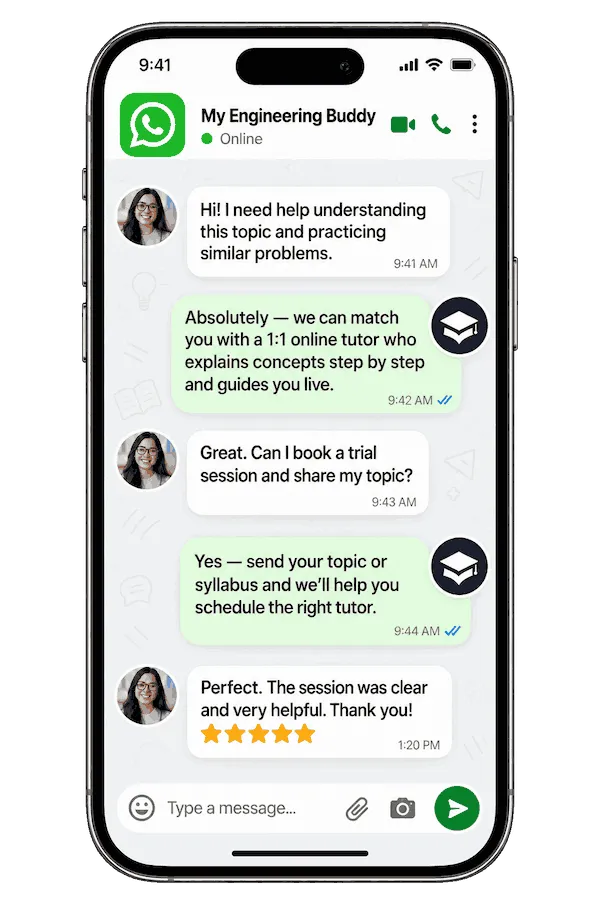
WhatsApp MEB for a quick quote — average response time under 1 minute.
Who This Telecommunications Tutoring Is For
This is not a general electronics refresher. Telecommunications draws on signals, probability, electromagnetics, and coding theory at the same time — and most courses assume you’ve already absorbed all of it. If one of those foundations is shaky, everything after it stacks up wrong.
- Undergraduate students in Electrical Engineering, Electronics, or Computer Engineering hitting the Telecommunications module for the first time
- Graduate students working through digital communications, wireless systems, or RF engineering coursework
- Students retaking after a failed first attempt — especially those who lost marks on modulation analysis or link budget calculations
- Students with a university conditional offer depending on this grade
- Students needing structured homework and assignment guidance alongside lectures
- Parents watching a child’s confidence drop alongside their grades in an engineering programme
Students in this subject come from universities including MIT, Georgia Tech, Imperial College London, ETH Zurich, the University of Toronto, UNSW Sydney, and TU Delft — among many others MEB works with regularly.
1:1 Tutoring vs Self-Study vs AI vs YouTube vs Online Courses
Self-study works if you already know which gaps to close — most students don’t. AI tools answer fast but can’t watch you work through a Fourier transform and catch the moment you drop a sign. YouTube covers AM/FM modulation well enough; it stops cold when you’re stuck on an OFDM subcarrier spacing derivation. Online courses are structured but move at one pace, whether you’re ready or not. With a 1:1 Telecommunications tutor through MEB, the session adjusts to your exact syllabus, your actual exam paper format, and the specific problem you’re stuck on — in real time.
Outcomes: What You’ll Be Able To Do in Telecommunications
After working with an MEB Telecommunications tutor, you will be able to analyse modulation schemes — AM, FM, BPSK, QPSK, QAM — and explain why one outperforms another under specific channel conditions. You will solve Shannon capacity problems and apply the Nyquist theorem without reaching for a formula sheet mid-exam. You will model noise behaviour in baseband and passband systems and present link budget calculations for real wireless scenarios. You will apply error-correction principles — Hamming codes, convolutional codes — to practical data transmission problems. Students sitting university exams in Telecommunications consistently report moving from dropping marks on derivations to completing full solutions with confidence.
Try your first session for $1 — 30 minutes of live 1:1 tutoring or one homework question explained in full. No registration. No commitment. WhatsApp MEB now and get matched within the hour.
Based on feedback from 40,000+ sessions collected by MEB from 2022 to 2025, 58% of students improved by one full grade after approximately 20 hours of 1:1 tutoring in subjects like Telecommunications. A further 23% achieved at least a half-grade improvement.
Source: MEB session feedback data, 2022–2025.
What We Cover in Telecommunications (Syllabus / Topics)

Track 1: Signals, Modulation & Noise
- Continuous-time and discrete-time signal representations
- Fourier series, Fourier transform, and spectral analysis
- AM, FM, and PM analogue modulation — bandwidth and power trade-offs
- BPSK, QPSK, QAM digital modulation — constellation diagrams and bit error rate
- Noise figure, SNR, and noise in cascaded systems
- Nyquist sampling theorem and aliasing
- Matched filters and optimum detection
Core texts: Haykin & Moher Communication Systems (5th ed.); Lathi & Ding Modern Digital and Analog Communication Systems. Support also available for analog signal processing tutoring and signals and systems help.
Track 2: Channel Capacity, Coding & Error Control
- Shannon’s channel capacity theorem and information theory fundamentals
- Source coding — Huffman, Shannon-Fano, run-length encoding
- Channel coding — Hamming codes, cyclic codes, convolutional codes
- Turbo codes and LDPC codes — principles and BER performance
- ARQ and HARQ protocols in practical systems
- Link budget calculations — path loss, fading margins, receiver sensitivity
Core texts: Proakis & Salehi Digital Communications (5th ed.); Sklar Digital Communications: Fundamentals and Applications. Also connects to digital signal processing help.
Track 3: Wireless Systems, RF & Optical Communications
- Multipath propagation, Rayleigh and Rician fading models
- OFDM — subcarrier spacing, cyclic prefix, spectral efficiency
- MIMO antenna systems — spatial multiplexing and diversity gain
- 5G NR — numerology, beamforming, mmWave propagation
- RF link design and antenna fundamentals
- Optical fibre transmission — single-mode vs multimode, dispersion, wavelength-division multiplexing
- Satellite link design and geostationary vs LEO system trade-offs
Core texts: Rappaport Wireless Communications: Principles and Practice; Saleh & Teich Fundamentals of Photonics. Students also seek microwave engineering tutoring, optical communications help, and satellite communications tutoring.
At MEB, we’ve found that students who struggle with OFDM aren’t missing the maths — they’re missing a clear mental model of what the subcarriers are actually doing. One focused session on the time-frequency picture fixes more than two weeks of re-reading the textbook.
What a Typical Telecommunications Session Looks Like
The tutor opens by checking the previous topic — usually wherever you stalled on link budget analysis or BER curve interpretation. You share your screen or work together on a shared digital whiteboard. The tutor walks through a worked example of QPSK demodulation or Shannon capacity derivation using a digital pen-pad, narrating every step. Then it’s your turn: you attempt the next problem while the tutor watches and cuts in only when reasoning goes off track. The session closes with a specific task — two past-exam questions on multipath fading or one full link budget calculation — and the next topic noted so neither of you wastes time at the start of the following session. Students working with tutors in communication systems tutoring follow the same structured session format.
How MEB Tutors Help You with Telecommunications (The Learning Loop)
Diagnose: In the first session, the tutor asks you to attempt two or three problems — one from modulation theory, one from channel capacity — and watches where your reasoning breaks down. That tells them exactly which foundation is missing, not just which topic you said you found hard.
Explain: The tutor works through the correct solution live, on screen, with a digital pen-pad. You see the derivation of Shannon’s theorem or the construction of a QPSK constellation being built step by step — not just the answer on a slide.
Practice: You attempt the next problem with the tutor present. This is not homework time — it’s monitored practice where errors get caught before they become habits.
Feedback: The tutor explains exactly where marks were lost and why. “You substituted bandwidth before converting to Hz — that’s two marks gone in an exam.” Specific. Actionable. No vague encouragement.
Plan: At the end of each session, the tutor sets the next two topics and a target: complete these past-paper questions before we meet again. Progress is tracked session by session, not assumed.
Sessions run on Google Meet. The tutor uses a digital pen-pad or iPad with Apple Pencil for derivations. Before your first session, share your course syllabus, the specific module or topic causing problems, and any past paper or homework question you’re stuck on. Start with the $1 trial — 30 minutes of live tutoring that also serves as your first diagnostic. Whether you need a quick catch-up before a final exam, structured revision over four to eight weeks, or ongoing weekly support through the semester, the tutor maps the session plan after that first diagnostic.
Students consistently tell us that the moment a Telecommunications concept clicks — really clicks — it’s because someone showed them the derivation being built, not just the formula at the end. That’s what live 1:1 sessions do that a textbook cannot.
Source: My Engineering Buddy, compiled from student session feedback.
Tutor Match Criteria (How We Pick Your Tutor)
Not every electrical engineer can teach Telecommunications well. MEB matches on four specific dimensions.
Subject depth: The tutor must have formal academic or professional background in the specific area you need — digital communications, RF engineering, optical systems, or wireless. A power systems specialist does not teach your OFDM module.
Tools: Every Telecommunications tutor uses Google Meet and a digital pen-pad or iPad with Apple Pencil. No tutor who relies solely on verbal explanation is matched to a maths-heavy engineering subject.
Time zone: Matched to your region — US, UK, Gulf, Canada, or Australia. Sessions start on time because the tutor is already awake.
Goals: Whether you need exam score improvement, conceptual depth in antenna theory, homework completion support, or research-level guidance on channel modelling, the match criteria include your stated objective — not just your subject name.
Unlike platforms where you fill out a form and wait, MEB responds in under a minute, 24/7. Tutor match takes under an hour. The $1 trial means you test before you commit. Everything runs over WhatsApp — no logins, no intake forms.
Pricing Guide
Telecommunications tutoring starts at $20/hr for standard undergraduate coursework. Graduate modules — advanced wireless systems, MIMO signal processing, 5G standards — typically run $40–$70/hr. For students targeting top engineering programmes or professional roles requiring deep RF or photonics expertise, tutors with industry or research backgrounds are available at higher rates. Share your specific goal and MEB will match the tier to your timeline.
Rate factors: your current level, topic complexity, how close the exam is, and tutor availability at your preferred hours.
Slots fill fast in the weeks before finals. Book ahead if your exam is within six weeks.
Start with the $1 trial — 30 minutes, no registration, no commitment. WhatsApp MEB for a quick quote.
A common pattern our tutors observe is that students arriving two weeks before a Telecommunications exam have already covered every topic — but haven’t worked a single full exam-length problem under timed conditions. That one shift, from topic review to timed exam practice, produces more marks than anything else at that stage.
FAQ
Is Telecommunications hard?
It is demanding. The subject combines signal theory, probability, and electromagnetics simultaneously. Most students who struggle are not weak at maths — they hit a conceptual gap in Fourier analysis or noise modelling early on and it compounds across every topic that follows.
How many sessions are needed?
Students with one or two specific gaps — BER analysis, link budget calculations — often resolve them in three to five sessions. Students working through a full Telecommunications module from scratch typically need ten to twenty hours spread over a semester. The diagnostic session clarifies this quickly.
Can you help with homework and assignments?
Yes. MEB tutoring is guided learning — you understand the work, then submit it yourself. The tutor explains the method and walks through the reasoning; you produce and submit the answer. See our Academic Integrity policy and Why MEB page for full details on what we help with and what we don’t.
Will the tutor match my exact syllabus or exam board?
Yes. Before matching, MEB asks for your university, course code, and the specific module or exam component causing difficulty. Tutors are matched against that information — not assigned generically by subject name alone.
What happens in the first session?
The tutor runs a short diagnostic — two or three problems covering modulation and channel theory — to locate the exact gap. The remaining time is spent directly on the highest-priority topic. You leave with a specific task and a session plan for what follows.
Is online tutoring as effective as in-person?
For Telecommunications specifically, yes — and sometimes better. Shared screens, digital pen-pad derivations, and the ability to pull up your actual past papers or problem sets mid-session make online 1:1 tutoring at least as productive as a whiteboard session in a library.
Can I get Telecommunications help at midnight?
Yes. MEB operates across multiple time zones and tutors are available around the clock. WhatsApp MEB at any hour — average response is under a minute. Session booking for the same day is available in most regions.
What if I don’t like my assigned tutor?
Tell MEB on WhatsApp and a replacement is arranged — no forms, no waiting period. The $1 trial exists precisely so you test the match before committing to a paid block of sessions.
Do you cover 5G NR and advanced wireless topics, or only undergraduate basics?
Both. MEB has tutors covering undergraduate signal theory through to graduate-level 5G NR numerology, MIMO beamforming, and mmWave propagation. Share your specific topic when you message and MEB matches accordingly. You can also get help with adjacent subjects like radar systems tutoring.
What is the difference between Telecommunications and Digital Communications — do I need separate tutors?
Digital Communications is a sub-discipline within Telecommunications, focusing specifically on digital modulation, coding, and detection theory. Many tutors cover both. When you contact MEB, describe your specific module — the tutor matched will cover whichever domain your syllabus sits in. Students often also need analog communication help alongside digital coursework.
How do I get started?
Three steps: WhatsApp MEB, share your exam board or course outline and your hardest current topic, and start the $1 trial — 30 minutes of live tutoring or one full question explained. No registration. No commitment. Tutor match usually takes under an hour.
Can MEB help with Telecommunications lab reports and simulation assignments using MATLAB?
Yes. Tutors experienced with MATLAB-based simulation — BER curves, channel modelling, filter design — can guide you through both the theory behind the simulation and the reasoning needed to write a coherent lab report. For circuit-level simulation work, students also use digital signal processing tutoring alongside Telecommunications sessions.
Our experience across thousands of sessions shows that Telecommunications students lose the most marks not on the hard derivations but on the setup: wrong units in a noise figure calculation, bandwidth in the wrong domain, a sign flip in a phase equation. Systematic error correction over three or four sessions closes most of that gap permanently.
Trust & Quality at My Engineering Buddy
Every MEB tutor goes through a structured screening process: academic credentials verified, a live demonstration session evaluated, and ongoing session feedback reviewed against student outcomes. Tutors covering Telecommunications hold degrees in Electrical Engineering, Electronics, or related disciplines — many have professional or research experience in RF, wireless systems, or optical communications. Rated 4.8/5 across 40,000+ verified reviews on Google. That track record, across 52,000+ students and 18 years operating since 2008, is what the rating reflects.
MEB tutoring is guided learning — you understand the work, then submit it yourself. For full details on what we help with and what we don’t, read our Academic Integrity policy and Why MEB.
MEB serves students in the US, UK, Canada, Australia, Gulf, and Europe across 2,800+ subjects. Within Electrical Engineering, the platform covers Telecommunications alongside subjects including electromagnetic field theory tutoring, transmission lines and waveguides help, and network theory tutoring. For an overview of how sessions are structured from first diagnostic to final review, see our tutoring methodology.
IEEE Spectrum covers the professional and technical landscape that Telecommunications students are preparing to enter — from 5G deployment and spectrum policy to optical networking advances. It is worth reading alongside your coursework.
Source: IEEE Spectrum.
Explore Related Subjects
Students studying Telecommunications often also need support in:
- FPGA Design
- Embedded Systems
- Internet of Things (IoT)
- Control Systems
- VLSI Design
- Optoelectronics
- Semiconductor Devices
Next Steps
When you message MEB, share three things: your exam board or university course code, the specific Telecommunications topic causing the most difficulty, and your exam or submission date.
Also share your availability and time zone — tutor matching accounts for both.
MEB matches you with a verified Telecommunications tutor, usually within 24 hours. The first session opens with a diagnostic so every minute is targeted at your actual gaps — not a generic review of the syllabus.
Before your first session, have ready:
- Your course syllabus or exam board specification
- A recent past paper attempt or homework question you struggled with
- Your exam or deadline date
The tutor handles the rest. Visit www.myengineeringbuddy.com for more on how MEB works.
WhatsApp to get started or email [email protected].
Reviewed by Subject Expert
This page has been carefully reviewed and validated by our subject expert to ensure accuracy and relevance.