Hire Verified & Experienced
Green Chemistry Tutors
4.8/5 40K+ session ratings collected on the MEB platform



Hire The Best Green Chemistry Tutor
Top Tutors, Top Grades. Without The Stress!
52,000+ Happy Students From Various Universities



How Much For Private 1:1 Tutoring & Hw Help?
Private 1:1 Tutoring and HW help Cost $20 – 35 per hour* on average.
Green Chemistry is one of those subjects where students lose marks not because they don’t understand chemistry — but because they don’t know which principle applies where.
Green Chemistry Tutor Online
Green Chemistry is a branch of chemistry that designs chemical products and processes to reduce or eliminate hazardous substances. Grounded in Anastas and Warner’s 12 Principles, it equips students to evaluate synthesis routes, atom economy, and waste prevention.
If you’ve searched for a Green Chemistry tutor near me, you’ve likely hit a wall — very few tutors have hands-on familiarity with the 12 Principles, life cycle assessment, or solvent selection frameworks at a graduate or advanced undergraduate level. MEB connects you with a specialist Green Chemistry tutor online who knows exactly where students drop marks — and why. As part of MEB’s broader Chemistry tutoring offering, this is 1:1 online tutoring and homework help across 2,800+ advanced subjects, with sessions tailored to your exact course.
- 1:1 online sessions mapped to your specific syllabus or course outline
- Expert-verified tutors with postgraduate-level Green Chemistry knowledge
- Flexible scheduling across US, UK, Canada, Australia, and Gulf time zones
- Structured learning plan built after a diagnostic in your first session
- Ethical homework and assignment guidance — you understand the work, then submit it yourself
52,000+ students across the US, UK, Canada, Australia, and the Gulf have used MEB since 2008 — including students in Chemistry subjects like Green Chemistry, environmental chemistry, and industrial chemistry.
Source: My Engineering Buddy, 2008–2025.
How Much Does a Green Chemistry Tutor Cost?
Most Green Chemistry sessions run $20–$40/hr. Graduate-level work — life cycle analysis, green metrics, or research-aligned sessions — can reach up to $100/hr depending on tutor expertise. The $1 trial gets you 30 minutes of live tutoring or a full explanation of one homework question before you commit to anything.
| Level / Need | Typical Rate | What’s Included |
|---|---|---|
| Undergraduate (most levels) | $20–$35/hr | 1:1 sessions, homework guidance |
| Graduate / Research-Level | $35–$100/hr | Expert tutor, green metrics, LCA depth |
| $1 Trial | $1 flat | 30 min live session or 1 homework question |
Tutor availability tightens at the end of semester and during dissertation submission windows. Book early if you’re within six weeks of a deadline.
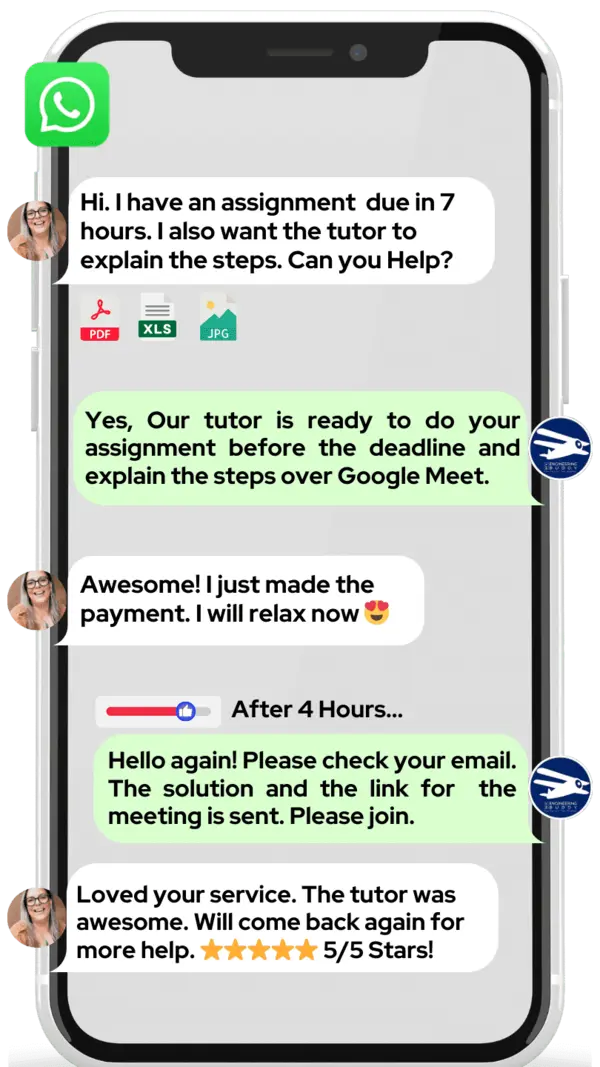
WhatsApp MEB for a quick quote — average response time under 1 minute.
Who This Green Chemistry Tutoring Is For
Green Chemistry draws students from chemistry, chemical engineering, environmental science, and pharmacy. The challenge isn’t always the theory — it’s applying the 12 Principles to actual synthesis problems or written assessments without a clear template to follow.
- Undergraduate chemistry or chemical engineering students covering sustainable synthesis or solvent selection for the first time
- Graduate students working on green metrics (atom economy, E-factor, PMI) for coursework or a thesis chapter
- Students 4–6 weeks from an exam with significant gaps in the 12 Principles still to close
- Students with a coursework or assignment deadline approaching and no clear feedback on where their answers fall short
- Students retaking after a failed first attempt — often because they memorised principles without understanding how to apply them
- Parents watching a student’s confidence drop as the subject moves from memorisation into critical analysis of real synthesis routes
Students at institutions including MIT, UC Berkeley, Imperial College London, the University of Toronto, ETH Zurich, the University of Melbourne, and Carnegie Mellon have used MEB for Green Chemistry support at both undergraduate and graduate level.
The $1 trial is a low-risk way to check whether the tutor fits before committing to a series of sessions.
1:1 Tutoring vs Self-Study vs AI vs YouTube vs Online Courses
Self-study works if you have a strong general chemistry base and time to read — but Green Chemistry requires evaluating trade-offs, not just reading principles. AI tools can define atom economy instantly but can’t tell you why your specific synthesis route scores poorly on an E-factor calculation. YouTube covers the basics well; it stops when you need to critique a real reaction. Online courses give structure, but the pace is fixed and the feedback is zero. 1:1 tutoring with MEB is live, corrects reasoning errors in the moment, and works through your actual coursework — whether that’s green metrics calculations, solvent selection justification, or an LCA-based assignment.
Outcomes: What You’ll Be Able To Do in Green Chemistry
After focused 1:1 sessions, students can apply the 12 Principles of Green Chemistry to evaluate and redesign synthesis routes, calculate atom economy and E-factor for real reactions, explain solvent selection decisions using green solvent guides, analyse life cycle assessment data at a level expected in graduate coursework, and write technically sound justifications for green process design choices in assessments and reports.
Supporting a student through Green Chemistry? MEB works directly with parents to set up sessions, track progress, and keep coursework on schedule. WhatsApp MEB — average response time is under a minute, 24/7.
Based on feedback from 40,000+ sessions collected by MEB from 2022 to 2025, 58% of students improved by one full grade after approximately 20 hours of 1:1 tutoring in subjects like Green Chemistry. A further 23% achieved at least a half-grade improvement.
Source: MEB session feedback data, 2022–2025.
What We Cover in Green Chemistry (Syllabus / Topics)

Track 1: Foundations — The 12 Principles and Green Metrics
- Anastas and Warner’s 12 Principles of Green Chemistry — origin, logic, and application
- Atom economy: calculation, interpretation, and comparison across reactions
- E-factor and process mass intensity (PMI) in industrial and lab contexts
- Waste hierarchy and prevention strategies in synthesis design
- Renewable feedstocks — biobased starting materials and their trade-offs
- Hazard assessment: identifying and replacing substances of concern
- Energy efficiency in chemical processes — heat integration, microwave, flow chemistry
Core text: Green Chemistry: Theory and Practice by Anastas & Warner (Oxford). Supporting: Real World Cases in Green Chemistry, ed. Cann & Connelly.
Track 2: Green Synthesis and Solvent Selection
- Green solvent guides — GSK, ACS GCIPR, and Pfizer solvent selection tools
- Supercritical CO₂, water as solvent, ionic liquids, and deep eutectic solvents
- Catalysis for greener reactions: catalysis help covering bio-, organo-, and photo-catalysis
- Click chemistry and atom-efficient coupling reactions
- Protecting-group-free synthesis strategies
- Flow chemistry and continuous processing as green alternatives to batch
Core text: Green Chemistry and the Ten Commandments of Sustainability by Tang et al. Supporting: peer-reviewed case studies from ACS Sustainable Chemistry & Engineering.
Track 3: Life Cycle Assessment and Industrial Application
- LCA methodology: goal and scope definition, inventory analysis, impact assessment
- Comparative LCA for green vs conventional process routes
- Green chemistry in pharmaceutical manufacturing — API synthesis, solvent recovery
- Polymer design for end-of-life: polymer chemistry tutoring and degradable alternatives
- Industrial ecology concepts — circular economy, industrial symbiosis
- Regulatory frameworks: REACH, RoHS, and green procurement standards
Core text: Green Chemistry: An Introductory Text by Cann & Connelly. Supporting: OpenStax General Chemistry for prerequisite review.
What a Typical Green Chemistry Session Looks Like
The tutor opens by checking the previous topic — say, atom economy calculations from last time. If the numbers were right but the interpretation was off, that’s fixed first. From there, the session moves into the current focus: maybe it’s justifying a solvent swap using the GSK guide, or walking through an E-factor problem for a multi-step synthesis. The tutor writes out the reasoning on a digital pen-pad so you can follow each step. You then replicate the logic for a similar reaction — not to copy, but to show the tutor where your thinking breaks down. The session closes with one concrete practice problem and a note of the next topic: often LCA methodology or a specific application area like pharmaceutical green synthesis. You leave knowing exactly what to do before the next session.
How MEB Tutors Help You with Green Chemistry (The Learning Loop)
Diagnose: In the first session, the tutor identifies exactly where understanding breaks down — whether that’s the calculation side (atom economy, E-factor), the conceptual side (why Principle 7 matters in a given synthesis), or the written analysis expected in assessments.
Explain: The tutor works through live examples using a digital pen-pad — annotating reaction schemes, walking through LCA steps, or showing how a green solvent selection justification is structured for marks.
Practice: You attempt a problem with the tutor present. This matters more in Green Chemistry than in most subjects because the common error is applying the right principle to the wrong situation.
At MEB, we’ve found that Green Chemistry students make the fastest progress when they stop treating the 12 Principles as a list to memorise and start using them as a decision-making framework — one they can apply in under two minutes for any synthesis route.
Feedback: The tutor goes through errors step by step — not just flagging wrong answers but showing exactly where the reasoning diverged and what a mark-scoring answer looks like.
Plan: Each session ends with a clear next topic and a practice task. If you’re working toward a specific deadline, the tutor maps a sequence: Principles and metrics first, then synthesis application, then LCA and written analysis.
Sessions run on Google Meet. The tutor uses a digital pen-pad or iPad with Apple Pencil. Before your first session, have your course outline or syllabus ready, plus one recent assignment or problem set you found difficult. The first session covers a diagnostic and at least one worked example in your weakest area.
Start with the $1 trial — 30 minutes of live tutoring that also serves as your first diagnostic.
Students consistently tell us that the shift from “I’ve read all the principles” to “I can actually use them in an exam” happens in the third or fourth session — once the tutor has diagnosed the specific gap and drilled the application, not the definition.
Source: My Engineering Buddy tutor feedback reports, 2022–2025.
Tutor Match Criteria (How We Pick Your Tutor)
Not every chemistry tutor can teach Green Chemistry well. Here’s what MEB checks before matching.
Subject depth: The tutor must hold a postgraduate qualification in chemistry, chemical engineering, or a directly related field, with demonstrable coursework or research in sustainable chemistry, green metrics, or LCA. General chemistry knowledge alone is not sufficient.
Tools: Every tutor uses Google Meet plus a digital pen-pad or iPad with Apple Pencil — so reaction schemes, calculations, and LCA diagrams can be worked through visually in real time.
Time zone: Matched to your region — US, UK, Gulf, Canada, or Australia — so sessions fit your schedule without early-morning workarounds.
Goals: Whether you need to lift a coursework grade, close gaps before an exam, or work through a graduate-level research question, the tutor is selected for fit to that specific goal.
Unlike platforms where you fill out a form and wait, MEB responds in under a minute, 24/7. Tutor match takes under an hour. The $1 trial means you test before you commit. Everything runs over WhatsApp — no logins, no intake forms.
A common pattern our tutors observe is this: a student arrives having covered Green Chemistry in lectures but having never been asked to evaluate a synthesis route from scratch. The first session that requires that kind of application feels like a completely different subject. It isn’t — it just needs a different kind of practice.
Study Plans (Pick One That Matches Your Goal)
After the diagnostic, the tutor builds a specific session sequence. Three common patterns: Catch-up (1–3 weeks) for students who’ve fallen behind and need to close gaps in the 12 Principles and green metrics before a submission; Exam prep (4–8 weeks) for structured revision covering synthesis application, LCA, and written analysis; Weekly support for ongoing alignment with semester deadlines, coursework stages, and lab report requirements. The tutor determines the sequence after seeing where you actually are — not based on a fixed template.
Pricing Guide
Green Chemistry tutoring starts at $20/hr for standard undergraduate support and runs to $40/hr for most levels. Graduate-level sessions — particularly those involving research-grade LCA, green process design, or dissertation support — can reach up to $100/hr. Rate factors include course level, topic complexity, how close you are to a deadline, and tutor availability.
Peak demand hits hard in April–May and November–December. If you’re within six weeks of a submission or exam, expect shorter lead times for tutor matching.
For students targeting positions in pharmaceutical companies, chemical manufacturers, or sustainability consultancies with rigorous green chemistry expectations, MEB has tutors with professional research and industry backgrounds available at higher rates — share your goal and MEB will match the right tier.
Start with the $1 trial — 30 minutes, no registration, no commitment. WhatsApp MEB for a quick quote.
FAQ
Is Green Chemistry hard?
It depends on your chemistry base. Students strong in organic chemistry and chemical kinetics adapt quickly. The difficulty is applying the 12 Principles analytically — not just recognising them — especially in written coursework and LCA assignments.
How many sessions are needed?
Most students see measurable improvement in 4–6 sessions. Closing a full grade gap across coursework and exam components typically takes 12–20 hours of 1:1 work. The tutor sets a realistic timeline after the first diagnostic session.
Can you help with homework and assignments?
MEB tutoring is guided learning — you understand the work, then submit it yourself. The tutor explains the approach and works through similar examples with you. See our Academic Integrity policy and Why MEB page for full details on what we help with and what we don’t.
Will the tutor match my exact syllabus or exam board?
Yes. Before matching, you share your course outline, institution, and specific topics causing difficulty. The tutor is selected based on direct familiarity with that syllabus — whether it’s an ACS-aligned undergraduate module, an RSC-accredited programme, or a graduate course.
What happens in the first session?
The tutor runs a short diagnostic to identify where your understanding breaks down — calculation errors, conceptual gaps, or written analysis technique. At least one worked example follows in the session. You leave with a clear plan for subsequent sessions.
Is online tutoring as effective as in-person?
For Green Chemistry, yes. The digital pen-pad replicates whiteboard work for reaction schemes and calculations. Students in the US, UK, and Gulf consistently report the same quality of explanation as face-to-face sessions — often with better scheduling flexibility.
What’s the difference between Green Chemistry and Environmental Chemistry?
Environmental chemistry studies how chemicals behave in natural systems — air, water, soil. Green Chemistry focuses on designing reactions and processes that prevent pollution at the source. They overlap but have different frameworks, assessments, and career applications. MEB has dedicated tutors for environmental chemistry help as well.
How do the 12 Principles get assessed in exams and coursework?
Assessment varies by course. Most undergraduate modules test application — students are given a synthesis route and asked to evaluate it against specific principles, calculate green metrics, or propose a greener alternative. Graduate courses often require written LCA-based analysis. The tutor prepares you for the exact format your course uses.
Can MEB help with atom economy and E-factor calculations specifically?
Yes — these are among the most commonly requested topics. Students often get the formula right but misidentify the desired product or miscalculate molecular weights in multi-step routes. The tutor works through your specific errors using real examples from your course materials.
Do you cover green chemistry software like atom mapping or LCA tools?
MEB tutors can cover qualitative and quantitative LCA frameworks, and can guide students through software environments where they’re course-required. For ChemDraw-specific support, MEB also offers dedicated ChemDraw tutoring.
How do I get started?
Three steps: WhatsApp MEB, get matched with a verified Green Chemistry tutor within the hour, and start the $1 trial — 30 minutes of live tutoring or one homework question explained in full. No registration. No intake form.
Our experience across thousands of sessions shows that students who bring a specific problem — one calculation they got wrong, one assignment question they couldn’t answer — make faster progress in the first session than students who arrive with a general “I need help with Green Chemistry” goal. Come with something concrete.
Trust & Quality at My Engineering Buddy
Every MEB tutor goes through subject-specific screening — degrees and postgraduate qualifications are verified, a live demo session is evaluated before any student-facing work begins, and ongoing session feedback is reviewed. Tutors teaching Green Chemistry must demonstrate working knowledge of green metrics, synthesis evaluation, and LCA frameworks — not just general chemistry. Rated 4.8/5 across 40,000+ verified reviews on Google, MEB has been operating since 2008 with 52,000+ students served.
MEB tutoring is guided learning — you understand the work, then submit it yourself. For full details on what we help with and what we don’t, read our Academic Integrity policy and Why MEB.
MEB serves students across the US, UK, Canada, Australia, the Gulf, and Europe in 2,800+ subjects since 2008. Within Chemistry, the platform covers Green Chemistry, physical chemistry tutoring, inorganic chemistry help, and dozens of specialist sub-fields. Tutors are matched by subject, level, and exam board — not assigned by availability alone. Read about the matching methodology at MEB’s tutoring methodology.
MEB has operated since 2008 — before “green chemistry” became a standard module title. The tutors who cover it now have lived through the field’s shift from a niche research area to a core part of undergraduate and graduate chemistry programmes worldwide.
Source: My Engineering Buddy, 2008–2025.
Explore Related Subjects
Students studying Green Chemistry often also need support in:
- Analytical Chemistry
- Atmospheric Chemistry
- Computational Chemistry
- Thermochemistry
- Surface Chemistry
- Supramolecular Chemistry
- Medicinal Chemistry
Next Steps
To get matched with the right tutor, have three things ready: your exam board or course outline, the topic or assignment you’re most stuck on, and your exam or submission date. Share your availability and time zone — MEB matches students with a verified tutor within 24 hours in most cases.
- Your syllabus or course outline (or just the module name and institution)
- A recent past paper attempt or homework question you couldn’t solve
- Your exam or deadline date — the tutor builds the session plan from there
The first session starts with a diagnostic so every minute is used on the right material. Visit www.myengineeringbuddy.com for more on how MEB works.
WhatsApp to get started or email meb@myengineeringbuddy.com.
Reviewed by Subject Expert
This page has been carefully reviewed and validated by our subject expert to ensure accuracy and relevance.