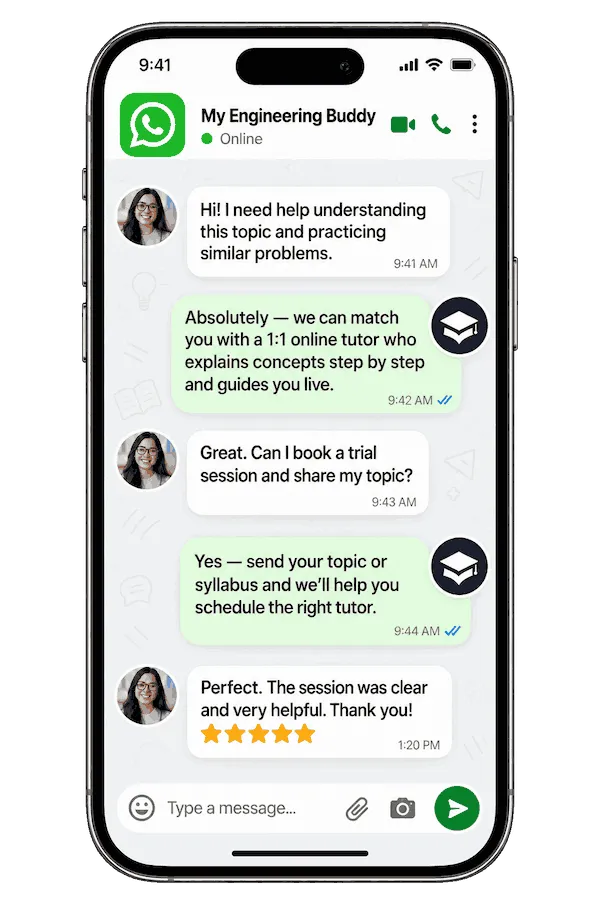
~1 min
Average Reply Time
~1 hour
To Be Matched With A Tutor
30 Min Trial
75% Find Their Tutor On The 1st Trial
$20-35+/hr
Premium Yet Affordable Learning
Hire The Best Catalysis Tutor





Most students who struggle with catalysis aren’t confused about chemistry — they’re confused about mechanism logic. One session fixes that.
Catalysis Tutor Online
Catalysis is the process by which a catalyst increases the rate of a chemical reaction without being consumed. Studied across undergraduate and graduate chemistry programmes, it covers homogeneous, heterogeneous, and enzymatic systems, equipping students to analyse reaction mechanisms and industrial processes.
Finding a Catalysis tutor near me used to mean settling for whoever was available locally. MEB connects you with a verified specialist in Chemistry — including catalysis — matched to your exact course level, exam board, and timezone. Sessions are 1:1, live, and built around what you don’t yet understand. You won’t sit through content you already know.
- 1:1 online sessions tailored to your specific syllabus and course level
- Expert-verified tutors with subject-specific knowledge in reaction kinetics and mechanism analysis
- Flexible time zones — US, UK, Canada, Australia, Gulf, and Europe
- Structured learning plan built after a diagnostic session
- Ethical homework and assignment guidance — you understand the work before you submit it
52,000+ students across the US, UK, Canada, Australia, and the Gulf have used MEB since 2008 — including students in Chemistry subjects like Catalysis, Chemical Kinetics, and Physical Chemistry.
Source: My Engineering Buddy, 2008–2025.
How Much Does a Catalysis Tutor Cost?
Rates start at $20–$40/hr for most undergraduate levels. Graduate and specialist topics — zeolite catalysis, surface mechanisms, industrial reactor design — run higher. The $1 trial gets you 30 minutes of live tutoring or one full homework question explained before you commit to anything.
| Level / Need | Typical Rate | What’s Included |
|---|---|---|
| Standard undergraduate | $20–$35/hr | 1:1 sessions, homework guidance |
| Advanced / Specialist | $35–$70/hr | Expert tutor, niche depth (industrial, enzymatic) |
| $1 Trial | $1 flat | 30 min live session or 1 homework question |
Tutor availability tightens around semester finals and exam windows. WhatsApp MEB for a quick quote — average response time under 1 minute.
Who This Catalysis Tutoring Is For
Catalysis courses sit at the intersection of thermodynamics, kinetics, and mechanism logic. Students often hit a wall when they move from textbook equations to explaining why a specific catalyst works under specific conditions.
- Undergraduate chemistry, chemical engineering, or biochemistry students covering catalytic mechanisms for the first time
- Graduate students working through heterogeneous or enzymatic catalysis in coursework or research modules
- Students retaking after a failed first attempt — particularly those who lost marks on mechanism problems or rate law derivations
- Students with a university conditional offer depending on this grade in a physical or industrial chemistry module
- Students 4–6 weeks from finals with gaps in Langmuir-Hinshelwood kinetics, Michaelis-Menten, or transition state theory
- Parents watching a child’s confidence drop alongside their chemistry grades as the course shifts into catalysis
Students who’ve worked through catalysis with MEB come from programmes at institutions including MIT, Caltech, Imperial College London, ETH Zürich, the University of Toronto, the University of Melbourne, and King Abdullah University of Science and Technology. The $1 trial is available regardless of where you’re studying.
At MEB, we’ve found that catalysis is one of the few undergraduate chemistry topics where students genuinely believe they understand it — until they’re asked to derive a rate law from a proposed mechanism. That gap between recognition and recall is exactly what targeted 1:1 sessions close fastest.
1:1 Tutoring vs Self-Study vs AI vs YouTube vs Online Courses
Self-study works if you’re disciplined, but catalysis mechanism logic requires someone to catch your errors in real time — not after the exam. AI tools give fast definitions; they can’t diagnose why you keep getting the Langmuir isotherm wrong. YouTube covers the basics well and stops cold when you hit your specific rate expression problem. Online courses are structured but move at a fixed pace that won’t wait for you. A 1:1 online Catalysis tutor through MEB works through your exact problem set, corrects reasoning errors as they happen, and builds your next session around what the first one revealed.
Outcomes: What You’ll Be Able To Do in Catalysis
After working through catalysis with an MEB tutor, you’ll be able to solve multi-step mechanism problems and identify the rate-determining step with confidence. You’ll analyse Michaelis-Menten kinetics and explain enzyme saturation behaviour clearly. You’ll model Langmuir adsorption isotherms and apply them to heterogeneous surface reactions. You’ll explain why a homogeneous catalyst like an acid or metal complex lowers activation energy without being consumed. You’ll apply transition state theory to predict how temperature changes affect catalytic rate — not just quote the Arrhenius equation.
Based on feedback from 40,000+ sessions collected by MEB from 2022 to 2025, 58% of students improved by one full grade after approximately 20 hours of 1:1 tutoring in subjects like Catalysis. A further 23% achieved at least a half-grade improvement.
Source: MEB session feedback data, 2022–2025.
Supporting a student through Catalysis? MEB works directly with parents to set up sessions, track progress, and keep coursework on schedule. WhatsApp MEB — average response time is under a minute, 24/7.
Try your first session for $1 — 30 minutes of live 1:1 tutoring or one homework question explained in full. No registration. No commitment. WhatsApp MEB now and get matched within the hour.
What We Cover in Catalysis (Syllabus / Topics)

Homogeneous Catalysis
- Acid-base catalysis: mechanism and rate law derivation
- Metal complex catalysts: ligand effects and oxidative addition
- Organocatalysis: chiral catalysts and enantioselectivity
- Reaction coordinate diagrams for catalysed vs uncatalysed pathways
- Activation energy and the pre-exponential factor in Arrhenius analysis
- Solvent effects on homogeneous catalytic rates
Core texts: Catalysis: An Integrated Approach (van Santen et al.) and Homogeneous Catalysis (Bhaduri & Mukesh) cover these topics at undergraduate and graduate level.
Heterogeneous Catalysis and Surface Chemistry
- Langmuir adsorption isotherm: assumptions, derivation, and applications
- Langmuir-Hinshelwood, Eley-Rideal, and Mars-van Krevelen mechanisms
- BET surface area analysis and catalyst characterisation techniques
- Zeolite structure and acid site distribution
- Catalyst poisoning, deactivation, and regeneration
- Surface chemistry fundamentals: chemisorption vs physisorption
- Industrial applications: Haber-Bosch, Fischer-Tropsch, catalytic cracking
Key references: Introduction to Surface Chemistry and Catalysis (Somorjai & Li) and Principles of Heterogeneous Catalysis (Ertl et al.).
Enzymatic and Biocatalysis
- Michaelis-Menten kinetics: derivation of the rate equation and Km
- Lineweaver-Burk plots and enzyme inhibition types
- Competitive, uncompetitive, and non-competitive inhibition mechanisms
- Transition state stabilisation and enzyme active site geometry
- Cofactors, coenzymes, and allosteric regulation
- Industrial biocatalysis: immobilised enzymes and fermentation
Standard references include Biochemistry (Stryer et al.) for enzyme kinetics and Biocatalysis (Drauz, Groeger & May) for applied enzymatic systems. Students working on chemical kinetics alongside this track benefit from covering both simultaneously.
What a Typical Catalysis Session Looks Like
The tutor opens by checking where the previous session ended — usually the Langmuir-Hinshelwood mechanism or Michaelis-Menten derivation. From there, the student and tutor work through two or three problems on screen: deriving a rate law from a proposed mechanism, plotting a Lineweaver-Burk graph, or identifying the rate-determining step in a catalytic cycle. The tutor uses a digital pen-pad to annotate reaction coordinate diagrams and mechanism arrows in real time. The student replicates the reasoning step by step, not just the answer. By the end, there’s a specific problem set to attempt before the next session, and the next topic — often catalyst deactivation or transition state theory — is noted and previewed. Nothing is left vague.
How MEB Tutors Help You with Catalysis (The Learning Loop)
Diagnose: In the first session, the tutor asks you to work through a mechanism problem unprompted. This immediately reveals whether you’re confusing rate-determining step logic, misapplying steady-state approximation, or just misreading the isotherm equations. Most catalysis struggles are specific — not general.
Explain: The tutor works through the correct approach on screen using a digital pen-pad, annotating every arrow, intermediate, and rate expression as they go. You see the reasoning built from scratch, not handed to you as a finished answer.
Practice: You attempt the next problem while the tutor watches. Errors surface immediately — before they become exam habits. This is where most of the learning happens.
Feedback: The tutor walks through exactly where your reasoning diverged from the correct path and why those steps cost marks. Not general encouragement — specific correction tied to the mark scheme.
Plan: After each session, the tutor maps the next topic and sets targeted practice. If you’ve got an exam in four weeks, the sequence is built around what will appear on it.
Sessions run on Google Meet with a digital pen-pad or iPad and Apple Pencil. Before your first session, share your syllabus or course outline, a recent problem set or homework question you couldn’t complete, and your exam or assignment date. Start with the $1 trial — 30 minutes of live tutoring that also serves as your first diagnostic. Whether you need a quick catch-up before an exam, structured revision over 4–8 weeks, or ongoing weekly support through the semester, the tutor maps the session plan after that first conversation.
Students consistently tell us that the moment catalysis clicks is when someone draws the energy profile correctly and links each dip to a mechanism step — not when they re-read the chapter a fourth time.
Source: MEB session feedback data, 2022–2025.
Students consistently tell us that catalysis is the point in a chemistry degree where the volume of interconnected concepts — kinetics, thermodynamics, surface science — hits a threshold. A common pattern our tutors observe is that one well-structured session on Langmuir isotherms unlocks the next three topics almost automatically.
Tutor Match Criteria (How We Pick Your Tutor)
Not every chemistry tutor can teach catalysis at graduate level. Here’s what MEB checks before matching you.
Subject depth: The tutor must have studied or taught catalysis at the level you need — undergraduate physical chemistry, graduate heterogeneous systems, or industrial process chemistry. Exam board and syllabus fit are verified before matching.
Tools: Every MEB tutor uses Google Meet with a digital pen-pad or iPad and Apple Pencil. Mechanism drawing and energy profile annotation require real-time visual tools — not screen-sharing a PDF.
Time zone: Matched to your region — US, UK, Gulf, Canada, or Australia. No 3am sessions because the platform defaulted to the wrong continent.
Goals: Whether you need exam scores, conceptual depth in enzymatic kinetics, homework completion support, or help with a research literature review — the tutor is briefed on your specific aim before session one.
Unlike platforms where you fill out a form and wait, MEB responds in under a minute, 24/7. Tutor match takes under an hour. The $1 trial means you test before you commit. Everything runs over WhatsApp — no logins, no intake forms.
Pricing Guide
Most catalysis sessions run $20–$40/hr. Graduate-level topics — surface science, industrial reactor kinetics, biocatalytic process design — typically fall in the $40–$100/hr range depending on tutor background and topic complexity. Rate factors include your course level, the specificity of the topic, your timeline, and tutor availability.
Availability tightens in the six weeks before semester finals and during January exam periods in UK institutions.
For students targeting research-track programmes or roles at pharmaceutical, petrochemical, or specialty chemical companies, tutors with professional research or industry backgrounds in catalysis are available at higher rates — share your specific goal with MEB and they’ll match the right tier.
Start with the $1 trial — 30 minutes, no registration, no commitment. WhatsApp MEB for a quick quote.
FAQ
Is catalysis hard?
It’s one of the harder topics in a physical or industrial chemistry course. The difficulty isn’t the equations — it’s the interconnected logic: mechanism, kinetics, surface behaviour, and thermodynamics all appear simultaneously. Most students find it clicks once someone works through one full mechanism with them live.
How many sessions are typically needed?
Students with specific exam gaps usually close them in 4–8 targeted sessions. Those building from scratch or covering research-level content typically work across a full semester. The tutor gives a realistic estimate after the first diagnostic session.
Can you help with catalysis homework and assignments?
MEB tutoring is guided learning — you understand the work, then submit it yourself. The tutor explains the method, works through a similar problem with you, and confirms your reasoning before you write up your answer. See our Academic Integrity policy and Why MEB page for full details on what we help with and what we don’t.
Will the tutor match my exact syllabus or exam board?
Yes. Before matching, MEB confirms your course, institution level, and syllabus. A tutor covering AP Chemistry catalysis content is not the same as one covering graduate-level industrial catalysis. You get someone who knows the specific material being tested.
What happens in the first session?
The tutor asks you to attempt a representative problem unprompted. This diagnostic reveals exactly where the gaps are — rate law derivation, adsorption isotherm application, enzyme kinetics, or something else. The rest of the session addresses the clearest gap directly. No time wasted on material you already know.
Is online tutoring as effective as in-person for catalysis?
For mechanism and kinetics problems, yes. The digital pen-pad replicates whiteboard-style annotation. Students share their working on screen; tutors annotate in real time. The format works particularly well for reaction coordinate diagrams and stepwise mechanism drawing.
What’s the difference between homogeneous and heterogeneous catalysis, and do you cover both?
Homogeneous catalysis involves catalyst and reactants in the same phase; heterogeneous involves different phases — typically a solid catalyst with gas or liquid reactants. MEB covers both, including enzymatic (biocatalysis) as a third category. Tutors specialise — tell MEB which track your course focuses on.
Can I get help with catalysis topics that appear in the Journal of Chemical Physics or primary literature for a research course?
Yes. Tutors with graduate research backgrounds can work through primary literature interpretation, mechanism analysis from research papers, and preparation for group meeting presentations. This is available at higher rates — share your specific research context when you WhatsApp MEB.
Can I get catalysis help at midnight or on weekends?
Yes. MEB operates 24/7. WhatsApp MEB at any hour — the average response time is under one minute. Tutors cover every major time zone, so late-night sessions for students in the US or Gulf are standard, not an exception.
What if I don’t like my assigned tutor?
Request a swap. MEB matches a replacement, typically within 24 hours. There’s no penalty, no form to complete, and no explanation required beyond “this isn’t working.” The $1 trial exists specifically so you can test fit before committing to paid sessions.
How do I get started?
Three steps: WhatsApp MEB, get matched with a verified catalysis tutor usually within the hour, then start your $1 trial — 30 minutes of live tutoring or one homework question explained in full. No registration. No contract. Done.
Trust & Quality at My Engineering Buddy
Every MEB tutor goes through subject-specific vetting: a written application, a live demonstration session evaluated by a senior tutor, and an ongoing review process tied to student feedback. Tutors covering catalysis hold degrees in chemistry, chemical engineering, or biochemistry — most at postgraduate level. Rated 4.8/5 across 40,000+ verified reviews on Google.
MEB tutoring is guided learning — you understand the work, then submit it yourself. For full details on what we help with and what we don’t, read our Academic Integrity policy and Why MEB.
MEB has been running since 2008, serving 52,000+ students across the US, UK, Canada, Australia, the Gulf, and Europe in 2,800+ subjects. Within Chemistry, that includes students working through physical chemistry tutoring, organic chemistry help, and analytical chemistry tutoring alongside catalysis. See how MEB’s tutoring methodology works for more on session structure and tutor accountability.
A common pattern our tutors observe is that students who struggle most with catalysis have solid equation recall but no framework for choosing which model applies to a given system. That’s a reasoning gap, not a knowledge gap — and it’s exactly what 1:1 sessions address.
Source: MEB session feedback data, 2022–2025.
Our experience across thousands of sessions shows that catalysis questions on exams reward process over product — examiners want to see your mechanism reasoning, not just the final rate expression. Students who practise deriving, not memorising, consistently outperform those who don’t.
Explore Related Subjects
Students studying Catalysis often also need support in:
- Chemical Equilibrium
- Thermochemistry
- Inorganic Chemistry
- Organometallic Chemistry
- Photochemistry
- Green Chemistry
- Industrial Chemistry
- Computational Chemistry
Next Steps
Before your first session, have ready: your exam board and syllabus (or course outline), a recent problem set or homework question you couldn’t complete, and your exam or assignment date. The tutor handles the rest.
- Share your course level, hardest component (mechanisms, kinetics, surface chemistry), and current timeline
- Share your availability and time zone
- MEB matches you with a verified catalysis tutor — usually within 24 hours, often within the hour
First session starts with a diagnostic so every minute is used well. Visit www.myengineeringbuddy.com for more on how MEB works.
WhatsApp to get started or email [email protected].
Reviewed by Subject Expert
This page has been carefully reviewed and validated by our subject expert to ensure accuracy and relevance.