




~1 min
Average Reply Time
~1 hour
To Be Matched With A Tutor
30 Min Trial
75% Find Their Tutor On The 1st Trial
$20-35+/hr
Premium Yet Affordable Learning
Most students don’t fail Jewish Law because the texts are too hard. They fail because no one ever showed them how halakhic reasoning actually works — step by step, source by source.
Jewish Law Tutor Online
Jewish Law (Halacha) is the comprehensive legal and ethical framework derived from the Torah, Talmud, and rabbinic literature, governing religious practice, civil conduct, and communal life within Jewish tradition across seminary, undergraduate, and graduate study.
MEB offers 1:1 online tutoring and homework help in 2800+ advanced subjects, including a dedicated Law tutoring programme covering religious, comparative, and historical legal systems. If you’ve searched for a Jewish Law tutor near me and want live, structured sessions rather than recorded lectures, you’re in the right place. Our tutors work through primary sources with you — Mishnah, Gemara, Rishonim, Acharonim — and connect them to your actual course requirements.
- 1:1 online sessions tailored to your syllabus — seminary, undergraduate, or graduate level
- Expert verified tutors with subject-specific knowledge in Halacha and rabbinic literature
- Flexible time zones — US, UK, Canada, Australia, Gulf
- Structured learning plan built after a diagnostic session
- Ethical homework and assignment guidance — you understand the material before you submit
52,000+ students across the US, UK, Canada, Australia, and the Gulf have used MEB since 2008 — including students in Law subjects like Jewish Law, Islamic Law tutoring, and Jurisprudence help.
Source: My Engineering Buddy, 2008–2025.
How Much Does a Jewish Law Tutor Cost?
Most Jewish Law sessions run $20–$40/hr depending on level and tutor background. Graduate and rabbinical-programme students working on advanced responsa or comparative religious law may see rates up to $100/hr. New students can start with the $1 trial before committing to anything further.
| Level / Need | Typical Rate | What’s Included |
|---|---|---|
| Standard (undergraduate / seminary) | $20–$35/hr | 1:1 sessions, homework guidance |
| Advanced / Graduate / Rabbinical | $35–$100/hr | Expert tutor, primary source depth |
| $1 Trial | $1 flat | 30 min live session or 1 homework question explained |
Tutor availability tightens around end-of-semester submission windows and yeshiva programme finals. Book early if your deadline is within four weeks.
WhatsApp MEB for a quick quote — average response time under 1 minute.
Who This Jewish Law Tutoring Is For
Jewish Law covers an unusually wide student population — from first-year undergraduates encountering the Talmud in translation to rabbinical students navigating She’elot u’Teshuvot in the original Aramaic. The gap between those groups is enormous, and tutoring has to reflect that.
- Undergraduate students taking Jewish Law, Talmud, or Jewish Studies modules at universities in the US, UK, Canada, or Australia
- Seminary and yeshiva students working through structured Gemara or Halacha curricula
- Graduate and rabbinical programme students preparing responsa, thesis chapters, or comparative religious law essays
- Students retaking after a failed first attempt — particularly those who struggled with halakhic methodology or the logic of rabbinic argument
- Students with a coursework or essay submission deadline approaching and significant gaps still to close
- Parents supporting a child enrolled in a Jewish Studies degree or yeshiva high school programme
Students working with MEB come from programmes at institutions including Yeshiva University, Brandeis University, the University of Toronto, King’s College London, Hebrew University of Jerusalem programmes taught in English, and Bar-Ilan University distance courses.
Students consistently tell us that the hardest part of Jewish Law isn’t memorising the rulings — it’s following the chain of reasoning from biblical verse to Talmudic debate to medieval commentary to practical ruling. That’s exactly what a 1:1 session is built to untangle.
1:1 Tutoring vs Self-Study vs AI vs YouTube vs Online Courses
Self-study works if you’re disciplined, but halakhic texts demand a back-and-forth that a textbook can’t provide. AI tools will summarise a sugya but can’t catch where your reasoning broke down or why your essay argument missed the Rishonim’s point. YouTube covers introductory Talmud well — it stops the moment you need help with a specific Tosafot passage on your syllabus. Online courses move at a fixed pace regardless of where you’re stuck. 1:1 tutoring with MEB is live, calibrated to your exact course and text, and corrects errors in your halakhic reasoning in the moment — not after you’ve submitted.
Outcomes: What You’ll Be Able To Do in Jewish Law
After working with an online Jewish Law tutor through MEB, students consistently report clearer command of the material that actually matters for their assessments. You’ll be able to analyze a Talmudic sugya and trace how the Rishonim and Acharonim differ on its ruling. You’ll apply halakhic methodology to novel scenarios — the skill that separates strong seminar contributors from weak ones. You’ll explain the relationship between biblical, rabbinic, and post-Talmudic sources without conflating them. You’ll write structured responsa-style essays that demonstrate genuine engagement with the chain of legal reasoning, not just surface summary. And you’ll present your argument in the academic register your course demands — whether that’s a modern law journal style or a traditional she’elot u’teshuvot format.
“Based on feedback from 40,000+ sessions collected by MEB from 2022 to 2025, 58% of students improved by one full grade after approximately 20 hours of 1:1 tutoring in subjects like Jewish Law. A further 23% achieved at least a half-grade improvement.”
Source: MEB session feedback data, 2022–2025.
Supporting a student through Jewish Law? MEB works directly with parents to set up sessions, track progress, and keep coursework on schedule. WhatsApp MEB — average response time is under a minute, 24/7.
Try your first session for $1 — 30 minutes of live 1:1 tutoring or one homework question explained in full. No registration. No commitment. WhatsApp MEB now and get matched within the hour.
What We Cover in Jewish Law (Syllabus / Topics)

Track 1: Talmudic Study and Halakhic Methodology
- Structure of the Mishnah and Gemara — tannaitic vs. amoraic layers
- Reading a sugya: identifying the question, dispute, and resolution
- Rashi and Tosafot as interpretive frameworks
- Principles of halakhic decision-making (psak halacha)
- Applying the thirteen hermeneutical principles (middot) of Rabbi Ishmael
- Navigating Rishonim and Acharonim disagreements on a single ruling
- How contemporary responsa (teshuvot) engage with classical precedent
Core texts: The Talmud: A Reference Guide by Adin Steinsaltz; Introduction to the Talmud and Midrash by Strack and Stemberger; The Halakhic Process by Joel Roth.
Track 2: Substantive Areas of Jewish Law
- Shabbat and holiday law — melachot, eruv, and rabbinic extensions
- Kashrut — biblical prohibitions, rabbinic fences, and modern applications
- Family law — kiddushin, gittin, and agunah in historical and contemporary perspective
- Civil and tort law — neziqin, property, and damage in Talmudic and later codes
- Jewish medical ethics — end-of-life, organ donation, and reproductive technology
- Comparative analysis: where Maimonides’ Mishneh Torah and the Shulchan Aruch diverge
Core texts: The Mishneh Torah (Maimonides); Shulchan Aruch (Rabbi Yosef Karo); Jewish Law: History, Sources, Principles by Menachem Elon.
Track 3: Jewish Law in Comparative and Academic Context
- Jewish Law as a legal system — comparison with civil law and common law traditions
- Influence of Greco-Roman and Islamic legal thought on halakhic development
- Jewish Law and state law — conflicts of jurisdiction in Israel, US, and UK contexts
- Academic methodologies: historical-critical vs. traditional doctrinal approaches
- Writing research essays and responsa in university law or religion departments
- Legal research help applied to primary rabbinic and secondary scholarly sources
Core texts: An Introduction to Jewish Law by George Horowitz; Law and Tradition in Classical Islamic Thought (for comparative study); The Jewish Law Annual (academic journal series).
Jewish Law sits at the intersection of religion, history, philosophy, and legal theory — making it one of the richest and most demanding subjects in any humanities or law programme. MEB tutors have worked through all three dimensions.
Source: My Engineering Buddy, 2008–2025.
What a Typical Jewish Law Session Looks Like
The tutor opens by checking the previous topic — usually a specific Talmudic passage or halakhic ruling the student was reviewing, such as the sugya on muktze in Tractate Shabbat or the Rambam’s position on damages in Bava Kamma. The student reads or paraphrases the text; the tutor listens for where the reasoning breaks down. Together they work through the passage on screen — the tutor uses a digital pen-pad to annotate the Aramaic text, mark the logical structure of the debate, and flag where the student’s essay argument diverged from the source’s actual claim. The student then reconstructs the argument in their own words. The session closes with a specific reading task — one Tosafot, one responsum, or one comparative paragraph — and the next topic is noted so the following session doesn’t waste ten minutes re-establishing context.
How MEB Tutors Help You with Jewish Law (The Learning Loop)
Diagnose: In the first session, the tutor identifies whether the difficulty is textual (reading the Aramaic or Hebrew), conceptual (following the halakhic argument), structural (knowing how the codes relate to each other), or expressive (translating understanding into a well-argued essay). These are four different problems requiring four different approaches.
Explain: The tutor works through a live example — a sugya, a section of Shulchan Aruch, or a responsum — using a digital pen-pad to annotate the text in real time. The logic of the argument is made visible, not just described.
Practice: The student attempts the next passage or essay section with the tutor present. Mistakes are caught immediately — before they calcify into a wrong mental model that takes three more sessions to undo.
Feedback: Step-by-step error correction. The tutor explains not just what went wrong but why a marker or examiner would lose confidence in the argument at that point. For essay work, this means tracing exactly where the halakhic chain was dropped.
Plan: Each session ends with a clear next step — a specific text to read, a practice question to attempt, or a draft paragraph to revise. The tutor tracks progress across sessions and adjusts the sequence when the student moves faster or slower than expected.
All sessions run on Google Meet. Tutors use a digital pen-pad or iPad with Apple Pencil to annotate texts in real time. Before your first session, share your course syllabus or programme outline, the specific text or topic you’re working on, and any essay prompts or assignments you’re preparing for. Whether you need a quick catch-up before a submission deadline, structured revision over 4–8 weeks, or ongoing weekly support through the semester, the tutor maps the session plan after the first diagnostic. Start with the $1 trial — 30 minutes of live tutoring that also serves as your first diagnostic.
A common pattern our tutors observe is that students who’ve studied Jewish Law in a traditional setting — hevruta, shiur, or yeshiva — often know more than they can show on paper. The gap isn’t knowledge; it’s translating oral reasoning into written academic argument. That’s a teachable skill, and it tends to close faster than students expect.
Tutor Match Criteria (How We Pick Your Tutor)
Not every tutor who knows Talmud can teach it to a second-year undergraduate at a secular university. MEB matches on specifics.
Subject depth: Tutors are matched to your exact level — seminary, undergraduate Jewish Studies, graduate religion or law programme, or rabbinical school. A tutor who specialises in Talmud text study is not automatically the right match for a comparative Jewish and Islamic law essay.
Tools: Every tutor uses Google Meet with a digital pen-pad or iPad and Apple Pencil — essential for annotating Hebrew and Aramaic texts live.
Time zone: Matched to your region — US, UK, Gulf, Canada, Australia. Sessions at times that don’t require you to be awake at 3am.
Goals: Whether you need help with a specific essay, ongoing legal theory tutoring applied to halakhic sources, or targeted exam preparation, the match reflects your actual objective — not a generic tutor profile.
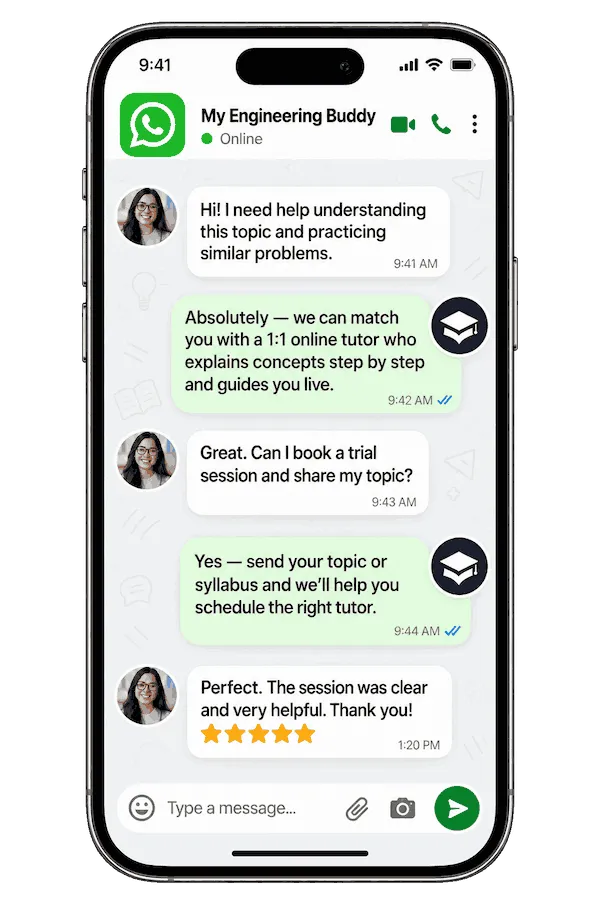
Unlike platforms where you fill out a form and wait, MEB responds in under a minute, 24/7. Tutor match takes under an hour. The $1 trial means you test before you commit. Everything runs over WhatsApp — no logins, no intake forms.
Study Plans (Pick One That Matches Your Goal)
MEB offers three session structures for Jewish Law students. Catch-up (1–3 weeks): targeted sessions on the specific texts or topics causing the most damage to your grade, prioritised by what’s coming up soonest. Exam or submission prep (4–8 weeks): structured revision across the full syllabus, with timed essay practice and source analysis in the final two weeks. Weekly ongoing support: one or two sessions per week aligned to your course schedule, covering each new topic as it arrives so nothing builds up. The tutor builds the specific sequence after the diagnostic session.
Pricing Guide
Jewish Law tutoring starts at $20/hr for standard undergraduate and seminary-level sessions. Graduate-level work — including advanced responsa, comparative religious law, and dissertation support — typically runs $40–$100/hr depending on tutor background and topic complexity.
Rate factors include your programme level, the primary language of the texts (English, Hebrew, or Aramaic), timeline urgency, and tutor availability. During peak end-of-semester periods, availability at preferred time slots tightens — earlier booking gets you the tutor that’s the right fit, not just the one that’s left.
For students in competitive graduate programmes in Jewish law or religion at institutions aiming for academic careers or rabbinical ordination, tutors with advanced academic or rabbinical backgrounds are available at higher rates — share your specific goal and MEB will match the tier to your ambition.
Start with the $1 trial — 30 minutes, no registration, no commitment. WhatsApp MEB for a quick quote.
FAQ
Is Jewish Law hard?
It’s genuinely demanding — the texts are in Aramaic and Hebrew, the reasoning is layered across 1,500 years of commentary, and academic courses expect both close textual reading and comparative legal argument. Most students find the methodology more difficult than the content volume.
How many sessions are needed?
For a specific essay or short-term gap, 3–5 sessions often make a measurable difference. For full-semester support or graduate-level work, most students book 8–15 sessions across a term. The diagnostic session clarifies what’s needed and in what order.
Can you help with homework and assignments?
Yes — MEB tutoring is guided learning. You understand the material, work through the sources, and submit the work yourself. See our Academic Integrity policy and Why MEB page for full details on what we help with and what we don’t.
Will the tutor match my exact syllabus or exam board?
Yes. Share your course outline or programme name when you first contact MEB. Tutors are matched by level and text focus — a Brandeis undergraduate Jewish Studies course and a KCL Law and Religion module have different priorities, and the tutor match reflects that.
What happens in the first session?
The tutor runs a short diagnostic — asking you to work through a passage or essay argument live. This identifies exactly where reasoning breaks down. The rest of the session addresses the most pressing gap, and a plan for subsequent sessions is outlined before you finish.
Is online tutoring as effective as in-person?
For text-based subjects like Jewish Law, often more so. The digital pen-pad lets tutors annotate Hebrew and Aramaic sources in real time, and sessions are recorded on request so you can review the tutor’s annotations later. The format suits the material well.
Can I get Jewish Law help at midnight or on weekends?
Yes. MEB operates 24/7 across time zones. WhatsApp MEB at any hour — response is typically under a minute, and tutor availability includes evenings and weekends to fit students in the US, Gulf, and Australia without schedule contortion.
What if I don’t connect with my assigned tutor?
Say so. MEB will rematch you, usually within the hour. The $1 trial exists precisely for this — you find out before you’ve spent $40 whether the tutor’s teaching style and knowledge depth match what you need.
Do you cover both traditional and academic approaches to Jewish Law?
Yes. Some students need help with traditional Talmud study methods — hevruta-style reasoning, close reading of Rishonim. Others need a comparative legal framework suited to a secular university law or religion department. MEB tutors are matched to the approach your course actually uses.
What is the difference between Halacha and Jewish ethics (Mussar), and does MEB cover both?
Halacha is the legal framework — what is permitted, prohibited, or required. Mussar is the ethical-character tradition, which overlaps but is distinct. MEB covers both, including coursework where they intersect, such as Jewish medical ethics or environmental halakha modules.
How do I find a Jewish Law tutor for a specific text — like Tractate Ketubot or Maimonides’ Laws of Repentance?
Just tell MEB the specific text when you WhatsApp. Tutors are matched by tractate, code section, or topic — not just the general subject name. Mention the tractate, chapter, or responsum you’re working on and MEB will match accordingly.
How do I get started?
WhatsApp MEB with your course level and the topic you’re stuck on. You’ll be matched with a verified tutor — usually within the hour. The first session is the $1 trial: 30 minutes of live tutoring or one assignment question explained fully. Three steps: WhatsApp, get matched, start.
Trust & Quality at My Engineering Buddy
Every MEB tutor goes through a multi-stage screening process: subject knowledge assessment, a live demo session evaluated by senior staff, and ongoing review based on student session feedback. Tutors in Jewish Law hold degrees in Jewish Studies, Talmud, Law and Religion, or relevant rabbinical qualifications — and are vetted specifically on the texts and levels they claim to cover. Rated 4.8/5 across 40,000+ verified reviews on Google.
MEB tutoring is guided learning — you understand the work, then submit it yourself. For full details on what we help with and what we don’t, read our Academic Integrity policy and Why MEB.
MEB has served 52,000+ students since 2008 across the US, UK, Canada, Australia, the Gulf, and Europe — in 2,800+ subjects spanning Law and adjacent disciplines. Students working on legal studies tutoring, family law help, and Jewish Law regularly move between MEB tutors depending on which module is live. For more on how MEB selects and trains tutors, see our tutoring methodology.
MEB has operated since 2008 — before most tutoring platforms existed. Eighteen years of session feedback, tutor screening refinement, and student outcome tracking is what sits behind the 4.8/5 rating.
Source: My Engineering Buddy, 2008–2025.
Explore Related Subjects
Students studying Jewish Law often also need support in:
- Constitutional Law
- Human Rights Law
- International Humanitarian Law
- Civil Law
- International Law (Public & Comparative)
- Law of Evidence
- Property Law
Next Steps
Getting started takes under a minute. Share your exam board or course name, the text or topic you’re currently struggling with, and your submission or exam date. Include your time zone and when you’re available. MEB matches you with a verified Jewish Law tutor — usually within 24 hours, often faster.
Before your first session, have ready:
- Your course syllabus or programme outline (or the specific tractate / code section you’re working on)
- A recent essay, homework question, or passage you struggled with
- Your exam or submission deadline
The tutor handles the rest. Visit www.myengineeringbuddy.com for more on how MEB works.
WhatsApp to get started or email [email protected].
Reviewed by Subject Expert
This page has been carefully reviewed and validated by our subject expert to ensure accuracy and relevance.




