




~1 min
Average Reply Time
~1 hour
To Be Matched With A Tutor
30 Min Trial
75% Find Their Tutor On The 1st Trial
$20-35+/hr
Premium Yet Affordable Learning
Hire The Best Mass Spectrometry Tutor



If you’ve stared at a fragmentation pattern for twenty minutes and still can’t assign the base peak — you need a Mass Spectrometry tutor, not another YouTube video.
Mass Spectrometry Tutor Online
Mass Spectrometry is an analytical technique that ionises chemical species and sorts the resulting ions by mass-to-charge ratio, enabling identification of molecular weight, elemental composition, and structural fragmentation patterns in unknown compounds.
MEB offers 1:1 online tutoring and homework help in Mass Spectrometry — covering undergraduate organic chemistry courses, analytical chemistry modules, and graduate-level instrument methods. If you’ve searched for a Mass Spectrometry tutor near me and found nothing local, every session runs online via Google Meet with a digital pen-pad, so your location is never a barrier. Our chemistry tutoring programme spans 2,800+ subjects, and Mass Spectrometry sits at the core of it. Tutors are matched to your exact course, exam board, or instrument type — not assigned at random.
- 1:1 online sessions aligned to your specific course or syllabus
- Expert-verified tutors with instrument-level knowledge of MS techniques
- Flexible scheduling across US, UK, Canada, Australia, and Gulf time zones
- Structured learning plan built after a diagnostic of your current gaps
- Ethical homework and assignment guidance — you understand the work, then submit it yourself
52,000+ students across the US, UK, Canada, Australia, and the Gulf have used MEB since 2008 — including students in Chemistry subjects like Mass Spectrometry, NMR Spectroscopy, and Analytical Chemistry.
Source: My Engineering Buddy, 2008–2025.
How Much Does a Mass Spectrometry Tutor Cost?
Rates start at $20–$40/hr for most undergraduate-level Mass Spectrometry courses. Graduate and specialist instrument methods — such as LC-MS/MS, HRMS, or tandem MS interpretation — run up to $100/hr depending on depth required. The $1 trial gets you 30 minutes of live tutoring or a full explanation of one homework question, with no registration needed.
| Level / Need | Typical Rate | What’s Included |
|---|---|---|
| Standard (undergrad) | $20–$40/hr | 1:1 sessions, homework guidance, fragmentation practice |
| Advanced / Graduate | $40–$100/hr | HRMS, tandem MS, proteomics, metabolomics methods |
| $1 Trial | $1 flat | 30 min live session or one full homework question explained |
Tutor availability tightens around end-of-semester lab report deadlines and final exam periods. Book early if your submission is within two weeks.
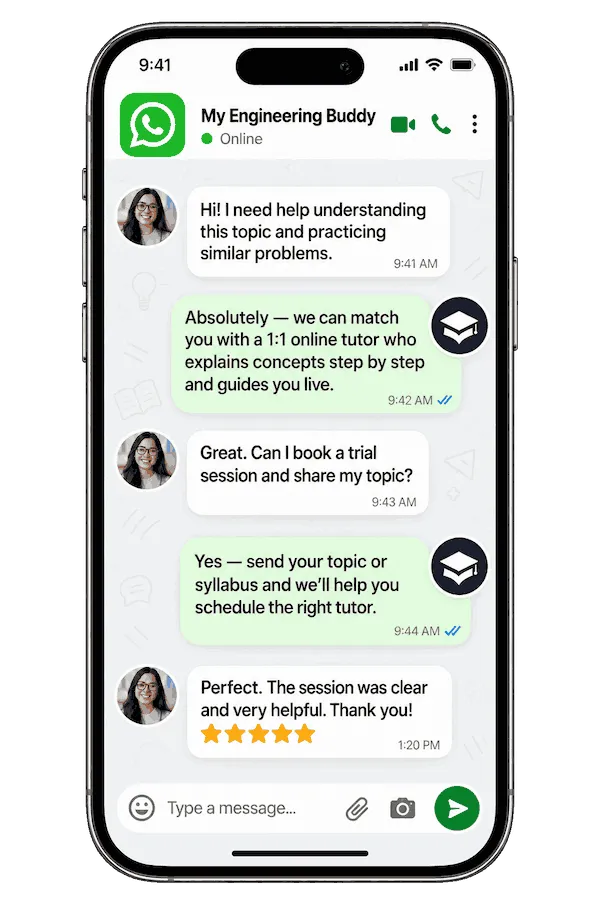
WhatsApp MEB for a quick quote — average response time under 1 minute.
Who This Mass Spectrometry Tutoring Is For
Most students who come to MEB for Mass Spectrometry tutoring aren’t struggling with chemistry in general — they’ve hit one specific wall. Fragmentation logic, isotope pattern reading, or interpreting a mass spectrum from a lab experiment are the most common sticking points.
- Undergraduate chemistry or biochemistry students with a lab report or MS problem set due
- Students retaking after a failed first attempt in an analytical chemistry module
- Students 4–6 weeks from a final exam with significant gaps in spectral interpretation
- Graduate students needing to interpret LC-MS or GC-MS data for a research project
- Parents watching a child’s confidence drop alongside their practical chemistry grades
- Students enrolled at universities including MIT, UC Berkeley, Imperial College London, University of Toronto, University of Melbourne, ETH Zurich, and NUS who need subject-specific support
Need to get through a mass spectrum problem set before tomorrow’s class? The $1 trial gives you 30 minutes of live help immediately — no commitment beyond that.
1:1 Tutoring vs Self-Study vs AI vs YouTube vs Online Courses
Self-study works if you’re disciplined, but Mass Spectrometry fragmentation rules require someone to catch your reasoning errors live. AI tools explain individual concepts quickly but can’t look at your specific spectrum and tell you where your logic went wrong. YouTube gives a solid intro to EI ionisation or base peaks, then leaves you alone when the actual problem is in front of you. Online courses move at a fixed pace regardless of whether you’ve genuinely understood the McLafferty rearrangement yet. 1:1 tutoring with MEB puts a tutor on your screen who can draw fragmentation pathways with you in real time, correct your logic mid-problem, and adjust what gets covered based on exactly where you’re stuck in your Mass Spectrometry course.
Outcomes: What You’ll Be Able To Do in Mass Spectrometry
After working through Mass Spectrometry with an MEB tutor, you’ll be able to interpret EI and ESI mass spectra to deduce molecular weight and molecular formula from M⁺ and M+1 peaks. You’ll analyse fragmentation patterns to identify functional groups and propose plausible structural assignments for unknowns. Apply isotope ratio rules to distinguish chlorine, bromine, and sulfur-containing compounds directly from the spectrum. Explain the difference between soft and hard ionisation methods and select the appropriate technique for a given analyte type. Write up instrument data sections in lab reports with the precision your course markers expect.
Based on feedback from 40,000+ sessions collected by MEB from 2022 to 2025, 58% of students improved by one full grade after approximately 20 hours of 1:1 tutoring in subjects like Mass Spectrometry. A further 23% achieved at least a half-grade improvement.
Source: MEB session feedback data, 2022–2025.
Supporting a student through Mass Spectrometry? MEB works directly with parents to set up sessions, track progress, and keep coursework on schedule. WhatsApp MEB — average response time is under a minute, 24/7.
What We Cover in Mass Spectrometry (Syllabus / Topics)

Track 1: Fundamentals of Mass Spectrometry
- Ionisation methods: electron ionisation (EI), chemical ionisation (CI), electrospray (ESI), MALDI
- Mass analysers: quadrupole, time-of-flight (TOF), ion trap, magnetic sector
- Interpreting the molecular ion (M⁺) and accurate mass
- Base peak, relative abundance, and reconstructing a mass spectrum from raw data
- Isotope patterns: M+1 and M+2 peaks for Cl, Br, S compounds
- Degrees of unsaturation (DBE) calculated from molecular formula
- Resolution, sensitivity, and dynamic range in instrument performance
Core texts for this track include Silverstein, Webster & Kiemle’s Spectrometric Identification of Organic Compounds and Gross’s Mass Spectrometry: A Textbook.
Track 2: Fragmentation and Structural Interpretation
- Alpha-cleavage and inductive cleavage mechanisms
- McLafferty rearrangement: recognition conditions and product prediction
- Retro-Diels-Alder fragmentation in cyclic systems
- Loss of small neutrals: CO, H₂O, NH₃, HCl — diagnostic significance
- Aromatic compound fragmentation: tropylium ion (m/z 91) and related patterns
- Combined spectral interpretation: cross-referencing MS with IR and NMR spectroscopy data
- Working through unknown compound identification problems step by step
Recommended: Clayden, Greeves & Warren’s Organic Chemistry for mechanistic context alongside your department’s MS problem sets.
Track 3: Advanced and Hyphenated Techniques
- GC-MS: coupling, separation, and library matching for volatile analytes
- LC-MS and LC-MS/MS: applications in pharmaceutical and environmental analysis
- High-resolution mass spectrometry (HRMS): exact mass and elemental composition determination
- Tandem MS (MS/MS): product ion scans, precursor ion scans, neutral loss scans
- Proteomics applications: peptide sequencing via MS/MS fragmentation (b and y ions)
- Metabolomics: untargeted and targeted workflows, data interpretation challenges
- Data processing software: working with MZmine, Xcalibur, or vendor software outputs
For this track, Watson & Sparkman’s Introduction to Mass Spectrometry provides clear coverage of both instrument principles and real-world applications across analytical chemistry workflows.
At MEB, we’ve found that students who struggle with Mass Spectrometry fragmentation most often have a gap in their understanding of carbocation stability — not in spectroscopy itself. Fixing the underlying organic chemistry mechanism usually unlocks the spectral interpretation within two sessions.
What a Typical Mass Spectrometry Session Looks Like
The tutor opens by checking what you covered last time — usually a specific fragmentation type such as alpha-cleavage or McLafferty rearrangement — and asking you to explain the mechanism back before moving on. From there, you and the tutor work through a mass spectrum on screen together: reading the molecular ion, noting isotope clusters, and systematically assigning the major fragment ions using the digital pen-pad to draw each cleavage pathway in real time. When you misidentify a peak, the tutor pauses, backs up to the mechanism, and shows you exactly why the ion forms at that m/z value. By the end of the session you’ll have a concrete practice problem — usually an unknown spectrum from a past exam or your own course materials — along with a note of which technique or compound class gets covered next.
How MEB Tutors Help You with Mass Spectrometry (The Learning Loop)
Diagnose: In the first session, the tutor gives you one or two unseen mass spectra to interpret. They’re not grading you — they’re mapping exactly where your reasoning breaks down, whether that’s at isotope pattern reading, fragmentation logic, or understanding which ionisation method produced the spectrum.
Explain: The tutor works live problems on the digital pen-pad, annotating each fragmentation step on screen. Nothing is skipped. If you don’t follow the loss of m/z 15 from a methyl group, the tutor redraws it until the mechanism is clear.
Practice: You attempt a problem with the tutor present. Not watching — present. They let you work, then step in the moment your approach goes off track, before the error compounds.
Feedback: Every error gets a specific explanation. “You misread the M+2 peak as noise” is more useful than “check your isotope ratios.” The tutor ties each correction back to what an examiner expects in a written answer.
Plan: At session close, the tutor notes which fragmentation types are solid, which need more work, and sets the next topic. Progress is tracked across sessions so nothing important gets skipped before your deadline.
Sessions run via Google Meet. The tutor uses a digital pen-pad or iPad with Apple Pencil to annotate spectra and draw fragmentation mechanisms live. Before the first session, share your course syllabus or exam board specification, a recent problem set or past paper question you struggled with, and your exam or submission date. The tutor handles the structure from there. Start with the $1 trial — 30 minutes of live tutoring that also serves as your first diagnostic.
Students consistently tell us that their biggest breakthrough in Mass Spectrometry came not from memorising fragmentation rules, but from finally understanding why a particular ion forms — and that usually happens within the first two hours of 1:1 work.
Source: My Engineering Buddy, compiled from session feedback.
Try your first session for $1 — 30 minutes of live 1:1 tutoring or one homework question explained in full. No registration. No commitment. WhatsApp MEB now and get matched within the hour.
Tutor Match Criteria (How We Pick Your Tutor)
Not every chemistry tutor can handle Mass Spectrometry at the instrument level. Here’s what MEB checks before assigning yours.
Subject depth: The tutor must demonstrate hands-on familiarity with the specific MS techniques your course covers — EI fragmentation for undergraduate organic chemistry, or LC-MS/MS and HRMS for graduate analytical work. General chemistry knowledge is not sufficient.
Tools: Every Mass Spectrometry tutor at MEB uses Google Meet with a digital pen-pad or iPad and Apple Pencil. Spectrum annotation and fragmentation pathway drawing happen in real time — not described verbally.
Time zone: Matched to your region — US, UK, Gulf, Canada, or Australia. No scheduling across seven time zones for a 7am session.
Goals: Whether your priority is exam score improvement, making sense of your own lab data, or building enough depth for a research methods section, the tutor is matched to that specific aim — not assigned from a generic pool.
Unlike platforms where you fill out a form and wait, MEB responds in under a minute, 24/7. Tutor match takes under an hour. The $1 trial means you test before you commit. Everything runs over WhatsApp — no logins, no intake forms.
Study Plans (Pick One That Matches Your Goal)
After the diagnostic session, the tutor builds a specific sequence for you. Three common structures work well for Mass Spectrometry: a catch-up plan covering the highest-yield fragmentation types and isotope rules in 1–3 weeks before an exam; a structured 4–8 week exam prep block working through your full syllabus with past paper practice built in; or ongoing weekly support aligned to your semester — covering each new technique as your course introduces it, with homework guidance throughout. The tutor decides the sequence after seeing where you actually are, not based on a generic template.
Pricing Guide
Standard Mass Spectrometry tutoring runs $20–$40/hr, covering most undergraduate organic and analytical chemistry courses. Graduate-level work — HRMS data interpretation, LC-MS/MS method development, proteomics fragmentation — goes up to $100/hr. Rate depends on the specific technique, course level, how quickly you need to progress, and tutor availability at your preferred time.
For students targeting graduate research programmes, pharmaceutical industry roles, or positions requiring certified analytical chemistry competency, MEB can match tutors with professional instrument experience at higher rates — share your specific goal and MEB will match accordingly.
Availability tightens around end-of-semester deadlines and exam windows. If your submission or exam is within three weeks, book now rather than later.
Start with the $1 trial — 30 minutes, no registration, no commitment. WhatsApp MEB for a quick quote.
FAQ
Is Mass Spectrometry hard?
For most students, yes — specifically the fragmentation logic. The instrument principles are manageable, but predicting which bonds break and why requires a solid grounding in carbocation stability and organic mechanisms. Students without that foundation find MS interpretation disproportionately difficult until those gaps are closed.
How many sessions are needed?
Students with one or two specific sticking points — such as isotope patterns or McLafferty rearrangement — often see clear progress in 3–5 sessions. Students working through an entire analytical chemistry module or building research-level MS competency typically need 10–20 hours of structured work.
Can you help with homework and assignments?
MEB tutoring is guided learning — you understand the work, then submit it yourself. The tutor walks through the reasoning and helps you reach the answer independently. See our Academic Integrity policy and Why MEB page for full details on what we help with and what we don’t.
Will the tutor match my exact syllabus or exam board?
Yes. Share your course outline, exam board, or university module description when you make contact and MEB matches a tutor who knows that specific syllabus — not a generalist who will work it out as they go.
What happens in the first session?
The tutor gives you one or two unseen spectra to interpret, identifies exactly where your reasoning breaks down, and uses the rest of the session to address the most urgent gaps. You leave with a clear picture of what to tackle next and a concrete practice task.
Is online tutoring as effective as in-person?
For Mass Spectrometry specifically, online tutoring with a digital pen-pad is often more effective than in-person whiteboard sessions — the tutor can annotate your actual spectrum on screen, draw fragmentation arrows directly on the data, and share worked examples without you having to copy from a board.
Can I get Mass Spectrometry help at short notice — even late at night?
Yes. MEB operates 24/7 via WhatsApp. Average response time is under a minute. If your lab report is due at 9am and it’s currently midnight, send a message now — a tutor can often be available within the hour depending on time zone and availability.
What if I don’t get on with my assigned tutor?
Request a change. There’s no friction in doing so. MEB will rematch you with a different tutor who covers your syllabus and technique requirements. The $1 trial exists specifically so you can test the fit before committing to a regular schedule.
What’s the difference between EI and ESI mass spectrometry, and will my tutor know both?
Electron ionisation (EI) is a hard ionisation method that produces extensive fragmentation — standard for GC-MS and volatile organic compounds. Electrospray ionisation (ESI) is soft ionisation, preserving the intact molecule — used in LC-MS for proteins, pharmaceuticals, and polar compounds. MEB tutors covering Mass Spectrometry are vetted on both, along with MALDI and CI where your course requires them.
Do I need to own or operate an actual mass spectrometer to get value from these sessions?
No. The majority of course assessment focuses on spectral interpretation — reading and assigning peaks from a printed or digital spectrum rather than operating the instrument. Tutors work from spectra on screen and can also help you interpret data from your own lab experiments if you have instrument output to share.
How do I get started?
Use the $1 trial — 30 minutes of live Mass Spectrometry tutoring or one full problem explained. Three steps: WhatsApp MEB, get matched with a verified tutor within the hour, then start your trial session. No registration form, no wait.
Can you help with interpreting tandem MS (MS/MS) data for a research project?
Yes. MEB has tutors experienced in MS/MS fragmentation — product ion scans, neutral loss scans, and b/y ion series for peptide sequencing. Share your data type, instrument platform, and what you’re trying to determine, and MEB will confirm tutor availability for that specific method before you commit.
Trust & Quality at My Engineering Buddy
Every MEB tutor goes through screening that includes a subject knowledge assessment and a live demo session before they teach a single student. For Mass Spectrometry, that means demonstrating they can actually work through fragmentation problems, assign peaks correctly, and explain instrument principles — not just claim they covered spectroscopy in their degree. Rated 4.8/5 across 40,000+ verified reviews on Google. Ongoing feedback from every session is reviewed, and tutors with declining ratings are removed. MEB has been running since 2008 and has served 52,000+ students across the US, UK, Canada, Australia, and the Gulf.
MEB tutoring is guided learning — you understand the work, then submit it yourself. For full details on what we help with and what we don’t, read our Academic Integrity policy and Why MEB.
MEB covers 2,800+ subjects across Chemistry, including Mass Spectrometry, Chromatography tutoring, and Physical Chemistry help. Whether you’re at the undergraduate level building core analytical skills or at the graduate level working through instrument data for a research project, MEB has a tutor matched to that exact stage. Find out more about how we run sessions at MEB’s tutoring methodology page.
A common pattern our tutors observe is that students arrive convinced the problem is memorisation — that they just need to learn more fragmentation rules. In almost every case, the real issue is a missing conceptual step in the mechanism. Working through that once, properly, changes everything.
MEB has operated since 2008. In that time, the platform has grown to cover over 2,800 subjects — with Chemistry, including Mass Spectrometry, Organic Chemistry tutoring, and Physical Chemistry support, among its most requested areas.
Source: My Engineering Buddy, 2008–2025.
Explore Related Subjects
Students studying Mass Spectrometry often also need support in:
- Stereochemistry
- Organic Chemistry
- Inorganic Chemistry
- Computational Chemistry
- Thermochemistry
- Environmental Chemistry
- Medicinal Chemistry
Next Steps
To get matched quickly, share the following when you message MEB:
- Your exam board or university course code, and the specific topics giving you trouble
- Your availability and time zone
- Your exam date, lab report deadline, or submission window
Before your first session, have ready: your exam board and syllabus or course outline, a recent past paper attempt or homework question you struggled with, and your exam or deadline date. The tutor handles the rest.
MEB matches you with a verified Mass Spectrometry tutor — usually within 24 hours. The first session starts with a diagnostic so every minute is used on what actually matters for your course.
Visit www.myengineeringbuddy.com for more on how MEB works.
WhatsApp to get started or email [email protected].
Reviewed by Subject Expert
This page has been carefully reviewed and validated by our subject expert to ensure accuracy and relevance.




