Hire Verified & Experienced
Metagenomics Tutors
Email: [email protected]
4.8/5 40K+ session ratings collected on the MEB platform



Hire The Best Metagenomics Tutor
Top Tutors, Top Grades. Without The Stress!
Most students hit a wall when QIIME2 stops making sense and their assembly stats look nothing like the paper they’re supposed to replicate. A verified Metagenomics tutor closes that gap fast.
Metagenomics Tutor Online
Metagenomics is the direct sequencing and analysis of genetic material from environmental samples, enabling researchers to characterise microbial communities without prior cultivation — equipping students to apply shotgun sequencing, taxonomic profiling, and functional annotation workflows.
If you’ve searched for a Metagenomics tutor near me, MEB gives you something better: a 1:1 online Metagenomics tutor matched to your exact course, pipeline, and deadline. MEB has offered 1:1 online tutoring and homework help in 2800+ advanced subjects since 2008. Your tutor works through the precise gaps in your understanding — whether that’s assembly, binning, or statistical interpretation — without padding sessions with content you already know. You work through the problem. You submit the work.
MEB covers Metagenomics at undergraduate, graduate, and research levels across Biomedical Engineering and related life-science programmes.
- 1:1 online sessions tailored to your course syllabus and pipeline tools
- Expert-verified tutors with subject-specific Metagenomics knowledge
- Flexible time zones — US, UK, Canada, Australia, Gulf
- Structured learning plan built after a diagnostic session
- Ethical homework and assignment guidance — you understand the work, then submit it yourself
52,000+ students across the US, UK, Canada, Australia, and the Gulf have used MEB since 2008 — including students in Biomedical Engineering subjects like Metagenomics, Genomics, and Computational Biology.
Source: My Engineering Buddy, 2008–2025.
How Much Does a Metagenomics Tutor Cost?
Most Metagenomics tutoring sessions run $20–$40/hr. Graduate-level or research-focused support with specialist tutors can reach $100/hr. The $1 trial gives you 30 minutes of live 1:1 tutoring or a full explanation of one homework question — no registration required.
| Level / Need | Typical Rate | What’s Included |
|---|---|---|
| Undergraduate / Standard | $20–$35/hr | 1:1 sessions, homework guidance |
| Graduate / Research-Level | $35–$100/hr | Expert tutor, pipeline and analysis depth |
| $1 Trial | $1 flat | 30 min live session or 1 homework question |
Tutor availability tightens around semester deadlines and thesis submission windows. Book early if your timeline is fixed.
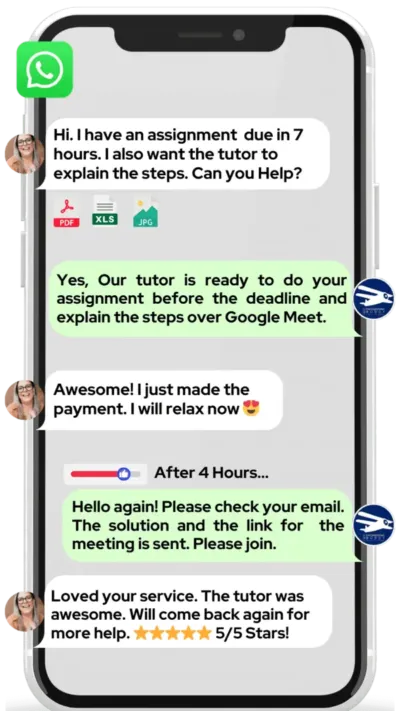
WhatsApp MEB for a quick quote — average response time under 1 minute.
Who This Metagenomics Tutoring Is For
Metagenomics sits at the intersection of microbiology, bioinformatics, and statistics. Most students struggle not because the biology is hard, but because the computational pipeline — quality filtering, assembly, taxonomic classification, functional annotation — demands fluency in tools they’ve never formally been taught.
- Undergraduate students in genomics, microbiology, or bioinformatics modules encountering metagenomic datasets for the first time
- Masters and PhD students whose research involves 16S rRNA or shotgun sequencing and need help interpreting QIIME2, MetaPhlAn, or HUMAnN output
- Students with a thesis chapter deadline approaching and assembly or diversity analysis that isn’t making sense
- Students retaking a failed practical or computational assignment — one of the most common entry points for Metagenomics tutoring at MEB
- Researchers at universities including MIT, University of Michigan, Imperial College London, University of Toronto, University of Melbourne, ETH Zurich, and King Abdullah University of Science and Technology who need focused support on a specific analytical bottleneck
- Students working in applied areas like gut microbiome research, environmental monitoring, or clinical microbial diagnostics
If the $1 trial covers your most pressing question, that alone is worth it. Many students book their first full session immediately after.
1:1 Tutoring vs Self-Study vs AI vs YouTube vs Online Courses
Self-study works if your pipeline runs cleanly — but when it doesn’t, there’s no one to tell you why. AI tools explain concepts at surface level; they can’t look at your FASTQ files and diagnose why your alpha diversity plot looks wrong. YouTube covers QIIME2 basics well but stops when your specific error message appears. Online courses follow fixed pacing — useful for foundations, not for dissertation deadlines. A 1:1 online Metagenomics tutor from MEB works through your actual data, your actual errors, and your actual course requirements — live, in real time, correcting mistakes before they compound.
Outcomes: What You’ll Be Able To Do in Metagenomics
After working with an MEB Metagenomics tutor, students can apply quality control and trimming protocols to raw sequencing reads with confidence. They can explain the difference between 16S amplicon sequencing and shotgun metagenomics, and choose the right approach for a given research question. They can analyse taxonomic composition using tools like QIIME2 or Kraken2, interpret beta diversity metrics, and present findings from differential abundance testing. They can also write up methods sections that accurately describe their pipeline — a specific gap that regularly costs marks in graduate assessments.
Based on feedback from 40,000+ sessions collected by MEB from 2022 to 2025, 58% of students improved by one full grade after approximately 20 hours of 1:1 tutoring in subjects like Metagenomics. A further 23% achieved at least a half-grade improvement.
Source: MEB session feedback data, 2022–2025.
At MEB, we’ve found that Metagenomics students almost never struggle with the biology itself. The sticking point is almost always the pipeline — knowing which parameter to change, and why, when the tool throws an unexpected result. One session on that single issue often unblocks weeks of stalled work.
What We Cover in Metagenomics (Syllabus / Topics)

Track 1: Sequencing Fundamentals and Quality Control
- Principles of shotgun metagenomics vs 16S/18S/ITS amplicon sequencing
- Library preparation and sequencing platforms (Illumina short-read, Nanopore long-read)
- FASTQ format, Phred quality scores, and read length distributions
- Quality trimming with Trimmomatic and FastQC interpretation
- Host DNA removal and contamination filtering strategies
- Paired-end vs single-end read considerations in downstream analysis
Core references: Quince et al. Nature Biotechnology (2017); Bioinformatics module readings; Goodrich et al. Cell Host & Microbe (2014).
Track 2: Assembly, Binning, and Taxonomic Classification
- De novo assembly using MEGAHIT and metaSPAdes — parameter choices and trade-offs
- Contig quality metrics: N50, L50, coverage depth
- Metagenomic binning with MetaBAT2 and CONCOCT
- Bin quality assessment using CheckM (completeness and contamination scores)
- Taxonomic classification: Kraken2, Bracken, Kaiju, and Krona visualisation
- Marker-gene-based profiling with MetaPhlAn — interpreting relative abundance tables
- Reference database selection (NCBI RefSeq, GTDB) and its effect on classification results
Core references: Kang et al. PeerJ (2019); Parks et al. Genome Research (2015). See also Structural Bioinformatics for related sequence analysis methods.
Track 3: Functional Annotation, Diversity Analysis, and Statistics
- Functional profiling with HUMAnN3 — pathway abundance and coverage outputs
- KEGG Orthology, COG, and eggNOG annotation frameworks
- Alpha diversity metrics: Shannon index, Chao1, observed species
- Beta diversity: Bray-Curtis dissimilarity, UniFrac, PCoA and PERMANOVA interpretation
- Differential abundance analysis: LEfSe, DESeq2, ANCOM — when to use which
- Compositional data challenges: rarefaction, normalisation, and the centre-log-ratio transform
- Visualising metagenomic results for reports, theses, and publications
Core references: Mallick et al. Nature Methods (2021); Weiss et al. Microbiome (2017). Supports Systems Biology integration coursework.
What a Typical Metagenomics Session Looks Like
The tutor opens by checking the previous session’s task — usually a FastQC report interpretation or a QIIME2 artefact the student was asked to generate independently. From there, the session moves to whatever is most pressing: today that might be a MetaPhlAn relative abundance table that doesn’t match the expected community composition, or a PERMANOVA result the student doesn’t know how to report. The tutor annotates directly on screen using a digital pen-pad, walks through the reasoning step by step, and asks the student to explain the logic back before moving on. If the student is preparing a methods section, the tutor reviews the written description against the actual commands run. The session ends with a specific task: re-run the classification with an updated database, or draft the alpha diversity paragraph for the results chapter. The next topic — usually functional annotation or differential abundance — is flagged so the student can read ahead.
How MEB Tutors Help You with Metagenomics (The Learning Loop)
Diagnose: In the first session, the tutor identifies exactly where the student’s pipeline breaks down — whether that’s a misunderstood quality threshold, a wrong tool parameter, or a conceptual gap between what the data shows and what the student thinks it shows.
Explain: The tutor works through a live example using the student’s own files where possible. Everything is shown on screen with a digital pen-pad — not described abstractly. The student sees the reasoning, not just the answer.
Practice: The student runs the next step independently while the tutor watches. Errors surface immediately and get corrected before they propagate through the rest of the analysis.
Feedback: The tutor explains why each mistake happened — not just what to fix. For assessed work, the tutor identifies which steps would cost marks and why.
Plan: Each session ends with a specific next task and the topic sequence for upcoming sessions — mapped to the student’s submission date or exam window.
Sessions run over Google Meet. The tutor uses a digital pen-pad or iPad with Apple Pencil for annotation. Before the first session, share your course outline or module handbook, a recent assignment or error output you’re stuck on, and your deadline. The first session covers a diagnostic and the first actionable fix — students regularly leave with something working that didn’t before. Start with the $1 trial — 30 minutes of live tutoring that also serves as your first diagnostic.
Students consistently tell us that the moment things click in Metagenomics is when they stop treating QIIME2 as a black box and start understanding what each step is actually doing to their data. That shift usually takes one focused session — not a semester.
Tutor Match Criteria (How We Pick Your Tutor)
MEB matches tutors on four criteria — not just “available and has a biology degree.”
Subject depth: Tutors must have direct experience with metagenomic analysis at the level the student needs — undergraduate coursework, graduate research, or active research use.
Tools: Every session runs on Google Meet with a digital pen-pad or iPad and Apple Pencil. Tutors working on computational pipelines can share screens and annotate live.
Time zone: Matched to the student’s region — US, UK, Canada, Australia, Gulf — so sessions run at reasonable hours without compromise on tutor quality.
Goals: Whether the student needs homework guidance, thesis chapter support, exam preparation, or help with a specific pipeline error, the tutor is matched to that stated goal — not assigned generically.
Unlike platforms where you fill out a form and wait, MEB responds in under a minute, 24/7. Tutor match takes under an hour. The $1 trial means you test before you commit. Everything runs over WhatsApp — no logins, no intake forms.
Study Plans (Pick One That Matches Your Goal)
After the diagnostic session, your tutor builds the sequence. Three common starting points: a catch-up plan (1–3 weeks) for students behind on a specific pipeline component before a submission deadline; an exam prep plan (4–8 weeks) covering the full Metagenomics syllabus in sequence, with past question practice and method write-up review; or ongoing weekly support aligned to semester milestones, research progress, or thesis chapter drafts. The tutor adjusts pacing after each session based on what’s working. Get Genomics support alongside Metagenomics if your course covers both.
Pricing Guide
Metagenomics tutoring starts at $20/hr for standard undergraduate-level support. Graduate and research-level sessions with specialist tutors run $35–$100/hr depending on depth, timeline, and tutor background.
Rate factors: course level, specific pipeline complexity, how close the deadline is, and tutor availability. Sessions during peak thesis submission periods book out faster — don’t leave it to the week before.
For students targeting competitive research programmes or positions at institutions with strong computational biology groups, MEB has tutors with active research backgrounds available at higher rates. Share your specific goal and MEB will match the tier to your timeline.
Start with the $1 trial — 30 minutes, no registration, no commitment. WhatsApp MEB for a quick quote.
MEB has served 52,000+ students since 2008, with tutors available across 2,800+ subjects. Sessions are flexible, response times are fast, and the $1 trial removes every barrier to getting started.
Source: My Engineering Buddy, 2008–2025.
FAQ
Is Metagenomics hard?
It’s not conceptually impossible — most students understand the biology. The difficulty is the pipeline: tool versions, parameter choices, database selection, and interpreting outputs that don’t match expectations. A tutor who has run these workflows makes the difference.
How many sessions are needed?
Students with a specific stuck point — one broken pipeline step, one confusing assignment question — often resolve it in one or two sessions. Students building full analysis competence for a thesis typically need 10–20 sessions spread across the project timeline.
Can you help with homework and assignments?
MEB tutoring is guided learning — you understand the work, then submit it yourself. See our Academic Integrity policy and Why MEB page for full details on what we help with and what we don’t.
Will the tutor match my exact syllabus or exam board?
Yes. Before matching, MEB asks for your course outline, institution, and current module focus. Tutors are selected based on that specific fit — not assigned from a generic pool.
What happens in the first session?
The tutor runs a diagnostic: reviews your course outline, your current sticking point, and any output or error you’ve shared in advance. By the end of the first session, you have a clear picture of the gap and at least one concrete fix in place.
Is online tutoring as effective as in-person?
For computational subjects like Metagenomics, online is often better. Screen sharing, live pipeline walkthrough, and digital annotation work precisely because the subject lives on a screen. There’s no whiteboard that beats watching your actual QIIME2 output being corrected in real time.
What’s the difference between 16S rRNA sequencing and shotgun metagenomics, and does it matter for my course?
16S targets a single marker gene for taxonomic profiling — faster and cheaper but limited. Shotgun sequences all DNA, enabling functional annotation. Most undergraduate courses introduce both; graduate research usually specifies one. Your tutor will confirm which your course requires and focus there.
Can a tutor help me choose between QIIME2, Mothur, and other platforms for my project?
Yes. Tutors familiar with multiple pipelines can walk through the trade-offs based on your data type, computing environment, and what your supervisor or course expects. Tool choice has real consequences for reproducibility and results — getting it right early saves significant time.
Do you offer group Metagenomics sessions?
MEB focuses on 1:1 tutoring. Group sessions aren’t offered. The reason is simple: pipeline errors are specific to your data and your setup. A shared session rarely solves the problem you’re actually facing.
Can I get Metagenomics help at midnight?
Yes. MEB operates 24/7. WhatsApp response time averages under a minute at any hour. Tutors are matched across time zones, so late-night sessions in the US, UK, Australia, or Gulf are all available without sacrificing tutor quality.
How do I get started?
WhatsApp MEB, share your course details and what you’re stuck on, and get matched with a verified tutor — usually within an hour. The first session is the $1 trial: 30 minutes of live 1:1 tutoring or one homework question explained in full.
How do I find a Metagenomics tutor in my city?
You don’t need to. MEB’s tutors work online, across all time zones. Students in New York, London, Toronto, Sydney, Dubai, and Riyadh all access the same verified tutor pool — sessions run over Google Meet, no travel required.
Trust & Quality at My Engineering Buddy
Every MEB tutor goes through a subject-specific vetting process — not a general teaching assessment. For Metagenomics, that means verifying hands-on pipeline experience, not just a genomics or biology degree. Tutors complete a live demo evaluation before any student sessions, and ongoing session feedback is reviewed to flag quality issues early. Rated 4.8/5 across 40,000+ verified reviews on Google.
MEB tutoring is guided learning — you understand the work, then submit it yourself. For full details on what we help with and what we don’t, read our Academic Integrity policy and Why MEB.
MEB has served 52,000+ students across the US, UK, Canada, Australia, Gulf, and Europe since 2008 — in 2,800+ subjects. Biomedical Engineering is one of MEB’s largest subject areas, with strong demand for Biotechnology tutoring, Cellular Engineering help, and support in closely related subjects like Genetic Engineering. Metagenomics tutoring sits squarely within this network. See our tutoring methodology for how sessions are structured across all levels.
Explore Related Subjects
Students studying Metagenomics often also need support in:
- Biomedical Science
- Biomolecular Engineering
- Biosensors
- Drug Delivery
- Pharmaceutical Science Engineering
- Nanotechnology
- Signal Processing
Next Steps
Getting started takes two minutes.
- Share your exam board or course outline, the specific component you’re stuck on, and your deadline
- Share your availability and time zone
- MEB matches you with a verified Metagenomics tutor — usually within an hour
Before your first session, have ready: your course outline or module handbook, a recent assignment or pipeline output you struggled with, and your submission or exam date. The tutor handles the rest.
Visit www.myengineeringbuddy.com for more on how MEB works.
WhatsApp to get started or email [email protected].
Try your first session for $1 — 30 minutes of live 1:1 tutoring or one homework question explained in full. No registration. No commitment. WhatsApp MEB now and get matched within the hour.
18 years. 52,000+ students. 2,800+ subjects. MEB has been the first call for students who need a tutor who actually knows the subject — not just someone who passed a general science exam.
Source: My Engineering Buddy, 2008–2025.
A common pattern our tutors observe is this: students who struggle most in Metagenomics are the ones who skipped the quality control steps because they seemed routine. Cleaning your data properly is not optional — it determines everything downstream. We spend time on this in every first diagnostic session.
52,000+ Happy Students From Various Universities



How Much For Private 1:1 Tutoring & Hw Help?
Private 1:1 Tutoring and HW help Cost $20 – 35 per hour* on average.
Reviewed by Subject Expert
This page has been carefully reviewed and validated by our subject expert to ensure accuracy and relevance.