~1 min
Average Reply Time
~1 hour
To Be Matched With A Tutor
30 Min Trial
75% Find Their Tutor On The 1st Trial
$20-35+/hr
Premium Yet Affordable Learning
Hire The Best Structural Bioinformatics Tutor

Protein folding made sense on paper — until PyMOL opened and nothing matched the lecture notes.
Structural Bioinformatics Tutor Online
Structural Bioinformatics applies computational methods to determine, analyze, and predict the three-dimensional structures of biological macromolecules. A structural bioinformatics tutor helps students interpret PDB data, run molecular modeling pipelines, and connect protein structure to biological function.
If you’ve searched for a Structural Bioinformatics tutor near me and found mostly generic science platforms, MEB is different. Our 1:1 online Structural Bioinformatics tutoring is matched to your exact course — whether you’re working through homology modeling, docking simulations, or structure-based drug design at the graduate level. Sessions run over Google Meet with a digital pen-pad, and you get a tutor who has worked in this specific field, not just a bioinformatics generalist.
- 1:1 online sessions tailored to your course syllabus and exam board
- Expert verified tutors with hands-on structural bioinformatics knowledge
- Flexible time zones — US, UK, Canada, Australia, Gulf
- Structured learning plan built after a diagnostic session
- Ethical academic guidance — you understand the work before you submit it
52,000+ students across the US, UK, Canada, Australia, and the Gulf have used MEB since 2008 — across 2,800+ subjects, from AP Calculus to A Level Music Technology to Data Science.
Source: My Engineering Buddy, 2008–2025.
How Much Does a Structural Bioinformatics Tutor Cost?
Most Structural Bioinformatics tutoring sessions run $20–$40/hr. Graduate-level work involving molecular dynamics, cryo-EM interpretation, or research-grade docking pipelines typically falls in the $50–$100/hr range. The $1 trial gets you 30 minutes of live 1:1 tutoring or a full explanation of one homework question — no registration needed.
| Level / Need | Typical Rate | What’s Included |
|---|---|---|
| Undergraduate (most levels) | $20–$40/hr | 1:1 sessions, homework guidance |
| Graduate / Research-level | $50–$100/hr | Expert tutor, niche depth, pipeline review |
| $1 Trial | $1 flat | 30 min live session or 1 homework question |
Tutor availability tightens at the end of semester and before dissertation deadlines. Book early if your submission date is within six weeks.
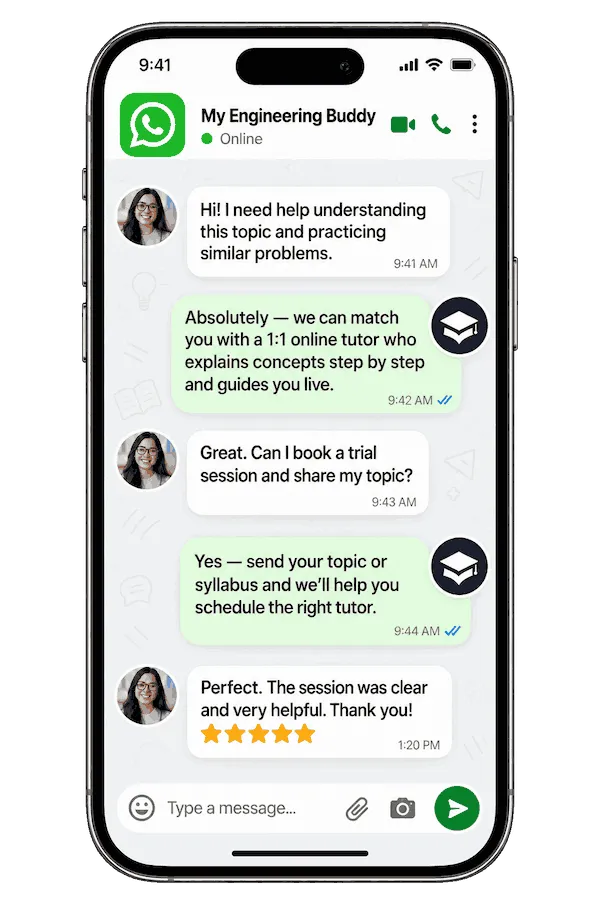
WhatsApp MEB for a quick quote — average response time under 1 minute.
Who This Structural Bioinformatics Tutoring Is For
This service is built for students where the gap between lecture content and practical application has become a real problem. If you can follow the theory but freeze when PyMOL loads or SWISS-MODEL returns a model you can’t evaluate, that gap needs closing — fast.
- Undergraduate students in bioinformatics, biochemistry, or computational biology courses covering protein structure
- Masters and PhD students working on structural analysis, homology modeling, or docking as part of their research
- Students retaking a structural bioinformatics module after a failed first attempt who need to close specific gaps before resits
- Researchers new to structure-based methods who need guided help with tools like MODELLER, AutoDock, or Chimera
- Students at institutions including MIT, Johns Hopkins, UCL, the University of Toronto, ETH Zurich, and the University of Melbourne who need support between office hours
- Anyone who needs structured bioinformatics tutoring and wants it matched to their exact course content
1:1 Tutoring vs Self-Study vs AI Tools
Self-study works for motivated students, but structural bioinformatics has a specific problem: you can read a chapter on Ramachandran plots three times and still misinterpret your own output. Without feedback, the same misreading repeats. AI tools are genuinely useful for quick definitions and code snippets, but they cannot look at your MODELLER alignment file, spot where your template selection went wrong, and walk you through the fix in real time. That kind of live, annotated troubleshooting — where the tutor marks up your actual PyMOL session on screen — is what changes results in this subject. MEB delivers that, online, matched to your course, with no commute and no scheduling friction.
Outcomes: What You’ll Be Able To Do in Structural Bioinformatics
After working with an online Structural Bioinformatics tutor through MEB, students consistently describe being able to interpret PDB files and assess model quality using RMSD and Ramachandran statistics, analyze active site geometry and predict binding pocket residues with confidence, apply homology modeling workflows in SWISS-MODEL or MODELLER and critically evaluate the output, explain the structural basis of protein-ligand interactions in the context of structure-based drug design, and present structural data clearly in assignments, dissertations, or research group meetings.
Based on feedback from 40,000+ sessions collected by MEB from 2022 to 2025, 58% of students improved by one full grade after approximately 20 hours of 1:1 tutoring in a single subject. A further 23% achieved at least a half-grade improvement.
Source: MEB session feedback data, 2022–2025.
At MEB, we’ve found that the students who improve fastest in structural bioinformatics aren’t necessarily the ones with the strongest biology background — they’re the ones who stop treating PyMOL and MODELLER as black boxes and start asking why the output looks the way it does. That shift usually happens in one or two sessions with the right tutor.
What We Cover in Structural Bioinformatics (Syllabus / Topics)

Protein Structure and Analysis
- Levels of protein structure: primary, secondary, tertiary, quaternary
- Ramachandran plots: interpretation and quality assessment
- PDB file format: reading, parsing, and extracting structural data
- Structure visualization using PyMOL and UCSF Chimera
- Secondary structure assignment algorithms (DSSP, STRIDE)
- B-factors, resolution, and R-values as quality indicators
- Structural alignment and RMSD calculation
Key references: Introduction to Bioinformatics by Arthur Lesk; Structural Bioinformatics edited by Gu and Bourne (Wiley-Liss).
Homology Modeling and Structure Prediction
- Template selection and sequence-structure alignment
- Comparative modeling with MODELLER and SWISS-MODEL
- Loop modeling and side-chain refinement
- Model validation: PROCHECK, ERRAT, ProSA
- Ab initio and threading methods: Rosetta, I-TASSER overview
- AlphaFold2 output interpretation and limitations
- Evaluating predicted models for downstream use
Key references: Bioinformatics Algorithms by Compeau and Pevzner; Computational Molecular Biology by Setubal and Meidanis.
Molecular Docking and Drug Design
- Principles of protein-ligand interaction and binding affinity
- Active site identification and cavity detection tools
- AutoDock Vina: setup, docking run, and result interpretation
- Virtual screening workflows and scoring functions
- Structure-based drug design concepts
- Fragment-based drug discovery introduction
Key references: An Introduction to Bioinformatics Algorithms by Jones and Pevzner; course-specific lecture notes as directed by your tutor.
What a Typical Structural Bioinformatics Session Looks Like
The tutor opens by checking where you left off — usually your homology model validation results or an AutoDock output you couldn’t interpret. You share your screen and the tutor works through the problem with you, annotating directly using a digital pen-pad: marking up the Ramachandran plot, pointing to outlier residues, showing exactly why your RMSD is higher than expected. You try the next step yourself while the tutor watches, then explain your reasoning out loud. By the end of the session, you have a clear picture of what went wrong, why it went wrong, and a specific task — usually re-running a refined model or annotating a binding pocket — to complete before the next session.
How MEB Tutors Help You with Structural Bioinformatics (The Learning Loop)
Diagnose: In the first session, the tutor identifies exactly where your understanding breaks down — whether that’s template selection logic, misreading model validation scores, or confusing docking poses. This shapes every session after it.
Explain: The tutor works through a live example using a digital pen-pad — annotating a PDB structure, walking through a MODELLER script line by line, or marking up a docking result. You see the reasoning, not just the answer.
Practice: You attempt the next problem while the tutor watches. In structural bioinformatics, this matters: running a tool is not the same as understanding its output, and the tutor catches the gap in real time.
Feedback: Every error gets a specific explanation — not just “that’s wrong” but which step failed, why it costs marks, and what the correct reasoning looks like. Students doing 1:1 computational biology tutoring alongside structural bioinformatics find this cross-subject feedback especially useful.
Plan: The session closes with a concrete next topic, a specific task, and a timeline. Nothing is left vague.
Sessions run over Google Meet. The tutor uses a digital pen-pad or iPad with Apple Pencil. Before your first session, share your course syllabus or assignment brief and any output files you’re struggling with. The first session covers diagnosis and one full worked problem. Whether you need a quick catch-up before an exam, structured revision over 4–8 weeks, or ongoing weekly support through the semester, the tutor maps the session plan after the first diagnostic.
Start with the $1 trial — 30 minutes of live tutoring that also serves as your first diagnostic.
Try your first session for $1 — 30 minutes of live 1:1 tutoring or one homework question explained in full. No registration. No commitment. WhatsApp MEB now and get matched within the hour.
Tutor Match Criteria (How We Pick Your Tutor)
Not every bioinformatics tutor can teach structural bioinformatics at the level your course demands. Here’s what MEB checks before matching.
Subject depth: The tutor must have direct experience with the tools and methods in your course — PyMOL, MODELLER, AutoDock, or equivalent — not just a general computational biology background.
Tools: All sessions run over Google Meet with a digital pen-pad or iPad and Apple Pencil for live annotation. For pipeline work, the tutor shares their screen and walks through the actual software.
Time zone: MEB covers New York, Los Angeles, Chicago, London, Dubai, Toronto, Sydney, Melbourne, and all US, UK, Gulf, Canadian, Australian, and European time zones — evenings and weekends included.
Learning style: The tutor calibrates their approach from the first session — some students need more conceptual grounding, others need hands-on tool walkthroughs. Both are accommodated.
Communication: Clear English, adapted to the student’s level. No jargon without explanation.
Goals: Whether you’re targeting a specific exam score, completing a dissertation chapter, or building research skills in genomics and structural analysis, the match reflects your actual goal.
Unlike platforms where you fill out a form and wait, MEB responds in under a minute, 24/7. Tutor match takes under an hour. The $1 trial means you test before you commit. Everything runs over WhatsApp — no logins, no intake forms.
Study Plans (Pick One That Matches Your Goal)
The tutor builds a specific session sequence after the diagnostic — but here are the three most common structures. Catch-up (1–3 weeks): for students with a resit or submission deadline close — tight focus on the failing component. Exam prep (4–8 weeks): structured coverage of modeling, docking, and analysis topics with past-paper practice woven in. Weekly support: ongoing sessions aligned to your semester schedule, covering each new topic as it appears.
Pricing Guide
Structural Bioinformatics tutoring starts at $20/hr for undergraduate-level sessions. Graduate-level work — research pipelines, dissertation support, advanced docking or MD simulation walkthroughs — runs up to $100/hr depending on the tutor’s background and the complexity of your project.
Rate factors: your course level, the tools involved, your timeline, and tutor availability. Rates are confirmed before the first paid session.
For students targeting graduate programs at institutions like MIT, ETH Zurich, or Johns Hopkins, or aiming for research roles in structural biology or structure-based drug discovery, tutors with active research or industry backgrounds are available at higher rates — share your specific goal and MEB will match the tier to your ambition.
Availability tightens in the final four weeks of semester. Start with the $1 trial — 30 minutes, no registration, no commitment. WhatsApp MEB for a quick quote.
Students consistently tell us that the biggest mistake in structural bioinformatics isn’t a wrong answer — it’s running a tool, getting a result, and moving on without checking whether the model is actually valid. PROCHECK and ProSA exist for a reason. A tutor who catches that habit early saves you from submitting work built on a flawed foundation.
FAQ
Is Structural Bioinformatics hard?
It’s conceptually demanding and tool-heavy. Students often manage the biology theory but struggle when the computational side requires interpreting model quality scores or troubleshooting software pipelines. 1:1 sessions address both at the same time, which is what makes the subject click.
How many sessions do I need?
Most students see clear improvement in 4–6 sessions when targeting a specific gap. Broader course support across homology modeling, docking, and structure analysis typically runs 10–15 sessions across a semester. Your tutor will give a realistic estimate after the first diagnostic.
Can you help with practice exercises?
Yes — the tutor explains the concept and method, works through a similar example, and guides you through your own attempt. You understand the work before you submit it yourself.
MEB tutoring is guided learning — you understand the work, then submit it yourself. For full details on what we help with and what we don’t, read our Academic Integrity policy and Why MEB.
Will the tutor match my exact syllabus or exam board?
Yes. Share your course outline, institution, and the specific tools or methods covered. The tutor is matched to those specifics — not a generic structural biology curriculum. If you’re also getting systems biology help, that can run alongside with the same or a different tutor.
What happens in the first session?
The tutor runs a short diagnostic — asking you to walk through a problem or interpret an output — to identify exactly where the gaps are. From there, the session moves into live worked examples on the highest-priority topic. You leave with a concrete task and a session plan.
Is online tutoring as effective as in-person?
For structural bioinformatics, often more so. Screen sharing and live annotation of PyMOL sessions, PDB files, and docking outputs are actually easier online than at a shared desk. The digital pen-pad gives the tutor the ability to mark up exactly what you’re seeing in real time.
Can I get Structural Bioinformatics help at midnight?
Yes. MEB operates 24/7 across all time zones. WhatsApp response time is typically under a minute. If your deadline is tomorrow morning and you’re stuck on a MODELLER output at 11 pm, a tutor can be arranged for the same night.
What if I don’t like my assigned tutor?
Tell MEB via WhatsApp and a replacement is arranged, usually within a few hours. The $1 trial is specifically designed so you can test the match before committing to paid sessions. No friction, no lengthy process.
Do you offer group Structural Bioinformatics sessions?
MEB focuses on 1:1 tutoring. Group sessions are not offered because the diagnostic and feedback loop — the core of what makes sessions effective in this subject — requires individual attention. Two students, two different gaps, two different needs.
How do I get started?
Three steps: WhatsApp MEB with your subject and course level, get matched with a verified tutor within the hour, start the $1 trial — 30 minutes of live tutoring or one homework question explained in full. No registration, no commitment required.
Trust & Quality at My Engineering Buddy
Every tutor on the MEB platform goes through subject-specific screening before being matched with students. That means a live demo evaluation, a review of their academic and professional background, and ongoing session feedback checks. For structural bioinformatics, the bar includes hands-on experience with the actual tools students use — not just a degree in a related field. MEB has been running since 2008, serving 52,000+ students across 2,800+ subjects. Rated 4.8/5 across 40,000+ verified reviews on Google.
MEB tutoring is guided learning — you understand the work, then submit it yourself. For full details on what we help with and what we don’t, read our Academic Integrity policy. We guide — you submit your own work.
MEB serves students across the US, UK, Canada, Australia, the Gulf, and Europe in over 2,800 subjects. Students working in adjacent areas also use MEB for biomolecular engineering tutoring, drug delivery academic guidance, and biomedical science academic guidance. Find out more about how the platform works at MEB’s tutoring methodology page.
A common pattern our tutors observe is that students arrive thinking they have a tool problem — they can’t get AutoDock to run properly — when the real issue is they haven’t correctly identified the binding site first. Fix the conceptual step, and the tool problem disappears. That’s why diagnosis always comes before software in our sessions.
Explore Related Subjects
Students studying Structural Bioinformatics often also need support in:
- Bioinformatics
- Computational Biology
- Genomics
- Systems Biology
- Biotechnology
- Metagenomics
- Genetic Engineering
- Pharmaceutical Science Engineering
Next Steps
Here’s what to do right now:
- Share your course outline, the specific topic or tool you’re stuck on, and your exam or submission date
- Share your time zone and preferred session times — evenings and weekends are available in all regions
- MEB matches you with a verified Structural Bioinformatics tutor, usually within 24 hours
Before your first session, have ready: your course syllabus or module guide, any model output files or assignment briefs you’re struggling with, and your deadline date. The tutor handles the rest.
Visit www.myengineeringbuddy.com for more on how the MEB process works — from matching to first session to progress tracking.
WhatsApp to get started or email [email protected].
Reviewed by Subject Expert
This page has been carefully reviewed and validated by our subject expert to ensure accuracy and relevance.