




~1 min
Average Reply Time
~1 hour
To Be Matched With A Tutor
30 Min Trial
75% Find Their Tutor On The 1st Trial
$20-35+/hr
Premium Yet Affordable Learning
Most NREMT candidates don’t fail because they don’t know medicine — they fail because they don’t know how the CAT algorithm scores them.
NREMT Tutor Online
The NREMT (National Registry of Emergency Medical Technicians) is a US national certification exam for EMT and Paramedic candidates, administered as a computer-adaptive test (CAT) that adjusts question difficulty based on demonstrated competency across medical, trauma, and operations domains.
If you’re searching for a NREMT tutor near me, MEB connects you with a verified specialist in test preparation who understands exactly how the CAT scoring model works and where most candidates lose ground. One tutor. One plan. Built around your weak points, not a generic syllabus. Most students start seeing clearer clinical reasoning within the first two to three sessions.
- 1:1 online sessions matched to your NREMT level — EMT, AEMT, or Paramedic
- Expert-verified tutors with emergency medicine and EMS education backgrounds
- Flexible time zones — US, UK, Canada, Australia, Gulf
- Structured learning plan built after a diagnostic session
- Ethical homework and assignment guidance — you understand the material, then sit the exam yourself
52,000+ students across the US, UK, Canada, Australia, and the Gulf have used MEB since 2008 — including students in test preparation subjects like HESI tutoring, NCLEX-RN tutoring, and MCAT tutoring.
Source: My Engineering Buddy, 2008–2025.
How Much Does a NREMT Tutor Cost?
Most NREMT tutoring sessions run $20–$40 per hour. Paramedic-level and advanced clinical reasoning work can reach $60–$100/hr depending on tutor background. The $1 trial gives you 30 minutes of live 1:1 prep or a full explanation of one practice question — no registration needed.
| Level / Need | Typical Rate | What’s Included |
|---|---|---|
| EMT / AEMT Level | $20–$35/hr | 1:1 sessions, CAT strategy, practice Q review |
| Paramedic Level | $35–$70/hr | Advanced clinical reasoning, scenario-based prep |
| $1 Trial | $1 flat | 30 min live session or 1 exam question explained |
Availability tightens in the weeks before NREMT testing windows. If you’re working to a fixed date, book early.
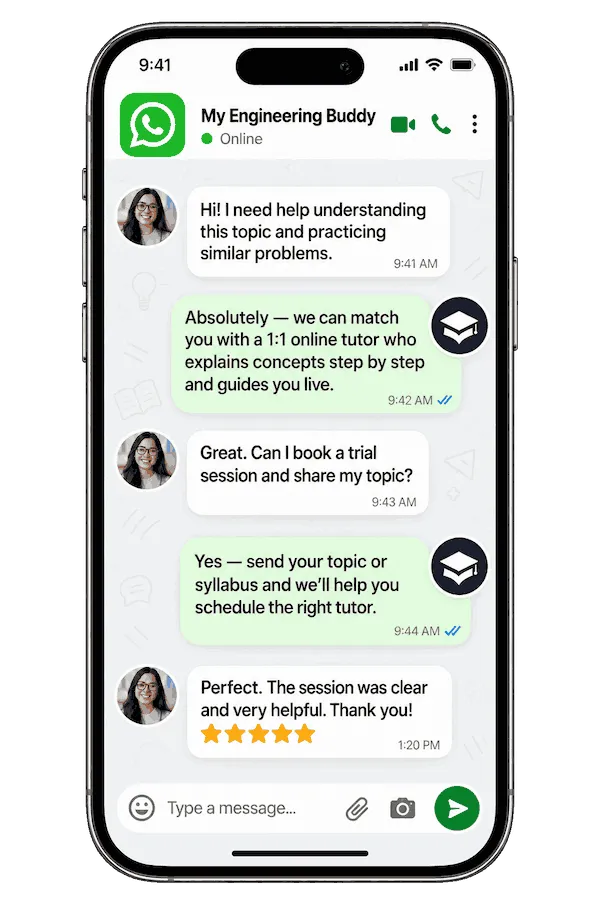
WhatsApp MEB for a quick quote — average response time under 1 minute.
Who This NREMT Tutoring Is For
NREMT candidates come to MEB at very different points. Some are weeks from their first attempt and hitting a wall on cardiac or respiratory questions. Others have already sat the exam and need to rethink their approach entirely.
- First-attempt candidates who completed EMT or Paramedic training but aren’t confident with CAT-style question logic
- Students retaking after a failed first attempt — particularly those who ran out of questions at the maximum count without passing
- Candidates with strong clinical instincts but weak test-taking strategy under the adaptive format
- Students who struggled with specific content areas — airway management, pharmacology, trauma assessment, or OB/GYN emergencies
- EMS students at community colleges and paramedic programs across the US, including those at programs affiliated with institutions like George Washington University, University of Maryland, and Creighton University
- International candidates relocating to the US who need to understand the NREMT framework from the ground up
At MEB, we’ve found that NREMT candidates who struggle on their second attempt often have the clinical knowledge — what they’re missing is an understanding of how the CAT algorithm weighs their answers and which content domains carry the highest risk of early termination.
1:1 Tutoring vs Self-Study vs AI vs YouTube vs Online Courses
Self-study works if you’re disciplined, but the NREMT CAT doesn’t reward memorisation — it tests reasoning under pressure. AI tools explain concepts quickly but can’t simulate the adaptive pressure of a real CAT sequence or diagnose which content domains are dragging your performance down. YouTube is useful for protocols and visuals, but it stops when you hit a question that doesn’t match the example. Online courses give you structure at a fixed pace, with no adjustment for what you already know. With a 1:1 NREMT tutor online, every session recalibrates to your exact gaps — your cardiac rhythm weak spots, your pharmacology blind spots, your pacing errors on long-case scenarios. That’s the difference for a high-stakes adaptive exam.
Outcomes: What You’ll Be Able To Do in NREMT
After structured 1:1 NREMT tutoring, you’ll be able to apply systematic patient assessment frameworks under timed pressure, not just recall protocols. You’ll analyze CAT-style questions and identify the decision logic the exam is testing — not just the surface answer. You’ll explain your clinical reasoning on airway, circulation, and trauma calls step by step, the way an entry-level provider must think. You’ll solve pharmacology questions using weight-based dosing and contraindication logic without second-guessing. You’ll present on scenario-based OB, pediatric, and behavioral emergency calls with enough confidence to select the correct intervention when the question is deliberately ambiguous.
Based on feedback from 40,000+ sessions collected by MEB from 2022 to 2025, 58% of students improved by one full grade after approximately 20 hours of 1:1 tutoring in subjects like NREMT. A further 23% achieved at least a half-grade improvement.
Source: MEB session feedback data, 2022–2025.
Start with the $1 trial — 30 minutes of focused NREMT prep that doubles as your first diagnostic session.
What We Cover in NREMT (Syllabus / Topics)
NREMT covers five content domains for EMT-level and a broader clinical scope for Paramedic. Sessions are structured around your weak domains, not a generic run-through of the whole syllabus.
Airway, Respiration & Ventilation
- Airway anatomy and obstruction management
- Bag-valve-mask technique and oxygen delivery systems
- Respiratory assessment — rate, depth, effort, SpO2 interpretation
- Identifying respiratory distress vs failure vs arrest
- Pediatric airway differences and management considerations
- CPAP indications and contraindications (Paramedic level)
- Needle decompression and chest seal application (Paramedic level)
Core references: Emergency Care by Limmer & O’Keefe; Paramedic Care: Principles & Practice by Bledsoe, Porter & Cherry — airway and ventilation chapters.
Cardiology, Resuscitation & Medical Emergencies
- Cardiac arrest protocols — adult, pediatric, neonatal
- 12-lead ECG interpretation and rhythm recognition (Paramedic)
- AED use and CPR quality indicators
- Pharmacology — epinephrine, amiodarone, adenosine dosing and indications
- Stroke recognition and Cincinnati Prehospital Stroke Scale
- Diabetic emergencies — hypoglycemia vs hyperglycemia management
- Toxicology: common overdoses, antidote protocols, scene safety
Core references: Brady Paramedic cardiology chapters; ACLS Provider Manual for resuscitation algorithms.
Trauma, Operations & Special Populations
- Mechanism of injury analysis — blunt vs penetrating
- Hemorrhage control: tourniquet application, wound packing
- Spinal motion restriction — indications and current evidence-based changes
- Obstetric emergencies — normal delivery, prolapsed cord, eclampsia
- Pediatric assessment triangle and weight-based medication dosing
- Geriatric considerations — fall assessment, medication interactions
- EMS operations: incident command, hazmat awareness, mass casualty triage (START)
Core references: PHTLS: Prehospital Trauma Life Support; Nancy Caroline’s Emergency Care in the Streets.

What a Typical NREMT Session Looks Like
The tutor opens by reviewing where you left off — usually your performance on a set of CAT-style practice questions from the previous session, specifically which content domain caused the most errors. From there, you work through 8–12 live questions on screen together. The tutor doesn’t just tell you the right answer — they walk through the distractor logic, showing you why each wrong option was designed to trap a candidate who half-understands the concept. You replicate the reasoning process on the next question independently, and the tutor listens to your thinking out loud, catching errors in clinical priority or protocol sequence before they become exam habits. The session closes with a focused practice block — typically 20 questions timed — and a clear note on which sub-domain gets treated next.
How MEB Tutors Help You with NREMT (The Learning Loop)
Diagnose: In the first session, the tutor identifies which of the five NREMT content domains are pulling your performance down — not by asking, but by working through a representative question set with you and mapping where your reasoning breaks.
Explain: The tutor works through live problems on a digital pen-pad, showing the decision tree behind each question type. For NREMT, this means demonstrating how to read a patient presentation, eliminate distractors, and select the answer that reflects the highest level of care a provider at your certification level should deliver.
Practice: You attempt questions with the tutor present — not as a quiz, but as a thinking exercise. You say your reasoning out loud. The tutor tracks where you stall or jump to conclusions.
Feedback: Every error gets a specific explanation — not “that’s wrong” but “you prioritised ABC over airway because the scenario front-loaded the cardiac detail.” That kind of feedback changes how you read questions permanently.
Plan: At the end of each session, the tutor sets a realistic practice target for the week — number of questions, specific domains, timed vs untimed — and flags the next topic in sequence.
Sessions run on Google Meet with a digital pen-pad or iPad and Apple Pencil for visual walkthroughs. Before your first session, have a recent practice test result ready along with your target exam date and your current certification level. The first session starts with a diagnostic — no wasted time.
Try your first session for $1 — 30 minutes of live 1:1 tutoring or one homework question explained in full. No registration. No commitment. WhatsApp MEB now and get matched within the hour.
Tutor Match Criteria (How We Pick Your Tutor)
Not every tutor who knows emergency medicine can teach the NREMT. Here’s what MEB looks for specifically.
Subject depth: Tutors hold paramedic certifications, nursing degrees, or emergency medicine academic backgrounds — with demonstrated experience teaching CAT-style question strategy, not just clinical content.
Tools: Every tutor works on Google Meet with a digital pen-pad or iPad and Apple Pencil. Visual walkthroughs of patient scenarios and ECG strips are standard.
Time zone: Matched to your region — US, UK, Gulf, Canada, or Australia. Late-night and weekend sessions available.
Goals: Whether you’re preparing for a first attempt, retaking after a failed sit, or working on a specific domain score, the tutor is matched to your stated objective — not assigned randomly.
Unlike platforms where you fill out a form and wait, MEB responds in under a minute, 24/7. Tutor match takes under an hour. The $1 trial means you test before you commit. Everything runs over WhatsApp — no logins, no intake forms.
Study Plans (Pick One That Matches Your Goal)
A tutor builds your specific session sequence after the diagnostic, but here’s how most NREMT candidates structure their prep. Catch-up (1–3 weeks): intensive focus on two or three weak domains for candidates with an imminent exam date. Exam prep (4–8 weeks): full domain coverage with weekly timed practice blocks and CAT simulation. Weekly support: ongoing sessions through a paramedic programme, aligned to coursework and clinical rotation schedules. The tutor adapts the sequence after every session based on where you’re improving and where you’re not.
Pricing Guide
NREMT tutoring starts at $20/hr for EMT-level exam prep. Paramedic-level work, advanced pharmacology, and clinical reasoning sessions for candidates who have already failed one attempt typically run $35–$70/hr. Tutors with professional EMS medical director or emergency medicine faculty backgrounds are available at higher rates — share your specific goal and MEB will match the tier to what you actually need.
Rate factors include certification level, content complexity, timeline pressure, and tutor availability. If you’re three weeks from your exam date, flag that immediately — availability is tightest in the final weeks before major testing windows.
Start with the $1 trial — 30 minutes, no registration, no commitment. WhatsApp MEB for a quick quote.
NREMT pass rates vary by attempt number and certification level. Targeted 1:1 prep focused on CAT question logic and domain-specific gaps is one of the most direct ways to close the distance between clinical knowledge and exam performance.
Source: National Registry of Emergency Medical Technicians; MEB tutor feedback, 2022–2025.
FAQ
Is the NREMT hard?
It’s harder than most candidates expect — not because the clinical content is obscure, but because the CAT format penalises guessing and rewards consistent reasoning. Candidates who know protocols well but struggle with question logic frequently fail at lower question counts.
How many sessions do I need?
Most EMT-level candidates need 6–12 sessions depending on their weak domains. Paramedic candidates typically need 12–20 sessions. Retakers focused on one or two specific content areas can sometimes turn it around in 4–6 targeted sessions.
Can you help with homework and assignments from my EMT or Paramedic programme?
Yes — MEB tutoring is guided learning. The tutor explains the concept, works through the problem with you, and you submit your own work. See our Academic Integrity policy and Why MEB page for full details on what we help with and what we don’t.
Will the tutor match my exact exam level and content domains?
Yes. Before your first session, you share your certification level — EMT, AEMT, or Paramedic — and your weakest domains. The tutor is matched on that basis and builds the session plan around your specific NREMT content blueprint, not a generic curriculum.
What happens in the first session?
The tutor runs a structured diagnostic — typically 15–20 CAT-style questions across all five content domains — to map where your reasoning breaks. From that point, every subsequent session targets the highest-impact gaps first. Nothing is guessed. Nothing is wasted.
Is online tutoring as effective as in-person for NREMT?
For exam prep — yes. The NREMT is a screen-based test. Practising question logic on screen with a tutor who can annotate in real time over Google Meet replicates the exam environment more closely than a paper-and-pen in-person session would.
How does the NREMT computer-adaptive test actually work — and how does that change how I should study?
The CAT adjusts question difficulty based on your answers. A correct answer raises difficulty; an incorrect one lowers it. The exam ends when the algorithm is statistically confident you are above or below the passing standard. This means raw memorisation is less useful than consistent, defensible clinical reasoning across all five domains.
What if I’ve already failed the NREMT once — is tutoring still worth it?
Most retakers failed for a specific, identifiable reason — not a general knowledge deficit. A diagnostic session with an MEB tutor typically isolates the problem within 30–40 minutes. Targeted retake prep of 6–10 sessions is often enough to pass on the next attempt.
Can I get NREMT tutoring help at midnight or on weekends?
Yes. MEB tutors cover multiple time zones including US Eastern, Central, and Pacific, with availability extending through evenings and weekends. WhatsApp MEB any time — average response is under one minute.
What if I don’t get along with my assigned tutor?
Request a switch. MEB replaces tutors on request, usually within the same day. The $1 trial exists precisely so you can assess fit before committing to a full session block.
How do I get started?
Three steps: WhatsApp MEB with your certification level and exam date, get matched with a verified NREMT tutor within the hour, then start your $1 trial — 30 minutes of live prep or one full practice question explained in depth. No forms. No waiting.
Is there a difference between NREMT tutoring for EMT-Basic versus Paramedic candidates?
Significantly. Paramedic content is broader — 12-lead interpretation, advanced pharmacology, and complex multi-system trauma — and the CAT runs longer. EMT-level prep focuses more tightly on the five core domains at a foundational clinical reasoning level. Tutors are matched accordingly.
Trust & Quality at My Engineering Buddy
Every MEB tutor goes through subject-specific vetting before taking a session. For NREMT, that means verified clinical or EMS education credentials, a live demo session reviewed by MEB, and ongoing feedback monitoring after every student interaction. Tutors are not self-certified — they’re assessed. Rated 4.8/5 across 40,000+ verified reviews on Google.
MEB tutoring is guided learning — you understand the work, then submit it yourself. For full details on what we help with and what we don’t, read our Academic Integrity policy and Why MEB.
MEB has been serving students in the US, UK, Canada, Australia, Gulf, and Europe since 2008 — across 2,800+ subjects. In test preparation specifically, we work with students on USMLE tutoring, NAPLEX tutoring, and ARRT exam help alongside NREMT — all with the same tutor matching and diagnostic approach.
MEB has operated since 2008 — that’s 17 years of iterating on what actually helps candidates pass high-stakes certification exams, not just finish a course. The $1 trial exists because we’re confident enough in the match to let you test it first.
Source: My Engineering Buddy, 2008–2025.
Students consistently tell us that the shift from “I know this content” to “I know how to answer this question” is the single biggest unlock in NREMT prep. Our tutors build that skill directly — through structured practice, not more reading.
Explore Related Subjects
Students studying NREMT often also need support in:
Next Steps
Ready to start? Here’s what to do:
- Share your certification level (EMT, AEMT, or Paramedic), your weakest content domain, and your target exam date
- Share your availability and time zone — MEB covers US, UK, Gulf, Canada, and Australia
- MEB matches you with a verified NREMT tutor, usually within 24 hours
- Your first session opens with a diagnostic so every minute from that point is targeted
Before your first session, have ready: your NREMT content blueprint or program syllabus, a recent practice test result or a question set you struggled with, and your exam date. The tutor handles the rest.
Visit www.myengineeringbuddy.com for more on how MEB works.
WhatsApp to get started or email [email protected].
Reviewed by Subject Expert
This page has been carefully reviewed and validated by our subject expert to ensure accuracy and relevance.




