
ADVANCED SUBJECTS · LIVE 1:1 TUTORING
PHP Tutoring Online
Personalized instruction for demanding courses and technical subjects. Learn with a tutor selected for your topic, level, and learning goals.
University · Master’s & PhD · Professional Upskilling
Request tutor availability and a quote. Or email [email protected].

Since 2008
Established Tutoring Service
~1 min
Average First Response
Specialist Match
For Your Subject & Level
30-Min Trial
Try Tutoring Before a Longer Plan
Hire The Best PHP Tutor

Most PHP students don’t fail because the language is too hard. They fail because nobody caught the logic error in their loop three weeks ago — and it’s compounded ever since.
PHP Tutor Online
PHP is a server-side scripting language used to build dynamic web applications. It integrates with HTML, MySQL, and frameworks like Laravel and CodeIgniter, equipping developers to create database-driven websites and APIs.
MEB connects you with a 1:1 computer programming tutor who specialises in PHP — covering everything from beginner syntax to advanced object-oriented patterns, framework development, and REST API construction. Whether you’re searching for a PHP tutor near me or need flexible online sessions across the US, UK, Canada, Australia, or Gulf, MEB matches you within the hour. You get a tutor who knows your course, your framework, and your deadlines.
- 1:1 online sessions tailored to your course or project requirements
- Expert-verified tutors with professional PHP and web development backgrounds
- Flexible time zones — US, UK, Canada, Australia, Gulf covered
- Structured learning plan built after a diagnostic session
- Guided project support — we explain, you build
52,000+ students across the US, UK, Canada, Australia, and the Gulf have used MEB since 2008 — including students in Computer Programming subjects like PHP, JavaScript, and Python.
Source: My Engineering Buddy, 2008–2025.
How Much Does a PHP Tutor Cost?
PHP tutoring at MEB starts at $20/hr for standard undergraduate and bootcamp-level work, rising to $40/hr for advanced OOP, framework architecture, or database optimisation. Niche topics — REST API security, microservices, or legacy codebase refactoring — can reach $100/hr. Start with the $1 trial to test the match before committing to a rate.
| Level / Need | Typical Rate | What’s Included |
|---|---|---|
| Beginner / Introductory PHP | $20–$30/hr | 1:1 sessions, syntax, logic, project guidance |
| Intermediate (OOP, Laravel, MySQL) | $30–$40/hr | Framework sessions, debugging, architecture |
| Advanced / Specialist | $40–$100/hr | API design, security, legacy migration |
| $1 Trial | $1 flat | 30 min live session or one project problem explained |
Tutor availability tightens during semester submission windows — particularly in May and November. Book early if you’re on a deadline.
WhatsApp MEB for a quick quote — average response time under 1 minute.
Who This PHP Tutoring Is For
PHP sits at an awkward middle point in most CS curricula — taught as a web module but expected to carry the weight of a full production language. Students often hit a wall when the syntax is fine but the project logic falls apart.
- Undergraduate CS students with a PHP web development module assignment due
- Students who passed the syntax unit but can’t build a working CRUD application
- Students retaking after a failed first attempt at a web programming course
- Bootcamp students whose instructor pace left gaps in OOP or database integration
- Students with a course project deadline approaching and no functioning codebase yet
- Developers new to PHP who need structured guidance rather than scattered tutorials
Students from programs at institutions including the University of Toronto, University of Edinburgh, TU Munich, Purdue University, UNSW, and NYU have used MEB for PHP project support. If your course uses PHP as part of a broader web or backend stack, MEB tutors know exactly where those programs set the bar.
The $1 trial is the fastest way to find out whether your tutor can crack your specific problem — 30 minutes, no registration.
1:1 Tutoring vs Self-Study vs AI vs YouTube vs Online Courses
Self-study works if you’re disciplined, but PHP errors compound silently — no feedback loop catches them. AI tools like ChatGPT give fast code snippets but can’t diagnose why your session handling is broken across your specific project. YouTube is useful for concept overviews; it stops when you’re stuck on a specific Laravel routing conflict at 11pm. Online courses are structured but fixed-pace — they don’t care that you have a submission in four days. With a 1:1 PHP tutor online from MEB, the session is live, calibrated to your actual codebase, and corrects the logic error before it becomes a failing grade.
Outcomes: What You’ll Be Able To Do in PHP
After targeted 1:1 PHP tutoring, you’ll be able to build and debug a fully functional web application using PHP and MySQL from scratch. You’ll write clean object-oriented PHP classes, apply inheritance and interfaces correctly, and explain your design choices under assessment conditions. Solve real authentication and session management problems — the type most students lose marks on. Apply Laravel’s MVC structure to organise routes, controllers, and views without copying boilerplate you don’t understand. Present a working REST API endpoint that handles GET, POST, and error responses cleanly.
Based on feedback from 40,000+ sessions collected by MEB from 2022 to 2025, 58% of students improved by one full grade after approximately 20 hours of 1:1 tutoring in subjects like PHP. A further 23% achieved at least a half-grade improvement.
Source: MEB session feedback data, 2022–2025.
At MEB, we’ve found that PHP students who bring their actual project file to the first session — even a broken one — make faster progress than those who start from scratch exercises. Real code reveals real gaps. That’s where the session earns its value.
What We Cover in PHP (Syllabus / Topics)

Track 1: PHP Fundamentals and Core Syntax
- Variables, data types, operators, and control flow (if/else, switch, loops)
- Functions — parameters, return values, scope, and recursion
- Arrays — indexed, associative, multidimensional, and array functions
- String manipulation — regex, formatting, and common built-in functions
- Form handling — $_GET, $_POST, and basic input validation
- File I/O — reading, writing, and managing files on the server
- Error handling — try/catch blocks and custom error pages
Core references: Learning PHP, MySQL & JavaScript by Robin Nixon; PHP: The Right Way (phptherightway.com); Modern PHP by Josh Lockhart.
Track 2: Object-Oriented PHP and Database Integration
- Classes, objects, constructors, and destructors
- Inheritance, interfaces, abstract classes, and traits
- Namespaces and autoloading with Composer
- MySQL connection via PDO and MySQLi — prepared statements and parameterised queries
- CRUD operations — Create, Read, Update, Delete with real database tables
- Session management and cookie handling for user authentication
- Security — SQL injection prevention, XSS filtering, password hashing with bcrypt
Core references: PHP Objects, Patterns and Practice by Matt Zandstra; PHP and MySQL Web Development by Luke Welling & Laura Thomson.
Track 3: PHP Frameworks, APIs, and Deployment
- Laravel MVC architecture — routes, controllers, views, and Blade templates
- Eloquent ORM — models, migrations, relationships, and query builder
- CodeIgniter and Symfony — structure comparison and use-case differences
- RESTful API design — JSON responses, HTTP methods, status codes, and middleware
- Authentication with Laravel Sanctum and Passport
- WordPress plugin and theme development using PHP hooks and filters
- Deployment basics — Apache/Nginx configuration, .htaccess, environment variables
Core references: Laravel: Up & Running by Matt Stauffer; official Laravel documentation; WordPress Plugin Development Cookbook by Yannick Lefebvre.
Students consistently tell us that the moment PHP clicks is when they stop thinking about it as writing code and start thinking about it as describing a process the server should follow. That mental shift — from syntax to logic — is what the tutor accelerates.
Platforms, Tools & Textbooks We Support
PHP development spans multiple environments and MEB tutors are comfortable working across all of them. Sessions run on Google Meet with shared screens so your tutor can see your actual editor and terminal output in real time.
- IDEs and editors: VS Code, PhpStorm, Sublime Text, Atom
- Local environments: XAMPP, WAMP, MAMP, Laravel Valet, Docker
- Version control: Git and GitHub — branching, pull requests, merge conflicts
- Package management: Composer
- Databases: MySQL, MariaDB, SQLite — via phpMyAdmin or CLI
- Frameworks: Laravel, CodeIgniter, Symfony, Slim
- CMS: WordPress (custom theme and plugin development)
What a Typical PHP Session Looks Like
The tutor opens by checking where you left off — usually your Eloquent model relationships or the authentication middleware you struggled with last time. You share your screen and walk through the broken section together. The tutor uses a digital pen-pad to annotate the logic directly on screen, showing you exactly where the data flow breaks and why the error is thrown. You attempt a fix yourself while the tutor watches — they don’t type it for you, they ask questions that lead you to the answer. By the end, you have a working function, a clear note on what to practice before the next session, and the next topic already planned. Nothing is left vague.
How MEB Tutors Help You with PHP (The Learning Loop)
Diagnose: In the first session, the tutor reviews your existing code or asks you to write a small function from scratch. They identify whether the gap is conceptual (you don’t understand OOP inheritance) or procedural (you understand it but implement it wrong under pressure).
Explain: The tutor works through a live example on the digital pen-pad — not a generic textbook example, but one that mirrors your actual project or assignment structure. You see the reasoning, not just the result.
Practice: You write the next version yourself while the tutor watches. No copy-pasting. No looking at the solution first. This is where retention happens.
Feedback: Every error gets a name and a reason. “This returns null because PDO is catching the exception silently — here’s how to expose it.” Step-by-step, no hand-waving.
Plan: The session ends with a clear next topic, a small practice task, and a check-in question the tutor will open with next time. Accountability is built in.
All sessions run on Google Meet. The tutor uses a digital pen-pad or iPad with Apple Pencil for annotation. Before your first session, share your course outline or project brief and any error messages you’re currently stuck on. The first session starts with a diagnostic so not a minute is wasted. Start with the $1 trial — 30 minutes of live tutoring that doubles as your first diagnostic.
A common pattern our tutors observe is that PHP students spend hours debugging what turns out to be a missing semicolon or a scope issue — problems a tutor spots in under two minutes.
Source: My Engineering Buddy tutor observations, 2008–2025.
Try your first session for $1 — 30 minutes of live 1:1 tutoring or one homework question explained in full. No registration. No commitment. WhatsApp MEB now and get matched within the hour.
Tutor Match Criteria (How We Pick Your Tutor)
Not every PHP developer makes a good tutor. MEB matches on four criteria.
Subject depth: The tutor must have hands-on experience at the level you need — introductory procedural PHP, OOP with Composer, or production-grade Laravel and API design. We don’t assign a WordPress developer to a student working on a Symfony microservice.
Tools: Every tutor is set up for Google Meet with a digital pen-pad or iPad and Apple Pencil. Screen annotation is non-negotiable for PHP debugging sessions.
Time zone: Matched to your region — US, UK, Gulf, Canada, or Australia. Late-night sessions in your time zone are available.
Goals: Whether you need to pass a single module, build a portfolio project, or develop production-ready skills, the tutor is briefed on your specific target before session one.
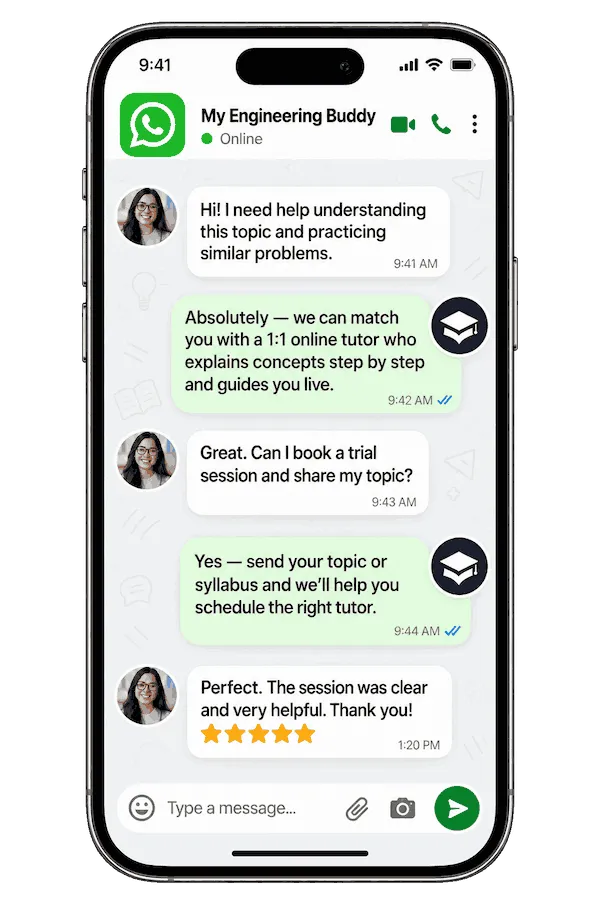
Unlike platforms where you fill out a form and wait, MEB responds in under a minute, 24/7. Tutor match takes under an hour. The $1 trial means you test before you commit. Everything runs over WhatsApp — no logins, no intake forms.
Study Plans (Pick One That Matches Your Goal)
After the diagnostic session, your tutor builds a plan around your timeline. Catch-up (1–3 weeks): intensive focus on the one or two topics blocking your project submission — usually OOP structure, database queries, or session handling. Exam prep (4–8 weeks): systematic coverage of your module’s assessed components, with practice tasks and code reviews between sessions. Weekly support: ongoing sessions aligned to your semester calendar, covering each topic as your course introduces it. The tutor sets the sequence after the first diagnostic — you don’t need to arrive with a plan.
Pricing Guide
PHP tutoring starts at $20/hr for introductory-level work and runs to $40/hr for framework-heavy or database-intensive sessions. Graduate-level or professional development work — API architecture, legacy PHP migration, or secure authentication design — is available up to $100/hr.
Rate factors: your level, the complexity of the topic, your timeline pressure, and tutor availability. A student debugging a first CRUD app costs less per hour than one refactoring a 10,000-line legacy codebase.
Availability tightens in April–May and October–November when semester projects and coursework deadlines peak. Book before those windows if you can.
For students targeting roles at top-tier tech firms or building portfolio projects for competitive graduate programmes, tutors with professional software engineering backgrounds are available at higher rates — share your specific goal and MEB will match the tier to your ambition.
Start with the $1 trial — 30 minutes, no registration, no commitment. WhatsApp MEB for a quick quote.
FAQ
Is PHP hard to learn?
PHP syntax is beginner-friendly, but students hit difficulty when they move from procedural scripts to object-oriented design, database integration, and framework conventions. Those transitions are where most marks are lost — and where a 1:1 PHP tutor makes the biggest difference.
How many sessions will I need?
Most students see a clear improvement in 3–5 sessions for a targeted topic gap. A full module or semester of support typically runs 10–20 hours. The diagnostic session at the start gives the tutor enough to build a realistic timeline for your specific goal.
Can you help with PHP projects and portfolio work?
Yes. MEB tutors guide you through the logic, structure, and debugging of your project — explaining what to do and why, so you build it yourself. All project work is produced and submitted by you. See our Policies page for full details on what we help with and what we don’t.
Will the tutor match my exact course or framework?
Yes. When you contact MEB, share your course outline, the framework your module uses (Laravel, CodeIgniter, Symfony, or plain PHP), and your current task. The tutor matched to you will have direct experience with that stack — not a general web developer who happens to know some PHP.
What happens in the first session?
The tutor runs a short diagnostic — usually asking you to walk through a piece of your own code or write a small function. This identifies exactly where the conceptual or implementation gap is. The rest of the session targets that gap directly. Nothing generic, nothing from a preset script.
Is online PHP tutoring as effective as in-person?
For code-based subjects, online is often better. Screen sharing lets the tutor see your exact editor, terminal, and error output. The digital pen-pad annotation works directly on your code. In-person tutoring rarely allows that level of precision on a live codebase.
Should I learn PHP or Python for web development?
PHP dominates server-side web development — it powers over 75% of websites with a known server-side language, including WordPress. Python is stronger for data science and ML. If your course or job target is web backend or CMS development, PHP is the right focus. MEB tutors can help you clarify this based on your actual programme or career goal.
Can you help with Laravel specifically, or only vanilla PHP?
Both. MEB has tutors for plain PHP at any level, and separate specialists in Laravel, Symfony, and CodeIgniter. If your course or project uses a specific framework, say so when you contact MEB and the match will reflect that — not just a generic PHP tutor assigned at random.
Can I get PHP tutoring help at midnight or on weekends?
Yes. MEB operates 24/7. Tutors are available across time zones, so a student in the US, Gulf, or Australia can find a session at any hour. WhatsApp MEB with your time zone and availability and you’ll get a response in under a minute.
What if I don’t get on with my assigned PHP tutor?
Tell MEB via WhatsApp and you’ll be matched with a different tutor — usually the same day. No awkward process, no forms to fill. The $1 trial exists precisely so you can test the match before spending more.
How do I get started with a PHP tutor?
Three steps: WhatsApp MEB with your course details and current problem, get matched to a verified PHP tutor within the hour, then start your $1 trial — 30 minutes of live 1:1 tutoring or one project problem explained in full. No registration required.
Trust & Quality at My Engineering Buddy
Every MEB tutor goes through subject-specific vetting — not just a CV check. Candidates complete a live demo session evaluated by an MEB reviewer, and ongoing session feedback determines whether they stay on the platform. PHP tutors hold degrees in computer science, software engineering, or related fields, and most have professional development experience outside academia. Rated 4.8/5 across 40,000+ verified reviews on Google.
MEB tutoring is guided learning — you understand the work, then submit it yourself. For full details on what we help with and what we don’t, read our Academic Integrity policy and Why MEB.
MEB has served 52,000+ students across the US, UK, Canada, Australia, Gulf, and Europe since 2008 — across 2,800+ subjects. In Computer Programming, that includes students working on Python tutoring, JavaScript help, and Java tutoring, alongside PHP. The platform is built for advanced technical subjects — not general academic guidance.
Our experience across thousands of sessions shows that PHP students who arrive with a specific error or broken function — rather than a vague “I don’t get it” — leave the session having understood something they can apply immediately.
Source: My Engineering Buddy tutor observations, 2008–2025.
A common pattern our tutors observe is that students who struggle with PHP frameworks have usually skipped one step: they didn’t consolidate core OOP before jumping to Laravel. Twenty minutes on that foundation saves three sessions of framework confusion.
Explore Related Subjects
Students studying PHP often also need support in:
Next Steps
Here’s what to do right now:
- Share your course outline, framework (Laravel, CodeIgniter, plain PHP), and current problem or error
- Share your time zone and availability — evening, weekend, or late-night sessions all available
- MEB matches you with a verified PHP tutor — usually within the hour, never more than 24 hours
- First session starts with a diagnostic so every minute is used on the actual gap
Before your first session, have ready:
- Your course outline or project brief
- A recent piece of code you’re stuck on, or an error message you can’t resolve
- Your submission or exam deadline date — the tutor builds the plan around it
Visit www.myengineeringbuddy.com for more on how MEB works.
WhatsApp to get started or email [email protected].
Reviewed by Subject Expert
This page has been carefully reviewed and validated by our subject expert to ensure accuracy and relevance.



