Hire Verified & Experienced
Power system analysis Tutors
4.8/5 40K+ session ratings collected on the MEB platform



Hire The Best Power system analysis Tutor
Top Tutors, Top Grades. Without The Stress!
52,000+ Happy Students From Various Universities






How Much For Private 1:1 Tutoring & Hw Help?
Private 1:1 Tutoring and HW help Cost $20 – 35 per hour* on average.
Load flow calculations breaking down at 2 a.m. before your power systems exam? That’s exactly when MEB tutors pick up.
Power System Analysis Tutor Online
Power system analysis is an electrical engineering discipline covering the steady-state and dynamic behaviour of generation, transmission, and distribution networks, equipping students to perform load flow, fault analysis, and stability studies on real grid topologies.
Finding a qualified power system analysis tutor near me is harder than it sounds — most general tutors stop at basic circuit theory and can’t walk you through Newton-Raphson load flow, symmetrical component fault calculations, or transient stability simulations. MEB’s electrical engineering tutoring network puts you with a specialist who has worked at this level, not someone reading the textbook alongside you. Whether you’re an undergraduate struggling with per-unit systems or a master’s student running ETAP models for your thesis, one outcome is consistent: you leave each session able to do the work, not just recognise it.
- 1:1 online sessions matched to your course syllabus — IEEE, IET, or university-specific
- Expert-verified tutors with graduate-level power systems backgrounds
- Flexible time zones — US, UK, Canada, Australia, Gulf
- Structured learning plan built after a diagnostic in your first session
- Ethical homework and assignment guidance — you understand the work before you submit it
How Much Does a Power System Analysis Tutor Cost?
Most power system analysis sessions run $20–$40/hr. Graduate-level work — transient stability, optimal power flow, FACTS device modelling — can reach $60–$100/hr depending on tutor specialisation and timeline. The $1 trial gets you 30 minutes of live 1:1 tutoring or a full solution and explanation for one homework question.
| Level / Need | Typical Rate | What’s Included |
|---|---|---|
| Undergraduate (most levels) | $20–$40/hr | 1:1 sessions, load flow & fault analysis guidance |
| Graduate / Specialist | $40–$100/hr | Stability studies, ETAP/PSCAD, research-level depth |
| $1 Trial | $1 flat | 30 min live session or one full homework question |
Tutor availability tightens sharply in the weeks before final exams. Book early if your exam window is within six weeks.
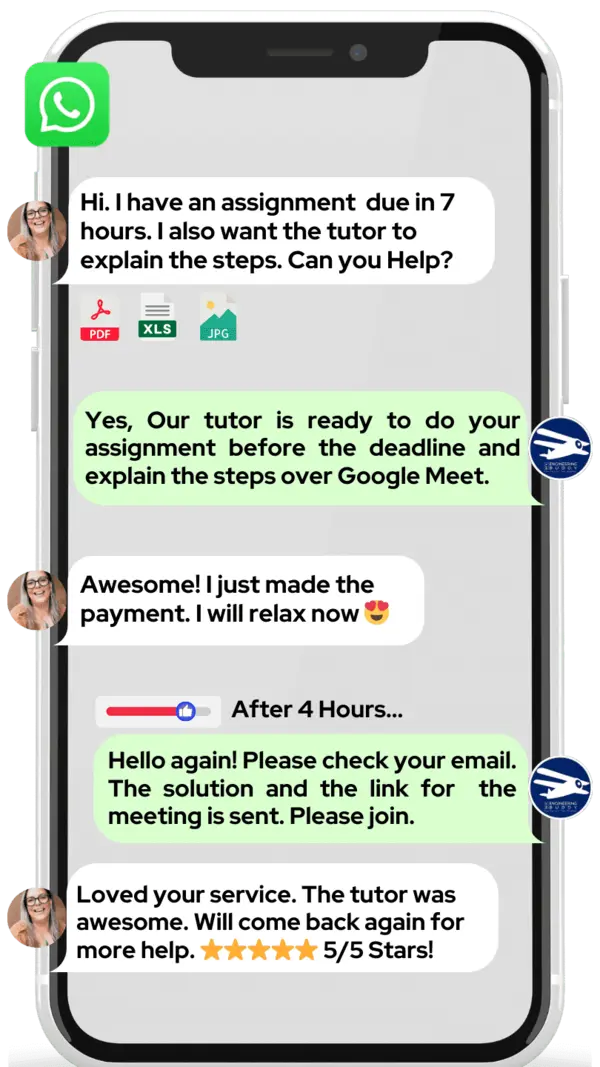
WhatsApp MEB for a quick quote — average response time under 1 minute.
52,000+ students across the US, UK, Canada, Australia, and the Gulf have used MEB since 2008 — including students in Electrical Engineering subjects like power system analysis, power systems, and power electronics.
Source: My Engineering Buddy, 2008–2025.
Who This Power System Analysis Tutoring Is For
Power system analysis sits at the hard end of electrical engineering. Most students hit a wall somewhere between per-unit normalisation and the Jacobian matrix in Newton-Raphson. If that’s you, you’re not behind — you just haven’t had someone explain it in the right order.
- Undergraduate electrical engineering students working through load flow and fault analysis modules
- Master’s and PhD students using ETAP, PSCAD, or MATLAB/Simulink for research or coursework projects
- Students retaking after a failed first attempt and needing to close specific gaps fast
- Students with a conditional university offer that depends on passing this module
- Engineers in the Gulf, Europe, or North America upskilling for grid modernisation or renewable integration roles
- Parents supporting an undergraduate student whose confidence has dropped alongside their grades
Students at institutions including MIT, Georgia Tech, Imperial College London, TU Delft, University of Toronto, KAUST, and ETH Zurich have used MEB for power systems support at every level from second-year undergraduate to doctoral research.
At MEB, we’ve found that students who struggle with Newton-Raphson load flow almost always have the same root problem: they’ve never seen a complete, hand-traced iteration worked from the Y-bus matrix to convergence. One session fixing that unlocks the rest of the topic.
1:1 Tutoring vs Self-Study vs AI vs YouTube vs Online Courses
Self-study works if you’re disciplined, but power system analysis has layers where a single wrong assumption compounds across every calculation that follows — no feedback loop catches it. AI tools give fast explanations but can’t watch you mis-apply symmetrical components in real time and correct it before it becomes a habit. YouTube is useful for overviews of per-unit conversion or Zbus formulation, but stops the moment you’re stuck on your specific bus system. Online courses move at a fixed pace — they won’t wait while you work through a three-bus Newton-Raphson iteration by hand. 1:1 tutoring with MEB is calibrated to your exact course, your actual error patterns, and your exam date.
Outcomes: What You’ll Be Able To Do in Power System Analysis
After focused sessions, you’ll be able to solve Newton-Raphson and Gauss-Seidel load flow problems from a cold start, construct and invert the Y-bus admittance matrix for multi-bus systems, and apply symmetrical components to calculate fault currents for three-phase, line-to-line, and single line-to-ground faults. You’ll model synchronous generators and induction motors in transient stability studies, analyse power system protection schemes including relay coordination and differential protection, and present simulation results from ETAP or PSCAD with enough technical depth to defend them in a viva or project review.
Based on feedback from 40,000+ sessions collected by MEB from 2022 to 2025, 58% of students improved by one full grade after approximately 20 hours of 1:1 tutoring in subjects like power system analysis. A further 23% achieved at least a half-grade improvement.
Source: MEB session feedback data, 2022–2025.
Try your first session for $1 — 30 minutes of live 1:1 tutoring or one homework question explained in full. No registration. No commitment. WhatsApp MEB now and get matched within the hour.
What We Cover in Power System Analysis (Syllabus / Topics)

Load Flow and Network Analysis
- Y-bus and Z-bus admittance matrix formation
- Gauss-Seidel load flow — iteration setup and convergence criteria
- Newton-Raphson load flow — Jacobian construction and mismatch equations
- Fast-decoupled load flow and when to use it
- Per-unit normalisation across base changes and transformer boundaries
- Power flow in transmission lines — Pi model, Ferranti effect
- Voltage profile analysis and reactive power dispatch
Standard references: Glover, Sarma & Overbye Power System Analysis and Design; Bergen & Vittal Power Systems Analysis; Stevenson & Grainger Elements of Power System Analysis.
Fault Analysis and System Protection
- Symmetrical components — sequence networks for positive, negative, and zero sequence
- Three-phase balanced fault calculations using Zbus
- Unsymmetrical faults — SLG, LL, and DLG fault current derivation
- Relay coordination — overcurrent, distance, and differential relay settings
- Circuit breaker interrupting ratings and fault clearing time
- Power system protection schemes — zone protection and backup
- Arc flash hazard analysis basics
Standard references: Anderson Analysis of Faulted Power Systems; Blackburn & Domin Protective Relaying.
Stability and Control
- Rotor angle stability — swing equation and equal area criterion
- Transient stability analysis — critical clearing time and angle
- Small-signal stability and eigenvalue analysis
- Voltage stability and P-V, Q-V curve interpretation
- Automatic generation control and load frequency control
- Power system operation and control — economic dispatch and optimal power flow concepts
- FACTS devices — SVC, STATCOM, UPFC applications
Standard references: Kundur Power System Stability and Control; Machowski, Bialek & Bumby Power System Dynamics.
What a Typical Power System Analysis Session Looks Like
The tutor opens by checking the previous session’s topic — usually something like Newton-Raphson iteration or sequence network construction — and asking you to work through one problem without help to see where the understanding actually sits. From there, the session moves to the current topic: if it’s a three-bus load flow, the tutor walks you through the Jacobian setup on a digital pen-pad, step by step, then hands it back to you to complete the next iteration. You explain your reasoning out loud. The tutor catches errors at the point they happen — not after you’ve repeated the same mistake across five more steps. The session closes with a specific practice problem set for before the next meeting and a note on which topic comes next in the sequence.
How MEB Tutors Help You with Power System Analysis (The Learning Loop)
Diagnose: In the first session, the tutor identifies exactly where your understanding breaks down — whether that’s Y-bus construction, per-unit base conversion, or interpreting swing curves — rather than starting from the beginning of the textbook.
Explain: The tutor works through a live problem using a digital pen-pad, showing every algebraic step, stating assumptions explicitly, and connecting the maths to what the grid is physically doing.
Practice: You attempt the next problem with the tutor present. Not after the session — during it, while support is available. This is where most of the learning actually happens.
Feedback: The tutor reviews each step, explains why a particular error costs marks in an exam context, and shows the correct method without simply handing you the answer.
Plan: At the end of every session, the tutor sets a specific task — typically one to three problems from a past paper or problem set — and logs the next topic in your sequence so sessions build on each other rather than repeating.
Sessions run on Google Meet. The tutor uses a digital pen-pad or iPad with Apple Pencil for live working. Before your first session, share your course syllabus or module outline, a past paper question you couldn’t complete, and your exam or submission date. The first session is your diagnostic and your first hour of progress. Start with the $1 trial — 30 minutes of live tutoring that also serves as your first diagnostic.
Students consistently tell us that the biggest shift in power system analysis comes when they stop memorising formula sequences and start understanding what the Jacobian is actually representing physically. Our tutors push hard for that conceptual anchor — every time.
Tutor Match Criteria (How We Pick Your Tutor)
Not every electrical engineer can teach power system analysis at graduate level. MEB’s matching process is specific.
Subject depth: Tutors are matched to your exact module level — undergraduate load flow, master’s stability studies, or doctoral research — not just “power engineering generally.”
Tools: Tutors work with ETAP tutoring, PSCAD tutoring, and MATLAB/Simulink depending on your course requirements.
Time zone: Matched to your region — US, UK, Gulf, Canada, Australia — so sessions happen at hours that don’t wreck your sleep before an exam.
Goals: Whether you need exam score improvement, conceptual depth for a viva, homework completion, or research-level support, the tutor knows which mode you’re in.
Unlike platforms where you fill out a form and wait, MEB responds in under a minute, 24/7. Tutor match takes under an hour. The $1 trial means you test before you commit. Everything runs over WhatsApp — no logins, no intake forms.
Study Plans (Pick One That Matches Your Goal)
Catch-up (1–3 weeks): for students with significant gaps — load flow, fault analysis, or stability — before a final exam. Sessions run daily or every other day, focused on the highest-yield topics for your specific paper. Exam prep (4–8 weeks): structured revision covering all three tracks above, with past paper practice built in from week two. Weekly support: ongoing sessions aligned to your semester schedule, keeping coursework submissions and mid-term assessments on track. The tutor maps the specific session sequence after the diagnostic.
For power system analysis and related subjects, MEB covers everything from undergraduate electrical circuits tutoring through to doctoral-level grid modelling — matched to your exact course, level, and software environment.
Source: My Engineering Buddy, 2008–2025.
Pricing Guide
Undergraduate power system analysis sessions: $20–$40/hr. Master’s-level stability analysis, optimal power flow, or FACTS modelling: $50–$100/hr depending on tutor background and timeline. Rate factors include module level, topic complexity, how close your exam is, and tutor availability in your time zone.
For students targeting positions at utilities, grid operators, or energy consultancies — or applying for competitive graduate programmes — tutors with professional grid operations or research backgrounds are available at higher rates. Share your specific goal and MEB will match the tier to your target.
Availability shrinks fast in the four weeks before university exam periods. Start with the $1 trial — 30 minutes, no registration, no commitment. WhatsApp MEB for a quick quote.
FAQ
Is power system analysis hard?
It’s one of the harder electrical engineering modules. The difficulty isn’t any single concept — it’s that load flow, fault analysis, and stability each build on the same mathematical foundations, so a shaky start with per-unit systems or matrix methods creates compounding problems across all three areas.
How many sessions are needed?
Students with one or two specific gaps — say, Newton-Raphson convergence or sequence network construction — often close them in four to six sessions. A full catch-up covering all three major tracks typically takes 15–25 hours depending on starting level and study time between sessions.
Can you help with homework and assignments?
Yes. MEB tutoring is guided learning — you understand the work, then submit it yourself. See our Academic Integrity policy and Why MEB page for full details on what we help with and what we don’t.
Will the tutor match my exact syllabus or exam board?
Yes. Tutors are matched to your specific course — whether that’s an IEEE-aligned undergraduate module at a US university, a UK MEng programme, or a Gulf-region master’s course using ETAP. Share your course outline at booking and the match reflects it.
What happens in the first session?
The tutor runs a short diagnostic — asking you to work through one or two representative problems — to identify exactly where the gaps are. The rest of the session addresses the highest-priority gap and sets the sequence for following sessions. No time is spent on topics you already understand.
Is online tutoring as effective as in-person?
For power system analysis, yes. The tutor works on a digital pen-pad via Google Meet, which means you see every step of a Newton-Raphson iteration or fault current derivation drawn live — often clearer than a physical whiteboard. The 52,000+ students MEB has served since 2008 are almost entirely online.
What is the difference between load flow analysis and fault analysis, and which should I learn first?
Load flow (power flow) studies the steady-state operating condition of a network. Fault analysis studies what happens when that steady state is disrupted by a short circuit. Most university syllabuses teach load flow first because fault analysis uses the same Y-bus and per-unit framework as its starting point.
Can you help with ETAP or PSCAD simulation assignments?
Yes. Several MEB tutors work specifically with PSCAD and ETAP at postgraduate level. Share your simulation task and software version when you WhatsApp — the match will reflect the tool you’re using.
Can I get power system analysis help at midnight or over a weekend?
Yes. MEB operates 24/7 across time zones. Gulf, US, and Australian students regularly book late-night sessions. WhatsApp is the fastest route — average first response is under a minute regardless of the hour.
What if I don’t understand my tutor’s explanation in the first session?
WhatsApp MEB immediately. A tutor swap takes under an hour and the $1 trial cost is not forfeited. The match process is a starting point — not a locked commitment. Most mismatches are resolved within the first session or two.
Do you cover renewable energy integration and smart grid topics within power system analysis?
Yes. Topics like distributed generation modelling, inverter-based resource grid integration, microgrid stability, and smart grid tutoring fall within the scope of advanced power system analysis courses and are covered by MEB tutors with relevant research or industry backgrounds.
How do I get started?
WhatsApp MEB with your course name, your hardest topic, and your exam or deadline date. MEB matches you with a verified tutor — usually within the hour. The first session is the $1 trial: 30 minutes live or one full question explained. Three steps: WhatsApp, get matched, start.
Trust & Quality at My Engineering Buddy
Every MEB tutor goes through subject-specific screening before their first session — not a generic teaching test but a live demo evaluation in their declared subject area. For power system analysis, that means demonstrating they can work through load flow and fault calculations at the level they’ll be teaching. Ongoing session feedback is reviewed, and tutors with consistently low ratings are replaced. MEB is rated 4.8/5 across 40,000+ verified reviews on Google. Tutors hold graduate degrees in electrical power engineering or closely related disciplines, and many have professional backgrounds in grid operations, protection engineering, or renewable energy development.
MEB tutoring is guided learning — you understand the work, then submit it yourself. For full details on what we help with and what we don’t, read our Academic Integrity policy and Why MEB.
MEB has served 52,000+ students since 2008 across the US, UK, Canada, Australia, the Gulf, and Europe — covering 2,800+ advanced subjects. Within electrical engineering, that includes high voltage engineering tutoring, electrical machines tutoring, control systems help, and the full range of power subjects from undergraduate through doctoral level. See how MEB’s tutoring methodology works for the full process.
Our experience across thousands of sessions shows that power system analysis students who bring a specific unsolved past paper question to the first session make faster initial progress than those who start with a general topic review. Come with something concrete — it tells the tutor exactly where to begin.
Explore Related Subjects
Students studying power system analysis often also need support in:
- Power transmission systems
- Power generation
- Electrical and electronics
- Electromagnetic field theory
- Electromechanical energy conversion
- Thermal power plants
- Energy storage systems
- Distributed control systems (DCS)
Next Steps
When you WhatsApp MEB, share three things: your exam board or university course name, the topic or component you’re finding hardest, and your exam or submission date. MEB matches you with a verified power system analysis tutor — usually within 24 hours, often within the hour.
Before your first session, have ready:
- Your course syllabus or module outline (or the specific textbook your course uses)
- A past paper question or homework problem you couldn’t complete
- Your exam date or coursework deadline
The tutor handles the rest. First session starts with the diagnostic so every minute of your time is used well.
Visit www.myengineeringbuddy.com for more on how MEB works.
WhatsApp to get started or email meb@myengineeringbuddy.com.
Reviewed by Subject Expert
This page has been carefully reviewed and validated by our subject expert to ensure accuracy and relevance.