~1 min
Average Reply Time
~1 hour
To Be Matched With A Tutor
30 Min Trial
75% Find Their Tutor On The 1st Trial
$20-35+/hr
Premium Yet Affordable Learning
Hire The Best Remote Sensing Tutor






Satellite imagery that looks sharp on screen can be impossible to interpret without knowing what you’re actually measuring. If image classification, spectral analysis, or sensor calibration is where you’re losing marks, a Remote Sensing tutor online can fix that fast.
Remote Sensing Tutor Online
Remote Sensing is the science of acquiring information about Earth’s surface using airborne or satellite sensors without direct contact, enabling analysis of land cover, vegetation, atmosphere, and terrain through electromagnetic data interpretation.
MEB offers 1:1 online tutoring and homework help in 2800+ advanced subjects, including Remote Sensing at undergraduate, postgraduate, and research levels. Whether you need help with a specific lab, a classification project, or exam revision, our tutors work through the exact material your course demands. Search for a Remote Sensing tutor near me and you’ll find plenty of options — but live, calibrated 1:1 help in a field this technical is harder to find than a listing. MEB has been matching students with Geomatics tutors and specialists across the full discipline since 2008.
- 1:1 online sessions tailored to your course syllabus and exam board
- Expert tutors with subject-specific Remote Sensing knowledge — satellite systems, sensors, image processing
- Flexible time zones — US, UK, Canada, Australia, Gulf
- Structured learning plan built after a diagnostic session
- Ethical homework and assignment guidance — you understand the work before you submit
52,000+ students across the US, UK, Canada, Australia, and the Gulf have used MEB since 2008 — including students in Geomatics subjects like Remote Sensing, Geographic Information Systems, and Photogrammetry.
Source: My Engineering Buddy, 2008–2025.
How Much Does a Remote Sensing Tutor Cost?
Most Remote Sensing tutoring sessions run $20–$40/hr depending on level and topic complexity. Graduate-level and research-focused work can reach $100/hr. Not sure it’s worth the investment? Start with the $1 trial first.
| Level / Need | Typical Rate | What’s Included |
|---|---|---|
| Undergraduate (standard) | $20–$35/hr | 1:1 sessions, homework guidance |
| Advanced / Postgraduate | $35–$70/hr | Expert tutor, research-level depth |
| $1 Trial | $1 flat | 30 min live session or 1 homework question explained |
Tutor availability tightens around semester deadlines and project submission windows. If you have a hard deadline coming up, book early.
WhatsApp MEB for a quick quote — average response time under 1 minute.
Who This Remote Sensing Tutoring Is For
Remote Sensing sits at the intersection of physics, data science, and geography. Students often hit a wall when theory meets real imagery — and that wall tends to appear right before an assessment.
- Undergraduate students in Earth Observation, Geomatics, or Environmental Science struggling with image classification or sensor theory
- Postgraduate and MSc students working through change detection, spectral analysis, or SAR interpretation for a dissertation or thesis
- Students retaking after a failed first attempt at a Remote Sensing module — gaps in radiometric correction or geometric processing often go unaddressed
- Students with a university conditional offer depending on passing this module
- Parents supporting a student whose confidence has dropped alongside their lab marks
- Researchers at institutions like the University of Edinburgh, ETH Zurich, Delft University of Technology, University of Melbourne, or Arizona State University needing targeted support on specific methods
If you need help before a project submission, the $1 trial gets you matched and started the same day.
1:1 Tutoring vs Self-Study vs AI vs YouTube vs Online Courses
Self-study works if you’re disciplined — but Remote Sensing involves sensor physics, coordinate systems, and software workflows that compound quickly when one concept is shaky. AI tools can explain NDVI or explain a confusion matrix in seconds; they can’t look at your classified image and tell you why your accuracy is 61% instead of 85%. YouTube covers the concept of supervised classification well. It won’t diagnose your specific band combination choices. Online courses are structured but move at one speed — not yours. 1:1 tutoring with MEB is live, calibrated to your exact dataset and assignment brief, and corrects errors before they cost you marks.
Outcomes: What You’ll Be Able To Do in Remote Sensing
After working with a Remote Sensing tutor through MEB, students consistently report clearer command of the material — not just familiarity with it. You’ll be able to analyze multispectral and hyperspectral imagery with confidence, applying the right band combinations for vegetation, water, or urban mapping. You’ll solve radiometric and geometric correction problems without second-guessing the workflow. You’ll explain the physics of passive vs active sensors — including SAR backscatter — in your own words, accurately. You’ll apply classification algorithms like Maximum Likelihood or Random Forest and interpret accuracy assessment outputs. You’ll present your image processing methodology in written reports or oral assessments without gaps.
Based on feedback from 40,000+ sessions collected by MEB from 2022 to 2025, 58% of students improved by one full grade after approximately 20 hours of 1:1 tutoring in subjects like Remote Sensing. A further 23% achieved at least a half-grade improvement.
Source: MEB session feedback data, 2022–2025.
At MEB, we’ve found that Remote Sensing students who struggle with classification accuracy almost always have the same root problem: they haven’t fully understood the spectral properties of the classes they’re trying to separate. Fix that first, and the algorithm results follow.
What We Cover in Remote Sensing (Syllabus / Topics)

Track 1: Fundamentals of Remote Sensing & Sensor Systems
- Electromagnetic spectrum and energy interactions with Earth’s surface
- Passive vs active sensors — optical, thermal infrared, microwave
- Satellite platforms and orbital characteristics (Landsat, Sentinel, MODIS, WorldView)
- Spatial, spectral, radiometric, and temporal resolution — trade-offs and selection
- Atmospheric effects and correction methods — DOS, FLAASH, 6S model
- Geometric correction and image registration — GCPs, resampling, orthorectification
Recommended references: Lillesand, Kiefer & Chipman, Remote Sensing and Image Interpretation (7th ed.); Jensen, Introductory Digital Image Processing (4th ed.).
Track 2: Image Processing & Classification
- Image enhancement — contrast stretching, histogram equalisation, filtering
- Band ratios and spectral indices — NDVI, NDWI, SAVI, EVI
- Supervised classification — Maximum Likelihood, SVM, Random Forest
- Unsupervised classification — ISODATA, K-means clustering
- Accuracy assessment — confusion matrix, overall accuracy, Kappa coefficient
- Change detection methods — post-classification comparison, image differencing, CVA
- Hyperspectral data analysis — spectral unmixing, endmember extraction
Recommended references: Richards, Remote Sensing Digital Image Analysis (5th ed.); Schowengerdt, Remote Sensing: Models and Methods for Image Processing.
Track 3: SAR, LiDAR & Advanced Applications
- Synthetic Aperture Radar (SAR) principles — backscatter, polarisation, interferometry (InSAR)
- SAR applications — flood mapping, surface deformation, forest biomass estimation
- LiDAR tutoring overlap — point cloud data, DTM/DSM generation, canopy height models
- Time-series analysis — NDVI trajectories, phenology monitoring
- Google Earth Engine for large-scale analysis — JavaScript API, image collections, reducers
- Integration with GIS tutoring workflows — spatial analysis, vector overlay, geodatabase management
Recommended references: Woodhouse, Introduction to Microwave Remote Sensing; Weng, Remote Sensing of Impervious Surfaces; Dronova et al. peer-reviewed literature on Earth observation applications.
What a Typical Remote Sensing Session Looks Like
The tutor starts by checking the previous topic — usually where the student got stuck on radiometric correction or a classification run that produced poor accuracy. From there, the student and tutor work through the current problem on screen together: for example, running a supervised classification in ENVI or QGIS, selecting training samples, and interpreting the resulting confusion matrix. The tutor uses a digital pen-pad to annotate imagery directly, marking up spectral signatures or walking through a geometric correction workflow step by step. The student replicates the process or explains their reasoning out loud. By the end of the session, the tutor sets a concrete practice task — typically a second image to classify independently — and flags the next topic for the following session.
Students consistently tell us that the moment Remote Sensing clicks is when they stop treating band combinations as a lookup table and start understanding why a particular ratio separates the classes they’re mapping. That shift usually happens in session two or three, not session ten.
How MEB Tutors Help You with Remote Sensing (The Learning Loop)
Diagnose: In the first session, the tutor identifies exactly where your understanding breaks down — whether that’s sensor physics, preprocessing steps, or classification logic. It’s not a quiz. It’s a structured conversation that surfaces gaps quickly.
Explain: The tutor works through live examples on screen using a digital pen-pad. If the issue is atmospheric correction, you’ll see the actual parameter choices explained in real time, not just the formula. Remote Sensing is visual — the tutoring matches that.
Practice: You attempt the next problem with the tutor present. Not after. The tutor watches your process, not just your answer — and that’s where most errors are caught.
Feedback: Step-by-step correction with explanation of why a classification decision was wrong, why your accuracy assessment doesn’t match expected results, or why your preprocessing sequence lost spatial detail. Marks are lost at specific steps — the tutor names them.
Plan: Every session ends with a clear next topic, a practice task, and a note of what to bring to the following session. No vague “keep reviewing.” Specific.
Sessions run on Google Meet. Tutors use a digital pen-pad or iPad with Apple Pencil to annotate satellite images and processing outputs directly. Before your first session, send your course outline or module descriptor, a recent lab or assignment you struggled with, and your submission or exam date. The first session covers the diagnostic and begins working on your most pressing topic immediately. Start with the $1 trial — 30 minutes of live tutoring that also serves as your first diagnostic.
Remote Sensing tutoring works best when students bring a real dataset or assignment to the first session. Generic practice problems exist — but working through your actual coursework is what builds the precision your assessments require.
Source: My Engineering Buddy, tutoring methodology notes, 2008–2025.
Tutor Match Criteria (How We Pick Your Tutor)
Not every Remote Sensing expert covers every track. Here’s how MEB matches you.
Subject depth: Tutors are matched to your specific syllabus area — undergraduate image processing, graduate SAR analysis, or dissertation-level Earth Observation. A tutor who knows optical remote sensing may not be right for InSAR work. MEB separates these.
Tools: Sessions run on Google Meet with a digital pen-pad or iPad and Apple Pencil — essential for a subject where annotating imagery matters.
Time zone: Matched to your region — US, UK, Canada, Australia, or Gulf. No scheduling across 12 time zones.
Goals: Exam revision, specific assignment help, conceptual depth for a dissertation, or ongoing weekly support through the semester. The match reflects your actual goal — not a generic slot.
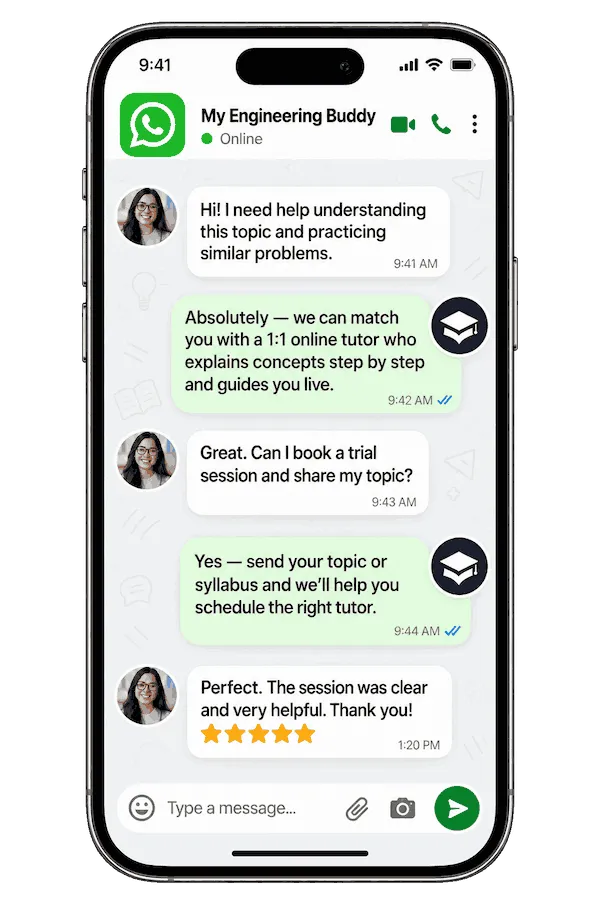
Unlike platforms where you fill out a form and wait, MEB responds in under a minute, 24/7. Tutor match takes under an hour. The $1 trial means you test before you commit. Everything runs over WhatsApp — no logins, no intake forms.
Study Plans (Pick One That Matches Your Goal)
Catch-up (1–3 weeks): for students behind on a specific topic — geometric correction, classification, or SAR interpretation — with a lab or exam approaching. Exam prep (4–8 weeks): structured revision across all syllabus areas, past paper practice, and accuracy assessment drills. Weekly support: ongoing sessions aligned to your semester schedule, covering each new topic as it’s taught. The tutor builds a specific sequence after the diagnostic — nothing is assumed about what you already know.
Pricing Guide
Remote Sensing tutoring starts at $20/hr for standard undergraduate modules and reaches $35–$70/hr for advanced postgraduate work or dissertation support. Research-level or highly specialised topics — InSAR analysis, hyperspectral processing, large-scale Google Earth Engine workflows — can reach $100/hr depending on tutor background and timeline.
Rate factors: your course level, the specific topic area, how quickly you need sessions, and tutor availability. Availability tightens around semester submission deadlines.
For students targeting positions at agencies like ESA, NASA, USGS, or remote sensing roles in environmental consultancies, tutors with professional research or industry backgrounds in Earth Observation are available at higher rates — share your specific goal and MEB will match the tier to your ambition.
Start with the $1 trial — 30 minutes, no registration, no commitment. WhatsApp MEB for a quick quote.
Try your first session for $1 — 30 minutes of live 1:1 tutoring or one homework question explained in full. No registration. No commitment. WhatsApp MEB now and get matched within the hour.
FAQ
Is Remote Sensing hard?
It’s a technically demanding subject — it combines sensor physics, image processing, and spatial analysis in one course. Most students find the jump from understanding concepts to applying them in software the hardest part. That gap closes quickly with structured 1:1 guidance.
How many sessions are needed?
Students with a single assignment gap typically need 3–5 sessions. Those working toward an exam or dissertation chapter over a full module often book 10–20 sessions. The tutor sets a realistic plan after the first diagnostic.
Can you help with homework and assignments?
Yes. MEB tutoring is guided learning — you understand the work, then submit it yourself. See our Academic Integrity policy and Why MEB page for full details on what we help with and what we don’t.
Will the tutor match my exact syllabus or exam board?
Yes. Remote Sensing is taught differently across institutions — some courses focus on optical imaging, others emphasise SAR or GEE. Share your module outline and the tutor is matched to your specific content, not a generic Remote Sensing syllabus.
What happens in the first session?
The tutor runs a short diagnostic — asking where you’re stuck, reviewing your most recent assignment or lab output, and identifying the specific gaps. The session then begins working on the highest-priority topic immediately. No setup time wasted.
Is online tutoring as effective as in-person for Remote Sensing?
For a software- and imagery-based subject, online tutoring works well. Screen sharing, live annotation on satellite images, and real-time walkthrough of processing workflows in ENVI, QGIS, or GEE translate directly to an online format with a pen-pad.
Can I get Remote Sensing help at midnight or on weekends?
Yes. MEB operates 24/7. Students in the Gulf, Australia, and North America regularly book late-night or weekend sessions. WhatsApp MEB at any hour — response time is typically under a minute and matching happens within the hour.
What if I don’t get on with my assigned tutor?
Tell MEB via WhatsApp and you’re rematched — usually within the same day. The $1 trial exists precisely so you can test the fit before committing to a full session block.
Do you cover Google Earth Engine (GEE) for Remote Sensing projects?
Yes. GEE is increasingly central to Remote Sensing coursework at undergraduate and postgraduate level. Tutors cover the JavaScript API, image collections, temporal compositing, and exporting results for further analysis in QGIS or ArcGIS.
What’s the difference between passive and active remote sensing, and why does it matter for my course?
Passive sensors detect reflected sunlight — optical and thermal systems like Landsat or Sentinel-2. Active sensors emit their own energy — radar and LiDAR. Most courses test both. Which matters more depends on your module focus; your tutor will clarify which your assessments weight most heavily.
How do I choose between supervised and unsupervised classification for my project?
Supervised classification needs training data and known class labels — better accuracy when you have ground truth. Unsupervised works when you don’t. Your tutor will review your dataset and assignment brief and help you select and justify the right method for your specific project.
How do I get started?
Start with the $1 trial — 30 minutes of live tutoring or one assignment question explained in full. Three steps: WhatsApp MEB, get matched with a Remote Sensing tutor, start your trial session. That’s it.
Trust & Quality at My Engineering Buddy
Every MEB tutor goes through subject-specific screening before working with students. That means a live demo evaluation, review of academic background and professional experience in Remote Sensing or a closely related Earth Observation field, and ongoing feedback review after sessions. Rated 4.8/5 across 40,000+ verified reviews on Google. Tutors aren’t generalists handed a subject list — they’re matched to the specific track you need, whether that’s optical image processing, SAR analysis, or research-level Earth Observation workflows. For more on how tutors are selected and assessed, see our tutoring methodology.
MEB tutoring is guided learning — you understand the work, then submit it yourself. For full details on what we help with and what we don’t, read our Academic Integrity policy and Why MEB.
MEB has served 52,000+ students across the US, UK, Canada, Australia, the Gulf, and Europe in 2,800+ subjects since 2008. In Geomatics and related disciplines, that includes students needing Photogrammetry tutoring, Geodesy help, and support with ArcGIS and ArcGIS Pro tutoring alongside their Remote Sensing coursework. The IPCC relies on remote sensing data to underpin climate assessments — students can read more about how Earth observation feeds into real science at the IPCC website.
MEB has operated since 2008 — long enough to have tutored students through multiple generations of satellite platforms, from Landsat 5 to Sentinel-2 to Planet Labs imagery. The subject has changed. The tutoring model hasn’t needed to.
Source: My Engineering Buddy, 2008–2025.
A common pattern our tutors observe is that Remote Sensing students underestimate how much preprocessing affects classification results. By the time they reach the classification step, the damage from skipped atmospheric correction is already done. We cover preprocessing first — always.
Explore Related Subjects
Students studying Remote Sensing often also need support in:
Next Steps
Ready to move forward? Here’s what to do:
- Share your module outline or exam syllabus, your hardest topic, and your current deadline or exam date
- Share your availability and time zone — sessions are matched to your region
- MEB matches you with a verified Remote Sensing tutor — usually within 24 hours, often within the hour
- Your first session opens with a diagnostic so every minute is used on what actually matters
Before your first session, have ready: your course outline or module descriptor, a recent lab or assignment you struggled with, and your submission or exam date. The tutor handles the rest.
Visit www.myengineeringbuddy.com for more on how MEB works.
WhatsApp to get started or email [email protected].
Reviewed by Subject Expert
This page has been carefully reviewed and validated by our subject expert to ensure accuracy and relevance.