~1 min
Average Reply Time
~1 hour
To Be Matched With A Tutor
30 Min Trial
75% Find Their Tutor On The 1st Trial
$20-35+/hr
Premium Yet Affordable Learning
Hire The Best Rock Mechanics Tutor

Most students who fail Rock Mechanics don’t lack effort — they hit a wall on stress analysis, failure criteria, or underground excavation problems and have nowhere to turn at 11 pm.
Rock Mechanics Tutor Online
Rock Mechanics is the study of the mechanical behaviour of rock and rock masses under applied stresses, covering failure criteria, discontinuity analysis, and underground excavation design — equipping engineers and geoscientists to solve tunnelling, mining, and slope stability problems.
MEB provides 1:1 online tutoring and homework help in 2,800+ advanced subjects, including a full range of Civil Engineering tutoring subjects. If you’ve searched for a Rock Mechanics tutor near me and found no one who knows the difference between Hoek-Brown and Mohr-Coulomb criteria, MEB’s verified tutors do. One session can shift your understanding from surface-level to exam-ready.
- 1:1 online sessions tailored to your exact course syllabus and exam board
- Expert-verified tutors with postgraduate subject knowledge in Rock Mechanics
- Flexible time zones — sessions available across the US, UK, Canada, Australia, and the Gulf
- Structured learning plan built after a diagnostic session in your first hour
- Ethical homework and assignment guidance — you understand the work before you submit it
52,000+ students across the US, UK, Canada, Australia, and the Gulf have used MEB since 2008 — including students in Civil Engineering subjects like Rock Mechanics, Geotechnical Engineering tutoring, and Slope Stability Analysis.
Source: My Engineering Buddy, 2008–2025.
How Much Does a Rock Mechanics Tutor Cost?
Most Rock Mechanics sessions run $20–$40/hr. Graduate-level or specialist topics — underground excavation design, rock burst prediction, numerical modelling with Phase2 or RS2 — can reach $60–$100/hr. The $1 trial gives you 30 minutes of live tutoring or a full explanation of one homework question before you commit to anything.
| Level / Need | Typical Rate | What’s Included |
|---|---|---|
| Standard undergraduate | $20–$40/hr | 1:1 sessions, homework guidance |
| Advanced / Graduate / Specialist | $40–$100/hr | Expert tutor, numerical modelling depth |
| $1 Trial | $1 flat | 30 min live session or 1 homework question |
Tutor availability tightens around end-of-semester submission windows. Book early if you have a deadline inside four weeks.
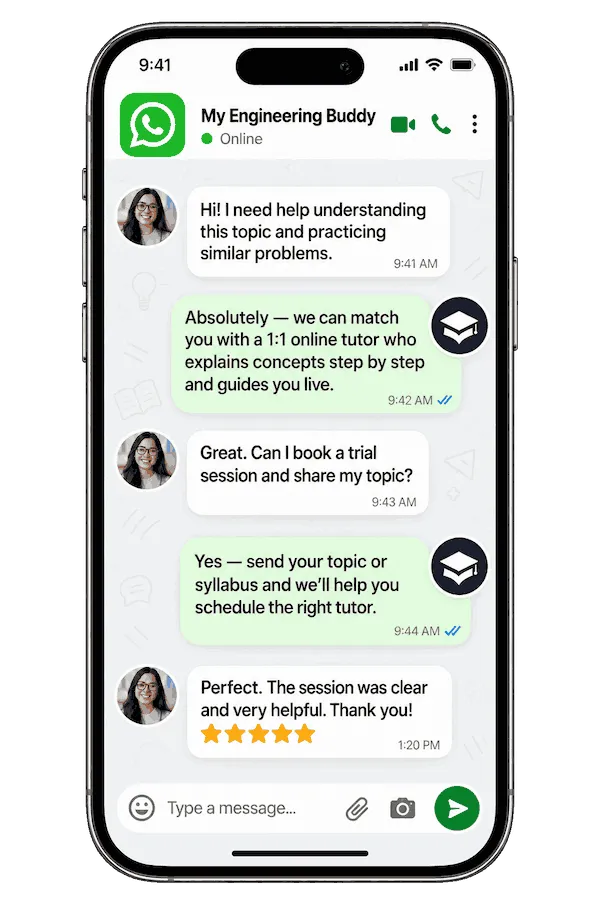
WhatsApp MEB for a quick quote — average response time under 1 minute.
Who This Rock Mechanics Tutoring Is For
Rock Mechanics sits at the harder end of civil, mining, and geotechnical engineering programmes. Students typically struggle not with effort but with connecting theory to real problem sets — especially when lectures move fast and office hours are limited.
- Undergraduate civil, mining, or geological engineering students covering rock mechanics for the first time
- Graduate and Masters students working through advanced topics — numerical methods, in-situ stress measurement, rock mass classification
- Students retaking after a failed first attempt who need targeted gap-filling, not a full course replay
- Students with a university conditional offer depending on this grade — every mark matters
- PhD researchers needing help structuring rock mechanics sections of a thesis or literature review
- Students at universities including MIT, ETH Zurich, Imperial College London, the University of Queensland, Georgia Tech, and Colorado School of Mines
Whether you need to close a specific gap in failure criteria or work through a full set of past exam problems, MEB matches you with a tutor who has covered the same material at postgraduate level.
1:1 Tutoring vs Self-Study vs AI vs YouTube vs Online Courses
Self-study works if you’re disciplined — but Rock Mechanics problems require feedback you can’t give yourself. AI tools explain concepts quickly but can’t adapt when your specific Hoek-Brown problem goes wrong halfway through. YouTube covers overviews well and stops there. Online courses move at a fixed pace regardless of where your gaps are. With MEB, a live tutor sees exactly where your reasoning breaks down — on your actual assignment, in real time — and corrects it before the error becomes a habit.
Outcomes: What You’ll Be Able To Do in Rock Mechanics
After consistent 1:1 sessions, you’ll be able to apply Mohr-Coulomb and Hoek-Brown failure criteria to real problem sets without confusion. You’ll analyse discontinuity patterns using stereographic projection and interpret kinematic feasibility for slope and tunnel design. You’ll model in-situ stress states and solve underground excavation problems with confidence. You’ll explain rock mass classification systems — RMR, Q-system — and use them to justify support design decisions in assignments and exams.
“Based on feedback from 40,000+ sessions collected by MEB from 2022 to 2025, 58% of students improved by one full grade after approximately 20 hours of 1:1 tutoring in subjects like Rock Mechanics. A further 23% achieved at least a half-grade improvement.”
Source: MEB session feedback data, 2022–2025.
Students consistently tell us that the moment things clicked in Rock Mechanics was when they stopped treating failure criteria as formulas to memorise and started applying them to physical scenarios. That shift — from recall to reasoning — is exactly what a good tutor creates in one or two sessions.
What We Cover in Rock Mechanics (Syllabus / Topics)

Track 1: Rock Properties and Stress Analysis
- Rock classification: igneous, sedimentary, metamorphic — mechanical implications
- Stress and strain in rock: principal stresses, stress transformation, Mohr’s circle
- Elastic and inelastic rock behaviour — Young’s modulus, Poisson’s ratio
- Laboratory testing: uniaxial compressive strength, Brazilian test, triaxial testing
- In-situ stress measurement: hydraulic fracturing, overcoring methods
- Anisotropy and heterogeneity in rock formations
Core texts include Jaeger, Cook & Zimmerman’s Fundamentals of Rock Mechanics and Brady & Brown’s Rock Mechanics for Underground Mining.
Track 2: Rock Failure Criteria and Discontinuities
- Mohr-Coulomb failure criterion — derivation, application, limitations
- Hoek-Brown failure criterion — GSI input, rock mass parameters, mi values
- Discontinuity characterisation: joint sets, spacing, persistence, roughness (JRC)
- Stereographic projection and kinematic analysis for slope and tunnel stability
- Rock mass classification: RMR (Bieniawski), Q-system (Barton), GSI (Hoek)
- Shear strength of rock joints — Barton-Bandis model
- Scale effects and the transition from intact rock to rock mass properties
Reference texts: Hoek’s Practical Rock Engineering (freely available via Rocscience) and Wyllie & Mah’s Rock Slope Engineering.
Track 3: Underground Excavation and Applied Design
- Stress redistribution around tunnels — Kirsch equations, plastic zone radius
- Support design: rock bolts, shotcrete, steel sets — selection and dimensioning
- Rock burst mechanisms and mitigation in deep excavations
- Numerical modelling concepts: finite element and finite difference methods (Phase2/RS2, FLAC)
- Slope stability in rock — wedge, plane, toppling failure modes
- Slope stability analysis help in conjunction with rock mechanics assignments
- Case studies: mine design, dam abutment stability, deep tunnel construction
Useful supplementary reading: Goodman’s Introduction to Rock Mechanics and Hudson & Harrison’s Engineering Rock Mechanics (Parts I and II).
What a Typical Rock Mechanics Session Looks Like
The tutor opens by checking your last topic — usually wherever Mohr-Coulomb or Hoek-Brown left you confused — and asks you to walk through your attempt before touching anything. From there, you and the tutor work through problems on screen: deriving principal stresses from a given stress state, plotting a stereonet for a joint set, or calculating plastic zone radius using Kirsch equations. The tutor uses a digital pen-pad to annotate diagrams live. You replicate the steps or explain the reasoning back. The session closes with a concrete problem set — two or three questions on the next topic — and a note on what comes up next so you arrive prepared.
At MEB, we’ve found that Rock Mechanics sessions work best when the student brings a specific question or past problem they’ve already attempted — even a wrong attempt. Working through where the reasoning broke down is faster than starting from scratch and far more likely to stick under exam conditions.
How MEB Tutors Help You with Rock Mechanics (The Learning Loop)
Diagnose: In the first session, the tutor identifies exactly which area is causing the block — whether that’s setting up a stress tensor, applying rock mass classification correctly, or interpreting a stereonet. This takes 10–15 minutes and shapes every session that follows.
Explain: The tutor works through a live example using a digital pen-pad on Google Meet — showing the derivation step by step, not just the answer. For underground excavation problems, this often means drawing the stress distribution around an opening in real time.
Practice: You attempt a parallel problem while the tutor watches. This is where most students find the gaps they didn’t know they had.
Feedback: The tutor pinpoints where marks would be lost and why — whether it’s unit errors in stress calculations, missing assumptions in a failure criterion, or an incomplete rock mass classification table.
Plan: Each session ends with a clear next topic, a short task, and a check-in question for the following session. No open-ended “just review chapters 4 and 5.”
Sessions run over Google Meet with a digital pen-pad or iPad + Apple Pencil. Before your first session, share your course outline or syllabus, one past exam question or assignment problem you found hardest, and your exam or submission date. The tutor uses these to set the session sequence from day one. Start with the $1 trial — 30 minutes of live tutoring that also serves as your first diagnostic.
Rock Mechanics sits at the intersection of Geotechnical Engineering, Structural Mechanics tutoring, and field geology — a combination that demands tutors who understand all three areas, not just one.
Source: My Engineering Buddy, 2008–2025.
Try your first session for $1 — 30 minutes of live 1:1 tutoring or one homework question explained in full. No registration. No commitment.
WhatsApp MEB now
and get matched within the hour.
Tutor Match Criteria (How We Pick Your Tutor)
Every Rock Mechanics tutor goes through subject-specific vetting — not a generic tutor screening. Here’s what MEB checks:
Subject depth: Postgraduate-level knowledge of the specific tracks in your syllabus — whether that’s underground excavation design, slope stability, or numerical modelling. Tutors are matched to your course level, not just the subject name.
Tools: All tutors use Google Meet with a digital pen-pad or iPad + Apple Pencil — essential for drawing stereonets, stress diagrams, and annotating equations live.
Time zone: Matched to your region — US, UK, Gulf, Canada, or Australia — so sessions happen when you need them, not when someone in a different time zone is available.
Goals: Whether you need to close a homework gap, prepare for a written exam, or build conceptual depth for a research project, the tutor is selected on fit, not just availability.
Unlike platforms where you fill out a form and wait, MEB responds in under a minute, 24/7. Tutor match takes under an hour. The $1 trial means you test before you commit. Everything runs over WhatsApp — no logins, no intake forms.
Study Plans (Pick One That Matches Your Goal)
After the first diagnostic session, the tutor builds the sequence around your timeline. Students four to eight weeks from an exam get a structured revision plan covering the highest-yield topics first. Students two to three weeks out get an intensive catch-up focused on the most likely exam problems — failure criteria application, rock mass classification, and underground excavation calculations. Students who need ongoing semester support get weekly sessions aligned to their lecture schedule and assignment deadlines. The plan isn’t fixed — it adjusts as your understanding improves and priorities shift.
Pricing Guide
Rock Mechanics tutoring starts at $20/hr for standard undergraduate content. Graduate-level topics — numerical modelling, advanced rock failure analysis, research support — run $60–$100/hr depending on tutor background and topic complexity. Rate factors include course level, how niche the topic is, timeline pressure, and tutor availability.
Slots fill fast in the weeks before end-of-semester exams and submission deadlines. If your deadline is within three weeks, message MEB today.
For students targeting top postgraduate programmes or positions in geotechnical consultancies, tunnelling firms, or mining companies, tutors with direct industry or research backgrounds are available at higher rates — share your specific goal and MEB will match the right tier.
Start with the $1 trial — 30 minutes, no registration, no commitment. WhatsApp MEB for a quick quote.
FAQ
Is Rock Mechanics hard?
Yes — most students find it genuinely difficult. The subject combines stress analysis, geology, and design in ways that don’t connect easily to earlier engineering courses. The biggest barrier is applying failure criteria to real scenarios rather than textbook examples. A tutor bridges that gap quickly.
How many sessions are needed?
Students with specific gaps — one topic, one assignment type — typically need three to five sessions. Those building from a weak foundation across the full syllabus usually need ten to twenty hours spread over six to eight weeks. The diagnostic session gives a clearer picture.
Can you help with homework and assignments?
Yes. MEB tutoring is guided learning — you understand the work, then submit it yourself. The tutor explains the method, works through a parallel example, and checks your reasoning. See our Academic Integrity policy and Why MEB page for full details on what we help with and what we don’t.
Will the tutor match my exact syllabus or exam board?
Yes. Rock Mechanics syllabi vary significantly between universities — some focus on underground mining applications, others on slope stability or geotechnical design. Share your course outline and the tutor is matched specifically to your content, not a generic version of the subject.
What happens in the first session?
The tutor runs a short diagnostic — asking you to work through a problem or explain a concept — to pinpoint exactly where the gaps are. From there, the session goes into the most urgent topic. You leave with a clear plan for the next two to three sessions.
Is online tutoring as effective as in-person?
For Rock Mechanics, yes. The digital pen-pad replicates whiteboard work for stress diagrams, stereonets, and worked derivations. Students consistently report that the ability to share their own problem set on screen — rather than working from a tutor’s example — makes online sessions more efficient than typical in-person sessions.
Can I get Rock Mechanics help at midnight?
Yes. MEB operates across time zones 24/7. WhatsApp the team at any hour and you’ll get a response in under a minute. Tutors in matching time zones are scheduled based on your availability — late-night sessions are common for students in the Gulf, Australia, and the US West Coast.
What if I don’t like my assigned tutor?
Tell MEB via WhatsApp and a replacement is arranged, usually within the same day. The $1 trial exists partly for this reason — you assess the tutor fit before paying full rates. No awkward conversations, no forms to fill in.
Do you offer group Rock Mechanics sessions?
No. MEB is 1:1 only. Group sessions dilute the feedback loop — when the tutor is watching three students, they can’t catch your specific reasoning error in real time. The entire MEB model is built around individual diagnosis and correction.
What is the difference between Mohr-Coulomb and Hoek-Brown — and which does my course use?
Mohr-Coulomb applies to intact rock and simple soil-like failure scenarios; Hoek-Brown is specifically derived for jointed rock masses and uses GSI as a key input. Most undergraduate courses teach both. Share your syllabus and the tutor will clarify which applies to your assignments and exam.
Can MEB help with rock mechanics numerical modelling software like RS2 or FLAC?
Yes. Tutors familiar with RS2 (formerly Phase2), FLAC, and related finite element and finite difference tools are available. Sessions cover model setup, boundary conditions, interpreting output, and connecting numerical results to your analytical work. Share the software your course uses when you message MEB.
How do I get started?
WhatsApp MEB, share your syllabus or the topic you’re stuck on, and you’re matched with a verified Rock Mechanics tutor — usually within an hour. The first session is the $1 trial: 30 minutes of live tutoring or one homework question fully explained. No registration needed.
Trust & Quality at My Engineering Buddy
Every MEB tutor goes through a multi-step vetting process: application review, subject knowledge assessment, a live demo session evaluated by MEB’s senior team, and ongoing feedback monitoring. Tutors covering Rock Mechanics hold postgraduate degrees in civil, geotechnical, or mining engineering — several have direct industry experience in tunnelling or geotechnical consultancy. Rated 4.8/5 across 40,000+ verified reviews on Google. That rating is maintained by replacing tutors who don’t consistently deliver — not by accumulating reviews and coasting.
MEB tutoring is guided learning — you understand the work, then submit it yourself. For full details on what we help with and what we don’t, read our Academic Integrity policy and Why MEB.
MEB has served 52,000+ students across the US, UK, Canada, Australia, the Gulf, and Europe since 2008, covering 2,800+ subjects. In Civil Engineering alone, MEB supports students across Foundation Design Engineering tutoring, Earthquake Engineering help, and Structural Engineering tutoring — alongside Rock Mechanics. The tutor pool spans every major region and time zone. Read more about MEB’s tutoring methodology.
Rock Mechanics students working with MEB tutors have gone on to stronger performance in Dam Engineering, Offshore Engineering tutoring, and postgraduate research — subjects where rock mechanics fundamentals appear directly in the coursework.
Source: My Engineering Buddy, 2008–2025.
A common pattern our tutors observe is that Rock Mechanics students arrive thinking they have a maths problem — they’re weak on the calculations. Within the first session, it’s usually clear the real issue is conceptual: they don’t have a working mental model of how rock fails. Fix the concept first. The numbers follow.
Explore Related Subjects
Students studying Rock Mechanics often also need support in:
- Soil Mechanics
- Fracture Mechanics
- Groundwater Engineering
- Structural Dynamics
- Blast Resistant Design
- Composite Materials & Structures
- PLAXIS 2D/3D
Next Steps
Getting started takes under two minutes.
- Share your exam board or university, the hardest topic you’re currently on, and your exam or submission date
- Share your availability and time zone
- MEB matches you with a verified Rock Mechanics tutor — usually within 24 hours, often within the hour
Before your first session, have ready:
- Your course outline or syllabus (or the specific topics your exam covers)
- A recent past paper attempt or a homework question you found hardest
- Your exam date or assignment submission deadline
The tutor handles the rest. The first session starts with a diagnostic so every minute is used well.
Visit www.myengineeringbuddy.com for more on how MEB works.
WhatsApp to get started or email [email protected].
Reviewed by Subject Expert
This page has been carefully reviewed and validated by our subject expert to ensure accuracy and relevance.