




~1 min
Average Reply Time
~1 hour
To Be Matched With A Tutor
30 Min Trial
75% Find Their Tutor On The 1st Trial
$20-35+/hr
Premium Yet Affordable Learning
Most students can write code that runs. Fewer can write a parser that handles edge cases without breaking — and that gap costs marks in compiler design, automata, and programming language courses.
Parsing Tutor Online
Parsing is the process of analysing a string of symbols — typically source code or structured text — according to formal grammar rules, producing a syntax tree or parse structure that compilers and interpreters use to execute programs.
MEB offers 1:1 online tutoring and homework help in 2800+ advanced subjects, including Parsing at undergraduate and graduate level. If you’ve searched for a Parsing tutor near me, you’re more likely to find better-matched expertise online than locally — this is a specialist topic inside Computer Science tutoring that demands tutors who have actually built parsers, not just read about them. One structured session can reframe what three lectures left unclear.
- 1:1 online sessions tailored to your course syllabus and exam board
- Expert-verified tutors with hands-on compiler and language theory backgrounds
- Flexible time zones — US, UK, Canada, Australia, Gulf
- Structured learning plan built after a diagnostic session
- Ethical homework and assignment guidance — you understand the work before you submit it
52,000+ students across the US, UK, Canada, Australia, and the Gulf have used MEB since 2008 — including students in Computer Science subjects like Parsing, Compiler Design tutoring, and Automata Theory.
Source: My Engineering Buddy, 2008–2025.
How Much Does a Parsing Tutor Cost?
Most Parsing tutoring sessions run $20–$40/hr. Graduate-level or niche compiler theory work can reach $60–$100/hr depending on tutor specialisation. Not sure where you fall? Start with the $1 trial — 30 minutes of live 1:1 tutoring or one homework question fully explained.
| Level / Need | Typical Rate | What’s Included |
|---|---|---|
| Standard (most undergrad levels) | $20–$35/hr | 1:1 sessions, homework guidance |
| Advanced / Graduate / Compiler Theory | $35–$100/hr | Expert tutor, deep theory and implementation |
| $1 Trial | $1 flat | 30 min live session or 1 homework question explained |
Tutor availability tightens during finals and semester-end project submission windows. Book early if you have a hard deadline.
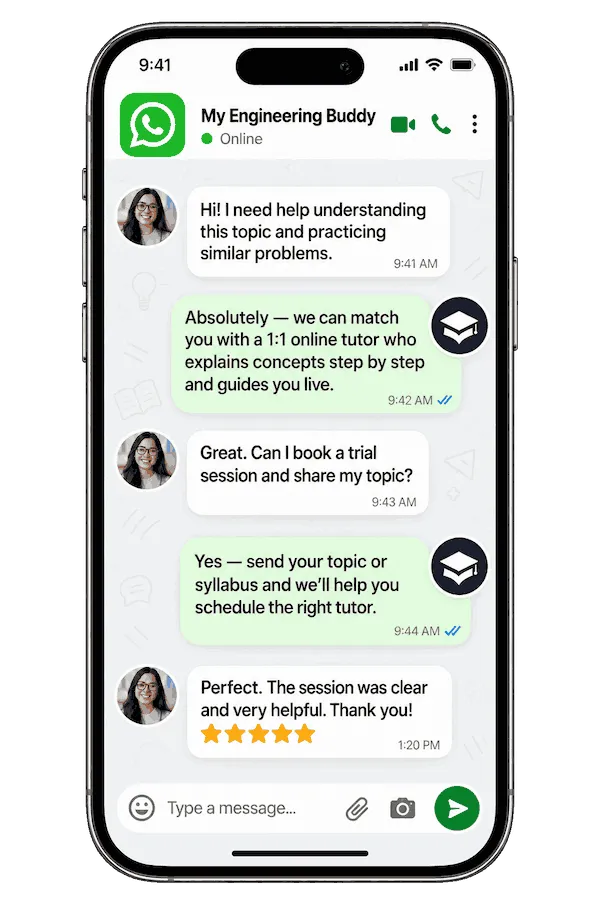
WhatsApp MEB for a quick quote — average response time under 1 minute.
Who This Parsing Tutoring Is For
Parsing sits at the intersection of formal language theory and practical compiler implementation. Students often understand the concept abstractly but struggle the moment they have to write an actual recursive descent parser or debug a shift-reduce conflict in Yacc.
- Undergraduate CS students covering lexical analysis, context-free grammars, and parse trees in a compilers or theory of computation course
- Graduate students implementing parser generators or working through language design projects
- Students retaking a compiler design module after a failed first attempt
- Students with a university conditional offer depending on passing their programming languages or compilers course
- Students 4–6 weeks from finals with significant gaps in LL(1), LR(0), or LALR parsing still to close
- Students at institutions including MIT, Carnegie Mellon, University of Toronto, ETH Zurich, University of Melbourne, Imperial College London, and TU Delft who need expert support beyond office hours
- Students needing guidance on parsing-related assignments — explained in full so you can submit your own work with genuine understanding
1:1 Tutoring vs Self-Study vs AI vs YouTube vs Online Courses
Self-study works if you’re disciplined, but parsing theory has enough notation-heavy grammar rules that isolated reading rarely sticks. AI tools explain shift-reduce conflicts in seconds — but they can’t watch you trace a parse table and catch where your reasoning goes wrong. YouTube is fine for an overview of recursive descent but goes quiet the moment your specific grammar has an ambiguity. Online courses are structured, fixed-pace, and not built around your particular exam board’s question style. A 1:1 Parsing tutor from MEB works through your actual grammar exercises, corrects your derivations live, and adjusts to exactly the parsing technique your course examines — whether that’s LL(k), LR(1), or Earley parsing.
Outcomes: What You’ll Be Able To Do in Parsing
After working with a Parsing tutor at MEB, you should be able to construct FIRST and FOLLOW sets from a context-free grammar without prompting, build and trace through an LL(1) parse table for a given grammar, explain and resolve shift-reduce and reduce-reduce conflicts in LR parsing, write a working recursive descent parser for a defined language fragment, and apply parsing concepts to analyse and extend an existing compiler front-end. These are not abstract goals — they are the precise skills that appear on compilers and theory of computation assessments at universities across the US, UK, Canada, and Australia.
Supporting a student through Parsing? MEB works directly with parents to set up sessions, track progress, and keep coursework on schedule. WhatsApp MEB — average response time is under a minute, 24/7.
Based on feedback from 40,000+ sessions collected by MEB from 2022 to 2025, 58% of students improved by one full grade after approximately 20 hours of 1:1 tutoring in subjects like Parsing. A further 23% achieved at least a half-grade improvement.
Source: MEB session feedback data, 2022–2025.
What We Cover in Parsing (Syllabus / Topics)
Track 1: Formal Grammars and Language Theory
- Context-free grammars (CFGs): production rules, derivations, parse trees
- Chomsky Normal Form and Greibach Normal Form transformations
- Ambiguous grammars: detection, disambiguation techniques
- FIRST and FOLLOW set computation
- Pushdown automata and their relationship to CFGs
- Automata Theory help for students linking parsing back to formal language foundations
Key references: Sipser’s Introduction to the Theory of Computation, Hopcroft, Motwani & Ullman’s Introduction to Automata Theory, Languages, and Computation.
Track 2: Top-Down Parsing (LL Parsing)
- Recursive descent parsing: implementation and limitations
- LL(1) grammars: construction and validation
- Predictive parsing tables: construction, conflict detection
- Left recursion elimination and left factoring
- Error recovery strategies in top-down parsers
- Practical parser implementation in C, Java, or Python
Key references: Aho, Lam, Sethi & Ullman’s Compilers: Principles, Techniques, and Tools (Dragon Book), Appel’s Modern Compiler Implementation.
Track 3: Bottom-Up Parsing (LR Parsing)
- LR(0), SLR(1), LALR(1), and canonical LR(1) parser construction
- Item sets, closure, and GOTO function
- Shift-reduce and reduce-reduce conflict resolution
- Parser generators: Yacc, Bison, ANTLR — understanding generated output
- Operator precedence parsing
- Handling real programming language grammars (C, Python subsets)
Key references: Aho et al. Dragon Book, Cooper & Torczon’s Engineering a Compiler.

What a Typical Parsing Session Looks Like
The tutor opens by checking the previous session’s topic — usually whichever parsing table construction step was left as a practice exercise. From there, the student and tutor work through a fresh grammar on screen: computing FIRST and FOLLOW sets together, then building the LL(1) or LALR(1) parse table step by step. The tutor uses a digital pen-pad to annotate grammar productions and trace derivations visually. When a conflict appears — a shift-reduce clash in the action table, for example — the student is asked to explain what caused it before the tutor corrects the reasoning. The session closes with one grammar set as independent practice and a note of which parsing technique gets covered next: often Earley parsing or error recovery if the course demands it.
At MEB, we’ve found that students who struggle with LR parsing almost always have the same underlying gap: they don’t have a clear mental model of what the parse stack represents at each step. Fix that first, and the rest of the table construction clicks into place within one or two sessions.
How MEB Tutors Help You with Parsing (The Learning Loop)
Diagnose: In the first session, the tutor identifies exactly where your understanding breaks down — whether that’s CFG notation, FIRST/FOLLOW computation, parse table construction, or conflict resolution. Most students think the problem is LR parsing; it’s often an unresolved gap in formal grammar rules.
Explain: The tutor works through live examples using a digital pen-pad, tracing derivations and building parse tables alongside you. Every step is visible, annotated, and explained before moving on. No skipping steps.
Practice: You attempt the next grammar or parse table construction with the tutor present. The goal is not to watch — it’s to do it, make errors, and have those errors caught immediately rather than three days later when the assignment is due.
Feedback: The tutor identifies precisely where marks are lost: wrong closure computation, incorrect action entry, misapplied rule. You get the corrected reasoning, not just the corrected answer.
Plan: After each session, the tutor sets a specific practice task and maps the next topic — whether that’s moving from LL to LR, introducing ANTLR, or working through past paper questions on Theory of Computation that include parsing components.
Sessions run over Google Meet. The tutor uses a digital pen-pad or iPad with Apple Pencil for live annotation. Before your first session, share your course syllabus or assignment sheet, one grammar or past paper question you’ve already attempted, and your exam or submission date. The first session functions as your diagnostic — every minute is used to pinpoint gaps and start closing them. Whether you need a quick catch-up before an exam, structured revision over 4–8 weeks, or ongoing weekly support through the semester, the tutor maps the session plan after that first diagnostic.
Start with the $1 trial — 30 minutes of live 1:1 tutoring that also serves as your first diagnostic.
Students consistently tell us that the moment parsing clicks is when they stop thinking about it as a table-filling exercise and start seeing it as a systematic process of tracking what the parser has seen and predicting what comes next. That shift usually happens in session two or three — not after re-reading the textbook chapter.
A 2014 study in PNAS (Freeman et al.) found that students in STEM courses with active, guided instruction were 1.5 times less likely to fail than those taught through passive lecture alone — a finding that applies directly to notation-heavy topics like formal grammars and parse table construction.
Source: Freeman et al., Google Scholar, 2014.
Tutor Match Criteria (How We Pick Your Tutor)
Not every CS tutor understands parsing at the implementation level. MEB matches specifically on:
Subject depth: Tutors are matched to your exact level — undergraduate compilers, graduate language theory, or specific tools like ANTLR or Bison — and to your exam board or course structure, whether that’s a US semester course or a UK module with coursework.
Tools: Every session runs on Google Meet with a digital pen-pad or iPad and Apple Pencil. Grammar derivations and parse tables require live annotation — a text chat won’t cut it.
Time zone: Tutors are matched to your region — US, UK, Gulf, Canada, Australia — so session times are practical, not 2am compromises.
Goals: Whether you need to pass a specific exam, complete a parser implementation assignment, or build conceptual depth for a research project, the match reflects that goal.
Unlike platforms where you fill out a form and wait, MEB responds in under a minute, 24/7. Tutor match takes under an hour. The $1 trial means you test before you commit. Everything runs over WhatsApp — no logins, no intake forms.
Pricing Guide
Parsing tutoring starts at $20/hr for standard undergraduate-level work. Graduate-level compiler theory, parser generator implementation, or research-adjacent sessions run $40–$100/hr depending on tutor specialisation and timeline urgency.
Rate factors include topic complexity (LR(1) and LALR sessions take more tutor preparation than LL(1) basics), your exam or submission deadline, and tutor availability. Spots fill fast in the four weeks before finals.
For students targeting top CS programmes at universities known for rigorous compiler coursework, tutors with professional compiler engineering or programming language research backgrounds are available at higher rates — share your specific goal and MEB will match the tier to your ambition.
Start with the $1 trial — 30 minutes, no registration, no commitment. WhatsApp MEB for a quick quote.
FAQ
Is Parsing hard?
Parsing is notation-heavy and logic-dependent. Students who struggle usually have a gap in formal grammar foundations — once that’s addressed, LL and LR parsing become systematic rather than confusing. It’s hard without guidance, manageable with it.
How many sessions are needed?
Most students close a specific parsing gap — FIRST/FOLLOW sets, shift-reduce conflicts, or recursive descent implementation — in 3–6 sessions. Full compilers course support across a semester typically runs 15–25 sessions depending on starting point and assignment load.
Can you help with homework and assignments?
MEB tutoring is guided learning — you understand the work, then submit it yourself. The tutor explains the grammar, walks through the method, and checks your reasoning. See our Academic Integrity policy and Why MEB page for full details on what we help with and what we don’t.
Will the tutor match my exact syllabus or exam board?
Yes. MEB asks for your course outline, textbook, and any past papers before matching. Tutors are selected based on familiarity with your specific parsing techniques — LL(1), LALR(1), Earley — not just general CS knowledge.
What happens in the first session?
The first session is diagnostic. The tutor identifies your specific gaps — whether in formal grammar, parse table construction, or implementation — then maps a session plan from there. You leave with a clear next step, not just notes.
Is online tutoring as effective as in-person?
For Parsing, online is often better. Digital pen-pads allow tutors to annotate grammar rules and trace parse tables in real time — something a whiteboard in a noisy tutoring centre rarely matches. Students across MIT, Imperial, and Melbourne report strong results.
What’s the difference between LL and LR parsing, and which one should I focus on?
LL parsers are top-down and simpler to implement by hand — most courses start here. LR parsers handle a wider class of grammars and are used in real compiler tools like Yacc and Bison. Your course syllabus determines the focus; MEB tutors cover both.
Can you help me understand ANTLR or Bison output — not just the theory?
Yes. MEB tutors work through generated parser code, grammar files, and conflict logs directly. If your assignment requires using a parser generator rather than hand-coding, the tutor works at that implementation level — not just abstract grammar theory.
Do you offer group Parsing sessions?
MEB specialises in 1:1 sessions only. Group sessions reduce the ability to diagnose individual gaps — and with a topic as error-specific as parsing, that diagnosis is usually what unlocks progress. Private sessions are the only format offered.
Can I get Parsing help at short notice — including evenings or weekends?
Yes. MEB operates 24/7 across time zones. WhatsApp a request and the average response time is under a minute. Tutor matching for a first session typically takes under an hour, even on weekends near exam season.
What if I’m stuck specifically on Earley parsing or GLR parsing — more advanced techniques?
MEB has tutors with graduate-level and research backgrounds in parsing algorithms. Earley, GLR, and CYK parsing are covered for students in advanced compilers or natural language processing courses where these techniques appear. Share your specific topic when you contact MEB.
How do I get started?
Start with the $1 trial — 30 minutes of live tutoring or one assignment question explained in full. WhatsApp MEB, get matched to a Parsing tutor within the hour, and begin your first session the same day.
Trust & Quality at My Engineering Buddy
Every MEB tutor goes through subject-specific screening — not a generic skills test. For Parsing, that means tutors are evaluated on their ability to construct parse tables, identify grammar conflicts, and explain implementation-level decisions, not just recite definitions. MEB uses live demo sessions and ongoing student feedback reviews to maintain quality. Rated 4.8/5 across 40,000+ verified reviews on Google.
MEB tutoring is guided learning — you understand the work, then submit it yourself. For full details on what we help with and what we don’t, read our Academic Integrity policy and Why MEB.
MEB has served 52,000+ students across the US, UK, Canada, Australia, Gulf, and Europe in 2,800+ subjects since 2008. Within Computer Science, the platform covers everything from introductory Data Structures and Algorithms tutoring through to graduate-level Formal Languages help and compiler implementation — making it one of the few platforms where Parsing tutors are genuinely subject-specific rather than general CS graduates. Read more on the MEB tutoring methodology page.
Try your first session for $1 — 30 minutes of live 1:1 tutoring or one homework question explained in full. No registration. No commitment.
WhatsApp MEB now
and get matched within the hour.
MEB has been operating since 2008 — before most online tutoring platforms existed. That track record across 52,000+ students in 2,800+ subjects is not marketing copy. It’s why students in specialist CS topics like Compiler Design return semester after semester.
Source: My Engineering Buddy, 2008–2025.
Explore Related Subjects
Students studying Parsing often also need support in:
- Algorithms
- Big-O Notation
- Recursion
- Regex
- String Operations
- Object-Oriented Programming (OOP)
- Design and Analysis of Algorithms
Next Steps
Before your first session, have ready: your exam board and syllabus (or course outline), a recent past paper attempt or grammar exercise you struggled with, and your exam or assignment deadline date. The tutor handles the rest.
- Share your exam board or course outline, your hardest parsing topic, and your current timeline
- Share your availability and time zone
- MEB matches you with a verified Parsing tutor — usually within the hour
The first session starts with a diagnostic so every minute is used on what actually needs fixing — not a general review of things you already know.
Visit www.myengineeringbuddy.com for more on how MEB works.
WhatsApp to get started or email [email protected].
Reviewed by Subject Expert
This page has been carefully reviewed and validated by our subject expert to ensure accuracy and relevance.




