




~1 min
Average Reply Time
~1 hour
To Be Matched With A Tutor
30 Min Trial
75% Find Their Tutor On The 1st Trial
$20-35+/hr
Premium Yet Affordable Learning
You spent three hours on the pumping lemma proof. You still can’t tell whether the language is regular or not. A formal languages tutor who has seen that exact failure point can fix it in one session.
Formal Languages Tutor Online
Formal languages is a branch of theoretical computer science covering grammars, automata, regular expressions, and computability. It provides the mathematical foundations for compiler design, programming language theory, and algorithm correctness proofs.
If you have searched for a formal languages tutor near me, MEB’s 1:1 online sessions are the practical alternative — matched to your exact course, whether you are working through Chomsky hierarchy, context-free grammars, or Turing machines. Our tutors cover every major university syllabus across the US, UK, Canada, Australia, and the Gulf. Sessions are live, interactive, and calibrated to where you are actually stuck — not where the lecture notes assume you are.
- 1:1 online sessions tailored to your course syllabus and exam format
- Expert-verified tutors with degrees and teaching experience in theoretical computer science
- Flexible time zones — US, UK, Canada, Australia, Gulf covered
- Structured learning plan built after a first diagnostic session
- Ethical homework and assignment guidance — you understand the work, then submit it yourself
52,000+ students across the US, UK, Canada, Australia, and the Gulf have used MEB since 2008 — including students in Computer Science subjects like Formal Languages, Automata Theory, and Compiler Design.
Source: My Engineering Buddy, 2008–2025.
How Much Does a Formal Languages Tutor Cost?
Most formal languages tutoring sessions run $20–$40/hr. Graduate-level or research-focused support reaches up to $100/hr depending on tutor seniority and topic depth. New students can start with the $1 trial — 30 minutes of live tutoring or one full homework question explained, no registration required.
| Level / Need | Typical Rate | What’s Included |
|---|---|---|
| Undergraduate (most levels) | $20–$35/hr | 1:1 sessions, homework guidance |
| Advanced / Graduate | $35–$100/hr | Expert tutor, research-level depth |
| $1 Trial | $1 flat | 30 min live session or 1 homework question |
Tutor availability tightens significantly in the six weeks before finals. Book early if your exam is within two months.
WhatsApp MEB for a quick quote — average response time under 1 minute.
Who This Formal Languages Tutoring Is For
Formal languages sits at the point where mathematics and computer science intersect — and it trips up students who are strong programmers but weaker in discrete math, and equally those who are good at proofs but have never written a grammar before. MEB tutors have seen both failure patterns.
- Undergraduate CS or software engineering students taking a Theory of Computation or Formal Languages course
- Graduate students whose research touches parsing, language design, or complexity theory
- Students retaking after a failed first attempt who need to close specific gaps fast
- Students with a conditional offer from MIT, Carnegie Mellon, Georgia Tech, University of Toronto, Imperial College London, ETH Zürich, or UNSW — where this module grade matters
- Students 4–6 weeks from finals with the pumping lemma, CYK algorithm, or Turing machine constructions still unclear
- Students who need ethical homework and assignment guidance — you understand the work, then submit it yourself
Start with the $1 trial if you are unsure whether your gaps are fixable quickly. The first session diagnosis will tell you exactly where you stand.
1:1 Tutoring vs Self-Study vs AI vs YouTube vs Online Courses
Self-study works if you are disciplined — but formal languages proofs without feedback produce confident wrong answers. AI tools explain pumping lemma steps quickly but cannot spot where your specific argument breaks down. YouTube covers DFA construction at an overview level, then stops when you need to prove a language is not context-free. Online courses move at a fixed pace regardless of whether you have mastered closure properties. 1:1 tutoring with MEB is live, adjusted to your exact syllabus — the tutor sees your reasoning in real time and corrects errors before they become exam habits.
Outcomes: What You’ll Be Able To Do in Formal Languages
After structured sessions with an MEB formal languages tutor, you will be able to construct DFAs, NFAs, and pushdown automata from scratch and convert between them without guessing. You will apply the pumping lemma correctly to prove languages are not regular or not context-free — including writing the adversary argument in the right form. You will write and simplify context-free grammars, apply the CYK parsing algorithm to ambiguous grammars, and explain the Church-Turing thesis and its implications for decidability. You will also identify whether a language falls into the regular, context-free, recursive, or recursively enumerable hierarchy and justify that classification rigorously.
Based on feedback from 40,000+ sessions collected by MEB from 2022 to 2025, 58% of students improved by one full grade after approximately 20 hours of 1:1 tutoring in subjects like Formal Languages. A further 23% achieved at least a half-grade improvement.
Source: MEB session feedback data, 2022–2025.
At MEB, we’ve found that the biggest formal languages exam mistakes come not from not knowing the definitions, but from applying them in the wrong order. Students who practice constructing proofs step-by-step — even slowly — outperform those who memorise worked examples without understanding the underlying logic.
What We Cover in Formal Languages (Syllabus / Topics)

Track 1: Regular Languages and Finite Automata
- Deterministic finite automata (DFA) — construction and state minimisation
- Nondeterministic finite automata (NFA) — subset construction, epsilon closure
- Regular expressions — equivalence with finite automata, Kleene’s theorem
- Closure properties of regular languages
- Pumping lemma for regular languages — formal proof structure and adversary arguments
- Regex in applied contexts — matching, tools, limitations
- Myhill-Nerode theorem and language classification
Core text: Introduction to the Theory of Computation by Michael Sipser (3rd ed.); Introduction to Automata Theory, Languages, and Computation by Hopcroft, Motwani & Ullman.
Track 2: Context-Free Languages and Pushdown Automata
- Context-free grammars (CFG) — derivations, parse trees, ambiguity
- Chomsky Normal Form (CNF) and Greibach Normal Form (GNF)
- Pushdown automata (PDA) — deterministic and nondeterministic variants
- Equivalence of CFGs and PDAs
- Pumping lemma for context-free languages
- CYK parsing algorithm — step-by-step application to ambiguous grammars
- Closure and decidability properties of CFLs
Core text: Sipser (above); Formal Languages and Automata Theory by C.K. Nagpal. Connection to compiler design is covered where your course requires it.
Track 3: Turing Machines, Decidability, and Complexity
- Turing machine variants — single-tape, multi-tape, nondeterministic
- Church-Turing thesis and computability
- Decidable and undecidable languages — halting problem, reductions
- Rice’s theorem and its applications
- Recursively enumerable vs recursive languages
- Introduction to complexity classes — P, NP, NP-completeness
- Connections to theory of computation and algorithm analysis
Core text: Sipser (above); Computational Complexity: A Modern Approach by Arora & Barak (for graduate-level depth).
What a Typical Formal Languages Session Looks Like
The tutor opens by checking the previous topic — usually wherever the student got stuck on NFA-to-DFA conversion or a CFG derivation exercise. They pull up the student’s attempted proof or grammar on screen. The student walks through their reasoning out loud while the tutor listens. When the logic breaks — at the choice of pumping length, or at the wrong transition function — the tutor marks it with a digital pen-pad in real time and rebuilds from that point. The student then attempts a parallel problem with the tutor present, not watching silently. Before the session closes, a specific practice task is set — usually two to three proof structures to attempt before the next session — and the next topic is named.
Students consistently tell us that the moment formal languages clicks is when they stop treating automata as diagrams to draw and start treating them as arguments to construct. The transition usually happens in session three or four, not session one.
How MEB Tutors Help You with Formal Languages (The Learning Loop)
Diagnose: In the first session, the tutor identifies which layer of the formal hierarchy is unstable — whether the student can construct machines but cannot prove language properties, or understands regular languages but loses track of the stack in pushdown automata.
Explain: The tutor works live problems on a digital pen-pad — showing the pumping lemma adversary game, building grammar derivations step by step, tracing Turing machine configurations — rather than restating definitions from the textbook.
Practice: The student attempts the next problem immediately, while the tutor watches. No waiting until homework is due. Errors surface immediately.
Feedback: The tutor explains exactly where the argument failed — wrong choice of pumping string, missing base case, incorrect stack operation — and what that costs in an exam marking scheme.
Plan: After each session, the tutor maps the next topic and assigns a specific number of proof attempts. Progress is tracked session by session against your exam or assignment deadline.
Sessions run on Google Meet with a digital pen-pad or iPad and Apple Pencil for live annotation. Before your first session, send the tutor your course syllabus or module outline and one example problem you could not complete. The first session covers that problem and uses it to build the diagnostic. Start with the $1 trial — 30 minutes of live tutoring that also serves as your first diagnostic.
Tutor Match Criteria (How We Pick Your Tutor)
MEB matches tutors to students on four criteria.
Subject depth: Tutors hold postgraduate degrees in computer science, mathematics, or a directly related field. Knowledge of formal languages at the level required for your specific course — undergraduate module, graduate seminar, or research support — is verified before assignment.
Tools: Every tutor uses Google Meet and a digital pen-pad or iPad with Apple Pencil. Live annotation is non-negotiable for a subject where diagram construction and proof steps need to be visible in real time.
Time zone: Matched to your region — US, UK, Gulf, Canada, or Australia. Late-night availability is common for students in Gulf time zones studying on US university schedules.
Goals: Whether you need to pass a resit, hit a distinction, close specific gaps before finals, or build research-level fluency, the tutor is selected against that specific outcome — not assigned generically.
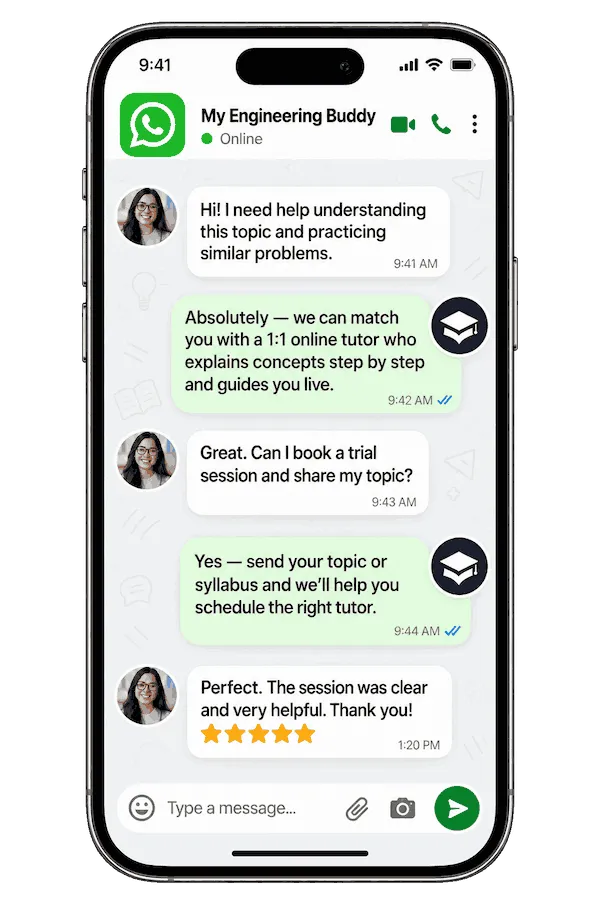
Unlike platforms where you fill out a form and wait, MEB responds in under a minute, 24/7. Tutor match takes under an hour. The $1 trial means you test before you commit. Everything runs over WhatsApp — no logins, no intake forms.
Study Plans (Pick One That Matches Your Goal)
After the diagnostic session, the tutor builds a session sequence matched to your timeline. Catch-up plans (1–3 weeks) target students with a specific gap — pumping lemma, Turing machine constructions, CYK — before an imminent exam or resubmission. Exam prep plans (4–8 weeks) work through the full formal hierarchy in order of exam weighting. Weekly support runs alongside your semester, timed to coursework and assignment deadlines. The tutor sets the exact sequence after session one — no generic plan applied before knowing where you stand.
Pricing Guide
Formal languages tutoring runs $20–$40/hr for most undergraduate levels. Graduate-level sessions or research-focused support with senior tutors reach up to $100/hr. Rate depends on the depth of topic, your timeline, and tutor availability at your preferred hours.
For students targeting top CS programmes at institutions like MIT, Stanford, ETH Zürich, or the University of Waterloo, tutors with research backgrounds in formal language theory and complexity are available — share your specific goal and MEB matches the right tier.
Availability tightens sharply in the four weeks before finals. Book your first session early. Start with the $1 trial — 30 minutes, no registration, no commitment. WhatsApp MEB for a quick quote.
MEB has served 52,000+ students since 2008 across 2,800+ subjects, with tutors active across every major time zone. Sessions are live, not pre-recorded, and every tutor is vetted before their first student assignment.
Source: My Engineering Buddy, 2008–2025.
FAQ
Is formal languages hard?
It is mathematically demanding in a specific way — proofs require precision that most CS courses do not prepare students for. Students who are strong coders often struggle with the abstract reasoning. Those gaps are fixable with the right guided practice on proof construction.
How many sessions are needed?
Students with one or two unclear topics typically need 3–5 sessions. Students working through the full course from DFAs to Turing machines typically need 12–20 hours. The tutor scopes this after the first diagnostic session.
Can you help with homework and assignments?
MEB tutoring is guided learning — you understand the work, then submit it yourself. The tutor explains the method, works a comparable example, and checks your reasoning. See our Academic Integrity policy and Why MEB page for full details on what we help with and what we don’t.
Will the tutor match my exact syllabus or exam board?
Yes. MEB tutors are matched to your specific course — whether that is a US university Theory of Computation module, a UK undergraduate Formal Languages course, or a graduate-level complexity seminar. Send your syllabus before the first session.
What happens in the first session?
The tutor reviews one problem you struggled with, identifies where the reasoning broke down, and uses that to map the rest of your session plan. It functions as both a diagnostic and a working session — no time wasted on general review.
Is online tutoring as effective as in-person?
For formal languages, yes. The subject is pen-and-paper proof work that translates directly to a shared digital whiteboard. The tutor’s digital pen-pad replicates the experience of working at a physical board, and Google Meet handles the rest.
What is the difference between formal languages and automata theory?
Automata theory is one component of a broader formal languages course. Formal languages also covers grammars, the Chomsky hierarchy, decidability, and Turing machines. Some universities teach them as a single course; others split them. MEB covers both as part of the same subject area, and the same tutor can handle automata theory tutoring and the full formal languages syllabus.
Do I need to know discrete mathematics before starting?
A basic grounding in sets, relations, and proof by induction is expected. If those foundations are shaky, MEB tutors address them in the first two sessions before moving into automata. You do not need a separate course — it is handled within the formal languages tutoring plan.
Can I get help at midnight or on weekends?
Yes. MEB tutors operate across multiple time zones, and WhatsApp availability runs 24/7. Students in the Gulf studying on US university schedules regularly book late-night sessions. Response time is typically under one minute regardless of hour.
What if I don’t like my assigned tutor?
WhatsApp MEB and a replacement is arranged — usually within the same day. The $1 trial exists precisely so you test the match before committing to a full schedule. No contract, no penalty for switching.
How do I get started?
Start with the $1 trial — 30 minutes of live tutoring or one homework question explained in full. WhatsApp MEB, get matched within the hour, and begin your first session. Three steps, no forms, no waiting.
Trust & Quality at My Engineering Buddy
Every MEB tutor goes through subject-specific vetting — a live demo session evaluated by MEB before they are assigned any student. Tutors hold postgraduate degrees in computer science, mathematics, or directly related disciplines. Ongoing student feedback is reviewed after every session block, and tutors are reassigned or removed based on outcomes. Rated 4.8/5 across 40,000+ verified reviews on Google. MEB has been running since 2008 — 18 years of subject-level tutor quality control, not a marketplace where anyone with a degree can list themselves.
MEB tutoring is guided learning — you understand the work, then submit it yourself. For full details on what we help with and what we don’t, read our Academic Integrity policy and Why MEB.
MEB serves students across the US, UK, Canada, Australia, the Gulf, and Europe in 2,800+ subjects. Within Computer Science, MEB covers Data Structures and Algorithms tutoring, Operating Systems tutoring, and Distributed Systems tutoring alongside Formal Languages — the same tutor pool, the same vetting standard. See our tutoring methodology for how sessions are structured.
Our experience across thousands of sessions shows that students who send a syllabus and one attempted problem before their first formal languages session make measurably faster progress than those who arrive without context. The tutor can diagnose in minutes, not half a session.
Explore Related Subjects
Students studying Formal Languages often also need support in:
- Algorithms
- Big-O Notation
- Design and Analysis of Algorithms
- Graph Algorithms
- Recursion
- Digital Logic Design
- Concurrent Programming
Next Steps
When you WhatsApp MEB, share your exam board or course outline, the topic or proof type giving you the most trouble, and your exam or assignment date. Include your time zone and preferred session hours.
MEB matches you with a verified formal languages tutor — usually within a few hours, sometimes within the hour.
- Have your course syllabus or module outline ready
- Bring one recent homework problem or past exam question you could not complete
- Note your exam or coursework deadline — the tutor uses this to sequence the session plan
The first session starts with a diagnostic. Every minute is used on what you actually need, not a generic introduction to the subject.
Visit www.myengineeringbuddy.com for more on how MEB works.
WhatsApp to get started or email [email protected].
Reviewed by Subject Expert
This page has been carefully reviewed and validated by our subject expert to ensure accuracy and relevance.




