




~1 min
Average Reply Time
~1 hour
To Be Matched With A Tutor
30 Min Trial
75% Find Their Tutor On The 1st Trial
$20-35+/hr
Premium Yet Affordable Learning
Pattern matching failing at 2 a.m. — your assignment due in six hours and your regex still returns nothing.
Regex Tutor Online
Regular expressions (Regex) are sequences of characters defining search patterns used for string matching, parsing, and text manipulation across programming languages including Python, JavaScript, Java, and Perl.
If you’ve searched for a Regex tutor near me, MEB offers something better — a computer science specialist available online, matched to your exact course and stack, often within the hour. Whether you’re stuck on lookaheads, struggling with greedy vs lazy quantifiers, or need help applying Regex in a real project, a 1:1 online Regex tutor works through your actual code, live on screen. No recorded lectures. No waiting three days for a forum reply.
- 1:1 online sessions tailored to your course syllabus or project stack
- Expert-vetted tutors with subject-specific knowledge in pattern matching and formal language theory
- Flexible time zones — US, UK, Canada, Australia, Gulf covered
- Structured learning plan built after a diagnostic session
- Ethical homework and assignment guidance — you understand the work, then submit it yourself
52,000+ students across the US, UK, Canada, Australia, and the Gulf have used MEB since 2008 — including students in Computer Science subjects like Regex, Formal Languages, and Automata Theory.
Source: My Engineering Buddy, 2008–2025.
How Much Does a Regex Tutor Cost?
Most Regex tutoring sessions run $20–$40/hr. Graduate-level work or highly specialised engine-specific tutoring can reach $100/hr. Not sure if it’s worth it? Start with the $1 trial — 30 minutes of live 1:1 tutoring or a full explanation of one homework question, no registration required.
| Level / Need | Typical Rate | What’s Included |
|---|---|---|
| Standard (undergrad / bootcamp) | $20–$35/hr | 1:1 sessions, homework guidance |
| Advanced / Specialist (grad, NLP, compiler) | $35–$100/hr | Expert tutor, engine-specific depth |
| $1 Trial | $1 flat | 30 min live session or 1 homework question |
Tutor availability tightens in the weeks before end-of-semester project deadlines and final exams. Book early if your deadline is within three weeks.
WhatsApp MEB for a quick quote — average response time under 1 minute.
Who This Regex Tutoring Is For
Regex looks deceptively simple on a slide deck. It breaks hard when you apply it to real data — messy strings, edge cases, Unicode, engine-specific quirks. This is exactly where a 1:1 Regex tutor earns their fee.
- Undergrad CS students whose assignment uses Regex for parsing or validation and nothing is matching
- Bootcamp students who’ve been told “just Google the pattern” — and still can’t make it work
- Graduate students applying Regex in NLP pipelines, log analysis, or compiler front-ends
- Developers preparing for technical interviews where Regex pattern design is tested under time pressure
- Students retaking after a failed first attempt on a CS module where string processing carries significant marks
- Parents watching a child’s confidence drop as their programming course accelerates and Regex becomes a recurring blocker
MEB tutors work with students at MIT, Carnegie Mellon, Georgia Tech, University of Toronto, Imperial College London, ETH Zürich, University of Melbourne, and AUB — among many others. If your course covers Regex, we cover your course.
At MEB, we’ve found that Regex is one of the most misunderstood topics in any CS curriculum — not because it’s theoretically hard, but because students are expected to read a cheat sheet and immediately apply it. That’s not how pattern-matching intuition develops. It takes a few dozen worked examples, live, with someone who can explain why the engine backtracks the way it does.
1:1 Tutoring vs Self-Study vs AI vs YouTube vs Online Courses
Self-study works if you have the time and a well-structured resource — but Regex has almost no feedback loop when you’re stuck. AI tools like ChatGPT will generate a pattern fast, but can’t watch you reason through an edge case and correct where your mental model breaks down. YouTube is good for syntax overviews; it stops being useful the moment you hit a real parsing problem specific to your data. Online courses move at a fixed pace and won’t slow down for the one concept — say, non-capturing groups or possessive quantifiers — that keeps tripping you up. A 1:1 Regex tutor from MEB sees exactly where you lose the thread and fixes it in the session, not two days later.
Outcomes: What You’ll Be Able To Do in Regex
After working with an online Regex tutor, you won’t just copy patterns from Stack Overflow — you’ll write them from scratch. Solve real validation problems: email addresses, phone numbers with international prefixes, custom date formats. Analyze log files using named capture groups and multi-line flags without losing track of what each group captures. Write Regex-powered parsers in Python’s re module or JavaScript’s RegExp that handle edge cases cleanly. Explain to an interviewer, in real time, why you chose a greedy over a lazy quantifier for a given input. Apply lookahead and lookbehind assertions in NLP preprocessing tasks without triggering catastrophic backtracking.
Based on feedback from 40,000+ sessions collected by MEB from 2022 to 2025, 58% of students improved by one full grade after approximately 20 hours of 1:1 tutoring in subjects like Regex. A further 23% achieved at least a half-grade improvement.
Source: MEB session feedback data, 2022–2025.
Try your first session for $1 — 30 minutes of live 1:1 tutoring or one homework question explained in full. No registration. No commitment.
WhatsApp MEB now
and get matched within the hour.
What We Cover in Regex (Syllabus / Topics)

Track 1: Core Syntax and Pattern Building
- Literals, metacharacters, and escape sequences
- Character classes:
[a-z],[^0-9], shorthandd,w,s - Anchors:
^,$,b,B - Quantifiers:
*,+,?,{n,m}— greedy vs lazy - Alternation and grouping:
|,(), non-capturing groups(?:) - Flags and modifiers: case-insensitive, multiline, dotall, global
- Real-world validation patterns: emails, URLs, postcodes, phone numbers
Recommended texts: Mastering Regular Expressions by Jeffrey Friedl (O’Reilly); Regular Expressions Cookbook by Goyvaerts & Levithan.
Track 2: Advanced Matching and Engine Mechanics
- Lookahead and lookbehind assertions:
(?=),(?!),(?<=),(?<!) - Named capture groups:
(?P<name>)in Python,(?<name>)in JavaScript - Backreferences:
1,k<name> - Atomic groups and possessive quantifiers (where engine supports)
- Catastrophic backtracking — causes, detection, fixes
- PCRE vs POSIX vs RE2 engine differences and when they matter
- Unicode support:
p{L},p{Script=Latin}, UTF-8 considerations
Recommended texts: Mastering Regular Expressions by Friedl; IEEE Xplore for peer-reviewed string processing and pattern-matching research.
Track 3: Applied Regex in Programming and NLP
- Python
remodule:search(),match(),findall(),sub(),compile() - JavaScript
RegExpobject: constructor vs literal, exec vs test vs match - Regex in shell scripting:
grep,sed,awkwith extended and basic syntax - Log file parsing: extracting structured data from unstructured text at scale
- Regex as a preprocessing step in parsing and tokenisation pipelines
- String operations in SQL:
REGEXP,SIMILAR TO, pattern-matching in queries - Integration with compiler design: lexical analysis, tokeniser rules, DFA construction from Regex
Recommended texts: Python Cookbook by Beazley & Jones (O’Reilly); language-specific documentation for re (Python), RegExp (MDN Web Docs).
What a Typical Regex Session Looks Like
The tutor opens by reviewing the last topic — say, whether possessive quantifiers clicked or if backtracking behaviour still felt unpredictable. Then you share your screen or paste your current pattern into a shared editor. The tutor traces through the matching engine’s logic step by step using a digital pen-pad, annotating exactly where your pattern fails and why — whether it’s a missing anchor causing a partial match or a greedy quantifier consuming more than intended. You rewrite the pattern yourself while the tutor watches, explaining your reasoning aloud. Common sticking points — lookaheads on variable-length strings, Unicode flag behaviour, named group extraction in Python — get worked through on real examples from your assignment or project data. The session closes with a specific pattern to build before next time and a note on which engine or language feature to tackle next.
How MEB Tutors Help You with Regex (The Learning Loop)
Diagnose: In the first session, the tutor identifies precisely where your Regex understanding breaks — syntax gaps, wrong mental model of how the engine reads a pattern, or confusion between PCRE and POSIX behaviour. This shapes everything that follows.
Explain: The tutor works through live examples on a digital pen-pad — building a pattern character by character, showing what each component matches against a real input string. No slides. No pre-made examples that don’t match your actual code.
Practice: You write the next pattern yourself, with the tutor present. Not watching a solution being produced — writing it, character by character, explaining your choices.
Feedback: Every mismatch gets traced back to its root. If a pattern fails on a specific input, the tutor explains exactly why the engine read it that way — not just what to change, but the underlying rule you need to internalise.
Plan: At the end of each session, the tutor maps the next topic — maybe moving from basic quantifiers to lookaheads, or from Python’s re module to shell-based string operations — and sets a practice task with a clear success condition.
Sessions run on Google Meet. The tutor uses a digital pen-pad or iPad with Apple Pencil for live annotation. Before your first session, share your course syllabus or project brief, a pattern you’ve tried that isn’t working, and your deadline. The first session starts with a 10-minute diagnostic, then moves straight into the problem. Start with the $1 trial — 30 minutes of live tutoring that also serves as your first diagnostic.
Students consistently tell us that Regex clicked only when someone traced the engine’s matching path alongside their actual pattern — not a textbook example, but the exact string they were trying to process. That 20-minute moment is what separates confusion from confidence.
Tutor Match Criteria (How We Pick Your Tutor)
Not every CS tutor knows Regex well enough to explain PCRE backtracking behaviour or Unicode property escapes. Here’s how MEB matches:
Subject depth: Tutors are vetted on the specific Regex track you need — core syntax for an intro course, advanced engine mechanics for a compilers module, or applied NLP Regex for a data science pipeline. Relevant work in theory of computation or formal language theory is verified separately.
Tools: Every tutor uses Google Meet with a digital pen-pad or iPad and Apple Pencil. Pattern annotation in a live shared editor is standard.
Time zone: Matched to your region — US, UK, Canada, Australia, Gulf. No 3 a.m. sessions unless you want them.
Goals: Whether you need to pass one assignment, build interview-ready pattern design skills, or integrate Regex into a production system, the tutor match reflects that goal.
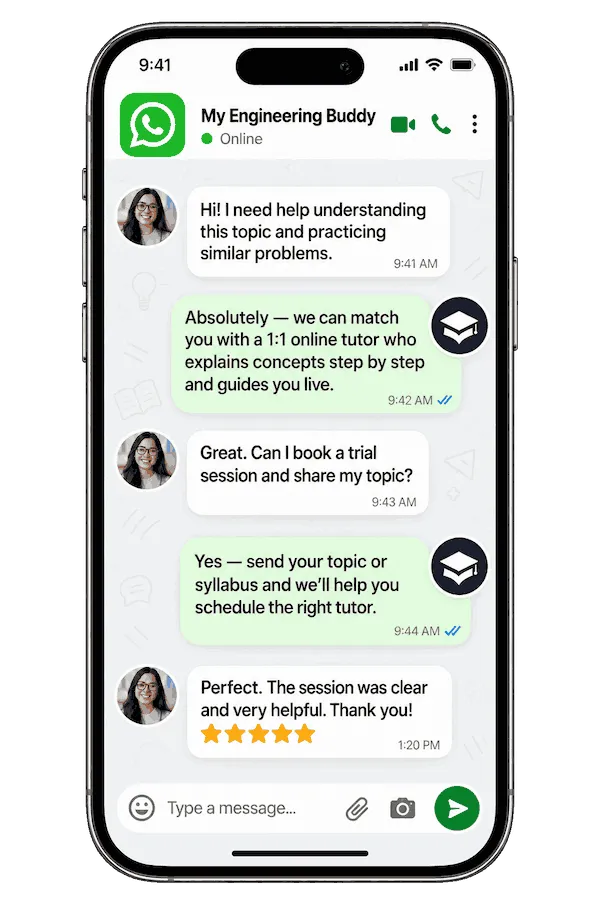
Unlike platforms where you fill out a form and wait, MEB responds in under a minute, 24/7. Tutor match takes under an hour. The $1 trial means you test before you commit. Everything runs over WhatsApp — no logins, no intake forms.
Study Plans (Pick One That Matches Your Goal)
After the diagnostic, your tutor builds a session sequence based on your timeline. Catch-up (1–3 weeks): close specific gaps before a project deadline or end-of-module test — fast, targeted, no detours. Exam prep (4–8 weeks): structured progression through core syntax, advanced matching, and applied use cases, with regular review sessions. Weekly support: ongoing sessions aligned to your semester schedule, covering each Regex topic as your course introduces it. The tutor builds the sequence — you show up ready to work.
Pricing Guide
Regex tutoring runs $20–$40/hr for most undergraduate and bootcamp levels. Graduate-level work — NLP pipelines, compiler lexer construction, formal language proofs involving regular expressions — can reach $100/hr depending on tutor specialisation.
Rate factors include: course level, engine or language specificity, your timeline, and tutor availability. Rates are confirmed before the first paid session — no surprises.
For students targeting roles at top tech companies where Regex pattern design appears in live coding interviews, MEB can match you with tutors who have professional software engineering or NLP research backgrounds. Share your specific goal and MEB will match the tier to your ambition.
Spots fill fast in the two weeks before semester finals and project submission deadlines. Start with the $1 trial — 30 minutes, no registration, no commitment. WhatsApp MEB for a quick quote.
MEB has served 52,000+ students since 2008, including undergraduate and graduate CS students who needed 1:1 support with data structures and algorithms, algorithms, and Regex — often under tight deadlines.
Source: My Engineering Buddy, 2008–2025.
FAQ
Is Regex hard?
The syntax is learnable in a few hours. The difficulty is understanding how the matching engine reads your pattern — greedy vs lazy behaviour, backtracking, and engine differences across languages. A 1:1 tutor walks through that engine logic live, which accelerates understanding significantly.
How many sessions are needed?
Most students working on a specific assignment or project gap need 2–4 sessions. Building solid Regex fluency across Python, JavaScript, and shell scripting from scratch typically takes 8–12 hours. Your tutor estimates this after the first diagnostic session.
Can you help with Regex homework and assignments?
Yes. MEB tutoring is guided learning — you understand the work, then submit it yourself. The tutor explains the pattern-matching logic, works through examples with you, and helps you write your own solution. See our Academic Integrity policy and Why MEB page for full details on what we help with and what we don’t.
Will the tutor match my exact syllabus or exam board?
Yes. Share your course outline, the specific programming language your assignment uses, and the Regex topics covered so far. The tutor is matched to that exact scope — not a generic CS curriculum.
What happens in the first session?
The tutor runs a 10-minute diagnostic: which Regex constructs you’ve used, where you’re getting wrong results, and what your end goal is. The rest of the session addresses your most urgent problem. You leave with something working and a plan for what’s next.
Is online Regex tutoring as effective as in-person?
For Regex specifically, online is often better. Patterns are written in text editors or REPLs — screen-sharing is natural. The tutor annotates directly on your code using a pen-pad. There’s no whiteboard advantage that in-person provides for a subject that lives entirely on a screen.
What’s the difference between PCRE, POSIX, and RE2 — and does my tutor know which one matters for my course?
Yes, and it matters more than most students realise. Python’s re module uses PCRE-like syntax, RE2 is used in Go and some Google tools, and POSIX governs grep and shell behaviour. Your tutor identifies which engine applies to your stack in the first session and teaches accordingly.
My Regex pattern works in an online tester but fails in my code — why?
Engine differences, flag settings, or how the language’s Regex API processes input often explain this. A live tutor can trace the mismatch against your actual code and data in minutes — no forum guessing required.
Can I get Regex help at midnight?
Yes. MEB operates 24/7. WhatsApp MEB at any hour — average response time is under a minute. If your assignment deadline is tomorrow morning, that’s exactly what the $1 trial is designed for.
How do I find a Regex tutor in my city?
You don’t need one locally. MEB matches you with an online Regex tutor within the hour, regardless of whether you’re in New York, London, Dubai, Sydney, or Toronto. Everything runs on Google Meet — location is irrelevant.
Do you offer group Regex sessions?
MEB specialises in 1:1 tutoring. Group sessions are not offered. The reason is straightforward: Regex errors are specific to each student’s pattern and mental model. A shared session cannot address that individually.
How do I get started?
WhatsApp MEB, share your course or project, and you’ll be matched with a tutor — usually within the hour. The first session is the $1 trial: 30 minutes of live tutoring or one homework question explained in full. Three steps: WhatsApp → matched → start trial.
Trust & Quality at My Engineering Buddy
Every MEB tutor goes through subject-specific screening: a live demo session, review of their academic and professional background, and ongoing student feedback monitoring. Regex tutors are assessed on core syntax, engine mechanics, and applied use in at least one major language. Rated 4.8/5 across 40,000+ verified reviews on Google. MEB has operated since 2008 — 18 years of refining how tutors are matched, vetted, and retained.
MEB tutoring is guided learning — you understand the work, then submit it yourself. For full details on what we help with and what we don’t, read our Academic Integrity policy and Why MEB.
MEB serves students across the US, UK, Canada, Australia, the Gulf, and Europe in 2,800+ subjects. Computer Science is one of the largest subject areas on the platform — covering everything from Regex and object-oriented programming through to operating systems and distributed systems. Tutoring methodology details are available at our tutoring methodology page.
A common pattern our tutors observe is that students who struggle with Regex have actually understood the individual components — they just haven’t seen how the engine evaluates the whole pattern as a sequence of decisions. One session tracing that evaluation path usually changes everything.
MEB tutors cover the full Computer Science stack — from Regex and recursion through concurrent programming and cryptography — with 1:1 sessions available across every time zone MEB serves.
Source: My Engineering Buddy, 2008–2025.
Explore Related Subjects
Students studying Regex often also need support in:
- Big-O Notation
- Binary Search
- Design Patterns
- Database Management Systems
- Graph Algorithms
- Fuzzy Logic
- Knowledge Representation
Next Steps
Getting started is straightforward:
- Share your exam board or course outline, the specific Regex topics causing problems, and your deadline
- Share your availability and time zone
- MEB matches you with a verified tutor — usually within the hour
Before your first session, have ready: your course syllabus or project brief, a pattern you’ve tried that isn’t working (with the input you’re testing against), and your submission or exam date. The tutor handles the rest.
Visit www.myengineeringbuddy.com for more on how MEB works.
WhatsApp to get started or email [email protected].
Reviewed by Subject Expert
This page has been carefully reviewed and validated by our subject expert to ensure accuracy and relevance.




