~1 min
Average Reply Time
~1 hour
To Be Matched With A Tutor
30 Min Trial
75% Find Their Tutor On The 1st Trial
$20-35+/hr
Premium Yet Affordable Learning
Most students who struggle with Spintronics hit the same wall: they understand quantum mechanics in isolation, but freeze when spin transport, magnetoresistance, and device physics collide in a single problem.
Spintronics Tutor Online
Spintronics is an advanced branch of condensed matter physics studying how electron spin — alongside charge — can store, process, and transmit information in magnetic and semiconductor devices, underpinning technologies like magnetic tunnel junctions and spin-orbit torque systems.
MEB connects you with a verified Spintronics tutor online who has worked through exactly these problems — spin Hall effect, GMR/TMR device modelling, Landau–Lifshitz–Gilbert dynamics, and the quantum mechanics underneath all of it. If you’ve been searching for a Spintronics tutor near me, online 1:1 sessions remove the geography problem entirely. Part of MEB’s wider Physics tutoring programme, Spintronics support is available across US, UK, Canada, Australia, and Gulf time zones. One outcome students report consistently: they stop guessing which formalism to use and start applying the right one.
- 1:1 online sessions tailored to your course syllabus and research context
- Expert-verified tutors with graduate-level Spintronics knowledge
- Flexible scheduling across US, UK, Canada, Australia, and Gulf time zones
- Structured learning plan built after a diagnostic session
- Ethical academic guidance — you understand the work, then submit it yourself
52,000+ students across the US, UK, Canada, Australia, and the Gulf have used MEB since 2008 — including students in Physics subjects like Spintronics, condensed matter physics, and quantum mechanics.
Source: My Engineering Buddy, 2008–2025.
How Much Does a Spintronics Tutor Cost?
Most Spintronics sessions run $35–$70/hr, reflecting the graduate-level depth of the subject. Introductory-level coverage starts closer to $20–$35/hr. The $1 trial gets you 30 minutes of live 1:1 tutoring — or a full explanation of one problem — before you commit to anything.
| Level / Need | Typical Rate | What’s Included |
|---|---|---|
| Advanced Undergraduate | $35–$55/hr | 1:1 sessions, homework guidance, problem sets |
| Masters / PhD Research | $55–$100/hr | Expert tutor, research-level depth, thesis support |
| $1 Trial | $1 flat | 30 min live session or one full homework explanation |
Tutor availability tightens around thesis submission windows and semester finals. Book early if your deadline is within four weeks.
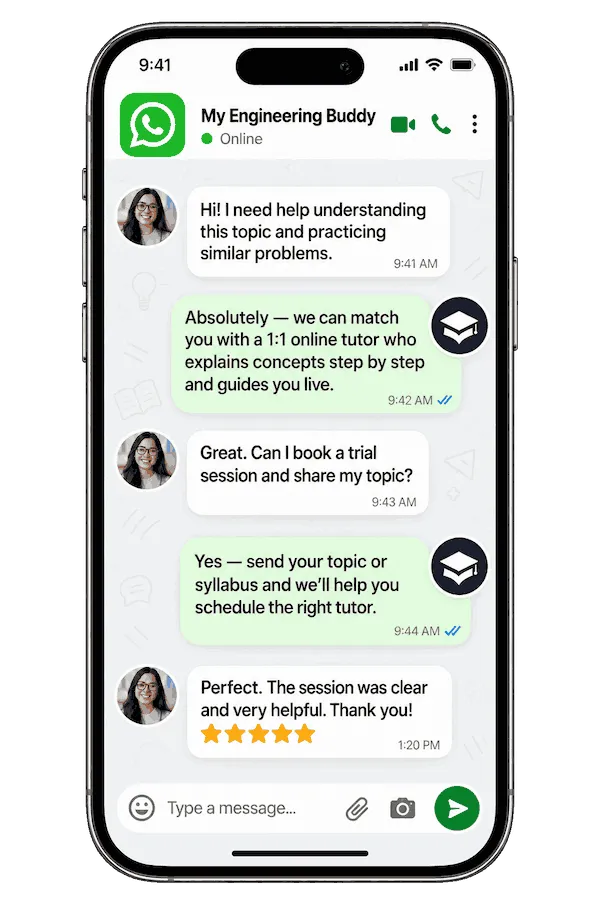
WhatsApp MEB for a quick quote — average response time under 1 minute.
Who This Spintronics Tutoring Is For
Spintronics sits at the intersection of quantum mechanics, solid-state physics, and materials science. Most students arrive having done well in quantum mechanics but finding that spin transport adds a layer of physical intuition that lectures alone don’t build.
- Advanced undergraduates tackling spin Hall effect, GMR, or TMR for the first time
- Masters students whose Spintronics module marks are pulling down their overall grade
- PhD researchers needing to discuss LLG equation modelling or spin-orbit coupling in their own project context
- Students retaking after a failed first attempt and needing a tutor who can diagnose exactly where the reasoning broke down
- Students with a thesis or dissertation chapter deadline approaching and gaps still to close
- Parents supporting a child through an advanced physics degree who want structured, trackable progress
Universities where MEB has supported Spintronics students include MIT, Caltech, ETH Zürich, Imperial College London, TU Delft, University of Toronto, and KAUST. The subject appears in physics, electrical engineering, and materials science programmes — the tutor matches your specific course structure.
1:1 Tutoring vs Self-Study vs AI vs YouTube vs Online Courses
Self-study works if you’re disciplined, but Spintronics has too many interlocking formalisms to self-correct reliably. AI tools give fast definitions but can’t spot where your Hamiltonian setup went wrong. YouTube handles overviews of GMR well — it stops when you’re stuck deriving the spin diffusion equation. Online courses run at a fixed pace that rarely matches your exam timeline. 1:1 tutoring with MEB is live, calibrated to your exact syllabus and research context, and corrects errors in the moment — before they compound into the next topic.
Outcomes: What You’ll Be Able To Do in Spintronics
After structured 1:1 sessions, students can solve spin transport problems using the Valet–Fert model, analyse magnetoresistance ratios in GMR and TMR multilayer stacks, model spin precession and damping using the Landau–Lifshitz–Gilbert equation, explain spin-orbit coupling mechanisms including Rashba and Dresselhaus terms, and apply non-equilibrium Green’s function methods to simple spintronic device geometries. These are not abstract goals — they are the tasks that appear in coursework, thesis chapters, and qualifying exams.
Based on feedback from 40,000+ sessions collected by MEB from 2022 to 2025, 58% of students improved by one full grade after approximately 20 hours of 1:1 tutoring in subjects like Spintronics. A further 23% achieved at least a half-grade improvement.
Source: MEB session feedback data, 2022–2025.
At MEB, we’ve found that Spintronics students often know more than they think — the real gap is translating physical intuition about spin into clean mathematical formalism. That translation is where 1:1 time pays off fastest.
What We Cover in Spintronics (Syllabus / Topics)

Spin Transport and Magnetoresistance
- Giant magnetoresistance (GMR): parallel vs antiparallel configurations
- Tunnelling magnetoresistance (TMR) and magnetic tunnel junctions (MTJs)
- Spin diffusion equation and spin accumulation at interfaces
- Valet–Fert model for current-perpendicular-to-plane (CPP) geometry
- Spin-transfer torque (STT) and switching in nanomagnets
- Two-current model for spin-dependent transport
Key texts: Maekawa et al. Spin Transport in Magnetic Nanostructures; Žutić, Fabian & Das Sarma, Reviews of Modern Physics 76 (2004).
Spin-Orbit Effects and Topological Phenomena
- Spin Hall effect (SHE) and inverse spin Hall effect (ISHE)
- Rashba and Dresselhaus spin-orbit coupling in 2D electron systems
- Spin-orbit torque (SOT) mechanisms and device applications
- Anomalous Hall effect and its connection to Berry phase
- Topological insulators as spintronic material platforms
- Dzyaloshinskii–Moriya interaction and skyrmion physics
Key texts: Sinova et al., Reviews of Modern Physics 87 (2015); Hasan & Kane, Reviews of Modern Physics 82 (2010).
Magnetisation Dynamics and Device Physics
- Landau–Lifshitz–Gilbert (LLG) equation and damping mechanisms
- Ferromagnetic resonance (FMR) and spin-wave excitations (magnons)
- Spin-torque nano-oscillators (STNOs) and their frequency response
- MRAM cell architectures: from first-generation field-switched to STT-MRAM
- Read/write cycles, thermal stability factor, and retention time
- Racetrack memory concept and domain wall motion
Key texts: Stancil & Prabhakar, Spin Waves; Bhatti et al., Materials Today 20 (2017) for MRAM device review.
What a Typical Spintronics Session Looks Like
The tutor opens by checking where you left off — usually the spin diffusion equation derivation or a specific GMR stack problem that wasn’t fully resolved. You share your course notes or problem sheet on screen. The tutor works through the formalism live with a digital pen-pad, showing exactly how boundary conditions at ferromagnet/normal-metal interfaces are handled. You then attempt the next problem yourself while the tutor watches and intervenes only when your reasoning forks from the correct path. By the end of the session, you have a concrete practice task — typically two to three unseen problems on the same topic — and the next session topic is already noted so the tutor can prepare targeted material.
How MEB Tutors Help You with Spintronics (The Learning Loop)
Diagnose: In the first session, the tutor identifies whether the gap is in underlying quantum mechanics, the physical picture of spin, mathematical formalism, or problem-solving strategy. These are different problems requiring different fixes.
Explain: The tutor works through a fully solved example on screen — LLG damping, spin Hall angle calculation, TMR ratio derivation — using a digital pen-pad so you see every algebraic step and the physical reasoning behind it.
Practice: You attempt the next problem with the tutor present. Not after the session. Live, so hesitation is visible and correctable before it becomes a habit.
Feedback: Step-by-step error correction. The tutor marks exactly where the reasoning diverged — wrong sign in the torque term, missing interface resistance — and explains why that matters for the answer.
Plan: At the end of each session, the tutor sets the next topic, assigns two or three problems, and notes what to review before the next meeting. Progress is tracked explicitly, not assumed.
Sessions run on Google Meet. The tutor uses a digital pen-pad or iPad with Apple Pencil. Before your first session, share your course syllabus or reading list, a recent problem you attempted, and your deadline or exam date. The first session covers diagnosis and at least one fully worked core topic. Start with the $1 trial — 30 minutes of live tutoring that also serves as your first diagnostic.
Students consistently tell us that the moment things click in Spintronics is when they stop treating spin as an abstract label and start tracking it as a physical current with its own continuity equation. That reframe usually takes one good session.
Tutor Match Criteria (How We Pick Your Tutor)
Not every physics tutor is equipped for Spintronics. MEB matches based on four criteria.
Subject depth: Graduate-level background in condensed matter physics or solid-state physics, with demonstrated familiarity with spin transport, magnetic materials, or device physics at the research or advanced course level.
Tools: Proficiency with Google Meet and a digital pen-pad or iPad with Apple Pencil — required for deriving equations live on screen.
Time zone: Matched to your region — US, UK, Gulf, Canada, or Australia — so sessions don’t require either party to work unreasonable hours.
Goals: Exam performance, conceptual depth for research, thesis chapter support, or qualifying exam preparation — the tutor brief is set around your specific objective, not a generic syllabus.
Unlike platforms where you fill out a form and wait, MEB responds in under a minute, 24/7. Tutor match takes under an hour. The $1 trial means you test before you commit. Everything runs over WhatsApp — no logins, no intake forms.
A common pattern our tutors observe is that students who struggle most in Spintronics are working from lecture slides alone. The field moves fast enough that the key derivations — especially in SOT and skyrmionics — need a textbook-level treatment alongside the slides.
Study Plans (Pick One That Matches Your Goal)
For a catch-up plan (one to three weeks), the tutor targets the highest-weight topics first — typically spin transport and magnetoresistance — and works through them intensively. For exam preparation over four to eight weeks, sessions follow a structured sequence from foundations to device physics to past-problem practice. For ongoing weekly support aligned to your semester, the tutor tracks your module schedule and stays one topic ahead. The specific sequence is built after the diagnostic first session — not before it.
Pricing Guide
Spintronics is a specialist graduate-level subject. Rates reflect that: $35–$70/hr for advanced undergraduate and masters-level work, up to $100/hr for PhD research support and thesis-level depth. Rate factors include your level, the specific topics involved, your timeline, and tutor availability at your preferred hours.
For students targeting admission to or progress within top condensed matter and quantum materials programmes — MIT, Caltech, ETH Zürich, Imperial, TU Delft — tutors with active research backgrounds in spintronics and magnetic materials are available at higher rates. Share your specific goal and MEB will match the tier to your ambition.
Availability tightens during semester finals and thesis submission periods. Start with the $1 trial — 30 minutes, no registration, no commitment. WhatsApp MEB for a quick quote.
MEB has covered 2,800+ subjects since 2008 — from foundational solid-state physics tutoring to advanced research-level support in areas like Spintronics and quantum field theory. Depth across the full physics stack is what makes cross-topic diagnosis possible.
Source: My Engineering Buddy, 2008–2025.
FAQ
Is Spintronics hard?
Yes — it demands fluency in quantum mechanics, electromagnetism, and solid-state physics simultaneously. Most difficulty comes from combining those formalisms, not from any single concept being impenetrable. A good tutor isolates exactly which of the three is causing the block.
How many sessions are needed?
For a specific stuck topic — LLG dynamics, TMR derivation — two to four sessions often resolves it. For course-wide support across a full Spintronics module, most students book eight to twelve sessions spread over a semester.
Can you help with practice exercises?
MEB tutoring is guided learning — you understand the work, then submit it yourself. The tutor explains the method, works through a similar example, and checks your reasoning. See our Academic Integrity policy and Why MEB page for full details on what we help with and what we don’t.
Will the tutor match my exact syllabus or exam board?
Yes. Share your course outline, reading list, or past papers before the first session. The tutor maps content to your specific module structure — whether that’s a condensed matter physics elective, an electrical engineering Spintronics course, or a research group’s internal training syllabus.
What happens in the first session?
The tutor runs a short diagnostic: which topics have you covered, where does the reasoning break down, what’s the nearest deadline. Then at least one core topic is worked through fully. You leave with a clear picture of what’s missing and a concrete plan for the next session.
Is online tutoring as effective as in-person?
For a derivation-heavy subject like Spintronics, the digital pen-pad makes the online format genuinely equivalent. You see every step written live. Many students find it easier to pause, rewind, and share their own working on screen than in a physical setting.
Can I get Spintronics help at midnight or on weekends?
Yes. MEB operates across time zones 24/7. WhatsApp response time averages under a minute. Tutor availability at off-hours varies, but matching within a few hours is standard even for late-night or weekend requests.
What if I don’t like my assigned tutor?
Request a change over WhatsApp. MEB re-matches you — no forms, no delays. The $1 trial session exists partly for this reason: test the tutor fit before committing to a full block of sessions.
Do you offer group Spintronics sessions?
MEB’s model is 1:1 by design. Group sessions dilute the diagnostic precision that makes Spintronics tutoring effective — two students rarely have identical gaps. Study partners are welcome to book separately and share notes between sessions.
What is the difference between STT-MRAM and SOT-MRAM, and can tutors cover both?
Yes. Spin-transfer torque MRAM uses current through the tunnel junction to switch magnetisation; spin-orbit torque MRAM separates the read and write paths, reducing junction fatigue. MEB tutors cover both architectures, including their thermal stability trade-offs and write-error-rate implications relevant to graduate coursework and research.
My research involves topological insulators as spintronic platforms — can MEB tutors handle that?
Yes. Tutors with backgrounds in topological condensed matter — Berry phase, surface states, and their coupling to spin-orbit effects — are available. Share your specific research context over WhatsApp and MEB will confirm tutor fit before you book.
How do I get started?
WhatsApp MEB, describe your course or research context and your nearest deadline. MEB matches you with a verified Spintronics tutor — usually within the hour. Your first session is the $1 trial: 30 minutes live or one full problem explained.
Trust & Quality at My Engineering Buddy
Every MEB tutor goes through subject-specific screening: verified degree credentials, a live demonstration session evaluated against problem-solving and explanation standards, and ongoing review based on student feedback after each session. Tutors covering Spintronics hold graduate degrees in physics, electrical engineering, or materials science — with demonstrable coursework or research experience in spin transport and magnetic materials. Rated 4.8/5 across 40,000+ verified reviews on Google.
MEB tutoring is guided learning — you understand the work, then submit it yourself. For full details on what we help with and what we don’t, read our Academic Integrity policy and Why MEB.
MEB has served 52,000+ students across the US, UK, Canada, Australia, the Gulf, and Europe since 2008 — across 2,800+ subjects including Physics, Spintronics, and closely related fields. Students needing semiconductor physics help, superconductivity tutoring, or support with quantum optics frequently move between these subjects in the same degree programme — MEB covers all of them.
Explore Related Subjects
Students studying Spintronics often also need support in:
- Atomic Physics
- Laser Physics
- Plasma Physics
- Crystallography
- Statistical Mechanics
- Photonics
- Modern Physics
Next Steps
Before your first session, have ready: your course syllabus or reading list (or research group brief), a recent problem set or derivation you got stuck on, and your exam or thesis deadline date. The tutor handles the rest.
- Share your exam board or course outline and the specific topics giving you trouble
- Share your availability and time zone
- MEB matches you with a verified Spintronics tutor — usually within 24 hours
Visit www.myengineeringbuddy.com for more on how MEB works.
WhatsApp to get started or email [email protected].
Try your first session for $1 — 30 minutes of live 1:1 tutoring or one homework question explained in full. No registration. No commitment. WhatsApp MEB now and get matched within the hour.
Reviewed by Subject Expert
This page has been carefully reviewed and validated by our subject expert to ensure accuracy and relevance.