~1 min
Average Reply Time
~1 hour
To Be Matched With A Tutor
30 Min Trial
75% Find Their Tutor On The 1st Trial
$20-35+/hr
Premium Yet Affordable Learning
Most students who struggle with superconductivity hit the same wall: they can describe the Meissner effect but can’t derive the London equations or explain why Cooper pairs don’t scatter.
Superconductivity Tutor Online
Superconductivity is the quantum phenomenon in which certain materials conduct electricity with zero electrical resistance below a critical temperature, enabling lossless current flow and complete magnetic flux expulsion, studied at advanced undergraduate and graduate physics levels.
If you’re searching for a Superconductivity tutor near me, MEB matches you with a verified specialist — someone who knows BCS theory, Ginzburg-Landau formalism, and type-I versus type-II behaviour, not just the surface-level definitions. MEB offers 1:1 online physics tutoring across 2,800+ advanced subjects, with sessions built around your exact syllabus and timeline. You won’t memorise your way through this subject. You’ll understand it.
- 1:1 online sessions tailored to your course module and university syllabus
- Expert-verified tutors with graduate-level or research backgrounds in condensed matter and solid-state physics
- Flexible scheduling across US, UK, Canada, Australia, and Gulf time zones
- Structured learning plan built after a diagnostic session that identifies your exact gaps
- Ethical homework and assignment guidance — you understand the material, then submit your own work
52,000+ students across the US, UK, Canada, Australia, and the Gulf have used MEB since 2008 — including students in Physics subjects like Superconductivity, condensed matter physics, and solid-state physics.
Source: My Engineering Buddy, 2008–2025.
How Much Does a Superconductivity Tutor Cost?
Most Superconductivity tutoring sessions run $20–$40/hr at standard undergraduate level. Graduate-level and research-focused sessions — covering advanced BCS derivations, proximity effects, or Josephson junction physics — can reach $70–$100/hr depending on tutor specialisation. You can start with the $1 trial before committing to a rate.
| Level / Need | Typical Rate | What’s Included |
|---|---|---|
| Undergraduate (standard) | $20–$40/hr | 1:1 sessions, homework guidance, problem sets |
| Advanced / Graduate | $40–$100/hr | Research-depth tutor, BCS/GL theory, niche topics |
| $1 Trial | $1 flat | 30 min live session or one homework question explained |
Tutor availability in Superconductivity is limited — this is a specialist field. During peak exam periods, slots fill fast. Book early if you have a fixed deadline.
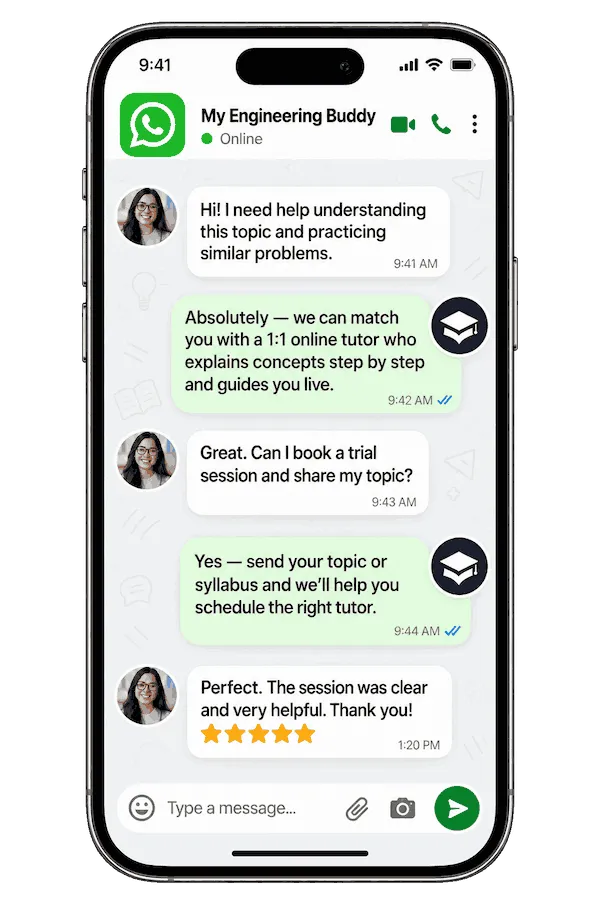
WhatsApp MEB for a quick quote — average response time under 1 minute.
Who This Superconductivity Tutoring Is For
Superconductivity sits at the intersection of quantum mechanics, statistical mechanics, and electrodynamics. It’s genuinely hard, and most students hit a wall somewhere between the phenomenological models and the microscopic theory. This tutoring is for students who need more than a lecture replay.
- Undergraduate physics or materials science students taking a condensed matter or solid-state module
- Graduate students preparing for qualifying exams that include superconductivity questions
- PhD students needing to consolidate foundational theory before advancing to research
- Students retaking a module after a failed first attempt — particularly those who lost marks on London equation derivations or order parameter problems
- Students with a university conditional offer depending on their final physics grade
- Parents supporting a student whose confidence has dropped alongside their marks in advanced physics
Students have come to MEB from programmes at MIT, Caltech, Imperial College London, ETH Zürich, the University of Toronto, TU Delft, and the Australian National University, among others.
At MEB, we’ve found that superconductivity is one of the few topics where students genuinely believe they understand the concept — until they sit down to derive anything. The Meissner effect makes sense in words. The maths of flux quantisation is where things fall apart. That gap is exactly what a tutor addresses.
1:1 Tutoring vs Self-Study vs AI vs YouTube vs Online Courses
Self-study works if you’re disciplined, but superconductivity has almost no feedback loop — you won’t know your London equation derivation is wrong until you lose marks. AI tools give fast definitions but can’t spot the specific step where your Ginzburg-Landau energy functional breaks down. YouTube covers the Meissner effect well and stops there. Online courses move at a fixed pace with no adjustment for your actual gaps. With 1:1 MEB tutoring, a specialist works through your exact problem set in real time, corrects the reasoning error on the spot, and moves at the pace your understanding demands — not the course schedule’s.
Outcomes: What You’ll Be Able To Do in Superconductivity
After targeted sessions, you’ll be able to derive and apply the London equations to real boundary-value problems, not just quote them. You’ll analyze type-I and type-II superconductors using the correct thermodynamic framework. You’ll explain the Cooper pair mechanism and BCS gap equation without reverting to hand-waving. You’ll model the behaviour of a Josephson junction and solve problems involving flux quantisation. You’ll present the Ginzburg-Landau order parameter formalism clearly enough to answer graduate-exam questions under time pressure.
Based on feedback from 40,000+ sessions collected by MEB from 2022 to 2025, 58% of students improved by one full grade after approximately 20 hours of 1:1 tutoring in subjects like Superconductivity. A further 23% achieved at least a half-grade improvement.
Source: MEB session feedback data, 2022–2025.
These aren’t guaranteed results. Progress depends on starting level, session frequency, and how much independent practice you put in between sessions. But the pattern is consistent.
Try your first session for $1 — 30 minutes of live 1:1 tutoring or one homework question explained in full. No registration. No commitment. WhatsApp MEB now and get matched within the hour.
What We Cover in Superconductivity (Syllabus / Topics)

Track 1: Phenomenological Theory and Experimental Foundations
- Zero resistance and the discovery of superconductivity — historical and experimental context
- Meissner-Ochsenfeld effect and perfect diamagnetism
- Critical temperature, critical field, and the phase diagram
- London equations — derivation, penetration depth, and magnetic field decay
- Type-I vs type-II superconductors — thermodynamic distinction and experimental signatures
- Vortex state, mixed phase, and Abrikosov lattice in type-II materials
- Flux quantisation and the fluxoid
Core texts for this track include Tinkham’s Introduction to Superconductivity (2nd ed.) and de Gennes’ Superconductivity of Metals and Alloys.
Track 2: Microscopic Theory — BCS and Beyond
- Phonon-mediated electron-electron attraction and Cooper pair formation
- BCS ground state wavefunction and coherence length
- The BCS gap equation — derivation and physical interpretation
- Quasiparticle excitations and the density of states near the gap
- Isotope effect as experimental evidence for phonon coupling
- Weak-coupling and strong-coupling regimes
- Introduction to high-temperature superconductors — cuprates and iron-based systems
Key references: Schrieffer’s Theory of Superconductivity and relevant chapters in Kittel’s Introduction to Solid State Physics.
Track 3: Ginzburg-Landau Theory and Josephson Effects
- Ginzburg-Landau free energy functional and the order parameter
- GL equations — first and second — and their boundary conditions
- Coherence length and penetration depth from GL theory
- GL parameter κ and the type-I/type-II boundary
- DC and AC Josephson effects — physics and equations
- SQUID operation and flux sensitivity
- Applications: MRI magnets, maglev, quantum computing qubits
Recommended: Annett’s Superconductivity, Superfluidity and Condensates and selected chapters from Zagoskin’s Quantum Theory of Many-Body Systems.
What a Typical Superconductivity Session Looks Like
The tutor opens by checking the previous topic — usually whatever London equation or GL boundary condition problem was set as practice. If there’s an error in the student’s written work, it gets identified at the line level, not waved away. The core of the session is a worked problem: the student and tutor go through it together on screen, the tutor using a digital pen-pad to write out the derivation step by step. Then the student replicates it — or explains the reasoning back — so the tutor can confirm whether it’s been understood or just copied. The session closes with a specific practice problem to attempt before the next meeting and a note of which topic comes next: often coherence length calculations, flux quantisation proofs, or quasiparticle density of states problems.
How MEB Tutors Help You with Superconductivity (The Learning Loop)
Diagnose: In the first session, the tutor runs a short diagnostic — asking you to explain the Meissner effect, attempt a London equation problem, or walk through a type-I vs type-II distinction. This takes 10–15 minutes and tells the tutor exactly where the conceptual gaps are, not where you think they are.
Explain: The tutor works through the topic live — BCS gap derivation, GL energy minimisation, Josephson junction physics — using a digital pen-pad. Every step is shown. Nothing is skipped. You ask questions mid-derivation, not at the end.
Practice: You attempt the next problem while the tutor watches. This is not homework — it happens in the session, while feedback is still possible.
Feedback: The tutor identifies the exact line where the reasoning breaks down. Not “check your algebra” — the actual error, why it happens, and what the correct physical reasoning is. This is where most grade improvement comes from.
Plan: Before the session ends, the tutor maps the next topic, sets one focused practice problem, and notes what needs to be reviewed at the start of the next session. No session ends without a clear next step.
Sessions run over Google Meet. The tutor uses a digital pen-pad or iPad with Apple Pencil — superconductivity involves a lot of real-time derivation, and typed notes don’t work for this subject. Before your first session, have your course syllabus or module outline ready, along with any past exam questions or problem sets you’ve already attempted. The first session is always a diagnostic, so every minute after that is used efficiently. Start with the $1 trial — 30 minutes of live tutoring that also serves as your first diagnostic.
Students consistently tell us that the moment a superconductivity topic clicks isn’t in the reading — it’s when they try to write the derivation themselves and a tutor stops them at the third line. That correction, in real time, is worth more than an hour of re-reading notes.
Tutor Match Criteria (How We Pick Your Tutor)
Not every physics tutor can teach superconductivity. MEB matches on specifics.
Subject depth: tutors are matched to your exact level — third-year undergraduate condensed matter, MSc solid-state physics, or PhD qualifying exam preparation. General physics tutors are not assigned to superconductivity without verified depth in the topic.
Tools: every tutor uses Google Meet and a digital pen-pad or iPad with Apple Pencil — essential for live derivation work in this subject.
Time zone: matched to your region — US, UK, Gulf, Canada, or Australia — so sessions run at hours that don’t destroy your sleep schedule.
Goals: whether you need to pass an exam, close a gap before a qualifier, or get to grips with high-temperature superconductor theory for research, the tutor’s background is matched to that specific target.
Unlike platforms where you fill out a form and wait days, MEB responds in under a minute, 24/7. Tutor matching takes under an hour. The $1 trial means you test the match before committing to a rate. Everything runs over WhatsApp — no logins, no intake forms, no onboarding sequences.
Study Plans (Pick One That Matches Your Goal)
After the diagnostic, your tutor builds a session sequence based on your actual timeline. Catch-up plans (1–3 weeks) focus on the highest-yield topics fast — London equations, BCS gap, type-I/II distinctions. Exam prep plans (4–8 weeks) work through the full syllabus with past paper practice built in from week three. Ongoing weekly support aligns to your module schedule, covering new material as it’s taught and revisiting anything that didn’t land. The tutor maps the exact sequence after the first diagnostic session — not from a template.
Pricing Guide
Standard undergraduate Superconductivity tutoring runs $20–$40/hr. Graduate-level work — BCS derivations, GL theory, Josephson physics, qualifying exam preparation — typically runs $40–$100/hr depending on tutor background and topic depth. Rate factors include your course level, how niche the topic is, your timeline, and tutor availability.
Superconductivity is a specialist area. Availability is not unlimited, particularly in the weeks before end-of-semester exams or PhD qualifying exam periods. Book with lead time if you have a fixed date.
For students targeting positions in quantum computing, cryogenic engineering, or condensed matter research — fields where deep superconductivity knowledge is a direct entry requirement — tutors with active research backgrounds are available at higher rates. Share your specific goal and MEB will match the right tier.
Start with the $1 trial — 30 minutes, no registration, no commitment. WhatsApp MEB for a quick quote.
IEEE is a leading professional body for electrical engineers and applied physicists working in superconductivity-adjacent fields — from power transmission to quantum devices.
Source: IEEE.
FAQ
Is superconductivity hard?
Yes — it’s one of the more demanding topics in advanced physics. It requires solid fluency in quantum mechanics and statistical mechanics before the microscopic theory makes sense. Most students find the London equations manageable but struggle when BCS and Ginzburg-Landau formalism arrive together.
How many sessions are needed?
For a student with reasonable prior knowledge of quantum mechanics, 8–12 sessions typically covers the core material to exam-passing standard. Students with larger gaps — or preparing for qualifying exams — usually need 15–20 sessions. The diagnostic in session one gives a more precise estimate.
Can you help with homework and assignments?
Yes. MEB tutoring is guided learning — you understand the work, then submit it yourself. The tutor walks through the reasoning, not the answer. See our Academic Integrity policy and Why MEB page for full details on what we help with and what we don’t.
Will the tutor match my exact syllabus or exam board?
Yes. Superconductivity is taught differently across institutions — some courses are heavily phenomenological, others go deep into BCS from week one. Share your module outline, reading list, or past papers before the first session and the tutor aligns to that specific content, not a generic curriculum.
What happens in the first session?
The first 10–15 minutes are diagnostic. The tutor asks you to explain a core concept or attempt a short problem to identify where your understanding breaks down. The rest of the session covers the highest-priority gap. You leave with a clear practice task and a plan for subsequent sessions.
Is online tutoring as effective as in-person?
For superconductivity, yes — and in some ways better. The tutor writes derivations live on a digital pen-pad that you see in real time on screen. You can pause, zoom, and replay. In-person tutoring rarely offers that level of clarity on equation-heavy content. Most MEB students prefer the online format after the first session.
Can I get superconductivity help late at night or on weekends?
Yes. MEB tutors are available across multiple time zones, including evening and weekend slots for students in the US, UK, Gulf, Canada, and Australia. WhatsApp MEB at any hour — average response time is under a minute, 24/7, and a tutor can often be matched the same day.
What if I don’t get along with the assigned tutor?
Request a different tutor — no explanation needed. The $1 trial exists precisely so you test the match before spending more. If the fit isn’t right after the trial, WhatsApp MEB and a replacement tutor is found, usually within an hour.
Do you cover high-temperature superconductors, or only conventional BCS materials?
Both. Tutors can cover conventional BCS superconductors in full, and also introduce cuprate and iron-based high-temperature systems at the level appropriate for your course. HTS materials are increasingly appearing in advanced condensed matter modules and graduate syllabuses, and MEB tutors are comfortable with both the theory and the open questions in the field.
How does superconductivity relate to quantum computing, and can tutors help with that connection?
Directly — superconducting qubits (transmons, flux qubits) rely on Josephson junction physics and macroscopic quantum coherence. If your interest or coursework spans into quantum information, tutors with backgrounds in both superconductivity and quantum field theory or quantum devices can bridge both areas explicitly.
Is there a difference between studying superconductivity in a physics programme versus a materials science or electrical engineering programme?
Yes, and it matters for tutor matching. Physics programmes emphasise the quantum mechanical and thermodynamic derivations. Materials science courses focus more on microstructure, critical current density, and fabrication. Electrical engineering treats superconductivity through the lens of device behaviour and power applications. Tell MEB which programme you’re in and the tutor is matched accordingly.
How do I get started?
Start with the $1 trial — 30 minutes of live 1:1 tutoring or one problem explained in full. Three steps: WhatsApp MEB, get matched with a verified superconductivity tutor (usually within an hour), then run the trial session. No registration, no commitment beyond the first dollar.
Trust & Quality at My Engineering Buddy
Every MEB tutor is screened before being assigned to students. The process includes subject-specific vetting, a live demo session evaluated by MEB, and ongoing review based on student feedback after sessions. For superconductivity, that means the tutor has demonstrated working knowledge of BCS theory, GL formalism, and London equation derivations — not just familiarity with the topic name. Rated 4.8/5 across 40,000+ verified reviews on Google.
MEB tutoring is guided learning — you understand the work, then submit it yourself. For full details on what we help with and what we don’t, read our Academic Integrity policy and Why MEB.
MEB has been running since 2008 and now serves 52,000+ students across the US, UK, Canada, Australia, the Gulf, and Europe — across 2,800+ subjects. Within Physics, that includes superconductivity alongside closely related areas like semiconductor physics tutoring, plasma physics help, and quantum optics tutoring. See our tutoring methodology for details on how sessions are structured.
Our experience across thousands of sessions shows that superconductivity students who arrive with a solid grounding in quantum mechanics make much faster progress — two to three sessions faster, typically. If that foundation isn’t there, a good tutor addresses it in the first session rather than pretending the gap doesn’t exist.
Explore Related Subjects
Students studying Superconductivity often also need support in:
Next Steps
Before your first session, have ready: your exam board and syllabus (or course module outline), a recent past paper attempt or problem set you struggled with, and your exam or submission deadline date. The tutor handles the rest.
- Share your course level, hardest topic so far, and current timeline
- Share your availability and time zone
- MEB matches you with a verified superconductivity tutor — usually within an hour
The first session starts with a diagnostic so every minute is used well. Visit www.myengineeringbuddy.com for more on how MEB works.
WhatsApp to get started or email [email protected].
Reviewed by Subject Expert
This page has been carefully reviewed and validated by our subject expert to ensure accuracy and relevance.