~1 min
Average Reply Time
~1 hour
To Be Matched With A Tutor
30 Min Trial
75% Find Their Tutor On The 1st Trial
$20-35+/hr
Premium Yet Affordable Learning
Yarn keeps locking up, your node_modules folder is a mess, and the deadline is tomorrow. A Yarn tutor online fixes that — fast.
Yarn (software) Tutor Online
Yarn is a fast, reliable JavaScript package manager that handles dependency resolution, version locking, and workspace management for Node.js projects. It equips developers to manage complex package trees and reproduce consistent builds across environments.
MEB offers 1:1 online tutoring and project help in 2800+ advanced subjects — including Yarn and the broader software engineering ecosystem. Whether you’re untangling a version conflict at midnight or building your first monorepo, a Yarn (software) tutor near me who actually knows the toolchain is worth every cent. Sessions run live over Google Meet with a digital pen-pad, matched to your time zone and your exact project.
- 1:1 online sessions tailored to your project structure and stack
- Expert verified tutors with hands-on Node.js and package management experience
- Flexible time zones — US, UK, Canada, Australia, Gulf
- Structured learning plan built after a diagnostic of your codebase and blockers
- Guided project support — we explain the fix, you implement it and understand why
52,000+ students across the US, UK, Canada, Australia, and the Gulf have used MEB since 2008 — including students in Software Engineering subjects like Node.js tutoring, npm and Yarn (software).
Source: My Engineering Buddy, 2008–2025.
How Much Does a Yarn (software) Tutor Cost?
Yarn tutoring at MEB starts at $20–$40/hr for most levels. Niche monorepo architecture or enterprise CI/CD integration work goes up to $100/hr. Not sure where you sit? Start with the $1 trial — 30 minutes live with a verified tutor.
| Level / Need | Typical Rate | What’s Included |
|---|---|---|
| Standard (most project levels) | $20–$35/hr | 1:1 sessions, project guidance, config walkthroughs |
| Advanced / Specialist | $35–$100/hr | Monorepo design, CI/CD pipeline integration, expert depth |
| $1 Trial | $1 flat | 30 min live session or one project problem explained in full |
Tutor availability tightens at end-of-semester and during internship application crunch periods — book early if your deadline is firm.
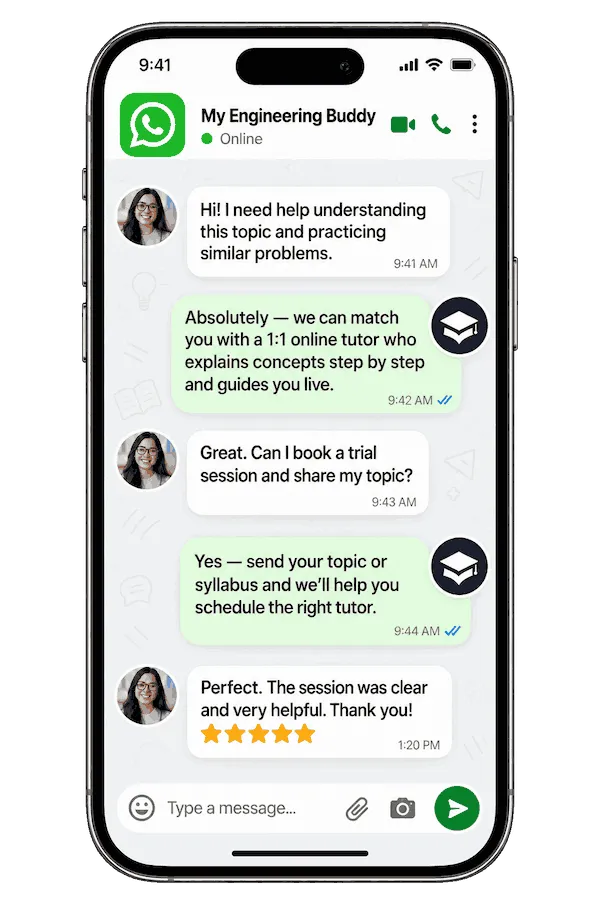
WhatsApp MEB for a quick quote — average response time under 1 minute.
Who This Yarn (software) Tutoring Is For
Yarn trips people up at every level — from students who have never touched a package manager to engineers who know npm cold but can’t get Yarn workspaces to behave. If something specific is blocking you, a session fixes it faster than three hours of Stack Overflow.
- Undergraduate and graduate CS students whose coursework requires Node.js dependency management
- Students with a capstone or portfolio project deadline approaching and a broken install to debug
- Students retaking a module after a failed first attempt who need to get the dev environment working this time
- Self-taught developers transitioning from npm who want to understand what Yarn 2 (Berry) actually changes
- Bootcamp students at institutions like MIT, Carnegie Mellon, Georgia Tech, University of Toronto, and UNSW who need guided project support beyond what their cohort provides
- Engineering teams onboarding junior developers and looking for structured back-end development tutoring
Start with the $1 trial — you’ll know within 30 minutes whether the session is worth continuing.
1:1 Tutoring vs Self-Study vs AI vs YouTube vs Online Courses
Self-study works if the error message is googleable — most aren’t. AI tools explain concepts fast but can’t see your actual package.json or tell you why your workspace resolution is silently failing. YouTube covers basic installs and stops there. Online courses walk you through a clean demo project, never your broken one. A 1:1 Yarn tutor online from MEB works inside your actual setup — live, on screen, correcting the specific conflict your project has right now.
Outcomes: What You’ll Be Able To Do in Yarn (software)
After focused 1:1 Yarn tutoring, you’ll be able to solve dependency resolution conflicts using yarn why and selective resolutions. You’ll analyze yarn.lock files and explain why a specific version was pinned. You’ll apply Yarn workspaces to structure a monorepo with shared packages and individual app builds. You’ll configure Plug’n’Play (PnP) mode and debug zero-install setups without reverting to node_modules. You’ll present a reproducible build pipeline — local and CI — that your team can onboard into without breakage.
Try your first session for $1 — 30 minutes of live 1:1 tutoring or one project problem explained in full. No registration. No commitment. WhatsApp MEB now and get matched within the hour.
Based on feedback from 40,000+ sessions collected by MEB from 2022 to 2025, students working 1:1 on Yarn (software) consistently report faster unblocking on real project issues and clearer understanding of dependency resolution than self-directed troubleshooting alone. Progress varies by starting level and project complexity.
Source: MEB session feedback data, 2022–2025.
What We Cover in Yarn (software) (Syllabus / Topics)

Track 1: Yarn Core — Installation, Configuration, and CLI
- Installing Yarn via Corepack, npm, or standalone scripts; understanding version differences (Classic 1.x vs Berry 2+)
- Initialising projects with
yarn initand understanding the generatedpackage.jsonfields - Core CLI commands:
yarn add,yarn remove,yarn upgrade,yarn install,yarn run - Reading and committing
yarn.lock: why it matters for reproducibility - Configuring
.yarnrc.ymlfor Berry projects — plugins, node-linker, and registry settings - Global vs local installs; managing binary resolution paths
- Migrating an existing npm project to Yarn without breaking dependencies
Reference: Yarn official documentation (yarnpkg.com); Node.js Design Patterns by Casciaro & Mammino for broader package ecosystem context.
Track 2: Workspaces and Monorepo Management
- Defining workspaces in
package.json; directory conventions for packages and apps - Cross-package dependency hoisting: when it helps and when it causes phantom dependency bugs
- Running scripts across workspaces with
yarn workspaces foreach - Using
yarn constraintsto enforce consistent package versions across a monorepo - Integrating with Turborepo or Nx for build orchestration inside a Yarn workspace
- Debugging broken workspace symlinks and resolution order issues
Reference: Monorepo Tools documentation (monorepo.tools); Learning JavaScript Design Patterns by Osmani for structural context.
Track 3: Plug’n’Play, Zero-Installs, and CI/CD Integration
- How PnP replaces node_modules: the virtual filesystem and
.pnp.cjsloader - Configuring editor SDKs (VS Code, IntelliJ) for PnP compatibility
- Zero-install strategy: committing the Yarn cache to version control for deterministic CI builds
- Integrating Yarn with GitLab CI/CD tutoring pipelines and GitHub Actions
- Using
yarn dlxfor one-off tooling without polluting the project - Auditing dependencies for vulnerabilities with
yarn npm audit
Reference: Yarn Berry documentation; Continuous Delivery by Humble & Farley for CI/CD pipeline principles.
What a Typical Yarn (software) Session Looks Like
The tutor opens by checking where you left off — usually a specific error like an unresolved peer dependency or a workspace script that exits with code 1. You share your screen over Google Meet and walk through the failing command together. The tutor uses a digital pen-pad to annotate the dependency tree or the .yarnrc.yml config as you talk. You apply the fix yourself — the tutor doesn’t type for you — and then explain back what changed and why. By the end of the session, you’ve resolved the blocker and have a concrete task: reproduce the same fix pattern in a second scenario before the next session.
At MEB, we’ve found that the fastest way to unstick a Yarn problem isn’t explaining the docs — it’s watching where the student’s mental model breaks under a real error message. That’s what the live session catches in the first 10 minutes.
How MEB Tutors Help You with Yarn (software) (The Learning Loop)
Diagnose: In the first session, the tutor reviews your project setup — package.json, lockfile state, Node version, and any error output you’ve already seen. Most blockers are visible within 15 minutes of looking at the actual files.
Explain: The tutor works through the fix live on screen with a digital pen-pad — not by pasting a solution, but by annotating why the resolution algorithm chose what it chose and where your config overrides need to go.
Practice: You replicate the pattern on a second problem with the tutor present. Watching someone else fix it is not the same as doing it yourself while someone catches your errors in real time.
Feedback: The tutor goes step by step through any misstep — not just “that’s wrong” but “this line tells Yarn to hoist X, which conflicts with Y over here.” You understand the mechanism, not just the workaround.
Plan: Each session ends with a specific next task and the topic for the following session — whether that’s PnP migration, workspace constraints, or setting up a zero-install CI pipeline.
Sessions run on Google Meet. The tutor uses a digital pen-pad or iPad with Apple Pencil to annotate dependency graphs and config files live. Before your first session, share your current package.json, any relevant error output, and your project goal. The first session is diagnostic and practical — you’ll leave having fixed something real.
Start with the $1 trial — 30 minutes of live tutoring that also serves as your first diagnostic.
Students consistently tell us that Yarn’s shift from Classic to Berry feels like switching tools entirely. It is. The tutor’s job isn’t to convince you the new way is better — it’s to make sure you can use both without confusion.
Tutor Match Criteria (How We Pick Your Tutor)
Not every JavaScript developer knows Yarn workspaces. MEB matches on specifics.
Subject depth: Tutors are matched on Yarn version (Classic vs Berry), stack (React, Next.js, Node microservices), and whether your issue is dependency management, monorepo design, or CI/CD integration.
Tools: Every tutor runs sessions over Google Meet with a digital pen-pad or iPad and Apple Pencil — no slides, no pre-recorded walkthroughs.
Time zone: Matched to your region. US East, US West, UK, Gulf, Canada, Australia — the tutor’s working hours fit yours.
Goals: Whether you need one session to unblock a project, weekly support through a semester, or a structured ramp from npm to Yarn Berry with full PnP, the match reflects that.
Unlike platforms where you fill out a form and wait, MEB responds in under a minute, 24/7. Tutor match takes under an hour. The $1 trial means you test before you commit. Everything runs over WhatsApp — no logins, no intake forms.
Pricing Guide
Yarn tutoring runs $20–$40/hr for most undergraduate and bootcamp-level project work. Graduate coursework, monorepo architecture, or enterprise CI/CD integration reaches up to $100/hr depending on tutor specialisation and timeline pressure.
Rate factors: your Yarn version, the complexity of the project (single package vs multi-workspace vs PnP), urgency, and tutor availability. Sessions during end-of-semester and internship crunch periods book out faster — plan ahead if you have a hard deadline.
For students targeting roles at companies with large-scale JavaScript monorepos — think enterprise product teams or open-source foundations using Yarn Berry — tutors with professional engineering backgrounds are available at higher rates. Share your goal and MEB matches the right tier.
Start with the $1 trial — 30 minutes, no registration, no commitment. WhatsApp MEB for a quick quote.
FAQ
Is Yarn (software) hard to learn?
Yarn Classic is approachable if you know npm. Yarn Berry (2+) is a genuine shift — PnP, zero-installs, and the new plugin system require deliberate learning. Most students get productive in Classic within a few sessions; Berry takes longer without a guide.
How many sessions will I need?
One session often unblocks a specific project issue. For a full ramp from npm to Yarn Berry with workspaces and PnP, expect 4–8 sessions depending on your starting point and how much you practice between them.
Can you help with projects and portfolio work?
Yes — MEB provides guided project support. The tutor explains the approach, you implement it and understand what you built. All project work is produced and submitted by you. See our Policies page for full details on what we help with and what we don’t.
Will the tutor match my exact stack and version?
Yes. Tutors are matched on your specific Yarn version, framework (Next.js, NestJS, plain Node), and the type of issue — whether that’s a single-package install problem or a multi-workspace dependency conflict.
What happens in the first session?
The tutor reviews your project setup, error output, and goal. You’ll share your screen. Most sessions resolve at least one real blocker before the 30-minute mark and establish a plan for what to tackle next.
Are online Yarn sessions as effective as in-person?
For a tool-based subject like Yarn, online is arguably better — the tutor sees your exact terminal, your actual config files, and your real errors. There’s no whiteboard abstraction. You fix the thing that’s actually broken, not a demo version of it.
What’s the difference between Yarn Classic and Yarn Berry — and which should I learn?
Classic (1.x) uses a traditional node_modules tree. Berry (2+) introduces PnP, strict dependency resolution, and zero-install support. Most new projects default to Berry. The tutor will assess your project and help you choose — or migrate — based on your actual requirements.
Can I get Yarn help at midnight?
Yes. MEB operates 24/7 across time zones. WhatsApp the team at any hour — average response time is under one minute. Tutor matching typically happens within the hour, including late-night sessions.
My CI pipeline keeps failing on yarn install — can a tutor help debug that?
That’s one of the most common Yarn issues MEB tutors work on. Cache invalidation, lockfile conflicts, PnP loader errors in GitHub Actions or GitLab — the tutor walks through your pipeline config live and identifies the exact failure point.
Do you offer group Yarn sessions?
MEB focuses on 1:1 sessions — the format that resolves your specific project issue, not a generic walkthrough. If your team needs onboarding support for multiple developers, contact MEB over WhatsApp to discuss options.
How do I get started?
Three steps: WhatsApp MEB → get matched with a verified Yarn tutor (usually within the hour) → start with the $1 trial. Thirty minutes live, or one project problem explained in full. No forms, no wait.
Trust & Quality at My Engineering Buddy
Every MEB tutor goes through a multi-stage screening: subject knowledge assessment, a live demo session evaluated by the MEB team, and ongoing review based on student feedback. Yarn tutors hold degrees in computer science or software engineering and carry real-world experience with Node.js ecosystems — not just textbook familiarity. Rated 4.8/5 across 40,000+ verified reviews on Google.
MEB provides guided learning support. All project work is produced and submitted by the student. See our Policies page for details.
MEB has been running since 2008, serving 52,000+ students across the US, UK, Canada, Australia, the Gulf, and Europe in 2,800+ subjects. Software Engineering is one of our highest-demand categories — students regularly come to us for Docker tutoring, Kubernetes help, and Yarn project support as part of the same stack. The MEB tutoring methodology is built around the diagnostic-first, live-practice model that works for tool-based subjects.
Our experience across thousands of sessions shows that tool subjects like Yarn are almost never a documentation problem. The student has read the docs. The gap is connecting what the docs describe to what the error message actually means in their specific project. That’s what the tutor closes.
Explore Related Subjects
Students studying Yarn (software) often also need support in:
Next Steps
When you WhatsApp MEB, have the following ready:
- Your Yarn version, Node version, and a brief description of what’s broken or what you’re trying to build
- Your availability and time zone
- Your deadline or project submission date if applicable
MEB matches you with a verified Yarn tutor — usually within 24 hours, often within the hour. The first session starts with a diagnostic so no time is wasted on irrelevant material.
Before your first session, have ready: your package.json, any error output you’ve captured, and your project goal or deadline. The tutor handles the rest.
Visit www.myengineeringbuddy.com for more on how MEB works.
WhatsApp to get started or email [email protected].
Reviewed by Subject Expert
This page has been carefully reviewed and validated by our subject expert to ensure accuracy and relevance.