~1 min
Average Reply Time
~1 hour
To Be Matched With A Tutor
30 Min Trial
75% Find Their Tutor On The 1st Trial
$20-35+/hr
Premium Yet Affordable Learning
Your pipeline keeps failing and the error logs aren’t helping. That’s exactly what a GitLab CI/CD tutor fixes — fast.
GitLab CI/CD Tutor Online
GitLab CI/CD is a built-in continuous integration and delivery system within the GitLab platform, enabling developers to automate building, testing, and deploying code through declarative pipeline configurations defined in .gitlab-ci.yml files.
If you’re stuck on runner configuration, broken stages, or a deployment that won’t go through, a GitLab CI/CD tutor near me — working live, online, with your actual repo — can cut through the confusion faster than any documentation. MEB connects students and developers across the US, UK, Canada, Australia, and the Gulf with expert software engineering tutors who know GitLab CI/CD from the inside. One session often unblocks what hours of searching couldn’t. We don’t promise overnight expertise, but we do promise you’ll leave each session understanding exactly what you did and why it works.
- 1:1 online sessions built around your specific repo, pipeline, and tech stack
- Verified tutors with real CI/CD and DevOps project experience
- Flexible time zones — US, UK, Canada, Australia, Gulf
- Structured learning plan built after a diagnostic session
- Guided project support — we explain, you build
52,000+ students across the US, UK, Canada, Australia, and the Gulf have used MEB since 2008 — including developers and students working in Software Engineering subjects like GitLab CI/CD, Docker, Kubernetes, and Terraform.
Source: My Engineering Buddy, 2008–2025.
How Much Does a GitLab CI/CD Tutor Cost?
Most GitLab CI/CD tutoring sessions run $20–$40/hr. Specialist tutors covering advanced runners, multi-project pipelines, or enterprise GitLab self-hosted setups may run higher. Start with the $1 trial — 30 minutes live or one pipeline problem explained in full — before committing to a package.
| Level / Need | Typical Rate | What’s Included |
|---|---|---|
| Standard (course/bootcamp level) | $20–$35/hr | 1:1 sessions, pipeline review, guided project support |
| Advanced / Specialist | $35–$100/hr | Expert tutor, enterprise CI/CD, niche runner configs |
| $1 Trial | $1 flat | 30 min live session or one full pipeline question explained |
Demand spikes around capstone deadlines and DevOps certification exam windows — tutor availability tightens during those periods. Book early.
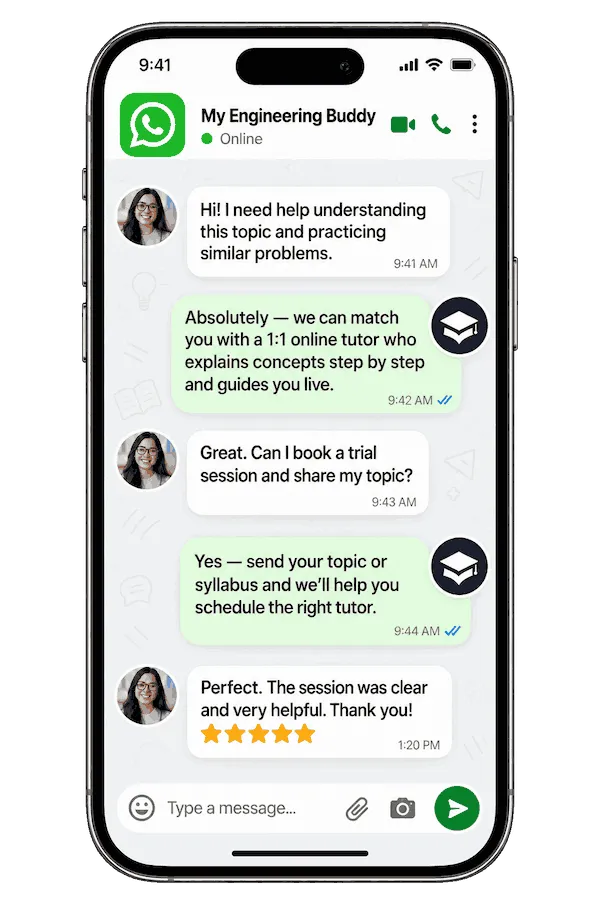
WhatsApp MEB for a quick quote — average response time under 1 minute.
Who This GitLab CI/CD Tutoring Is For
This isn’t a course for beginners who’ve never opened a terminal. It’s for people who are already building something and have hit a wall they can’t get past alone.
- Undergraduate and graduate students in DevOps tutoring courses or software engineering programmes
- Developers preparing for GitLab-related certification assessments
- Students with a capstone or portfolio project deadline approaching — and a pipeline that won’t pass
- Bootcamp graduates moving into their first engineering role who need to get CI/CD production-ready fast
- Students retaking a DevOps module after a failed first attempt — gaps in pipeline logic are usually the root cause
- Engineering faculty who want to test session delivery before recommending MEB to their cohort
Students come from programmes at universities including MIT, Carnegie Mellon, Georgia Tech, University of Toronto, Imperial College London, and ETH Zurich — as well as top bootcamps across the US, UK, and Australia.
1:1 Tutoring vs Self-Study vs AI vs YouTube vs Online Courses
Self-study works if your problem is knowledge — it breaks down when your problem is a misconfigured runner you can’t see. AI tools give fast answers but can’t read your .gitlab-ci.yml live and tell you why stage three is silently skipping. YouTube covers pipeline basics well and stops short the moment your setup diverges from the tutorial. Online courses give structure at a fixed pace with no one to ask when your real project doesn’t match the examples. 1:1 GitLab CI/CD tutoring with MEB is live, built around your exact repo and tech stack, and corrects errors the moment they happen — not after you’ve spent three hours in the wrong direction.
Outcomes: What You’ll Be Able To Do in GitLab CI/CD
After working with an MEB GitLab CI/CD tutor, you’ll be able to write and debug .gitlab-ci.yml files without guessing at syntax. You’ll apply stage-and-job logic to control pipeline execution order and handle conditional rules correctly. You’ll configure shared and specific runners, manage environment variables securely, and explain your pipeline decisions to a team. You’ll solve deployment failures by reading job logs rather than reverting commits and hoping. You’ll build multi-stage pipelines that cover build, test, and deploy in a sequence your production environment can trust.
Based on feedback from 40,000+ sessions collected by MEB from 2022 to 2025, students working 1:1 on GitLab CI/CD consistently report faster pipeline debugging, clearer understanding of CI/CD stage logic, and greater confidence managing deployments independently. Progress varies by starting level and practice frequency.
Source: MEB session feedback data, 2022–2025.
At MEB, we’ve found that most GitLab CI/CD problems students bring to a first session aren’t GitLab problems at all — they’re gaps in understanding how jobs inherit variables, or why a rule block silently skips a stage. Twenty minutes of live explanation clears what two days of documentation reading couldn’t.
What We Cover in GitLab CI/CD (Syllabus / Topics)

Pipeline Fundamentals and .gitlab-ci.yml Syntax
- Pipeline structure: stages, jobs, and execution order
- Job keywords:
script,before_script,after_script,artifacts,cache - Rules and
only/except— when jobs run and when they don’t - Anchors and extends for DRY pipeline configuration
- Environment variables: predefined, project-level, group-level, masked
- Debugging failed jobs using CI/CD job logs and exit codes
- Multi-project pipelines and downstream triggers
Recommended references: GitLab CI/CD official documentation; Sander van Vugt, Mastering GitLab 12 (Packt, 2019). Additional context in The Phoenix Project (Kim et al.) for CI/CD in organisational DevOps workflows.
Runners, Executors, and Infrastructure
- GitLab shared runners vs specific runners — when to use each
- Runner executors: Shell, Docker, Kubernetes, and virtualisation options
- Registering and configuring runners with Docker tutoring context
- Runner tags and job routing
- Caching strategies to speed up pipeline runs
- Security: protecting CI/CD secrets from exposure in logs
Recommended references: GitLab Runner documentation; Raju Gandhi, Docker in Practice (Manning, 2023).
Deployment, Testing Integration, and Advanced Pipelines
- Deploy jobs: environments, deployment variables, and rollback logic
- Integrating Kubernetes tutoring with GitLab Auto DevOps
- Test stages: unit, integration, and acceptance testing help in pipeline context
- Code quality and security scanning jobs (SAST, DAST, dependency scanning)
- Review apps and dynamic environments
- GitLab Pages and static site deployment via CI/CD
- Merge request pipelines and protected branch controls
Recommended references: John Willis & Jez Humble, Accelerate (IT Revolution, 2018); GitLab CI/CD official documentation (pipelines/environments).
Platforms, Tools & Textbooks We Support
GitLab CI/CD sessions work directly with the tools in your stack. Tutors are comfortable across the platforms and environments most commonly paired with GitLab pipelines.
- GitLab.com (SaaS) and self-hosted GitLab instances
- Docker and Docker Hub for containerised runners and build environments
- Kubernetes / Minikube for deployment pipeline targets
- Terraform tutoring for infrastructure provisioning within pipelines
- Ansible tutoring for configuration management stages
- SonarQube tutoring for code quality gate integration
- Prometheus and Datadog tutoring for monitoring integration post-deploy
- Communications of the ACM publishes relevant research on CI/CD toolchain design — see Communications of the ACM for practitioner-level literature.
What a Typical GitLab CI/CD Session Looks Like
The tutor opens by checking what you worked on since the last session — usually a specific job failure, a caching problem, or an unresolved deployment stage. You share your screen or paste your .gitlab-ci.yml directly into the chat. The tutor reads it with you, asks two or three targeted questions about your runner setup and environment variables, then works through the problem using a digital pen-pad to annotate the pipeline flow visually. You fix it together. Then the tutor sets a deliberate variation — a different trigger condition or a new deploy environment — so you can replicate the logic yourself, not just copy the fix. Before the session ends, the tutor notes the next topic and the one thing you should try before you meet again.
How MEB Tutors Help You with GitLab CI/CD (The Learning Loop)
Diagnose: In the first session, the tutor looks at your actual pipeline file, your error logs, and asks about your deployment target. They identify whether the problem is syntax, logic, runner config, or missing environment variables — most students come in convinced it’s one and it turns out to be another.
Explain: The tutor works through a live example on the digital pen-pad, showing how GitLab processes the YAML stage by stage. You see the execution order drawn out, not described in abstract.
Practice: You write the next job or pipeline rule yourself, with the tutor watching. This is where most of the learning happens — not while they explain, but while you attempt.
Feedback: The tutor catches errors as they occur and explains why they’d cause a failure in a real pipeline. Not “that’s wrong” — but “that keyword only applies inside a rules block, here’s what GitLab actually reads.”
Plan: At the end of each session, the tutor maps the next two or three topics in sequence — for example, moving from basic job configuration to multi-stage deploys, then to protected environments and secrets management.
Students consistently tell us that the biggest shift in GitLab CI/CD isn’t learning more syntax — it’s understanding how GitLab evaluates rules and variables at pipeline creation time versus job runtime. Once that clicks, debugging becomes methodical instead of guesswork.
Sessions run on Google Meet. Tutors use a digital pen-pad or iPad with Apple Pencil to annotate pipeline diagrams in real time. Before your first session, share your repo structure, the job or stage that’s failing, and your deployment environment. The first session covers a diagnostic run of your pipeline, identifies the two or three core gaps, and sets the sequence for what follows. Start with the $1 trial — 30 minutes of live project help that also serves as your first diagnostic.
Tutor Match Criteria (How We Pick Your Tutor)
Not every DevOps tutor is the right match for every GitLab problem.
Subject depth: Tutors are matched based on your specific use case — course-level pipelines, certification prep, or production-grade deployment work — not just “GitLab experience.” Tools: Every tutor works on Google Meet with a digital pen-pad or iPad and Apple Pencil. Time zone: Matched to your region — US, UK, Gulf, Canada, Australia — no 2am calls unless you want them. Goals: Whether you’re chasing a grade on a DevOps module, clearing a capstone project, or getting a pipeline production-ready, the tutor match reflects that specific goal.
Unlike platforms where you fill out a form and wait, MEB responds in under a minute, 24/7. Tutor match takes under an hour. The $1 trial means you test before you commit. Everything runs over WhatsApp — no logins, no intake forms.
Pricing Guide
GitLab CI/CD tutoring starts at $20/hr for standard course and bootcamp-level support. Graduate-level work, enterprise runner configuration, or sessions tied to professional DevOps certification prep can run up to $100/hr. Rate factors include your course level, the complexity of your pipeline setup, your timeline, and tutor availability at your preferred hours.
For students targeting roles at top-tier engineering teams or preparing for GitLab Professional Cloud Engineer or similar certifications, tutors with professional DevOps and platform engineering backgrounds are available at higher rates — share your specific goal and MEB will match the tier to your ambition.
Availability tightens during peak capstone and certification exam periods. Book before the crunch. Start with the $1 trial — 30 minutes, no registration, no commitment. WhatsApp MEB for a quick quote.
MEB has been matching students with expert tutors since 2008. 18 years of refinement means the match process is fast — and the tutors have seen your exact problem before, in a different repo, with a different team, at 11pm on a deadline night.
Source: My Engineering Buddy, 2008–2025.
Try your first session for $1 — 30 minutes of live 1:1 tutoring or one homework question explained in full. No registration. No commitment. WhatsApp MEB now and get matched within the hour.
FAQ
Is GitLab CI/CD hard to learn?
The basics — writing a simple build-and-test pipeline — are accessible within a few hours. The difficulty spikes when you introduce multi-stage deployments, runner configuration, environment-specific variables, and rules logic. Most students struggle not with syntax but with understanding how GitLab evaluates the pipeline at runtime.
How many sessions will I need?
Students with a specific stuck point — a broken pipeline, a failing deploy job — often resolve it in one or two sessions. Building solid end-to-end CI/CD capability from a foundation level typically takes six to twelve sessions, depending on your starting point and how much you practice between meetings.
Can you help with projects and portfolio work?
Yes. MEB provides guided project support — tutors explain the logic, walk through your configuration, and help you understand the solution. All project work is built and submitted by you. See our Policies page for full details on what we help with and what we don’t.
Will the tutor match my exact syllabus or exam board?
Yes. Tutors are matched to your specific course context — whether that’s a university DevOps module, a bootcamp curriculum, or a professional certification pathway. Share your course outline or certification guide when you WhatsApp MEB and the match reflects that.
What happens in the first session?
The tutor reviews your pipeline file or project setup, asks targeted questions about your stack and deployment target, and identifies the two or three gaps causing the most friction. You leave with a clear problem diagnosis and a concrete next step — not a reading list.
Are online sessions as effective as in-person for GitLab CI/CD?
For a tool-based subject like GitLab CI/CD, online is often better — you share your actual terminal, repo, and pipeline output in real time. The tutor sees exactly what you see. There’s no whiteboard approximation of a real config file.
What’s the difference between GitLab CI/CD and Jenkins?
GitLab CI/CD is built into the GitLab platform — no separate installation, pipeline config lives in your repo as a YAML file, and it integrates natively with merge requests and environments. Jenkins tutoring covers a standalone tool with a plugin ecosystem, more flexibility, and more configuration overhead. MEB tutors cover both.
Can you help me understand when to use GitLab CI/CD versus GitHub Actions or CircleCI?
Yes. This is a common decision point in engineering teams and a frequent exam or interview question. Tutors can walk through the architectural trade-offs — trigger models, runner management, secret handling, and cost at scale — so you can articulate the decision clearly in any context.
Can I get GitLab CI/CD help at midnight or on weekends?
Yes. MEB operates 24/7. WhatsApp response time averages under a minute regardless of the hour. If you’re hitting a pipeline failure at 11pm before a morning deadline, that’s exactly when to reach out.
What if my GitLab CI/CD problem is very specific — a custom runner, a niche executor, or a self-hosted instance?
Bring it. Tutors who specialise in infrastructure and DevOps work routinely handle self-hosted GitLab, custom runner configurations, and non-standard executor setups. Share the details when you first WhatsApp — MEB will match you to someone who’s worked with that setup before.
How do I get started?
WhatsApp MEB, share your course or project context, and you’ll be matched with a verified GitLab CI/CD tutor — usually within the hour. The first session is your $1 trial: 30 minutes of live tutoring or one full pipeline problem explained. No registration required.
Trust & Quality at My Engineering Buddy
Every MEB tutor goes through a multi-stage vetting process: subject knowledge screening, a live demo session evaluation, and ongoing review based on student session feedback. Tutors covering GitLab CI/CD hold degrees or professional experience in software engineering, DevOps, or platform engineering — and are assessed on their ability to explain pipeline logic clearly, not just their own technical fluency. Rated 4.8/5 across 40,000+ verified reviews on Google.
MEB provides guided learning support. All project work is produced and submitted by the student. See our Policies page for details.
MEB has served 52,000+ students across the US, UK, Canada, Australia, the Gulf, and Europe since 2008 — across 2,800+ subjects. In Software Engineering, that includes GitLab CI/CD alongside adjacent subjects like Azure DevOps tutoring and Infrastructure as Code tutoring. Tutors are matched to the depth and context your project actually needs — not just the subject name. Read more about MEB’s approach at our tutoring methodology page.
Since 2008, MEB has built its reputation one session at a time — 52,000+ students, 4.8/5 on Google, and tutors who stay with students through the hard problems, not just the easy ones.
Source: My Engineering Buddy, 2008–2025.
Explore Related Subjects
Students studying GitLab CI/CD often also need support in:
Next Steps
Getting started takes about two minutes.
- Share your course or project context — your stack, your pipeline problem, and your deadline
- Share your availability and time zone
- MEB matches you with a verified GitLab CI/CD tutor — usually within the hour
Before your first session, have ready: your .gitlab-ci.yml file or project repo structure, the specific job or stage that’s failing (with the error log if you have it), and your deadline or exam date. The tutor handles the rest.
A common pattern our tutors observe is that students arrive at a first GitLab CI/CD session having already tried three different fixes from Stack Overflow — each one adding a new layer of confusion. The first session clears all of it. Start clean, start right.
Visit www.myengineeringbuddy.com for more on how MEB works.
WhatsApp to get started or email [email protected].
Reviewed by Subject Expert
This page has been carefully reviewed and validated by our subject expert to ensure accuracy and relevance.