~1 min
Average Reply Time
~1 hour
To Be Matched With A Tutor
30 Min Trial
75% Find Their Tutor On The 1st Trial
$20-35+/hr
Premium Yet Affordable Learning
Hire The Best Journalism Tutor

Most students who struggle with Journalism don’t lack ideas — they lack structure. One tutor session fixes more than three weeks of guessing alone.
Journalism Tutor Online
Journalism is the practice of gathering, verifying, and presenting news and information for public audiences across print, broadcast, and digital media. It equips students to report accurately, write to deadline, and apply editorial judgment.
If you’ve searched for a Journalism tutor near me, MEB gives you something better — a 1:1 online Journalism tutor matched to your exact course, syllabus, or assignment brief. We cover undergraduate modules, postgraduate journalism programmes, and professional skills courses across the US, UK, Canada, Australia, and the Gulf. Whether you’re working through Communication & Media Studies or specialising in Journalism specifically, MEB has verified tutors ready now.
- 1:1 online sessions tailored to your course or syllabus
- Expert-verified tutors with subject-specific editorial and academic backgrounds
- Flexible time zones — US, UK, Canada, Australia, Gulf
- Structured learning plan built after a diagnostic session
- Ethical homework and assignment guidance — you understand the work before you submit
52,000+ students across the US, UK, Canada, Australia, and the Gulf have used MEB since 2008 — including students in Communication & Media Studies subjects like Journalism, Broadcast Journalism, and Mass Communication.
Source: My Engineering Buddy, 2008–2025.
How Much Does a Journalism Tutor Cost?
Most Journalism tutoring sessions run at $20–$40/hr, depending on your level and the complexity of the topic. Postgraduate and specialist modules can reach $100/hr. Before committing to a package, try the $1 trial — 30 minutes of live 1:1 tutoring or one assignment question explained in full.
| Level / Need | Typical Rate | What’s Included |
|---|---|---|
| Standard (most undergraduate levels) | $20–$35/hr | 1:1 sessions, assignment guidance |
| Advanced / Postgraduate / Specialist | $35–$100/hr | Expert tutor, niche depth, research support |
| $1 Trial | $1 flat | 30 min live session or one full homework explanation |
Tutor availability tightens during peak submission and exam periods — early booking secures your preferred slot.
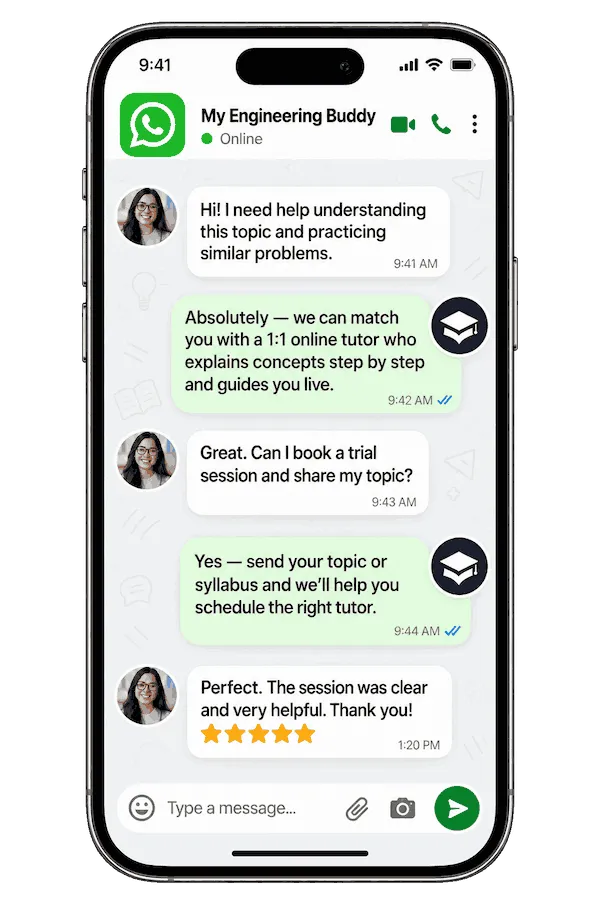
WhatsApp MEB for a quick quote — average response time under 1 minute.
Who This Journalism Tutoring Is For
Journalism is broader than most students expect. You might be strong at writing but weak on media law. Or solid on ethics theory but struggling with data-driven reporting or digital storytelling formats. MEB tutors cover all of it.
- Undergraduate Journalism students at universities including Columbia, Northwestern, Cardiff, King’s College London, and Ryerson (Toronto Metropolitan)
- Postgraduate students on MA Journalism, MA International Journalism, or MSc Data Journalism programmes
- Students with a university conditional offer depending on this grade
- Students 4–6 weeks from a major submission with significant gaps still to close
- Students struggling with specific components — longform features, news writing, shorthand, or media ethics essays
- Students needing homework and assignment guidance on journalism modules they weren’t prepared for
Try the $1 trial first. It costs nothing to find out whether the tutor is the right fit.
1:1 Tutoring vs Self-Study vs AI vs YouTube vs Online Courses
Self-study works if you’re disciplined, but journalism writing improves fastest with feedback — not just reading. AI tools give fast definitions but can’t assess your lede structure or tell you why your angle is off. YouTube covers the basics well and stops there. Online courses move at their own pace, not yours. With MEB, the tutor reads your actual draft or assignment brief, identifies the gap in real time, and corrects it before it becomes a habit. That’s the difference for Journalism specifically — this is a craft subject, and craft requires a live critical eye.
Outcomes: What You’ll Be Able To Do in Journalism
After working with an MEB Journalism tutor, you’ll write sharper, faster, and with greater structural confidence. Expect to apply inverted pyramid structure correctly across hard news formats, analyze media ethics scenarios using established frameworks like the SPJ Code of Ethics, present a fully sourced feature story that meets academic and professional standards, solve common pitfalls in interview technique and source attribution, and explain the legal boundaries of defamation, contempt, and privacy as they apply to your jurisdiction.
Supporting a student through Journalism? MEB works directly with parents to set up sessions, track progress, and keep coursework on schedule. WhatsApp MEB — average response time is under a minute, 24/7.
Based on feedback from 40,000+ sessions collected by MEB from 2022 to 2025, 58% of students improved by one full grade after approximately 20 hours of 1:1 tutoring in subjects like Journalism. A further 23% achieved at least a half-grade improvement.
Source: MEB session feedback data, 2022–2025.
What We Cover in Journalism (Syllabus / Topics)

News Writing & Reporting
- Inverted pyramid structure and hard news leads
- Source identification, interviewing technique, and attribution
- Deadline writing — speed without sacrificing accuracy
- Newsgathering across print, broadcast, and digital formats
- Fact-checking methods and verification workflows
- Covering courts, councils, and public institutions
Core texts include The Elements of Journalism by Kovach & Rosenstiel and News Reporting and Writing by the Missouri Group.
Media Law, Ethics & Regulation
- Defamation, libel, and slander — US and UK legal frameworks
- Privacy law, confidentiality, and source protection
- Contempt of court and reporting restrictions
- Regulatory bodies — IPSO (UK), FTC guidelines (US), ACMA (Australia)
- The SPJ Code of Ethics and editorial decision-making
- Bias, objectivity, and the public interest test
Key references: McNae’s Essential Law for Journalists (UK) and The Journalist’s Handbook on Libel and Privacy (US).
Digital & Data Journalism
- Data sourcing, cleaning, and visualisation for news stories
- Multimedia storytelling — video, audio, and interactive formats
- SEO fundamentals for online news publishing
- Social media as a reporting and distribution tool
- Podcast and broadcast script structure
- Freedom of Information requests and document-based reporting
Useful texts include The Data Journalism Handbook (open access) and Multimedia Journalism by Andy Bull. Students exploring data journalism tutoring will find dedicated support available at MEB.
At MEB, we’ve found that Journalism students who bring a real piece of their own writing to the first session — a draft article, an assignment brief, even a marked essay — make faster progress than those who start from scratch. Seeing where the gaps actually are saves the first two sessions.
What a Typical Journalism Session Looks Like
The tutor opens by checking the previous session’s practice task — usually a 300-word news report or a media ethics argument you drafted independently. From there, the session focuses on whatever is live: if your current assignment is a longform feature, the tutor walks through your structure, checks your sourcing, and works through your headline and lede with you on screen. If you’re revising media law, the tutor presents a case scenario and asks you to apply the relevant legal test — then corrects any gap in your reasoning step by step. A digital pen-pad lets the tutor annotate your draft or sketch out structural frameworks as you talk. The session ends with a specific task: rewrite your lede using the agreed approach, or draft the intro paragraph of your next section for review. One outcome. One task. Clear next step.
How MEB Tutors Help You with Journalism (The Learning Loop)
Diagnose: In the first session, the tutor identifies whether the issue is structural (your article doesn’t flow), technical (your sourcing is weak), or conceptual (you’re misapplying an ethics framework). Not all three. The one that’s costing you the most marks first.
Explain: The tutor works through a live example — your own draft or a parallel exercise — using the pen-pad to annotate directly. You watch the correct approach built in real time, not described abstractly.
Practice: You attempt the corrected version with the tutor present. For Journalism, this usually means rewriting a paragraph, restructuring an argument, or re-pitching an angle on the same story.
Feedback: The tutor explains exactly where marks are lost and why — not just what’s wrong, but the editorial reasoning behind it. That distinction matters for written exams and coursework both.
Plan: Each session ends with a topic note and a short task. The tutor tracks progression across sessions — from news writing fundamentals through to media law and digital formats.
Sessions run on Google Meet. The tutor uses a digital pen-pad or iPad with Apple Pencil to annotate your work in real time. Before your first session, send your course outline or assignment brief via WhatsApp. The first session is your diagnostic — and your first piece of real progress. Start with the $1 trial — 30 minutes of live tutoring that also serves as your diagnostic.
Students consistently tell us that the biggest shift in Journalism tutoring happens when the tutor stops correcting and starts asking: “What were you trying to say here?” That question — answered live — rewires how they approach every future piece.
Source: My Engineering Buddy tutor feedback log, 2022–2025.
Try your first session for $1 — 30 minutes of live 1:1 tutoring or one homework question explained in full. No registration. No commitment. WhatsApp MEB now and get matched within the hour.
Tutor Match Criteria (How We Pick Your Tutor)
Every Journalism tutor on MEB is matched on four criteria before your first session.
Subject depth: The tutor’s background must align with your specific module — news writing, media law, broadcast, or data journalism. A tutor who covers general English composition is not a match for a journalism ethics module.
Tools: All sessions use Google Meet and a digital pen-pad or iPad with Apple Pencil. Annotation of your actual work — not just whiteboard examples — is standard.
Time zone: Tutors are matched to your region. US students get US-or-compatible-timezone tutors. Same for UK, Gulf, Canada, and Australia.
Goals: Whether you need to pass an exam, improve a coursework grade, or strengthen a specific skill like interviewing technique or data visualisation, the match reflects that. Unlike platforms where you fill out a form and wait, MEB responds in under a minute, 24/7. Tutor match takes under an hour. The $1 trial means you test before you commit. Everything runs over WhatsApp — no logins, no intake forms.
Study Plans (Pick One That Matches Your Goal)
After your diagnostic session, the tutor builds a specific sequence. Three common structures: Catch-up (1–3 weeks) — for students behind on a module or facing an imminent submission deadline; Exam prep (4–8 weeks) — structured revision covering news writing, law, ethics, and digital formats in the order they appear on your paper; Weekly support — ongoing sessions aligned to your semester schedule and coursework deadlines. The tutor sets the sequence. You show up and work.
Pricing Guide
Journalism tutoring runs from $20–$40/hr for most undergraduate modules. Postgraduate, specialist, or research-level support reaches up to $100/hr. Rate factors include your level, the complexity of the topic, your timeline, and tutor availability. Slots fill fastest in April–May and October–November — the peak submission windows for most journalism programmes.
For students targeting top journalism schools — Columbia Graduate School of Journalism, Northwestern Medill, or Cardiff’s MA Journalism — tutors with professional editorial and newsroom backgrounds are available at higher rates. Share your specific goal and MEB will match the tier to your ambition.
Start with the $1 trial — 30 minutes, no registration, no commitment. WhatsApp MEB for a quick quote.
A common pattern our tutors observe is that Journalism students wait until the week before a submission to seek help. Two sessions that week can still make a difference — but four sessions over four weeks make a much bigger one. Earlier is always better, even if everything feels fine right now.
FAQ
Is Journalism hard?
It depends on where your gaps are. Writing fast and accurately under deadline pressure is genuinely difficult. Media law and ethics require precise reasoning. Students who struggle most are usually those who underestimate how technical the analytical components get.
How many sessions are needed?
Most students see clear improvement in 8–12 hours. For a specific assignment, 2–3 focused sessions often resolve the issue. Long-term grade improvement across a module typically requires 15–20 hours over 6–8 weeks.
Can you help with homework and assignments?
Yes. MEB tutoring is guided learning — you understand the work, then submit it yourself. See our Academic Integrity policy and Why MEB page for full details on what we help with and what we don’t.
Will the tutor match my exact syllabus or exam board?
Yes. Share your course outline or module handbook before the first session and the tutor aligns to it directly — whether that’s a UK university module, a US J-school course, or a specific postgraduate programme.
What happens in the first session?
The tutor runs a diagnostic — reviewing your past work, identifying the specific gaps, and setting a session sequence. You leave the first session knowing exactly what to fix and in what order. It’s practical from minute one.
Is online tutoring as effective as in-person?
For Journalism specifically, yes — often more so. Sharing a live document or article draft on screen and having the tutor annotate it in real time is a cleaner workflow than passing paper across a table. Most students adapt within the first session.
Can I get Journalism help at midnight?
MEB operates 24/7. WhatsApp MEB at any hour — a tutor or match coordinator responds within minutes. Late-night sessions before a morning deadline are common, especially for students in the US or Gulf time zones.
What if I don’t like my assigned tutor?
Tell MEB via WhatsApp and you’ll be re-matched — no explanation needed, no forms, no waiting period. The $1 trial exists precisely so you can test the match before committing to a longer session block.
Do Journalism tutors help with both print and digital formats?
Yes. MEB tutors cover print news writing, broadcast scripts, podcast formats, longform digital features, and multimedia storytelling. Specify your format when you first message — the tutor will be matched accordingly.
What’s the difference between news writing and feature writing — and can tutors help with both?
News writing prioritises speed, structure, and objectivity. Feature writing allows more narrative and analysis. They require different skills and are often assessed differently on journalism programmes. MEB tutors cover both and can help you switch between them without losing your voice or your marks.
How do I get started?
Start with the $1 trial — 30 minutes of live 1:1 tutoring or one question explained in full. Three steps: WhatsApp MEB, get matched within the hour, start your trial session. That’s it.
Can you help with data journalism — spreadsheets, visualisation tools, and FOI analysis?
Yes. MEB has tutors who specialise in data journalism help, covering tools like Datawrapper, Excel for data cleaning, and structuring FOI-based investigations into publishable stories.
Trust & Quality at My Engineering Buddy
Every MEB tutor goes through subject-specific screening before working with students — this includes a live demo session evaluation, verification of academic credentials, and review of prior teaching or professional editorial experience. Tutors covering media law are vetted separately from those covering news writing and data journalism. Rated 4.8/5 across 40,000+ verified reviews on Google.
MEB tutoring is guided learning — you understand the work, then submit it yourself. For full details on what we help with and what we don’t, read our Academic Integrity policy and Why MEB.
MEB has been serving students across the US, UK, Canada, Australia, Gulf, and Europe since 2008 — across 2,800+ subjects. In Communication & Media Studies, that includes students needing communication studies tutoring, copy editing help, and public speaking tutoring alongside Journalism. Read more about how sessions are structured at MEB’s tutoring methodology page.
MEB has supported students at undergraduate and postgraduate level across journalism, media law, and digital reporting since 2008. The tutors are practitioners and academics — not generalists. That matters when your assignment requires real editorial judgment.
Source: My Engineering Buddy, 2008–2025.
Explore Related Subjects
Students studying Journalism often also need support in:
- Advertising
- Cinematography
- Communication Skills
- Cultural Studies
- Essay Editing
- Intercultural Communication
- Visual Communication
Next Steps
When you message MEB, have these ready:
- Your course or module name, university, and year of study
- Your current assignment or exam component and deadline
- Your availability and time zone
MEB matches you with a verified Journalism tutor — usually within an hour. The first session starts with a diagnostic so every minute is used well. Before your first session, have ready: your syllabus or course outline, a recent assignment you struggled with, and your submission or exam date. The tutor handles the rest.
Visit www.myengineeringbuddy.com for more on how MEB works.
WhatsApp to get started or email [email protected].
Reviewed by Subject Expert
This page has been carefully reviewed and validated by our subject expert to ensure accuracy and relevance.