




~1 min
Average Reply Time
~1 hour
To Be Matched With A Tutor
30 Min Trial
75% Find Their Tutor On The 1st Trial
$20-35+/hr
Premium Yet Affordable Learning
Hire The Best Broadcast Journalism Tutor

Most students don’t fail broadcast journalism because they can’t write. They fail because nobody ever told them what a live package actually sounds like when it’s wrong.
Broadcast Journalism Tutor Online
Broadcast journalism is the practice of gathering, verifying, scripting, and delivering news content for radio, television, and digital platforms — equipping students to report accurately, write for the ear, and present under live conditions.
If you’re searching for a broadcast journalism tutor near me, MEB connects you with 1:1 online tutoring and homework help across 2,800+ advanced subjects, including the full range of Communication & Media Studies disciplines. Whether you’re building your first news package, struggling with media law, or preparing a final broadcast assessment, a dedicated broadcast journalism tutor works through exactly where you’re losing marks — not where the textbook says you should be.
- 1:1 online sessions tailored to your exact course and syllabus
- Expert-verified tutors with working broadcast and journalism backgrounds
- Flexible time zones — US, UK, Canada, Australia, Gulf
- Structured learning plan built after a diagnostic session
- Ethical homework and assignment guidance — you understand the work before you submit it
52,000+ students across the US, UK, Canada, Australia, and the Gulf have used MEB since 2008 — including students in Communication & Media Studies subjects like Broadcast Journalism, Journalism, and Mass Communication.
Source: My Engineering Buddy, 2008–2025.
How Much Does a Broadcast Journalism Tutor Cost?
Most broadcast journalism tutoring sessions run $20–$40/hr. Specialist tutors with television news or documentary production backgrounds sit at the higher end. The $1 trial gets you 30 minutes of live 1:1 tutoring or one homework question explained in full — no registration required.
| Level / Need | Typical Rate | What’s Included |
|---|---|---|
| Standard (most levels) | $20–$35/hr | 1:1 sessions, script feedback, assignment guidance |
| Advanced / Specialist | $35–$70/hr | Expert tutor, live production techniques, media law depth |
| $1 Trial | $1 flat | 30 min live session or 1 homework question explained |
Tutor availability tightens sharply in the weeks before final assessments and portfolio submission deadlines. Book early if your deadline is within six weeks.
WhatsApp MEB for a quick quote — average response time under 1 minute.
Who This Broadcast Journalism Tutoring Is For
Broadcast journalism draws students from hugely different starting points — some arrive with strong writing instincts but freeze on camera; others can present confidently but can’t structure a news report to save their grade. MEB tutoring works for both, and everyone in between.
- Undergraduates at universities such as Northwestern, Syracuse, Cardiff, Goldsmiths, Ryerson, RMIT, and NYU working through core broadcast modules
- Students with a conditional university offer that depends on passing a media studies or journalism qualification
- Students preparing broadcast journalism coursework or final portfolio submissions with a deadline approaching
- Graduate students in journalism programmes dealing with advanced media ethics, investigative reporting, or audience analytics coursework
- Students retaking after a failed first assessment — scripts marked down, packages rejected, or live reads that didn’t land
- Parents watching a child’s confidence drop alongside their grades in a media or communications course
At MEB, we’ve found that broadcast journalism students often know more than their grades suggest. The gap is usually technical — they don’t know why their script sounds wrong on air, or how to tighten a two-minute package to 90 seconds without losing the story. One focused session on that specific gap changes everything.
1:1 Tutoring vs Self-Study vs AI vs YouTube vs Online Courses
Self-study works if you’re disciplined, but broadcast journalism requires live feedback — reading your own script back rarely catches the problems a listener hears. AI tools can explain AP style or media law concepts quickly but can’t watch your on-camera delivery and tell you what’s off. YouTube covers the basics of news writing and studio production well, but stops the moment you need someone to critique your specific package. Online courses give you structure at a fixed pace, with no room to linger on the one thing you keep getting wrong. 1:1 tutoring with MEB is calibrated to your actual script, your actual assessment brief, and your actual deadline — an online broadcast journalism tutor corrects errors as they happen, not after you’ve submitted.
Outcomes: What You’ll Be Able To Do in Broadcast Journalism
After working with an MEB broadcast journalism tutor, students write broadcast scripts that serve the ear rather than the eye — short, active sentences that land when read aloud. They apply the inverted pyramid correctly to radio and TV formats, not just print. They analyse and apply media law principles — defamation, contempt, and right of reply — to real editorial scenarios. They present live-to-camera or live-to-microphone with controlled pace and clear signposting. They edit packages in post-production with a clear sense of story structure, nat sound, and interview clip placement.
These are not vague skills. Each one maps directly to what gets marked in broadcast journalism assessments.
Based on feedback from 40,000+ sessions collected by MEB from 2022 to 2025, 58% of students improved by one full grade after approximately 20 hours of 1:1 tutoring in subjects like Broadcast Journalism. A further 23% achieved at least a half-grade improvement.
Source: MEB session feedback data, 2022–2025.
Supporting a student through Broadcast Journalism? MEB works directly with parents to set up sessions, track progress, and keep coursework on schedule. WhatsApp MEB — average response time is under a minute, 24/7.
Try your first session for $1 — 30 minutes of live 1:1 tutoring or one homework question explained in full. No registration. No commitment. WhatsApp MEB now and get matched within the hour.
What We Cover in Broadcast Journalism (Syllabus / Topics)

News Writing & Scripting for Broadcast
- Writing for the ear: sentence length, active voice, and natural rhythm
- Inverted pyramid adapted for radio and TV news formats
- Cue sheets, two-ways, and package scripts — format and conventions
- Voice-over (VO), VO-SOT, and live shot scripting
- Accuracy, attribution, and source verification in broadcast contexts
- Headline and tease writing for broadcast bulletins
Recommended texts: Broadcast News Writing, Reporting, and Producing by Ted White & Frank Barnas; The Radio Handbook by Carole Fleming.
Media Law, Ethics & Editorial Judgement
- Defamation, libel, and slander: application to broadcast reporting
- Contempt of court and reporting restrictions in US, UK, and Australian contexts
- Right of reply, corrections, and editorial standards
- Privacy law, intrusion, and public interest defences
- Ofcom broadcasting code (UK) and FCC regulations (US) — key provisions
- Ethical frameworks: harm minimisation, source protection, and impartiality
Recommended texts: McNae’s Essential Law for Journalists by Mark Hanna & Mike Dodd; Journalism Ethics by Patrick Lee Plaisance.
Broadcast Production & Presentation
- On-camera and on-mic presentation: pace, tone, and authority
- Interview technique — preparation, questioning, and active listening
- Package structure: narration, nat sound, clips, and cutaways
- Live reporting and two-way conventions
- Digital and social media extensions: online video, podcast formats, and short-form broadcast content
- Audience analysis and editorial decisions across platforms
Recommended texts: Broadcast Journalism: Techniques of Radio and Television News by Andrew Boyd, Peter Stewart & Ray Alexander; Reporting for Radio by Jim Beaman.
Platforms, Tools & Textbooks We Support
Broadcast journalism programmes increasingly require students to work with industry-standard production and editing software alongside traditional reporting skills. MEB tutors support guidance on how these tools fit into your coursework and assessment workflow.
- Adobe Premiere Pro — video editing for news packages
- Audacity / Adobe Audition — radio and podcast audio editing
- ENPS and iNews — broadcast newsroom management systems
- Avid Media Composer — used in professional and university TV production suites
- Descript — transcript-based audio and video editing increasingly used in digital broadcast
- RODE, Zoom H5/H6 — field recording and interview audio capture
What a Typical Broadcast Journalism Session Looks Like
The tutor opens by reviewing the previous session’s task — usually a script draft or a recorded package you submitted. They listen or read with you and mark the first three places where a news editor would stop and question something: a passive construction that kills pace, an attribution that’s too vague, a clip that doesn’t match the narration around it. From there, you work through a specific component — maybe tightening a two-minute radio package to 90 seconds while keeping the story intact, or practising a live two-way with the tutor playing the studio anchor. The tutor uses a digital pen-pad to annotate your script in real time. Before the session closes, you get one clear rewrite task and know exactly what the next session will cover — usually the next weakest component in your assessment portfolio.
How MEB Tutors Help You with Broadcast Journalism (The Learning Loop)
Diagnose: In the first session, the tutor identifies where the real problem sits — not always where you think it is. A student convinced they have a presentation problem may actually have a scripting problem. The diagnostic separates surface issues from root ones.
Explain: The tutor works through a live example — your actual script or a model package — using a digital pen-pad to annotate, restructure, and demonstrate why certain choices work on air and others don’t. You’re not watching a lecture. You’re working through your own material.
Practice: You attempt the correction or the rewrite with the tutor present. For presentation skills, this means recording a read-aloud or on-camera take and playing it back together. The gap between what you think you sound like and what you actually sound like closes fast in this stage.
Feedback: The tutor goes through what worked and what still needs attention — specifically. Not “this section was unclear” but “this sentence has 34 words and loses the listener by word 20.” That precision is what changes marks.
Plan: Each session closes with the next topic noted, the practice task defined, and a clear checkpoint. Whether you need a two-week catch-up before a portfolio deadline or structured weekly support across a semester, the plan is built after that first diagnostic — not before. Start with the $1 trial — 30 minutes of live tutoring that also serves as your first diagnostic.
Sessions run on Google Meet. The tutor uses a digital pen-pad or iPad with Apple Pencil to annotate scripts and mark up assessment briefs. Before your first session, share your assignment brief, the most recent piece of work you submitted, and your deadline date. The tutor handles the structure from there.
Students consistently tell us that the shift from “writing to be read” to “writing to be heard” is the hardest adjustment in broadcast journalism. It’s not about intelligence or effort — it’s a specific skill that responds quickly to direct, expert feedback. Most students hear the difference after one session of focused script work.
Broadcast journalism assessments test a precise set of production and editorial skills — data journalism methods, media law application, and on-air delivery — that general media courses don’t always cover in depth. MEB tutors work specifically within those gaps.
Source: My Engineering Buddy, 2008–2025.
Tutor Match Criteria (How We Pick Your Tutor)
Not every journalism tutor is the right match for a broadcast journalism student. Here’s what MEB checks before making the match.
Subject depth: Tutors hold degrees or have professional experience specifically in broadcast journalism, media production, or communications — not just general journalism. Syllabus fit is verified against your course level and module content.
Tools: Every tutor works on Google Meet with a digital pen-pad or iPad and Apple Pencil. Script annotation and package review happen in real time, not in comments sent afterward.
Time zone: Matched to your region — US Eastern, UK/Europe, Gulf, Canada, or Australia — so sessions run at usable hours, not 2am.
Goals: Whether you need to pass a final broadcast assessment, improve your on-air delivery, complete a coursework portfolio, or develop long-form investigative skills, the tutor selection reflects that specific objective.
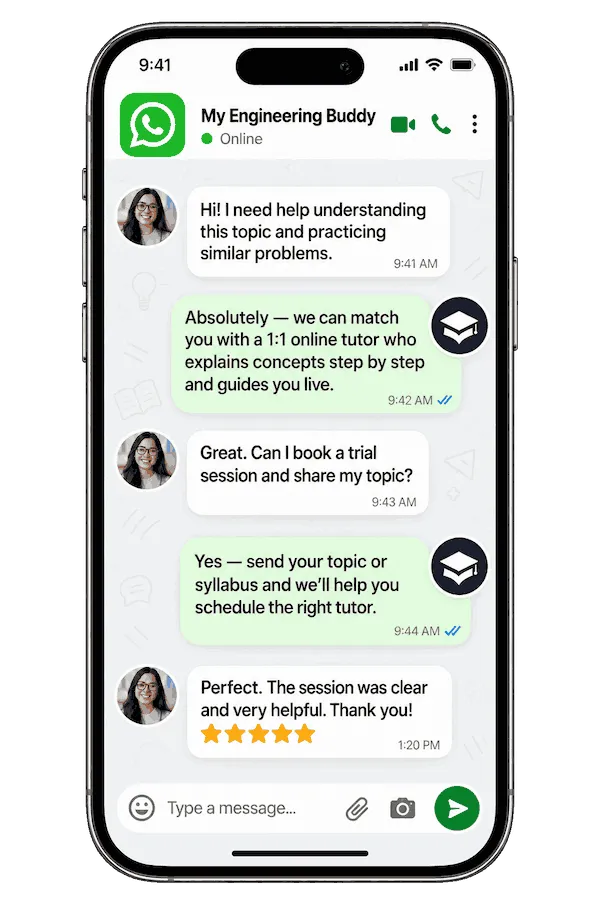
Unlike platforms where you fill out a form and wait days, MEB responds in under a minute, 24/7. Tutor match takes under an hour. The $1 trial means you test before you commit. Everything runs over WhatsApp — no logins, no intake forms.
Study Plans (Pick One That Matches Your Goal)
Once the diagnostic is done, your tutor builds the sequence — not before. As a guide: catch-up plans (1–3 weeks) focus on the one or two assessment components losing the most marks; exam prep plans (4–8 weeks) work through every assessable area systematically with past briefs and timed practice; weekly support runs in parallel with your semester, keeping each assignment on track as the deadline arrives. The tutor recommends which fits after seeing your work.
Pricing Guide
Broadcast journalism tutoring starts at $20/hr for standard undergraduate and A-level equivalent work. Graduate-level modules, specialist media law support, and tutors with active industry backgrounds — television news, radio production, or documentary — run up to $100/hr. Rate depends on level, topic complexity, your timeline, and tutor availability.
For students targeting top journalism programmes at schools like Northwestern Medill, Columbia Journalism School, or Cardiff School of Journalism, tutors with professional broadcast backgrounds are available at higher rates — share your specific goal and MEB will match the tier to your ambition.
Availability drops in the four weeks before portfolio submission deadlines and end-of-semester assessments. Start with the $1 trial — 30 minutes, no registration, no commitment. WhatsApp MEB for a quick quote.
FAQ
Is broadcast journalism hard?
It’s specific rather than difficult in the traditional sense. The hardest shift is learning to write for the ear — short, active, immediate. Students who can write well for print often need to relearn sentence structure entirely. That transition is where most marks are lost early on.
How many sessions are needed?
Most students working on a single assessment component — a radio package or live presentation — see clear improvement in 4–6 sessions. Students covering a full semester of broadcast journalism modules typically benefit from 10–15 hours of 1:1 support spread across the term.
Can you help with homework and assignments?
MEB tutoring is guided learning — you understand the work, then submit it yourself. If you’re stuck on a script draft, a media law problem question, or an editorial brief, the tutor explains the principles and works through the approach with you. See our Academic Integrity policy and Why MEB page for full details on what we help with and what we don’t.
Will the tutor match my exact syllabus or exam board?
Yes. Before matching, MEB confirms your course level, institution, and the specific assessment format — whether that’s a radio package, a TV bulletin, a media law essay, or a live newsroom simulation. The tutor is selected based on that specific fit, not general journalism knowledge.
What happens in the first session?
The tutor reviews your most recent work — a script, a recorded package, or an assignment brief — and identifies the two or three clearest gaps. From that, they build the session plan for the rest of your time together. Nothing is assumed in advance.
Is online tutoring as effective as in-person?
For broadcast journalism, yes — and in some respects better. Script annotation on a shared screen is faster than passing paper. Recorded read-alouds can be played back instantly. The Google Meet setup MEB uses handles all of it without technical friction.
Can I get broadcast journalism help at midnight or on weekends?
Yes. MEB operates 24/7 across all time zones. WhatsApp response typically comes within a minute regardless of hour. Tutors are matched across US, UK, Gulf, and Australian time zones so late-night sessions before a deadline are standard, not exceptional.
What’s the difference between a broadcast journalism tutor and a general media studies tutor?
A broadcast journalism tutor has specific expertise in audio-visual news production, scripting for air, and broadcast media law — not just media theory. If your assessment involves package production, live delivery, or newsroom-format tasks, that specialist background matters significantly for your results.
Do you offer group broadcast journalism sessions?
No. MEB’s model is 1:1 exclusively. Group sessions dilute the diagnostic element — the tutor can’t correct your specific script or delivery pattern if they’re managing four students at once. Every session is built around one student’s work and one student’s gaps.
How do I find a broadcast journalism tutor in my city?
MEB is fully online, which means location is irrelevant. A student in Toronto, Dubai, or Glasgow accesses the same tutor pool. Sessions run on Google Meet at times matched to your time zone — no travel, no geographic limitation on tutor quality.
How do I get started?
WhatsApp MEB with your course details, the assessment you’re working on, and your deadline. You’ll be matched with a verified broadcast journalism tutor — typically within the hour. The first session is the $1 trial: 30 minutes of live tutoring or one question explained in full.
What’s the best way to prepare for a broadcast journalism live assessment?
Record yourself at least once before the session and bring that recording. The tutor will analyse pace, articulation, script phrasing, and composure under pressure — all of which are marked in live broadcast assessments. Hearing the playback together in the first session cuts prep time significantly compared to practising blind.
Trust & Quality at My Engineering Buddy
Every MEB tutor goes through subject-specific vetting — a live demo session reviewed against broadcast journalism competencies, qualification verification, and ongoing feedback review from student sessions. Rated 4.8/5 across 40,000+ verified reviews on Google. Tutors in broadcast journalism hold degrees in journalism, media production, or communications, and many have professional television, radio, or digital news backgrounds. A degree in a related subject is not enough — the tutor needs to know how a newsroom actually works.
MEB tutoring is guided learning — you understand the work, then submit it yourself. For full details on what we help with and what we don’t, read our Academic Integrity policy and Why MEB.
MEB has served 52,000+ students across the US, UK, Canada, Australia, the Gulf, and Europe since 2008 — across 2,800+ subjects, including Communication & Media Studies disciplines such as broadcast journalism, communication theory tutoring, and copy editing help. The video production tutoring and film studies tutoring that sits alongside broadcast journalism in many media programmes is covered by the same tutor pool, verified to the same standard.
The Brookings Institution has highlighted the growing demand for journalists who can operate across broadcast, digital, and data-driven formats — skills that sit at the intersection of traditional broadcast reporting and emerging media practice.
Source: Brookings Institution.
Explore Related Subjects
Students studying Broadcast Journalism often also need support in:
- Advertising
- Cinematography
- Cultural Studies
- Essay Editing
- Intercultural Communication
- Interpersonal Communication
- Public Speaking
- Visual Communication
Next Steps
When you contact MEB, share your exam board or course name, the assessment component you’re most stuck on, and how many weeks you have before your deadline. Include your time zone and when you’re free to meet.
- MEB matches you with a verified broadcast journalism tutor — usually within an hour
- The first session opens with a diagnostic so every minute is spent on what actually matters
- Progress is tracked session by session — no guessing about where you stand
Before your first session, have ready: your course outline or assessment brief, the most recent piece of work you’ve submitted or attempted, and your submission or exam date. The tutor handles the rest.
Visit www.myengineeringbuddy.com for more on how MEB works.
WhatsApp to get started or email [email protected].
Reviewed by Subject Expert
This page has been carefully reviewed and validated by our subject expert to ensure accuracy and relevance.




