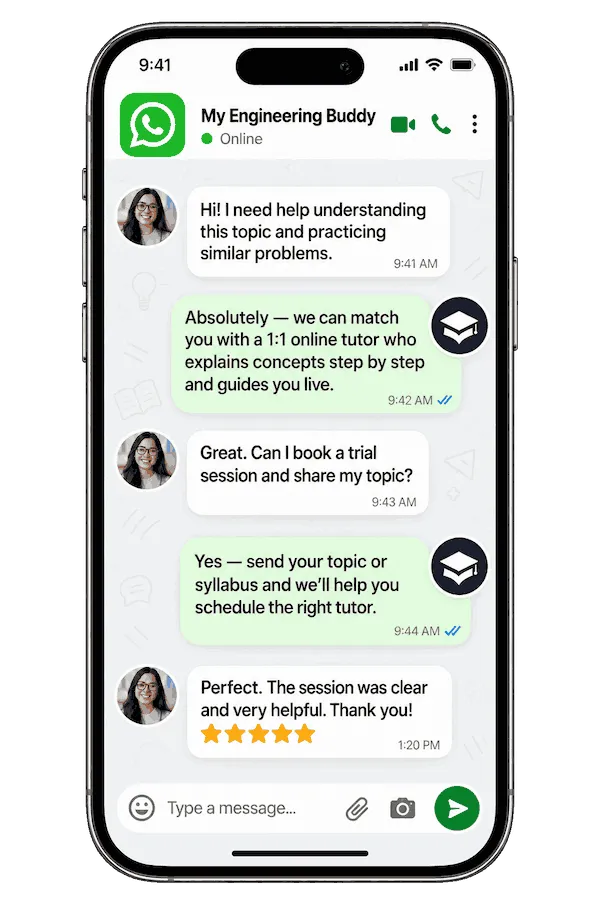
~1 min
Average Reply Time
~1 hour
To Be Matched With A Tutor
30 Min Trial
75% Find Their Tutor On The 1st Trial
$20-35+/hr
Premium Yet Affordable Learning
Most cinematography students lose marks not on theory — but on explaining why a shot works. A good tutor fixes that fast.
Cinematography Tutor Online
Cinematography is the art and technique of motion picture photography, covering shot composition, camera movement, lens selection, lighting design, and visual storytelling. It equips students to craft images that serve narrative and emotional intent.
If you’re searching for a cinematography tutor near me, MEB matches you with a specialist who knows your exact course — whether that’s an undergraduate film production module, a graduate-level visual storytelling programme, or a professional certification in camera operation. Our Communication & Media Studies tutoring covers 2,800+ subjects, and cinematography is one of our most requested. One diagnostic session tells us where your gaps are. Everything after that is targeted.
- 1:1 online sessions tailored to your syllabus and current unit
- Expert-verified tutors with working knowledge of cinematography principles and production workflows
- Flexible time zones — US, UK, Canada, Australia, Gulf
- Structured learning plan built after a diagnostic session
- Guided homework and assignment support — you understand the work, then submit it yourself
52,000+ students across the US, UK, Canada, Australia, and the Gulf have used MEB since 2008 — including students in Communication & Media Studies subjects like Cinematography, Filmmaking & Direction, and Film Studies.
Source: My Engineering Buddy, 2008–2025.
How Much Does a Cinematography Tutor Cost?
Most cinematography tutoring at MEB runs $20–$40/hr depending on your level and the complexity of the topic. Graduate and specialist sessions can go higher. The $1 trial gets you 30 minutes of live tutoring or a full explanation of one assignment question — no registration, no commitment.
| Level / Need | Typical Rate | What’s Included |
|---|---|---|
| Undergraduate (most modules) | $20–$35/hr | 1:1 sessions, assignment guidance |
| Graduate / Specialist | $35–$70/hr | Expert tutor, advanced analysis |
| $1 Trial | $1 flat | 30 min live session or 1 assignment Q |
Tutor availability drops fast during project submission windows and semester finals. Book early if your deadline is within four weeks.
WhatsApp MEB for a quick quote — average response time under 1 minute.
Who This Cinematography Tutoring Is For
Cinematography sits at the intersection of technical skill and critical analysis. Students often arrive confident in one area and completely stuck in the other. If that sounds familiar, you’re in the right place.
- Undergraduate film or media students struggling with shot analysis essays or practical critique write-ups
- Graduate students working through advanced visual theory, thesis chapters, or research-led production projects
- Students with a coursework or portfolio submission deadline approaching — and significant sections still incomplete
- Students who passed the practical components but are failing the written analysis side of their module
- Parents watching a student’s confidence drop as production assignments stack up without clear feedback
- Students at universities such as NYU Tisch, USC School of Cinematic Arts, UCLA Film School, Royal Holloway, Leeds Trinity, or Goldsmiths who need targeted support outside their timetabled sessions
1:1 Tutoring vs Self-Study vs AI vs YouTube vs Online Courses
Self-study works if you’re disciplined, but cinematography requires feedback on your reasoning — not just your output. AI tools can define a Dutch angle in seconds but can’t tell you why your specific shot selection undermined your scene’s tension. YouTube covers the basics well; it stops when your question gets specific. Online courses move at a fixed pace with no room for your exact assignment. With a 1:1 online cinematography tutor, every session is built around your actual work — your shots, your script, your examiner’s rubric.
Outcomes: What You’ll Be Able To Do in Cinematography
After working with an MEB cinematography tutor, you’ll be able to analyse shot composition using formal frameworks like the rule of thirds, leading lines, and depth of field — and explain your choices in writing. You’ll apply lighting theory to differentiate high-key and low-key setups and defend those decisions analytically. You’ll present a coherent argument about how camera movement — rack focus, dolly, handheld — generates meaning in a specific scene. You’ll solve the gap between what you see on screen and what you can write about it. These aren’t generic film skills; they’re the exact competencies your tutors, markers, and examiners look for.
Based on feedback from 40,000+ sessions collected by MEB from 2022 to 2025, 58% of students improved by one full grade after approximately 20 hours of 1:1 tutoring in subjects like Cinematography. A further 23% achieved at least a half-grade improvement.
Source: MEB session feedback data, 2022–2025.
Supporting a student through Cinematography? MEB works directly with parents to set up sessions, track progress, and keep coursework on schedule. WhatsApp MEB — average response time is under a minute, 24/7.
At MEB, we’ve found that the students who improve fastest in cinematography aren’t the ones who watch the most films — they’re the ones who practise writing about what they see, with someone pushing back on their reasoning in real time.
What We Cover in Cinematography (Syllabus / Topics)

Visual Language and Shot Design
- Shot types: extreme wide, medium, close-up, POV, over-the-shoulder
- Composition principles: rule of thirds, symmetry, negative space, leading lines
- Camera angles and their narrative effect: high angle, low angle, Dutch tilt
- Camera movement: pan, tilt, dolly, crane, handheld, Steadicam
- Depth of field: shallow vs deep, and when each is used deliberately
- Screen direction and the 180-degree rule
- Scene analysis: breaking down sequences from canonical films shot-by-shot
Key texts: Cinematography: Theory and Practice by Blain Brown; The Grammar of the Shot by Roy Thompson and Christopher Bowen.
Lighting and Exposure
- Three-point lighting: key, fill, and back light placement
- High-key vs low-key lighting and their emotional registers
- Natural light: golden hour, overcast diffusion, window light techniques
- Colour temperature: Kelvin scale, white balance, warm vs cool palettes
- Exposure triangle: ISO, aperture, shutter speed — and how they interact
- Practical lights and motivated light sources in narrative contexts
Key texts: Painting with Light by John Alton; Motion Picture and Video Lighting by Blain Brown.
Lenses, Cameras, and Technical Analysis
- Focal length and perspective distortion: wide, standard, telephoto
- Prime vs zoom lenses: trade-offs in different production contexts
- Sensor formats and aspect ratios: how format shapes visual grammar
- Digital vs film: technical and aesthetic distinctions relevant to academic analysis
- Colour grading fundamentals: LUTs, colour space, and how grading affects tone
- Reading technical shot lists and storyboards critically
Key texts: The Filmmaker’s Eye by Gustavo Mercado; The Visual Story by Bruce Block.
Students consistently tell us that the moment cinematography clicks is when they stop describing what’s on screen and start explaining why it works. That shift — from observation to argument — is what tutors target from the first session.
Platforms, Tools & Textbooks We Support
Cinematography coursework increasingly involves specific software for pre-production planning, shot analysis, and post-production review. MEB tutors can support you across the tools your programme actually uses — not just theory in the abstract.
- Celtx and StudioBinder — for shot lists, storyboards, and production planning
- DaVinci Resolve — colour grading and node-based correction
- Adobe Premiere Pro — timeline editing and basic colour tools
- Frame.io — shot review and collaborative annotation
- Shot Designer — blocking and camera angle planning
What a Typical Cinematography Session Looks Like
The tutor opens by reviewing the previous week’s focus — usually a shot analysis the student drafted or a specific lighting concept that wasn’t landing. From there, the session moves into the current challenge: maybe you’re writing a critical essay on deep focus in Citizen Kane, or you’re stuck explaining how rack focus creates dramatic irony in a scene you’ve been assigned. The tutor uses a digital pen-pad to annotate frame grabs directly, marking composition lines and light sources on screen while you follow. You then replicate the analysis on a different frame. By the end, you have a concrete task — two or three paragraphs drafted, a comparison drawn, or a storyboard annotated — and you know exactly which section of your module guide you’re working toward next.
How MEB Tutors Help You with Cinematography (The Learning Loop)
Diagnose: In the first session, the tutor identifies whether your gap is technical vocabulary, analytical writing, visual literacy, or the link between theory and practice. Most students have one dominant weakness — the tutor finds it within 20 minutes.
Explain: The tutor works through a specific scene or concept live — annotating frame grabs, drawing lighting diagrams, or modelling how to structure a shot analysis argument. You see the reasoning, not just the answer.
Practice: You attempt the analysis or task on screen with the tutor present. This is where most students accelerate — doing it in real time, with someone watching, beats doing it alone and finding out later it was wrong.
Feedback: The tutor corrects errors step by step. Not “this is wrong” — but “here’s where your argument broke down and why the examiner won’t follow it.” That specificity is what changes the next draft.
Plan: Each session closes with the next topic mapped out. If your submission is six weeks away, the tutor works backward from that date and tells you exactly what needs to happen each week.
All sessions run over Google Meet. The tutor uses a digital pen-pad or iPad with Apple Pencil to annotate directly on your work or on film stills. Before your first session, have your course outline, a recent assignment you struggled with, and your submission date ready. The tutor handles the rest. Start with the $1 trial — 30 minutes of live tutoring that also serves as your first diagnostic.
MEB tutors don’t teach cinematography from a textbook in isolation — they work from your actual coursework, your specific essay question, and your examiner’s mark scheme. That’s the difference between general knowledge and marks on the page.
Source: My Engineering Buddy, tutoring methodology overview.
Try your first session for $1 — 30 minutes of live 1:1 tutoring or one homework question explained in full. No registration. No commitment. WhatsApp MEB now and get matched within the hour.
Tutor Match Criteria (How We Pick Your Tutor)
Not every film tutor can teach cinematography at the analytical level your module demands. Here’s what MEB matches on.
Subject depth: The tutor must demonstrate working knowledge of cinematography theory — not just production experience. Academic levels, essay conventions, and syllabus-specific vocabulary all matter.
Tools: All tutors use Google Meet with a digital pen-pad or iPad and Apple Pencil. Sessions are visual by design.
Time zone: Matched to your region — US, UK, Gulf, Canada, or Australia — so scheduling isn’t an obstacle.
Goals: Whether you need help with analytical writing, technical understanding, visual grammar, or approaching a portfolio project, the match reflects your actual objective.
Unlike platforms where you fill out a form and wait, MEB responds in under a minute, 24/7. Tutor match takes under an hour. The $1 trial means you test before you commit. Everything runs over WhatsApp — no logins, no intake forms. For video production tutoring or adjacent subjects, the same matching process applies.
Study Plans (Pick One That Matches Your Goal)
If your essay submission or module exam is three weeks out, the tutor focuses on the highest-yield gaps first — usually analytical writing structure and the three or four key theoretical concepts your module keeps returning to. For students with a full semester ahead, the plan follows your module week by week. Four to eight weeks is the most common window: structured revision of core cinematography theory, scene analysis practice, and essay drafting in the final two weeks. The tutor maps the sequence after the first diagnostic — nothing is assumed.
Pricing Guide
Cinematography tutoring at MEB starts at $20/hr for standard undergraduate modules. Graduate-level and specialist sessions — particularly those involving advanced film theory, thesis support, or professional certification — run up to $100/hr. Rate factors include your level, how specific the topic is, your timeline, and tutor availability.
Availability tightens significantly during end-of-semester submission windows. If your deadline is within four weeks, reach out now rather than later.
For students targeting competitive MFA programmes at institutions like AFI, NFTS, or the London Film School, tutors with professional production and academic backgrounds are available at higher rates — share your specific goal and MEB will match the tier to your ambition.
Start with the $1 trial — 30 minutes, no registration, no commitment. WhatsApp MEB for a quick quote.
FAQ
Is cinematography hard?
The practical side is learnable with structured guidance. The part most students struggle with is writing analytically about what they see — connecting visual choices to theory and making a coherent argument. That’s exactly where a tutor adds the most value.
How many sessions do most students need?
Students closing a specific essay gap often see marked improvement in four to six sessions. Students working through a full module across a semester typically book weekly. The tutor gives you a realistic estimate after the first diagnostic session.
Can you help with homework and assignments?
MEB tutoring is guided learning — you understand the work, then submit it yourself. The tutor explains the concept, works through the approach, and helps you develop your own argument. See our Academic Integrity policy and Why MEB page for full details on what we help with and what we don’t.
Will the tutor match my exact syllabus or exam board?
Yes. Share your course outline, module handbook, or assignment brief before the first session. The tutor works from your actual document — not a generic cinematography curriculum. This applies whether your course is UK-based, North American, or another international programme.
What happens in the first session?
The tutor reviews your course outline and a recent piece of work, identifies your main gap, and begins working on it immediately. By the end of the first 30 minutes, you’ll have a clearer picture of what’s holding your grade back and what the next few sessions will address.
Is online tutoring as effective as in-person for cinematography?
For analytical and theoretical work, online is equally effective — often more so, since tutors can annotate film stills and share screen in real time. The digital pen-pad replicates whiteboard working closely. Purely practical camera handling is the one area where in-person has an edge, but most coursework assessment is writing-based.
Can I get cinematography help at midnight or on weekends?
Yes. MEB operates across time zones 24/7. If you’re in the Gulf, Australia, or the US West Coast and need a session late at night or on a Sunday, tutors are available. WhatsApp is the fastest way to check availability and get matched.
What if I don’t get on with my assigned tutor?
Tell MEB via WhatsApp and a replacement is arranged immediately — usually within the hour. There’s no form to fill out and no delay. The $1 trial exists partly for this reason: you test the match before committing to paid sessions.
Do you offer group cinematography sessions?
MEB’s model is 1:1 only. Group sessions dilute the diagnostic focus and slow down the student who needs to move fastest. Every session is built around one student’s specific work, gaps, and deadline.
What’s the difference between cinematography and film studies — and do your tutors know both?
Cinematography focuses on the technical and visual craft — how images are made. Film studies engages more broadly with cultural, historical, and theoretical interpretation of films. Many modules blend both. MEB tutors who cover film studies tutoring and cinematography are matched based on the balance your specific course requires.
Can you help with a cinematography portfolio or showreel analysis?
Yes. Tutors can help you select work, write analytical commentary, and structure a portfolio that meets programme-specific criteria — for example, MFA applications or production degree assessments. Share the brief or submission guidelines and the tutor works from those directly.
How do I get started?
Three steps: WhatsApp MEB, get matched with a verified cinematography tutor (usually within an hour), then start your $1 trial — 30 minutes of live tutoring or one assignment question explained in full. No registration required.
Trust & Quality at My Engineering Buddy
Every MEB tutor goes through subject-specific vetting: a live demo evaluation, degree and experience verification, and ongoing review based on student feedback. Tutors covering cinematography are assessed on their knowledge of visual theory, analytical frameworks, and familiarity with the types of assignments students are actually graded on — not just general film knowledge. Rated 4.8/5 across 40,000+ verified reviews on Google. For students needing visual communication tutoring alongside their cinematography work, the same screening standards apply.
MEB tutoring is guided learning — you understand the work, then submit it yourself. For full details on what we help with and what we don’t, read our Academic Integrity policy and Why MEB.
MEB has served 52,000+ students across the US, UK, Canada, Australia, the Gulf, and Europe since 2008 — across 2,800+ subjects in Communication & Media Studies and beyond. Students working on broadcast journalism tutoring and video editing help frequently pair those sessions with cinematography support. Read more about how sessions are structured at MEB’s tutoring methodology page.
The Smithsonian Institution’s visual arts collections and the broader field of visual culture studies both point to the same truth: the ability to read and construct images analytically is a distinct, teachable skill — not an innate talent.
Source: Smithsonian Institution.
Explore Related Subjects
Students studying Cinematography often also need support in:
- Advertising
- Communication Skills
- Communication Studies
- Cultural Studies
- Mass Communication
- Photo Editing
- Public Speaking
Next Steps
Here’s what to do right now.
- Share your module or course outline, your hardest topic, and your submission or exam date
- Share your time zone and availability — sessions are matched to your schedule
- MEB matches you with a verified cinematography tutor, usually within 24 hours
- The first session starts with a diagnostic — every minute is used on what actually matters
Before your first session, have ready: your course syllabus or module handbook, a recent assignment or essay you struggled with, and your deadline date. The tutor handles everything else.
Visit www.myengineeringbuddy.com for more on how MEB works.
WhatsApp to get started or email [email protected].
Reviewed by Subject Expert
This page has been carefully reviewed and validated by our subject expert to ensure accuracy and relevance.