




~1 min
Average Reply Time
~1 hour
To Be Matched With A Tutor
30 Min Trial
75% Find Their Tutor On The 1st Trial
$20-35+/hr
Premium Yet Affordable Learning
Hire The Best Redis Tutor


Your Redis commands work locally. Your production cache is evicting keys at the wrong time and you have no idea why. A live tutor finds that in 20 minutes.
Redis Tutor Online
Redis is an open-source, in-memory data structure store used as a database, cache, and message broker. It supports strings, hashes, lists, sets, sorted sets, and Pub/Sub messaging, equipping developers to build high-throughput, low-latency systems.
If you’re searching for a Redis tutor near me, the location doesn’t matter — MEB’s 1:1 online tutoring and project help covers everything from basic key-value operations to production-grade caching strategies and stream processing. Our software engineering tutoring network includes verified specialists who have deployed Redis in real systems, not just read the docs. One session can close the gap between code that almost works and code that ships.
- 1:1 online sessions tailored to your course, project, or system design goal
- Expert-verified tutors with hands-on Redis deployment experience
- Flexible time zones — US, UK, Canada, Australia, Gulf
- Structured learning plan built after a diagnostic session
- Guided project support — we explain, you build
52,000+ students across the US, UK, Canada, Australia, and the Gulf have used MEB since 2008 — including students working on software engineering projects in Redis, Apache Kafka, and MongoDB.
Source: My Engineering Buddy, 2008–2025.
How Much Does a Redis Tutor Cost?
Most Redis sessions run $20–$40/hr depending on level and topic depth — graduate-level distributed systems work or niche Redis modules can reach $100/hr. The $1 trial gets you 30 minutes of live 1:1 tutoring or a full explanation of one project problem, no registration needed.
| Level / Need | Typical Rate | What’s Included |
|---|---|---|
| Standard (undergrad / bootcamp) | $20–$35/hr | 1:1 sessions, project guidance |
| Advanced / Specialist (grad, production systems) | $35–$100/hr | Expert tutor, architecture depth |
| $1 Trial | $1 flat | 30 min live session or 1 project Q |
Tutor availability tightens around university project deadlines and end-of-semester sprints — book early if you have a hard submission date.
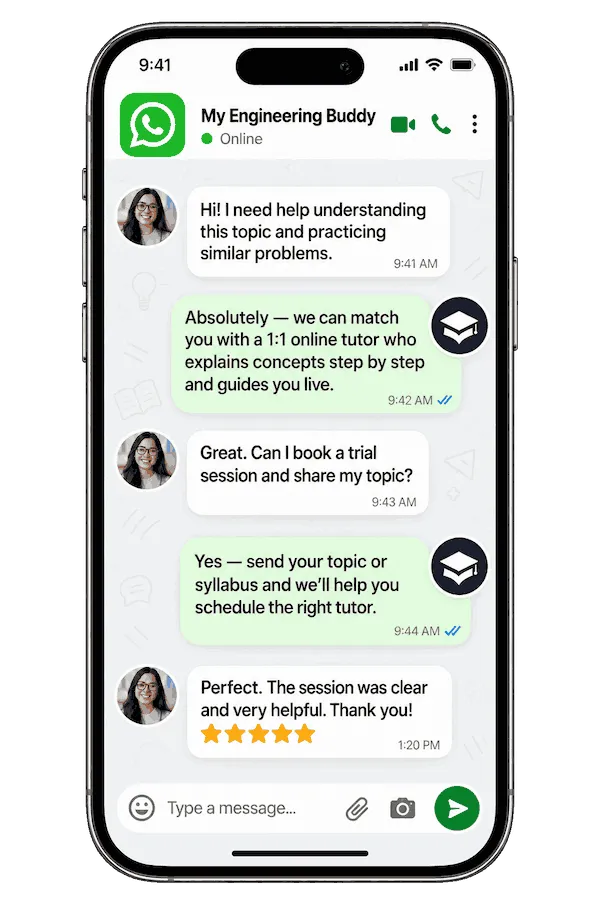
WhatsApp MEB for a quick quote — average response time under 1 minute.
Who This Redis Tutoring Is For
Redis is used at every level — from a CS sophomore’s first caching assignment to a senior engineer designing a rate-limiting layer for 10 million daily requests. The gap between those two is mostly practice and exposure, not raw ability.
- Undergrad and graduate CS students with Redis assignments or capstone projects
- Bootcamp graduates preparing for backend or full-stack roles where Redis knowledge is tested in interviews
- Software engineers moving into system design work who need to get Redis right under pressure
- Students with a project submission deadline approaching and persistent bugs in their caching or session logic
- Students who tried to learn Redis from docs and YouTube but can’t debug why their keys are expiring, their Pub/Sub isn’t delivering, or their Lua scripts aren’t running correctly
- Engineers at companies like Stripe, Shopify, or any fintech using Redis Streams who need faster, deeper fluency
Students have come to MEB from programmes at MIT, Carnegie Mellon, Georgia Tech, the University of Toronto, Imperial College London, and ETH Zurich — among many others.
1:1 Tutoring vs Self-Study vs AI vs YouTube vs Online Courses
Self-study: fine if you already know what you don’t know. AI tools: quick answers, can’t watch you misread a TTL config and correct you live. YouTube: good for concepts, useless when your Lua script throws a WRONGTYPE error at 11pm. Online courses: structured, but they teach the happy path, not your broken project. 1:1 Redis tutoring with MEB: live, on your actual code, calibrated to whether you’re building a session store, a leaderboard, or a message queue. The difference shows up in the debugging session, not the lecture.
Outcomes: What You’ll Be Able To Do in Redis
After working with an MEB Redis tutor online, you’ll be able to model data correctly across strings, hashes, lists, sorted sets, and HyperLogLog — not just pick one and hope. You’ll apply TTL strategies and eviction policies like allkeys-lru and volatile-ttl to production scenarios without guessing. You’ll explain the difference between Redis Pub/Sub and Redis Streams and choose the right one for your use case. You’ll write Lua scripts that execute atomically. You’ll present your architecture decisions in a system design interview or project defence with confidence.
Supporting a student through Redis? MEB works directly with parents to set up sessions, track progress, and keep project work on schedule. WhatsApp MEB — average response time is under a minute, 24/7.
Based on feedback from 40,000+ sessions collected by MEB from 2022 to 2025, students working 1:1 on Redis consistently report faster debugging of production caching issues, clearer understanding of data structure selection, and greater confidence in system design discussions. Progress varies by starting level and practice frequency.
Source: MEB session feedback data, 2022–2025.
What We Cover in Redis (Topics)
Core Data Structures and Commands
- Strings, integers, and INCR/DECR for counters and rate limiting
- Hashes for storing structured objects (user sessions, product data)
- Lists for queues, stacks, and activity feeds
- Sets and sorted sets — ZADD, ZRANGE, leaderboards, geospatial indexing
- HyperLogLog for approximate cardinality counting at scale
- Bitmaps and bitfields for compact boolean and numeric data
Recommended: Redis in Action by Josiah Carlson; The Little Redis Book by Karl Seguin; Redis official documentation (redis.io).
Caching, Persistence, and Eviction
- Cache-aside, write-through, and write-behind patterns
- TTL configuration, key expiry, and lazy vs active expiration
- Eviction policies: noeviction, allkeys-lru, volatile-lru, allkeys-lfu
- RDB snapshots vs AOF persistence — trade-offs for durability
- Memory profiling with MEMORY USAGE and OBJECT ENCODING
- Debugging cache stampedes and thundering herd problems
Recommended: Designing Data-Intensive Applications by Martin Kleppmann (chapters on caching and replication); Redis documentation on persistence.
Pub/Sub, Streams, and Distributed Patterns
- Redis Pub/Sub — channels, subscribe/publish, fire-and-forget semantics
- Redis Streams — consumer groups, XADD/XREAD, message acknowledgement
- Lua scripting for atomic multi-command operations (EVAL, EVALSHA)
- Distributed locks with the Redlock algorithm
- Redis Sentinel for high availability and automatic failover
- Redis Cluster — sharding, hash slots, and replication topology
- Integration with Apache Kafka and Docker in production pipelines
Recommended: Redis in Action (advanced chapters); Designing Data-Intensive Applications by Martin Kleppmann.

At MEB, we’ve found that most Redis confusion isn’t about missing commands — it’s about data model decisions made early that compound into bugs later. A tutor who has built real systems spots those in the first session and reframes the entire project approach.
Platforms, Tools & Textbooks We Support
Redis runs in every modern environment — MEB tutors work with you in whichever stack you’re using. Sessions cover Redis CLI, Redis Desktop Manager, RedisInsight, redis-py, ioredis (Node.js), Jedis (Java), and Spring Data Redis. We also support Redis deployments on AWS, Microsoft Azure, and Google Cloud Platform — including ElastiCache and Azure Cache for Redis configurations.
What a Typical Redis Session Looks Like
The tutor opens by checking where you got stuck last time — often it’s the eviction policy you set, or a sorted set query that’s returning results in the wrong order. You share your screen or paste your redis.conf and current commands. The tutor uses a digital pen-pad to draw the data model live while explaining why your LPUSH/RPOP queue is dropping messages under load. You replicate the corrected approach in your own terminal. The session closes with one concrete task: rewrite the session store using HSET instead of a JSON string in a single key, and test expiry behaviour before next time.
How MEB Tutors Help You with Redis (The Learning Loop)
Diagnose: In the first session, the tutor identifies exactly where your understanding breaks — usually it’s one of three things: data structure selection, TTL misconfiguration, or misunderstanding how Redis handles atomicity. They read your code, not just your description of the problem.
Explain: The tutor works through real examples on a digital pen-pad — showing, for instance, how MULTI/EXEC transactions differ from Lua scripts and when each one fails you. Live worked problems, not slides.
Practice: You attempt the corrected approach with the tutor watching. This is where most online courses fall short — they can’t see you make the mistake in real time and stop you before it becomes habit.
Feedback: The tutor walks through every error step by step — why your Pub/Sub subscriber missed messages, why your Redlock implementation has a race condition, and what the fix actually changes at the command level.
Plan: Each session ends with the next topic mapped out, a specific task to complete before the next session, and a note on which Redis module or pattern to tackle next.
Sessions run over Google Meet with a digital pen-pad or iPad + Apple Pencil. Before your first session, share your project brief or the specific Redis feature you’re working with. The first session starts with a diagnostic — the tutor identifies your gaps in 10–15 minutes and builds the plan from there. Start with the $1 trial — 30 minutes of live tutoring that also serves as your first diagnostic.
Students consistently tell us that one session on Redis Streams cleared up confusion that two weeks of documentation reading hadn’t. The difference is a tutor who has actually run consumer groups in production and can explain failure modes from experience.
Source: MEB student feedback, 2022–2025.
Try your first session for $1 — 30 minutes of live 1:1 tutoring or one project question explained in full. No registration. No commitment. WhatsApp MEB now and get matched within the hour.
Tutor Match Criteria (How We Pick Your Tutor)
Not every experienced developer is the right Redis tutor. MEB matches on four things.
Subject depth: The tutor must have worked with Redis in a production context — not just taught it. For advanced topics like Redis Cluster or Lua scripting, MEB matches tutors with demonstrated architecture or backend engineering backgrounds.
Tools: Every tutor works over Google Meet with a digital pen-pad or iPad + Apple Pencil — so they can draw your data model and annotate your config live.
Time zone: Matched to your region — US, UK, Canada, Australia, Gulf — so sessions don’t start at 2am unless you want them to.
Goals: Whether you need to pass a backend interview, ship a project, or understand distributed Redis for a graduate course, the tutor is briefed on your specific goal before session one.
Unlike platforms where you fill out a form and wait, MEB responds in under a minute, 24/7. Tutor match takes under an hour. The $1 trial means you test before you commit. Everything runs over WhatsApp — no logins, no intake forms.
Pricing Guide
Redis tutoring starts at $20/hr for undergraduate and bootcamp-level work. Graduate-level distributed systems, Redis Cluster architecture, or production debugging with a senior engineer tutor runs $50–$100/hr. Rate depends on topic complexity, your timeline, and tutor availability.
Tutor availability tightens near university project deadlines — if you have a submission date, book now rather than in week five of six.
For students targeting roles at high-scale companies or building Redis-backed infrastructure for research or enterprise systems, tutors with professional backend engineering backgrounds are available at higher rates — share your specific goal and MEB will match the tier to your ambition.
Start with the $1 trial — 30 minutes, no registration, no commitment. WhatsApp MEB for a quick quote.
MEB has covered 2,800+ subjects since 2008 — from back-end development tutoring and DevOps help to niche tools few other platforms even list. Redis is one of the subjects requested most frequently by backend engineers and CS students in the Gulf and North America.
Source: My Engineering Buddy internal subject demand data, 2022–2025.
A common pattern our tutors observe is that students can get basic Redis working in an afternoon but hit a wall when the project requires real decisions — expiry strategy, persistence mode, cluster vs sentinel. That wall is exactly where 1:1 sessions pay off fastest.
FAQ
Is Redis hard to learn?
The basics — GET, SET, EXPIRE, simple data structures — take a day or two. The hard part is knowing which data structure fits your use case, how eviction policies behave under memory pressure, and when Pub/Sub breaks down. That’s where most students get stuck.
How many sessions will I need?
For a specific project bug or assignment, one to three sessions usually closes it. For a full understanding of caching patterns, persistence, and distributed Redis, most students find six to ten hours sufficient to work confidently without external help.
Can you help with Redis projects and portfolio work?
Yes. MEB provides guided project support — the tutor explains the logic, the approach, and the correct commands, and you implement and submit the work yourself. See our Policies page and Why MEB page for full details on what we help with and what we don’t.
Will the tutor match my exact stack and use case?
Yes. Share your language (Python, Node.js, Java, Go), your deployment environment (bare metal, Docker, ElastiCache), and your specific goal. MEB matches a tutor briefed on all three before the first session starts.
What happens in the first session?
The tutor runs a short diagnostic — usually reviewing your current code or config — to identify exactly where the problem is. From there, the session moves directly into working through those gaps. No time wasted on topics you already know.
Is online Redis tutoring as effective as in-person?
For Redis work, yes. Screen sharing, live code annotation, and the digital pen-pad make remote sessions more productive than most in-person alternatives — the tutor can see your exact environment, not a whiteboard approximation of it.
What’s the difference between Redis Pub/Sub and Redis Streams — and do tutors cover both?
Yes, both are covered. Pub/Sub is fire-and-forget with no message persistence; Streams add consumer groups, acknowledgements, and replay. The choice matters a lot at scale. Tutors walk through the trade-offs using your actual project requirements, not abstract examples.
Can a Redis tutor help me prepare for system design interviews where Redis comes up?
Directly, yes. Tutors cover how to present Redis caching layers, session store design, rate limiting with sorted sets, and Redlock in interview contexts — including how to explain trade-offs to an interviewer at FAANG-tier companies or high-growth startups.
Can I get Redis help at midnight or on weekends?
Yes. MEB operates 24/7 across all time zones. WhatsApp response is typically under a minute regardless of when you message. If you’re debugging at 1am before a morning deadline, that’s exactly what the service is built for.
What if I don’t get along with my assigned tutor?
Switch. Message MEB on WhatsApp and a different tutor is matched — usually within the hour. No explanation required. The $1 trial is specifically designed so you know whether the fit is right before spending more.
Do you offer group Redis sessions?
No. Every session is 1:1. Group sessions slow down to the pace of the group’s weakest point, which rarely matches yours. MEB’s model is built around one tutor, one student, one specific problem — that’s the format that actually moves things forward.
How do I get started?
WhatsApp MEB, share your project or topic, and get matched with a verified Redis tutor — usually within 24 hours. Your first session is the $1 trial: 30 minutes live or one project question explained in full. Three steps: WhatsApp → matched → start.
Trust & Quality at My Engineering Buddy
Every MEB tutor goes through subject-specific screening — not a generic interview. For Redis, that means demonstrating working knowledge of data structure selection, caching strategy, and at least one distributed pattern before being accepted. Tutors then complete a live demo evaluation and are reviewed after every session. Rated 4.8/5 across 40,000+ verified reviews on Google.
MEB provides guided learning support. All project work is produced and submitted by the student. See our Policies page for details.
MEB has served 52,000+ students across the US, UK, Canada, Australia, the Gulf, and Europe in 2,800+ subjects since 2008 — including microservices tutoring, Kubernetes help, and Elasticsearch tutoring alongside Redis. The platform covers the full software engineering stack, from beginner fundamentals to graduate-level distributed systems architecture. Learn more about how MEB works at Why MEB and our tutoring methodology.
Explore Related Subjects
Students studying Redis often also need support in:
Next Steps
When you message MEB, share your exam board or course outline, the Redis topic or project component you’re stuck on, your current timeline, and your time zone. MEB matches you with a verified Redis tutor — usually within 24 hours.
Before your first session, have ready:
- Your course outline, project brief, or the specific Redis config/code you’re working with
- A recent error, failed test, or the exact behaviour you can’t explain
- Your submission or interview date
The tutor handles the rest. First session starts with a diagnostic so every minute is used well.
Visit www.myengineeringbuddy.com for more on how MEB works.
WhatsApp to get started or email [email protected].
Reviewed by Subject Expert
This page has been carefully reviewed and validated by our subject expert to ensure accuracy and relevance.




