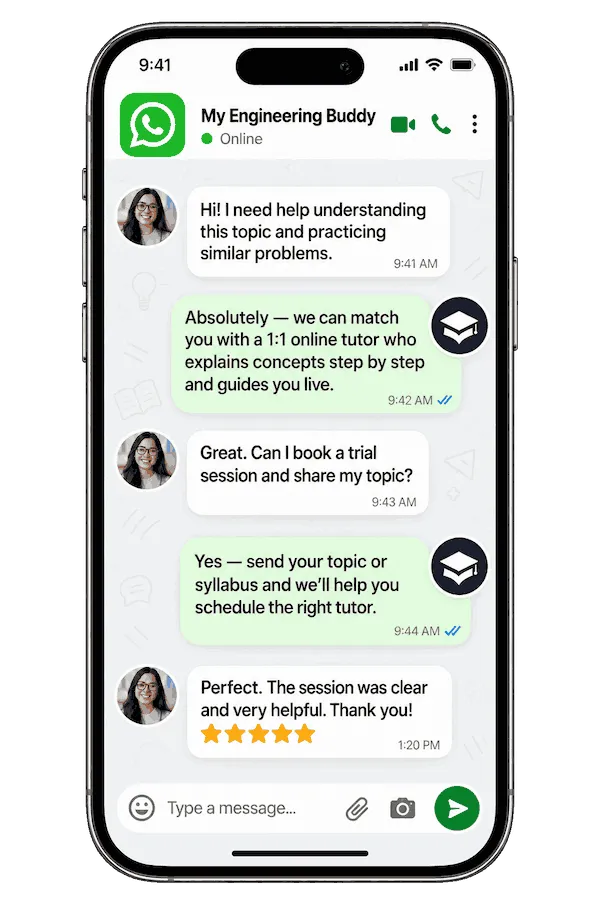
~1 min
Average Reply Time
~1 hour
To Be Matched With A Tutor
30 Min Trial
75% Find Their Tutor On The 1st Trial
$20-35+/hr
Premium Yet Affordable Learning
Hire The Best NoSQL Tutor

Your MongoDB queries keep timing out and your Cassandra schema looks nothing like the examples — you need a live NoSQL tutor, not another Stack Overflow thread.
NoSQL Tutor Online
NoSQL (Not Only SQL) is a category of database management systems — including document, key-value, column-family, and graph stores — designed for horizontal scalability, flexible schemas, and high-throughput workloads beyond what relational databases handle well.
MEB offers 1:1 online tutoring and project help in NoSQL across 2,800+ advanced subjects. Whether you’re searching for a NoSQL tutor near me or need an software engineering tutor who can cover data architecture end to end, MEB matches you with a verified expert — usually within the hour. Sessions run over Google Meet with a digital pen-pad. You leave each session knowing exactly what changed and why.
- 1:1 online sessions tailored to your course, project stack, or employer tech requirements
- Expert-verified tutors with hands-on NoSQL experience across MongoDB, Cassandra, Redis, DynamoDB, and Neo4j
- Flexible time zones — US, UK, Canada, Australia, Gulf
- Structured learning plan built after a diagnostic session
- Guided project support — we explain the design decisions, you build and submit
52,000+ students across the US, UK, Canada, Australia, and the Gulf have used MEB since 2008 — including students in Software Engineering subjects like NoSQL, MongoDB tutoring, and Apache Cassandra help.
Source: My Engineering Buddy, 2008–2025.
How Much Does a NoSQL Tutor Cost?
Most NoSQL tutoring sessions run $20–$40/hr. Graduate-level or specialist topics — distributed systems design, multi-region Cassandra clusters, graph traversal optimisation — can reach up to $100/hr. Not sure what tier you need? Start with the $1 trial and let the tutor assess your level in the first 30 minutes.
| Level / Need | Typical Rate | What’s Included |
|---|---|---|
| Standard (undergraduate / bootcamp) | $20–$35/hr | 1:1 sessions, project guidance, schema review |
| Advanced / Specialist (graduate, distributed systems) | $35–$100/hr | Expert tutor, production-scale design, niche depth |
| $1 Trial | $1 flat | 30 min live session or one project question explained in full |
Tutor availability tightens significantly in May–June and November–December when university project deadlines cluster. Book early if you’re working to a fixed submission date.
WhatsApp MEB for a quick quote — average response time under 1 minute.
Who This NoSQL Tutoring Is For
NoSQL isn’t one thing — it’s a family of technologies with very different mental models. Students run into trouble when they carry SQL assumptions into a document store, or when they try to design a Cassandra schema without thinking through query patterns first. MEB tutoring is built around catching those exact mistakes early.
- Undergraduate and graduate CS, data engineering, or software development students whose coursework requires MongoDB, Cassandra, or Redis
- Bootcamp students moving from SQL to NoSQL and hitting a wall on data modelling
- Students with a project submission deadline approaching and schema design that isn’t working
- Developers preparing for a technical interview at a company using a NoSQL-heavy stack
- Students who attempted a NoSQL project once, submitted something that failed peer review or grading, and need to understand what went wrong before the next attempt
- Engineering and data science students at institutions like MIT, Carnegie Mellon, Georgia Tech, University of Toronto, Imperial College London, TU Delft, and ETH Zurich whose programmes include distributed database or cloud data modules
The $1 trial is the fastest way to find out exactly where the gap is — most students who try it book a follow-up session within 48 hours.
1:1 Tutoring vs Self-Study vs AI vs YouTube vs Online Courses
Self-study works if you already know what you don’t know — most NoSQL students don’t. AI tools explain concepts quickly but can’t watch you build a schema and catch a partition key mistake in real time. YouTube covers the basics well but stops when your specific Cassandra read/write pattern breaks. Online courses move at a fixed pace that won’t bend to your project deadline. A 1:1 NoSQL tutor online from MEB works through your actual codebase, your specific database, and your actual error messages — and corrects your reasoning before you submit.
Outcomes: What You’ll Be Able To Do in NoSQL
After working with an MEB NoSQL tutor, you’ll be able to model document structures in MongoDB that handle real query patterns without triggering full collection scans. You’ll apply partition key selection in Cassandra to balance read performance against write amplification. You’ll explain the CAP theorem trade-offs for a given system design and justify your choice to a technical interviewer or project evaluator. You’ll write aggregation pipelines in MongoDB and use Redis for caching and session management with confidence. You’ll present a data architecture decision — not just implement one — because you’ll understand the reasoning, not just the syntax.
Based on feedback from 40,000+ sessions collected by MEB from 2022 to 2025, 58% of students improved by one full grade after approximately 20 hours of 1:1 tutoring in subjects like NoSQL. A further 23% achieved at least a half-grade improvement.
Source: MEB session feedback data, 2022–2025.
At MEB, we’ve found that NoSQL students who struggle with schema design almost always have the same root issue — they’re thinking in rows and foreign keys instead of access patterns. One session spent reframing that mental model unlocks progress faster than three weeks of solo practice.
What We Cover in NoSQL (Syllabus / Topics)

Document Databases (MongoDB)
- BSON document structure, collections, and embedded vs referenced documents
- CRUD operations and the MongoDB query language
- Aggregation pipeline:
$match,$group,$lookup,$unwind - Indexing strategies: single-field, compound, text, and geospatial indexes
- Schema design patterns: bucket, outlier, computed, and polymorphic
- Replication, replica sets, and write concern levels
- Sharding architecture and chunk distribution
Key references: MongoDB: The Definitive Guide (Chodorow), NoSQL Distilled (Fowler & Sadalage). The ACM Digital Library holds peer-reviewed research on document store performance benchmarks.
Column-Family Databases (Apache Cassandra & HBase)
- Cassandra’s ring architecture, consistent hashing, and virtual nodes
- Partition key, clustering key, and primary key design for query-first modelling
- CQL vs SQL — where they diverge and why it matters
- Consistency levels: ONE, QUORUM, ALL and the latency trade-offs
- Compaction strategies: SizeTiered vs LeveledCompaction
- Apache HBase tutoring — HBase table design, row key strategies, and coprocessors
- Tombstones, TTL, and deletion behaviour in wide-column stores
Key references: Cassandra: The Definitive Guide (Hewitt), HBase: The Definitive Guide (George). Supplementary reading from the Cassandra DataStax documentation.
Key-Value and Graph Databases (Redis, DynamoDB, Neo4j)
- Redis data structures: strings, hashes, lists, sets, sorted sets, streams
- Redis use cases: caching, pub/sub, session management, rate limiting
- DynamoDB partition key design, GSI/LSI, and on-demand vs provisioned capacity
- Single-table design in DynamoDB — entity modelling without joins
- Graph model fundamentals: nodes, edges, properties, and labels in Neo4j
- Cypher query language — MATCH, WHERE, RETURN, and path traversal
- Choosing between key-value, document, column-family, and graph — real system design decisions
Key references: Redis in Action (Carlson), Graph Databases (Robinson, Webber & Eifrem), AWS DynamoDB Developer Guide.
Students who understand why a partition key was chosen — not just what it is — score significantly higher on NoSQL project rubrics and pass technical interviews at a much higher rate. That understanding is exactly what 1:1 tutoring builds fastest.
Source: MEB tutor observation across 2,800+ technical sessions, 2022–2025.
Platforms, Tools & Textbooks We Support
NoSQL work happens across a specific set of tools. MEB tutors are fluent in the full practical stack, not just the theory. Sessions cover hands-on work inside the actual environments students are using for their courses or projects.
- Databases: MongoDB Atlas, Apache Cassandra, Redis, Amazon DynamoDB, Neo4j, CouchDB, Firebase Firestore
- Query & admin tools: MongoDB Compass, DataStax Astra, RedisInsight, AWS Console, Neo4j Browser
- Integration environments: Docker tutoring for containerised database instances, Kubernetes help for orchestration, Apache Kafka tutoring for event-driven pipelines feeding NoSQL stores
- Languages & drivers: Python (PyMongo, cassandra-driver), Node.js (Mongoose, ioredis), Java drivers
What a Typical NoSQL Session Looks Like
The tutor opens by checking where the previous session ended — usually a specific schema design task or a query that wasn’t returning the expected documents. They ask you to pull up your current project files or the database you’re working in. You walk through the problem together on screen. The tutor uses a digital pen-pad to annotate the data model — drawing out document relationships, explaining where your aggregation pipeline is losing records, or sketching a partition strategy for a Cassandra table. You replicate the fix or rewrite the query yourself while the tutor watches. By the end, there’s a concrete task: redesign the index on this collection, rewrite the Cypher query for this traversal, or benchmark two Redis caching strategies and note the difference. The next topic is already noted before the session closes.
How MEB Tutors Help You with NoSQL (The Learning Loop)
Diagnose: In the first session, the tutor identifies where your mental model breaks down — usually it’s SQL thinking applied to a schema-less store, or a partition key chosen for convenience rather than query pattern. That diagnosis shapes every session that follows.
Explain: The tutor works through live examples on a digital pen-pad — annotating a Cassandra ring diagram, building a MongoDB aggregation pipeline step by step, or tracing a graph traversal in Cypher. You see the reasoning, not just the answer.
Practice: You attempt the next problem yourself — designing the document model, writing the query, or choosing the right data structure — while the tutor watches and says nothing until you’re done.
Feedback: The tutor goes through your attempt step by step. Every wrong choice gets an explanation: why that partition key causes hotspots, why that embedded document will break at scale, why that index isn’t being used. Feedback is specific, not general.
Plan: Before the session ends, the tutor maps the next topic and sets a practice task. Progress is tracked across sessions so nothing gets revisited unnecessarily and nothing gets skipped.
Sessions run on Google Meet. The tutor uses a digital pen-pad or iPad with Apple Pencil for annotations. Before your first session, have your project brief or course spec ready, along with any error messages or query results you’ve already tried. The first session functions as a diagnostic — and you can start it for just $1 trial — 30 minutes of live tutoring that also serves as your baseline assessment.
Students consistently tell us that the moment things click in NoSQL isn’t when they read about CAP theorem — it’s when a tutor shows them exactly which of their own queries would fail under a network partition. Real examples from your own project change how fast it lands.
Tutor Match Criteria (How We Pick Your Tutor)
Not every tutor who knows MongoDB is the right tutor for your specific problem. Here’s what MEB looks at when matching.
Subject depth: Tutors are matched to your specific database technology — a MongoDB project goes to someone with hands-on aggregation and schema design experience, not just general database knowledge.
Tools: Every tutor uses Google Meet with a digital pen-pad or iPad and Apple Pencil — the visual layer that makes NoSQL data modelling actually teachable online.
Time zone: Matched to your region — US, UK, Canada, Australia, or Gulf — so sessions happen at hours that don’t require you to be awake at 3am.
Goals: Whether you need to pass a university module, prepare for a system design interview, or get a production-scale DynamoDB architecture reviewed, the tutor’s background is matched to that outcome.
Unlike platforms where you fill out a form and wait, MEB responds in under a minute, 24/7. Tutor match takes under an hour. The $1 trial means you test before you commit. Everything runs over WhatsApp — no logins, no intake forms.
Study Plans (Pick One That Matches Your Goal)
After the diagnostic session, the tutor builds a specific sequence. Three common structures: a catch-up plan (1–3 weeks) for students with an imminent project deadline and significant schema or query gaps to close; an exam/project prep plan (4–8 weeks) for structured coverage of MongoDB, Cassandra, and Redis before a final assessment; and weekly ongoing support aligned to your semester timeline, covering new topics as they’re introduced in lectures. The tutor chooses the sequence — you choose the pace.
Pricing Guide
Standard NoSQL tutoring runs $20–$40/hr. Graduate-level distributed systems, multi-region architecture review, or interview prep for senior engineering roles reaches up to $100/hr. Rate factors include the specific technology stack, topic complexity, how tight the deadline is, and tutor availability at your preferred hours.
Availability shrinks fast in November–December and April–June when university project deadlines and final exams stack up. If you have a fixed submission date, book sooner rather than later.
For students targeting roles at companies running large-scale NoSQL infrastructure — or positions requiring AWS DynamoDB or Cassandra expertise — tutors with direct production engineering backgrounds are available at higher rates. Share your specific goal and MEB will match the tier to what you’re actually aiming for.
Start with the $1 trial — 30 minutes, no registration, no commitment. WhatsApp MEB for a quick quote.
FAQ
Is NoSQL hard to learn?
The concepts aren’t inherently harder than SQL — but they require a different mental model. Students who already think in tables and joins take longer to adapt. The biggest difficulty is schema design: NoSQL gives you freedom that SQL doesn’t, and that freedom requires more discipline, not less.
How many sessions will I need?
Most students working on a single university project need 4–8 sessions. Those preparing for a technical interview covering distributed databases typically need 6–12. The diagnostic in session one gives a much more accurate estimate than any general guideline can.
Can you help with projects and portfolio work?
Yes. MEB tutoring is guided learning — the tutor explains the design decisions, walks through the query logic, and helps you understand the trade-offs. You build and submit the work yourself. See our Academic Integrity policy and Why MEB page for full details on what we help with and what we don’t.
Will the tutor match my exact syllabus or exam board?
Yes. When you contact MEB, share your course name, institution, and the specific technologies covered. Tutors are matched to your actual stack — not a generic NoSQL overview. A MongoDB-heavy curriculum gets a different tutor than a Cassandra-focused distributed systems module.
What happens in the first session?
The tutor runs a diagnostic — asking you to explain your current project or walk through a query you’ve written. This identifies where the mental model breaks down. By the end of session one, you have a clear picture of what to fix and in what order.
Are online NoSQL tutoring sessions as effective as in-person?
For a technical subject like NoSQL, online is often better. Sharing your actual database, query results, and error messages on screen — with the tutor annotating in real time — is more direct than sitting next to someone at a whiteboard. No commute either.
Can I get NoSQL help at midnight or on weekends?
Yes. MEB operates across all time zones, 24/7. Students in the Gulf, Australia, and across North America regularly book late-night or weekend sessions. WhatsApp MEB at any hour — average response time is under a minute regardless of when you message.
What if my project uses a NoSQL database I’ve never used before?
That’s one of the most common situations MEB handles. If your course suddenly introduces DynamoDB or Neo4j and you’ve only worked with MongoDB, the tutor starts from the conceptual difference and builds from there. No prior knowledge of the specific database is required before session one.
MongoDB vs Cassandra — which should I focus on for my course?
That depends entirely on what your course or project specifies. MongoDB suits document-heavy applications and is more beginner-friendly. Cassandra is the standard for high-throughput, distributed write workloads. If your course covers both, the tutor will sequence them so Cassandra’s complexity builds on MongoDB concepts you’ve already internalised.
Do you offer group NoSQL sessions?
No. MEB is 1:1 only. Group sessions can’t adapt to the specific point where each student’s understanding breaks down — and in NoSQL, that point is almost always different for every student. One-to-one is the only format that actually catches the individual mistake.
How do I get started?
Three steps: WhatsApp MEB with your database, course name, and the problem you’re working on. MEB matches you with a verified tutor — usually within the hour. Your first session starts for $1 — 30 minutes live or one full project question explained in detail.
A common pattern our tutors observe is that students who’ve been stuck on the same NoSQL issue for three days solve it inside 20 minutes once they can articulate the problem out loud to someone who already knows where the mistake is hiding. That’s the whole value of 1:1.
Trust & Quality at My Engineering Buddy
Every MEB tutor goes through subject-specific screening before taking a session. That means a live demo evaluation in the relevant technology, a review of their practical background — not just their degree — and ongoing feedback monitoring after every session they deliver. Tutors covering NoSQL are assessed on MongoDB schema design, Cassandra data modelling, and distributed systems fundamentals — not just general database knowledge. Rated 4.8/5 across 40,000+ verified reviews on Google.
MEB tutoring is guided learning — you understand the work, then submit it yourself. For full details on what we help with and what we don’t, read our Academic Integrity policy and Why MEB.
MEB has been serving students across the US, UK, Canada, Australia, the Gulf, and Europe since 2008 — across 2,800+ subjects including system design tutoring, cloud architecture help, and DevOps tutoring. If you’re studying Software Engineering at any level, the subject coverage runs deep enough to support your full programme — not just one module.
Since 2008, MEB has built its reputation on one principle: the tutor who shows up for your session should know your subject better than you do. For NoSQL, that means production experience with the databases — not just textbook familiarity.
Source: My Engineering Buddy, 2008–2025.
Try your first session for $1 — 30 minutes of live 1:1 tutoring or one homework question explained in full. No registration. No commitment. WhatsApp MEB now and get matched within the hour.
Explore Related Subjects
Students studying NoSQL often also need support in:
Next Steps
When you contact MEB, share your NoSQL stack (MongoDB, Cassandra, Redis, DynamoDB, or other), your current error or design problem, and your project or exam deadline. Include your time zone so the tutor match lands correctly.
Before your first session, have ready:
- Your course spec or project brief
- A recent query, schema, or code block you’ve been stuck on
- Your submission or exam date
MEB matches you with a verified NoSQL tutor — usually within 24 hours, often within the hour. The first session starts with a diagnostic so every minute is used on the actual problem, not background questions.
Visit www.myengineeringbuddy.com for more on how MEB works.
WhatsApp to get started or email [email protected].
Reviewed by Subject Expert
This page has been carefully reviewed and validated by our subject expert to ensure accuracy and relevance.