~1 min
Average Reply Time
~1 hour
To Be Matched With A Tutor
1 Trial
75% Find Their Tutor On The 1st Trial
$1
Your First 30 Minutes
Hire The Best Aerospace Engineering Tutor
Top Tutors, Top Grades. Without The Stress!





Related Subjects
Most students fail their first aerodynamics or orbital mechanics exam — not because they lack ability, but because no one showed them how to build the physical intuition behind the equations.
Aerospace Engineering Tutor Online
Aerospace engineering is the study of aircraft and spacecraft design, including aerodynamics, propulsion, structural analysis, and orbital mechanics. It equips students to analyse flight systems, model thermodynamic cycles, and solve complex control and dynamics problems.
MEB connects you with a verified Aerospace Engineering tutor online — matched to your exact course, university module, or research level. Whether you’re searching for an Aerospace Engineering tutor near me or need structured help across an entire semester, MEB covers every track: from subsonic aerodynamics and finite element analysis to spacecraft attitude control and compressible flow. Part of MEB’s broader engineering tutoring network — 2,800+ subjects, one platform.
- 1:1 online sessions tailored to your specific course and syllabus
- Expert-verified tutors with aerospace-specific academic and industry backgrounds
- Flexible time zones — US, UK, Canada, Australia, Gulf
- Structured learning plan built after a diagnostic session
- Ethical homework and assignment guidance — you understand the work before you submit
52,000+ students across the US, UK, Canada, Australia, and the Gulf have used MEB since 2008 — including students in Engineering subjects like Aerospace Engineering, Mechanical Engineering, and Systems Engineering.
Source: My Engineering Buddy, 2008–2025.
How Much Does an Aerospace Engineering Tutor Cost?
Most Aerospace Engineering tutoring sessions run $20–$40/hr. Advanced graduate topics — compressible flow, aeroelasticity, spacecraft dynamics — can reach up to $100/hr depending on tutor specialisation. First, try the $1 trial: 30 minutes of live 1:1 tutoring or one full homework question explained in detail.
| Level / Need | Typical Rate | What’s Included |
|---|---|---|
| Undergraduate (most levels) | $20–$40/hr | 1:1 sessions, homework guidance |
| Advanced / Graduate / Niche | $40–$100/hr | Expert tutor, specialist depth |
| $1 Trial | $1 flat | 30 min live session or 1 homework question |
Tutor availability tightens around finals and project submission periods. Book early if your deadline is within 4 weeks.
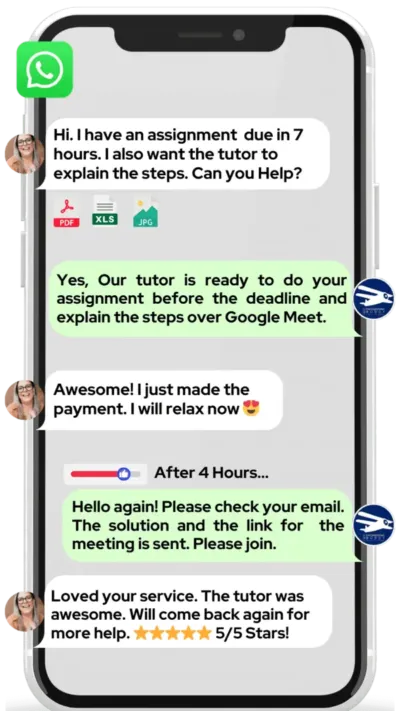
WhatsApp MEB for a quick quote — average response time under 1 minute.
Who This Aerospace Engineering Tutoring Is For
This isn’t a course for students who just need a refresher. It’s for students who are genuinely stuck — on specific derivations, on lab reports, on design projects with real marks attached. If you’ve watched the lecture twice and still can’t set up the momentum equation for a control volume, this is where you start.
- Undergraduate students struggling with aerodynamics, thermodynamics, or structural mechanics modules
- Graduate students working through compressible flow, aeroelasticity, or orbital mechanics at MSc or PhD level
- Students retaking after a failed first attempt — especially common in fluids and dynamics courses
- Students with a conditional university offer depending on passing this module
- Students 4–6 weeks from finals with gaps in propulsion or flight mechanics still to close
- Parents supporting a student whose grades have slipped after a difficult aerodynamics semester
Students in the US, UK, Canada, Australia, and the Gulf who’ve studied at institutions like MIT, Georgia Tech, Delft, Imperial College London, and RMIT have all used MEB for aerospace modules — from first-year statics through to final-year capstone design projects. The $1 trial is how most of them start.
1:1 Tutoring vs Self-Study vs AI vs YouTube vs Online Courses
Self-study works if you’re disciplined — but Aerospace Engineering problems require someone to catch the moment you set up the boundary conditions wrong. AI tools explain concepts quickly and can’t tell why your drag polar looks off. YouTube covers Bernoulli and lift beautifully, then stops when you’re stuck deriving the Navier-Stokes simplification for thin aerofoils. Online courses move at a fixed pace, with no one checking whether your finite element mesh is actually converging. With MEB, a tutor watches you work through a real problem — your problem, from your coursework — and corrects the reasoning live, not after you’ve submitted.
Outcomes: What You’ll Be Able To Do in Aerospace Engineering
After working with an MEB Aerospace Engineering tutor, students consistently report being able to tackle the types of problems that previously cost them marks. You’ll solve subsonic and supersonic flow problems using the correct compressibility corrections. You’ll analyse aircraft structural loads using free body diagrams and stress resultants. You’ll model propulsion cycles — from ideal Brayton to real turbofan — and explain where the efficiency losses come from. You’ll apply orbital mechanics to calculate transfer orbits, delta-v budgets, and re-entry windows. And you’ll present your reasoning in a way that earns marks, not just produces a number.
Based on feedback from 40,000+ sessions collected by MEB from 2022 to 2025, 58% of students improved by one full grade after approximately 20 hours of 1:1 tutoring in subjects like Aerospace Engineering. A further 23% achieved at least a half-grade improvement.
Source: MEB session feedback data, 2022–2025.
At MEB, we’ve found that aerospace students often know the theory — they’ve read the notes, they’ve watched the derivations. What they’re missing is the moment where someone watches them attempt a problem and says: that assumption you made in step two is where the error starts. That’s the correction that changes the grade.
What We Cover in Aerospace Engineering (Syllabus / Topics)
MEB tutors cover the full range of aerospace engineering modules — from first-year fundamentals through to graduate-level specialisations. Below are the core tracks.
Aerodynamics and Fluid Mechanics
- Potential flow theory: source, sink, vortex, and doublet flows
- Thin aerofoil theory and panel methods
- Boundary layer theory: laminar, turbulent, separation
- Compressible flow: isentropic relations, normal and oblique shocks
- Lift, drag, and pitching moment for aerofoil sections and finite wings
- Wind tunnel testing principles and data interpretation
Core texts include Anderson’s Fundamentals of Aerodynamics, Bertin and Cummings’ Aerodynamics for Engineers, and White’s Fluid Mechanics.
Propulsion and Thermodynamics
- Ideal Brayton cycle analysis and deviation from ideal: component efficiencies
- Turbojet, turbofan, and turboprop performance comparisons
- Rocket propulsion: specific impulse, thrust equation, nozzle flow
- Combustion fundamentals: stoichiometry, adiabatic flame temperature
- Inlet and nozzle design: convergent-divergent geometry, choked flow conditions
- Electric propulsion basics: ion thrusters, Hall-effect engines
Texts include Hill and Peterson’s Mechanics and Thermodynamics of Propulsion and Sutton’s Rocket Propulsion Elements.
Structures, Dynamics, and Orbital Mechanics
- Aircraft structural loads: V-n diagrams, manoeuvre and gust loads
- Stress analysis of thin-walled sections: bending, shear flow, torsion
- Vibration analysis: SDOF and MDOF systems, natural frequencies, modal analysis
- Flight mechanics: equations of motion, static and dynamic stability, control derivatives
- Two-body orbital problem: Kepler’s laws, conic sections, orbital elements
- Hohmann transfers, bi-elliptic transfers, plane change manoeuvres
- Attitude dynamics: Euler angles, quaternions, reaction wheel and thruster control
Key references: Megson’s Aircraft Structures for Engineering Students, Curtis’ Orbital Mechanics for Engineering Students, and Etkin and Reid’s Dynamics of Flight.

What a Typical Aerospace Engineering Session Looks Like
The tutor opens by checking where you got stuck last time — maybe it was setting up the Kutta condition in a panel method, or calculating the specific fuel consumption for an off-design turbofan. From there, you and the tutor work through problems on a shared screen: the tutor uses a digital pen-pad to annotate, sketch control volume boundaries, and walk through the algebra step by step. You replicate the reasoning — not just copy the answer. When you make an error — say, applying the wrong pressure ratio across a shock — the tutor catches it immediately and explains which assumption broke down. The session closes with a specific practice problem for you to attempt before the next session, and a note on the next topic to address.
How MEB Tutors Help You with Aerospace Engineering (The Learning Loop)
Diagnose: In the first session, the tutor identifies exactly where your understanding breaks down — whether that’s the physical intuition behind shock waves, the bookkeeping in a free body diagram, or the sign conventions in your orbital elements. You don’t waste sessions on topics you already know.
Explain: The tutor works through a fully solved example on the digital pen-pad — showing not just the answer but why each step follows from the physics, not just the formula sheet. Students following mechanical engineering tutoring or systems engineering help alongside their aerospace modules often find this cross-subject reinforcement accelerates understanding considerably.
Practice: You attempt a parallel problem while the tutor watches. No looking away. No moving on until you can set up the problem independently.
Feedback: The tutor marks your attempt in real time — not just right or wrong, but which step cost you marks and why. This is where most grade improvement actually happens.
Plan: At the end of each session, the tutor sets the next topic, assigns a specific practice task, and maps the sequence toward your exam or submission date.
Sessions run on Google Meet. The tutor uses a digital pen-pad or iPad with Apple Pencil. Before your first session, send your course outline or syllabus, a recent problem set you struggled with, and your exam or submission date. The first session is your diagnostic — the tutor shapes every subsequent session around what it reveals. Start with the $1 trial — 30 minutes of live tutoring that also serves as your first diagnostic.
Students consistently tell us that the biggest shift comes when they stop trying to memorise aerospace derivations and start building physical intuition — understanding why the boundary layer separates before they try to calculate where. That’s the focus in every MEB session.
Tutor Match Criteria (How We Pick Your Tutor)
Every tutor MEB assigns to an aerospace student is vetted against the specific module — not just the general discipline.
Subject depth: Tutor must have demonstrable expertise at your level — whether that’s undergraduate aerodynamics, MSc propulsion, or PhD-level aeroelasticity and structural dynamics.
Tools: All sessions use Google Meet with a digital pen-pad or iPad and Apple Pencil — non-negotiable for the kind of diagram-heavy, equation-intensive work aerospace requires.
Time zone: Matched to your region — US, UK, Gulf, Canada, or Australia — so scheduling doesn’t add friction to an already demanding course.
Goals: Whether you need to close a specific gap before a final, build conceptual depth across a full semester, or get support on a design project, the tutor is matched to that goal.
Unlike platforms where you fill out a form and wait, MEB responds in under a minute, 24/7. Tutor match takes under an hour. The $1 trial means you test before you commit. Everything runs over WhatsApp — no logins, no intake forms.
Study Plans (Pick One That Matches Your Goal)
MEB tutors build your session sequence after the diagnostic — but here’s how most aerospace students structure their time. Catch-up (1–3 weeks): for students behind on a module with a deadline approaching — aerodynamics gap closure, structures problem sets, propulsion exam prep. Exam prep (4–8 weeks): structured revision against past papers, weak-topic targeting, and timed problem practice. Weekly support: ongoing through the semester, aligned to your lecture schedule and coursework deadlines. The tutor builds the specific sequence after the first diagnostic session.
Pricing Guide
Aerospace Engineering tutoring starts at $20/hr for most undergraduate modules. Graduate-level topics — aeroelasticity, compressible flow simulation, spacecraft dynamics — typically run $40–$100/hr depending on tutor background and topic complexity. Rate factors include your level, the niche of the topic, your timeline, and tutor availability.
Availability drops sharply in the 2–3 weeks before finals and major project deadlines. If your exam is within a month, book now.
For students targeting programmes at institutions like MIT, Caltech, or Imperial — or seeking tutors with industry backgrounds in defence, propulsion, or satellite systems — MEB can match you with a tutor at a higher rate tier. Share your specific goal and MEB will find the right fit.
Start with the $1 trial — 30 minutes, no registration, no commitment. WhatsApp MEB for a quick quote.
MEB has served 52,000+ students across 2,800+ subjects since 2008 — with tutors available 24/7 across every major time zone. Sessions start with a diagnostic. Progress is tracked. Every session is built around your actual coursework.
Source: My Engineering Buddy, 2008–2025.
Try your first session for $1 — 30 minutes of live 1:1 tutoring or one homework question explained in full. No registration. No commitment. WhatsApp MEB now and get matched within the hour.
FAQ
Is Aerospace Engineering hard?
It’s one of the more demanding engineering disciplines — the combination of advanced mathematics, thermodynamics, fluid mechanics, and structures in a single degree is genuinely heavy. Most students hit a wall in aerodynamics or orbital mechanics. That’s normal. A tutor who knows exactly where the conceptual gaps tend to form makes a measurable difference.
How many sessions are needed to see improvement in Aerospace Engineering?
Most students notice a shift within 3–5 sessions when the tutor is matched correctly and sessions are focused on specific problem types. For a full-module gap or exam prep across multiple topics, 10–20 sessions over 4–6 weeks is a more realistic planning horizon.
Can you help with Aerospace Engineering homework and assignments?
Yes — MEB tutoring is guided learning. The tutor explains the method, works through an example, and you attempt the problem yourself. You understand the work, then submit it yourself. See our Academic Integrity policy and Why MEB page for full details on what we help with and what we don’t.
Will the tutor match my exact syllabus or exam board?
Yes. When you contact MEB, share your university, module name, and course outline. Tutors are matched to your specific syllabus — not just the general subject. This applies whether you’re studying to AIAA guidelines, on a UK BEng programme, or working through an American ABET-accredited curriculum.
What happens in the first Aerospace Engineering session?
The tutor runs a short diagnostic — reviewing a recent problem set or past exam attempt you found difficult. From this, they identify your specific gaps and build the session sequence. You won’t spend the first session on topics you already understand.
Is online Aerospace Engineering tutoring as effective as in-person?
For most students, yes. Aerospace Engineering is diagram- and equation-heavy — the digital pen-pad on Google Meet replicates a whiteboard session with a human tutor in front of you. Students from Georgia Tech, Delft, and Imperial have found it equally effective once they try the format.
What’s the difference between aerodynamics and fluid mechanics in an aerospace context — and do tutors cover both?
Fluid mechanics is the broader field; aerodynamics applies it specifically to flight — adding compressibility, lift theory, and boundary layer effects around aircraft geometry. MEB tutors cover both, and understand how they connect in your specific course structure. Many aerospace modules teach them together.
Can MEB help with MATLAB, ANSYS Fluent, or other aerospace software used in coursework?
Yes. Many aerospace assignments require MATLAB for dynamics simulations, ANSYS Fluent for CFD, or CATIA and SolidWorks for structural modelling. MEB tutors with software backgrounds in these tools are available — specify the software when you contact MEB so the right tutor is matched. You can also get computer-aided design help as a standalone subject if your CAD workload is significant.
Can I get Aerospace Engineering help late at night or on weekends?
Yes. MEB operates 24/7 across all time zones. Students in the US, Gulf, and Australia regularly book sessions outside standard business hours. The WhatsApp response time is under a minute regardless of when you contact.
What if I don’t like my assigned tutor?
Tell MEB via WhatsApp. Tutor reassignment is straightforward — no forms, no delays. Getting the right match matters more than preserving the first assignment. Most mismatches are resolved within the same day.
How do I get started with an Aerospace Engineering tutor?
Three steps: WhatsApp MEB with your module name, university, and exam date. MEB matches you with a verified tutor — usually within the hour. Start your $1 trial: 30 minutes of live tutoring or one full problem explained. No registration required.
Do you offer group Aerospace Engineering sessions?
No. MEB is 1:1 only. Group sessions dilute the diagnostic and correction process that drives grade improvement — particularly in a subject like aerospace where one wrong assumption in a derivation can cascade through every subsequent step. The 1:1 format is deliberate.
Trust & Quality at My Engineering Buddy
Every MEB tutor goes through a subject-specific screening process — not a generic application. For Aerospace Engineering, that means demonstrating depth in at least one core track: aerodynamics, propulsion, structures, or orbital mechanics. Tutors complete a live demo session, are assessed by the MEB team, and are reviewed by students after every session. Rated 4.8/5 across 40,000+ verified reviews on Google. Tutors hold relevant degrees and many have professional experience in aerospace, defence, or research environments.
MEB tutoring is guided learning — you understand the work, then submit it yourself. For full details on what we help with and what we don’t, read our Academic Integrity policy and Why MEB.
MEB has been running since 2008, serving 52,000+ students across 2,800+ subjects in the US, UK, Canada, Australia, Gulf, and Europe. The Engineering category is one of MEB’s largest — with nuclear engineering tutoring, materials science and engineering help, and mechatronics tutoring all available alongside Aerospace Engineering on the same platform. See the full MEB tutoring methodology for how sessions are structured across subjects.
A common pattern MEB tutors observe is that aerospace students who improve the fastest are not the ones who study the most hours — they’re the ones who get corrective feedback fastest after attempting a problem. Speed of error correction beats volume of revision every time.
Source: MEB tutor observation data, compiled internally.
Our experience across thousands of aerospace sessions shows that the hardest topics — normal shock relations, aerofoil panel methods, orbital transfer calculations — are only hard until the student sees them worked out with physical reasoning attached. After that, they’re solvable. Every time.
Explore Related Subjects
Students studying Aerospace Engineering often also need support in:
- Acoustical Engineering
- Automotive Engineering
- Marine Engineering, Naval Architecture & Ocean Engineering
- Metallurgical Engineering
- Military Engineering
- Power Plant Engineering
- Industrial Engineering
Next Steps
When you contact MEB, have these ready: your university or course name, the specific module or topic you’re stuck on, your exam or submission date, and your preferred session times and time zone. The more specific you are, the faster the tutor match.
- Share your syllabus, a recent problem set you struggled with, and your exam board or course code
- MEB matches you with a verified Aerospace Engineering tutor — usually within 24 hours, often within the hour
- The first session is a diagnostic — every subsequent session is built around what it reveals
Before your first session, have ready: your exam board and syllabus (or course outline), a recent past paper attempt or homework you struggled with, and your exam or deadline date. The tutor handles the rest.
Visit www.myengineeringbuddy.com for more on how MEB works.
WhatsApp to get started or email [email protected].
52,000+ Happy Students From Various Universities






Reviewed by Subject Expert
This page has been carefully reviewed and validated by our subject expert to ensure accuracy and relevance.