~1 min
Average Reply Time
~1 hour
To Be Matched With A Tutor
30 Min Trial
75% Find Their Tutor On The 1st Trial
$20-35+/hr
Premium Yet Affordable Learning
Sound travels through walls, floors, and structural joints in ways most students don’t anticipate until a problem set proves it. If wave equations, transmission loss calculations, or room mode analysis are where you’re losing marks, a 1:1 acoustical engineering tutor is the fastest way to close those gaps.
Acoustical Engineering Tutor Online
Acoustical engineering applies physics and engineering principles to the generation, propagation, and control of sound and vibration — equipping students to design quiet buildings, manage industrial noise, and optimise architectural acoustic environments.
MEB offers 1:1 online engineering tutoring across 2,800+ advanced subjects, including acoustical engineering. Whether you’re searching for an acoustical engineering tutor near me or need late-night help with a noise-control assignment, MEB connects you with a verified expert — usually within the hour. The $1 trial means there’s no financial risk in finding out whether it works for you.
- 1:1 online sessions tailored to your course syllabus and exam board
- Expert-verified tutors with acoustical or mechanical engineering backgrounds
- Flexible time zones — US, UK, Canada, Australia, Gulf
- Structured learning plan built after a diagnostic session
- Ethical homework and assignment guidance — you understand before you submit
52,000+ students across the US, UK, Canada, Australia, and the Gulf have used MEB since 2008 — including students in engineering subjects like acoustical engineering, architectural engineering, and mechanical engineering.
Source: My Engineering Buddy, 2008–2025.
How Much Does an Acoustical Engineering Tutor Cost?
Most acoustical engineering sessions run $20–$40/hr. Graduate-level or highly specialised topics — such as numerical acoustics or psychoacoustics modelling — can reach $100/hr. Start with the $1 trial: 30 minutes of live tutoring or one full homework question explained in detail.
| Level / Need | Typical Rate | What’s Included |
|---|---|---|
| Undergraduate (most levels) | $20–$35/hr | 1:1 sessions, homework guidance |
| Advanced / Graduate / Niche | $35–$100/hr | Expert tutor, specialised depth |
| $1 Trial | $1 flat | 30 min live session or 1 homework question |
Tutor availability tightens significantly during final exam periods. Booking early avoids the wait.
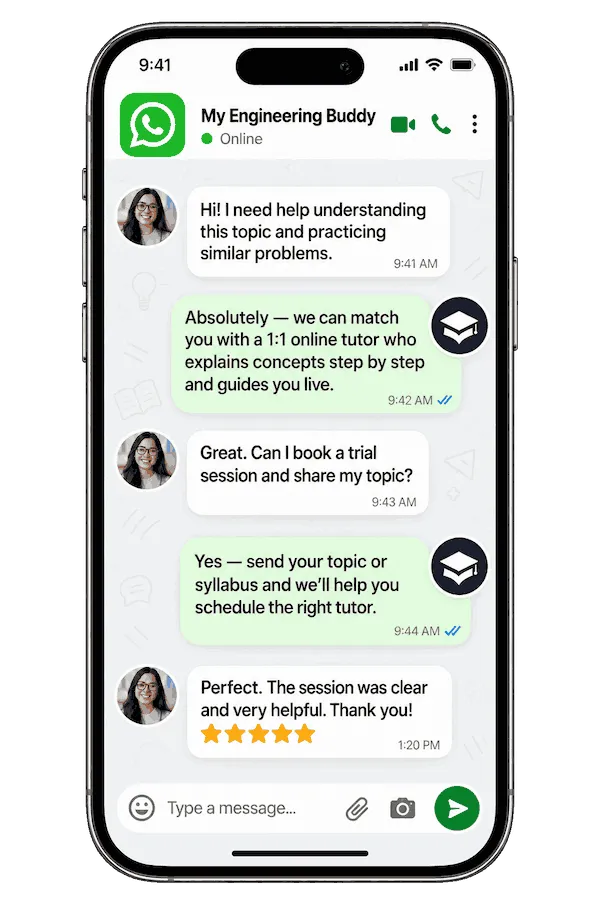
WhatsApp MEB for a quick quote — average response time under 1 minute.
Who This Acoustical Engineering Tutoring Is For
Acoustical engineering sits at the intersection of physics, mathematics, and structural design. Students often underestimate the mathematical load — particularly Fourier analysis, wave equations, and finite element methods — until coursework deadlines are close.
- Undergraduate students at universities including MIT, Georgia Tech, Penn State, TU Delft, University of Southampton, and UNSW struggling with wave propagation or room acoustics modules
- Graduate students working on noise-control research, vibration analysis, or acoustic modelling dissertations
- Students retaking an acoustics module after a failed first attempt — gap analysis is the first thing MEB tutors do
- Students with a conditional university offer that depends on passing an engineering acoustics unit
- Engineers in industry upskilling in building acoustics, environmental noise assessment, or duct system design
- Students who need homework and assignment guidance — you work through it, understand it, then submit it yourself
Penn State’s Graduate Program in Acoustics, the University of Southampton’s Institute of Sound and Vibration Research, and TU Delft’s acoustics engineering track all attract students who eventually need targeted 1:1 support. MEB covers the full curriculum at each level.
1:1 Tutoring vs Self-Study vs AI vs YouTube vs Online Courses
Self-study works if your foundations are solid — but acoustical engineering has too many interconnected topics for most students to self-diagnose gaps reliably. AI tools explain concepts quickly but can’t watch you set up a boundary condition problem and tell you where your logic breaks down. YouTube covers room mode theory well; it stops short when you’re stuck on a specific transmission loss calculation. Online courses move at a fixed pace and won’t slow down for vibration damping if that’s where you’re losing marks. With a 1:1 acoustical engineering tutor from MEB, every session is calibrated to your exact module — wave equations, noise metrics, or structural vibration — correcting errors the moment they appear.
Outcomes: What You’ll Be Able To Do in Acoustical Engineering
After consistent 1:1 sessions, students work with greater precision and less guesswork. You’ll be able to solve sound pressure level calculations and transmission loss problems without hunting for the right formula. You’ll analyse room modes and reverberation time using the Sabine and Eyring equations with confidence. You’ll model noise propagation in built environments and apply the inverse square law correctly in both free-field and reverberant conditions. You’ll explain vibration damping mechanisms and apply them to engineering design scenarios. You’ll present acoustic measurement data — SPL, NR curves, STC ratings — in a format your assessor expects.
Try your first session for $1 — 30 minutes of live 1:1 tutoring or one homework question explained in full. No registration. No commitment. WhatsApp MEB now and get matched within the hour.
Based on feedback from 40,000+ sessions collected by MEB from 2022 to 2025, 58% of students improved by one full grade after approximately 20 hours of 1:1 tutoring in subjects like acoustical engineering. A further 23% achieved at least a half-grade improvement.
Source: MEB session feedback data, 2022–2025.
What We Cover in Acoustical Engineering (Syllabus / Topics)
MEB tutors cover the full acoustical engineering curriculum across undergraduate and graduate levels. The three core tracks below reflect the most common course structures at universities in the US, UK, Canada, and Australia.
Track 1: Fundamentals of Sound and Vibration
- Wave equation derivation and plane wave solutions
- Sound pressure level, intensity, and power — measurement and calculation
- Free-field and reverberant-field propagation
- Vibration of strings, membranes, plates, and beams
- Damping mechanisms: viscous, structural, and radiation damping
- Fourier analysis and frequency-domain representation of signals
- Impedance, reflection, and transmission at interfaces
Core texts: Fundamentals of Acoustics (Kinsler et al.), Engineering Noise Control (Bies, Hansen & Howard).
Track 2: Room Acoustics and Architectural Sound
- Modal analysis and room modes in rectangular enclosures
- Reverberation time — Sabine and Eyring equations
- Sound absorption coefficients and material selection
- Speech intelligibility metrics: STI, RASTI, and %ALcons
- Concert hall and studio design principles
- Sound isolation: airborne and impact noise, STC and IIC ratings
- Measurement standards: ISO 3382, ANSI S12 series
Core texts: Architectural Acoustics (Marshall Long), Room Acoustics (Heinrich Kuttruff).
Track 3: Noise Control Engineering and Environmental Acoustics
- Industrial noise sources: machinery, HVAC, and duct systems
- Noise rating methods: NR curves, NC curves, dBA weighting
- Barrier attenuation and diffraction calculations
- Environmental noise assessment: road, rail, and aircraft noise models
- Hearing conservation and occupational noise exposure limits (OSHA, HSE)
- Active noise control principles and passive treatment strategies
- Vibration isolation: mounts, inertia blocks, and flexible connections
Core texts: Engineering Noise Control (Bies et al.), Noise and Vibration Control Engineering (Ver & Beranek). The MIT Department of Mechanical Engineering publishes open materials on vibration and acoustics that supplement these texts well.

What a Typical Acoustical Engineering Session Looks Like
The tutor opens by checking the previous session’s topic — usually reverberation time or transmission loss — and asks you to talk through one problem from memory. Then you work through new material on screen: today might be sound absorption coefficient calculations using measured data, or setting up a noise barrier attenuation model using the Maekawa method. The tutor uses a digital pen-pad to annotate diagrams and show each algebraic step in real time. You replicate the method on a fresh problem while the tutor watches, correcting sign errors or wrong formula choices immediately. The session closes with two practice problems set for before next time, and the next topic — perhaps duct breakout noise or room mode identification — is noted so you can scan the relevant section in advance. Sessions run on Google Meet. No specialist software needed on your end.
How MEB Tutors Help You with Acoustical Engineering (The Learning Loop)
Diagnose: In the first session, the tutor asks you to attempt two or three problems — typically one involving sound level addition and one on vibration — without help. This surfaces exactly which concepts are missing and which are just rusty.
Explain: The tutor works through the problem live using a digital pen-pad or iPad with Apple Pencil, showing each step in the wave equation derivation or the Sabine reverberation formula. No jumping to the answer. Every line has a reason.
Practice: You attempt a parallel problem while the tutor watches. This is where most students realise they understood the explanation but couldn’t reproduce it — which is the actual gap.
Feedback: The tutor walks back through your attempt step by step, naming which line lost marks and why. Common errors in acoustical engineering include incorrect reference values (20 µPa for sound pressure), wrong field assumptions (free vs reverberant), and sign errors in decibel addition.
Plan: Each session ends with a clear topic sequence for the next two weeks — for example: finish barrier diffraction, move to vibration isolation, then begin HVAC noise prediction. The tutor tracks this across sessions.
Sessions run on Google Meet. The tutor uses a digital pen-pad or iPad with Apple Pencil. Before your first session, share your course syllabus or past assignment sheet — the tutor will review it and begin the diagnostic from the first minute. Start with the $1 trial — 30 minutes of live tutoring that also serves as your first diagnostic. Whether you need a quick catch-up before an exam, structured revision over 4–8 weeks, or ongoing weekly support through the semester, the tutor maps the session plan after the first diagnostic.
At MEB, we’ve found that students in acoustical engineering most often lose marks not because they don’t understand the physics, but because they apply the right formula to the wrong field condition — free field when the problem is reverberant, or vice versa. One diagnostic session usually identifies this within 20 minutes.
Tutor Match Criteria (How We Pick Your Tutor)
Not every engineer with a degree in acoustics can teach it. MEB screens for both.
Subject depth: Tutors hold degrees in acoustical, mechanical, or civil engineering and have studied or worked in noise control, room acoustics, or vibration analysis at the level you need.
Tools: All tutors use Google Meet with a digital pen-pad or iPad plus Apple Pencil — essential for showing wave diagrams and decibel calculations in real time.
Time zone: Matched to your region — US, UK, Gulf, Canada, or Australia — so session times are practical, not disruptive.
Goals: Tutors are matched to your specific aim — exam preparation, conceptual depth, homework completion, or dissertation support in mechanical engineering adjacent topics.
Unlike platforms where you fill out a form and wait, MEB responds in under a minute, 24/7. Tutor match takes under an hour. The $1 trial means you test before you commit. Everything runs over WhatsApp — no logins, no intake forms.
Study Plans (Pick One That Matches Your Goal)
After the first diagnostic, the tutor builds a session sequence around your timeline. Catch-up plans (1–3 weeks) focus on the highest-priority gaps — typically transmission loss, room modes, or noise rating methods — before an assignment deadline. Exam prep plans (4–8 weeks) work through the full syllabus systematically, with past paper practice built in from week three. Ongoing weekly support runs alongside your semester, aligned to lecture topics and submission dates. The tutor sets the sequence; you just need to show up ready to work.
Pricing Guide
Acoustical engineering tutoring starts at $20/hr for standard undergraduate modules. Graduate-level support — finite element acoustic modelling, psychoacoustics, or advanced vibration analysis — runs $50–$100/hr depending on tutor background and topic complexity. Rate factors include level, niche depth, timeline urgency, and tutor availability.
Availability is limited during end-of-semester exam periods at US, UK, and Australian universities. Students who book early consistently get better scheduling flexibility.
For students targeting programmes at institutions like the University of Southampton’s ISVR, Penn State’s Graduate Program in Acoustics, or Georgia Tech’s acoustics research group, tutors with professional acoustic consultancy or research backgrounds are available at higher rates — share your specific goal and MEB will match the tier to your ambition.
Start with the $1 trial — 30 minutes, no registration, no commitment. WhatsApp MEB for a quick quote.
Students consistently tell us that the biggest surprise about acoustical engineering tutoring is how quickly their confidence shifts once someone shows them the logic behind the decibel scale — why it’s logarithmic, what the reference values mean, and why getting those wrong cascades through every calculation that follows.
FAQ
Is acoustical engineering hard?
It’s mathematically demanding. Wave equations, Fourier transforms, and decibel arithmetic catch most students off guard. The physics is manageable once the mathematical framework is solid. Most students find one or two specific topics — usually room modes or transmission loss — account for the majority of their lost marks.
How many sessions do students typically need?
Students with a specific assignment or exam topic usually need 3–5 sessions. Those working through a full module from behind need 10–20. The diagnostic session gives the tutor enough information to give you a realistic estimate after the first 30 minutes.
Can you help with homework and assignments?
Yes. MEB tutoring is guided learning — you understand the work, then submit it yourself. See our Academic Integrity policy and Why MEB page for full details on what we help with and what we don’t.
Will the tutor match my exact syllabus or exam board?
Yes. Share your course outline, university, and the specific module name when you contact MEB. Tutors are matched to your exact curriculum — whether that’s a UK BEng acoustics unit, a US graduate noise control course, or an Australian environmental acoustics module.
What happens in the first session?
The tutor asks you to attempt two or three problems without help to identify real gaps. Then they work through the correct method live. By the end of session one, you’ll have a prioritised list of topics and a plan for the next 2–4 weeks.
Is online tutoring as effective as in-person for acoustical engineering?
For calculation-based subjects like acoustical engineering, yes. The digital pen-pad replicates whiteboard work precisely. Students working through room acoustics calculations or vibration problems consistently report no difference in learning quality compared to face-to-face sessions.
Can I get acoustical engineering help at midnight or on weekends?
Yes. MEB operates 24/7 across time zones. Students in the Gulf, Australia, and the US West Coast regularly book late-night or early-morning sessions. WhatsApp MEB at any hour — average response time is under a minute.
What if I don’t get on with my assigned tutor?
Tell MEB via WhatsApp and a replacement is arranged — usually within the same day. There’s no awkward process. The $1 trial also lets you assess the fit before committing to a full session.
What is the difference between architectural acoustics and noise control engineering — and can MEB help with both?
Architectural acoustics focuses on sound quality inside spaces — concert halls, studios, classrooms. Noise control engineering focuses on reducing unwanted sound — industrial machinery, HVAC, environmental noise. Many acoustical engineering courses cover both. MEB tutors are matched to whichever track your syllabus follows.
Do you cover acoustic simulation software like ODEON, EASE, or COMSOL?
Yes. MEB tutors familiar with ODEON, EASE, Insul, and COMSOL Acoustics Module are available. Share the specific software and the task — whether that’s setting up a room model in ODEON or running a finite element mesh in COMSOL — when you contact MEB.
How do I get started?
Message MEB on WhatsApp — describe your subject, university level, and the topic giving you trouble. MEB matches you with a verified acoustical engineering tutor within hours. Your first session is the $1 trial: 30 minutes live or one homework question explained in full. Three steps: WhatsApp → matched → start trial.
Trust & Quality at My Engineering Buddy
Every MEB tutor goes through subject-specific vetting — a live demo session, degree verification, and review of their depth in the relevant sub-field. For acoustical engineering, that means tutors must demonstrate they can work through room acoustics problems, vibration analysis, and noise control calculations without referencing notes. Rated 4.8/5 across 40,000+ verified reviews on Google. Tutors are drawn from backgrounds in acoustic consultancy, mechanical and civil engineering research, and university-level teaching in the US, UK, Canada, and Australia.
MEB tutoring is guided learning — you understand the work, then submit it yourself. For full details on what we help with and what we don’t, read our Academic Integrity policy and Why MEB.
MEB has served 52,000+ students across 2,800+ subjects since 2008 — from first-year engineering students to doctoral researchers. Within the engineering category, this includes students studying civil engineering, structural engineering help, and acoustical engineering at universities across the US, UK, Canada, Australia, Gulf, and Europe. You can review MEB’s full tutoring methodology to understand how sessions are structured and quality is maintained.
Explore Related Subjects
Students studying acoustical engineering often also need support in:
- Aerospace Engineering
- Biomedical Engineering
- Electrical Engineering
- Materials Science and Engineering
- Systems Engineering
- Nuclear Engineering
- Mechatronics
Next Steps
Getting started takes less than two minutes.
- Share your exam board or university module name, the specific topic giving you trouble, and your current timeline
- Share your time zone and available hours — morning, evening, or weekend
- MEB matches you with a verified acoustical engineering tutor, usually within 24 hours
- Your first session starts with a diagnostic so every minute is used on the right material
Before your first session, have ready: your course syllabus or module guide, a recent homework problem or past paper question you struggled with, and your assignment or exam date. The tutor handles the rest.
Our experience across thousands of sessions shows that students who share a specific problem — not just a topic — before their first acoustical engineering session make faster progress. “I can’t do reverberation time” is useful. “Here’s the problem I got wrong on the last assignment” is even better. The tutor can prepare and the first session goes further.
Visit www.myengineeringbuddy.com for more on how MEB works.
WhatsApp to get started or email [email protected].
Reviewed by Subject Expert
This page has been carefully reviewed and validated by our subject expert to ensure accuracy and relevance.