Hire Verified & Experienced
Broadcast Engineering Tutors
4.8/5 40K+ session ratings collected on the MEB platform



Hire The Best Broadcast Engineering Tutor
Top Tutors, Top Grades. Without The Stress!
52,000+ Happy Students From Various Universities



How Much For Private 1:1 Tutoring & Hw Help?
Private 1:1 Tutoring and HW help Cost $20 – 35 per hour* on average.
Your RF chain is attenuating the signal and your transmission standards assignment is due Friday. That’s exactly why MEB exists.
Broadcast Engineering Tutor Online
Broadcast engineering covers the design, operation, and maintenance of transmission systems used to deliver audio and video content over RF, satellite, cable, and IP networks, equipping students with skills in signal processing, transmission standards, and broadcast infrastructure.
Finding a qualified Broadcast Engineering tutor near me online shouldn’t take a week. MEB provides 1:1 online tutoring and homework help in Broadcast Engineering — part of our broader Electrical Engineering tutoring programme covering 2,800+ advanced subjects. Tutors are matched to your exact course, your syllabus, and your timeline. You won’t get a one-size-fits-all session here.
- 1:1 online sessions tailored to your course and syllabus
- Expert verified tutors with subject-specific knowledge in broadcast systems and RF engineering
- Flexible time zones — US, UK, Canada, Australia, Gulf
- Structured learning plan built after a diagnostic session
- Ethical homework and assignment guidance — you understand the work before you submit it
52,000+ students across the US, UK, Canada, Australia, and the Gulf have used MEB since 2008 — including students in Electrical Engineering subjects like Broadcast Engineering, Communication Systems, and Satellite Communications.
Source: My Engineering Buddy, 2008–2025.
How Much Does a Broadcast Engineering Tutor Cost?
Most Broadcast Engineering sessions run at $20–$40/hr. Graduate-level or highly specialised RF and transmission topics can reach up to $100/hr depending on tutor expertise and timeline. Not sure of your budget? Start with the $1 trial first — 30 minutes live, no registration.
| Level / Need | Typical Rate | What’s Included |
|---|---|---|
| Standard (undergraduate) | $20–$35/hr | 1:1 sessions, homework guidance |
| Advanced / Graduate / Specialist RF | $35–$100/hr | Expert tutor, niche depth, research support |
| $1 Trial | $1 flat | 30 min live session or 1 homework question explained |
Tutor availability tightens during semester midterms and end-of-year assessment periods. Book early if you have a firm deadline.
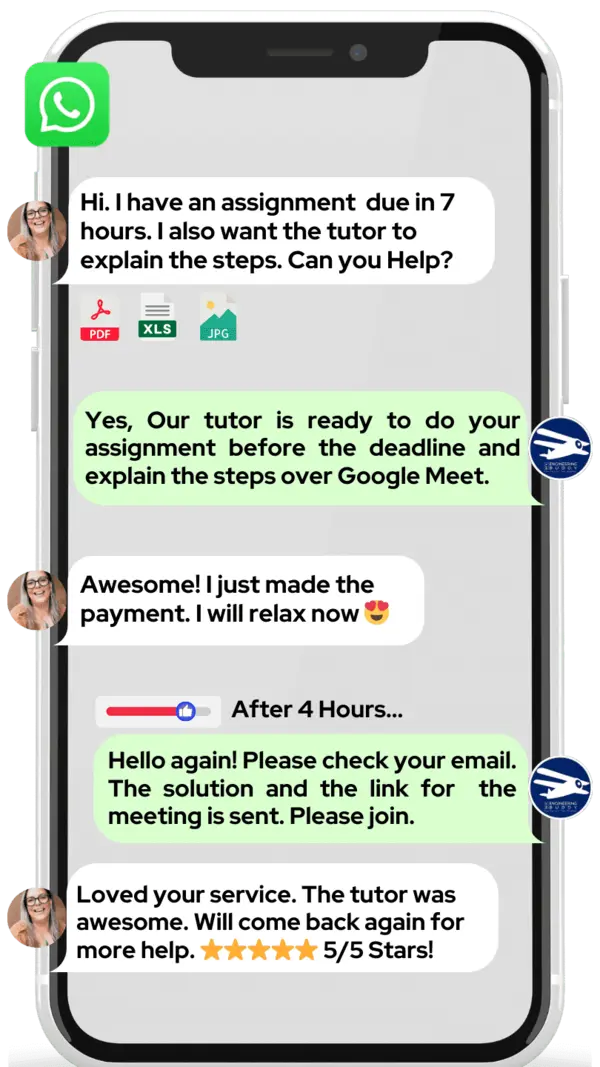
WhatsApp MEB for a quick quote — average response time under 1 minute.
Who This Broadcast Engineering Tutoring Is For
Broadcast Engineering draws students from electronics, telecommunications, and media technology backgrounds. The syllabus moves fast and the applied components — signal chains, encoding standards, RF propagation — trip up even well-prepared students.
- Undergraduate students in Electrical, Electronic, or Telecommunications Engineering with a Broadcast Engineering module
- Graduate students working on transmission system design, broadcast IP infrastructure, or ATSC/DVB standards coursework
- Students retaking after a failed first attempt — particularly those who struggled with RF link budgets or video compression fundamentals
- Students with a university conditional offer depending on this grade
- Parents watching a student’s confidence drop alongside their marks in an applied engineering module
- Working broadcast technicians upskilling through a part-time degree programme at institutions such as NYU, Salford, Bournemouth, RMIT, or Ryerson
1:1 Tutoring vs Self-Study vs AI vs YouTube vs Online Courses
Self-study works if you’re disciplined — but broadcast engineering has too many interdependencies between RF, signal processing, and encoding standards for gaps to stay small for long. AI tools give fast explanations but can’t adapt live when you’re confused about why your link budget calculation doesn’t close. YouTube covers DVB-T overviews well enough; it stops when you need to debug an actual transmission chain problem. Online courses are structured but fixed-pace, with no one correcting your specific mistakes. With a 1:1 Broadcast Engineering tutor online from MEB, the session is calibrated to your exact module — whether that’s ATSC standards, OFDM modulation, or satellite uplink design.
Outcomes: What You’ll Be Able To Do in Broadcast Engineering
After working with an MEB tutor, you’ll be able to analyse RF propagation and calculate link budgets for terrestrial and satellite broadcast paths. You’ll apply OFDM principles to explain how DVB-T2 and ATSC 3.0 manage multipath interference. You’ll solve signal chain problems from camera output to transmitter, identifying noise and loss at each stage. You’ll present broadcast network architectures clearly — from contribution feeds to distribution systems — in written assignments and oral assessments. Progress depends on starting level and the hours you put in, but students consistently close specific conceptual gaps faster with a tutor than alone.
Based on feedback from 40,000+ sessions collected by MEB from 2022 to 2025, 58% of students improved by one full grade after approximately 20 hours of 1:1 tutoring in subjects like Broadcast Engineering. A further 23% achieved at least a half-grade improvement.
Source: MEB session feedback data, 2022–2025.
What We Cover in Broadcast Engineering (Syllabus / Topics)

Track 1: Transmission Systems and RF Engineering
- RF spectrum allocation and frequency planning for broadcast bands
- Antenna theory — gain, directivity, polarisation, beam patterns
- Propagation models: free-space loss, Friis equation, terrain diffraction
- Link budget calculation for terrestrial and satellite paths
- Transmitter architectures: solid-state and high-power klystron systems
- Multiplexing: frequency-division (FDM), time-division (TDM), OFDM
- Modulation schemes: QAM, QPSK, VSB — and their trade-offs in broadcast
Recommended texts: Broadcast Engineers’ Reference Book (Emmett and Rees); Digital Television: Technology and Standards (Watkinson); RF System Design of Transceivers for Wireless Communications (Rudell).
Track 2: Broadcast Standards and Signal Processing
- Terrestrial standards: DVB-T2, ATSC 3.0 — frame structure, guard intervals, pilot patterns
- Satellite standards: DVB-S2, DVB-S2X — roll-off factor, forward error correction
- Video compression: MPEG-2, H.264/AVC, H.265/HEVC — encoder settings and artefact analysis
- Audio coding: AAC, Dolby AC-3/E-AC-3, loudness standards (EBU R128, ATSC A/85)
- Digital signal processing fundamentals applied to broadcast chains
- Transport stream structure: MPEG-2 TS, PID assignment, SI/PSI tables
- Error correction: Reed-Solomon, LDPC, BCH coding in broadcast contexts
Recommended texts: MPEG Video Compression Standard (Mitchell et al.); Digital Communications (Proakis and Salehi); Understanding Digital Television (Fischer).
Track 3: Broadcast IP Infrastructure and Contribution Networks
- ST 2110 and SMPTE standards for IP-based broadcast production
- Contribution codecs and live encoding for OB (outside broadcast) workflows
- CDN architecture and adaptive bitrate streaming (HLS, DASH) for OTT delivery
- Optical communications in broadcast fibre contribution networks
- Latency management in live broadcast IP chains
- Network redundancy: bonded cellular, satellite backup, MPLS failover
- Playout systems, automation, and master control room architecture
Recommended texts: IP Essentials for Television Engineers (IABM); The SMPTE Engineering Guideline EG 41; Video Over IP (Ely).
At MEB, we’ve found that Broadcast Engineering students who struggle with link budget calculations almost always have the same gap — they haven’t built solid intuition around noise figure and system temperature. Fix that one thing, and the rest of the RF chain clicks into place within a session or two.
Platforms, Tools and Textbooks We Support
Broadcast Engineering courses often require hands-on work with specialist simulation and signal analysis tools. MEB tutors are familiar with the platforms most commonly encountered in university lab work and coursework submissions.
- MATLAB and Simulink — signal chain modelling, BER simulation, filter design
- Advanced Design System (ADS) — RF and microwave circuit simulation
- GNU Radio — software-defined radio prototyping and signal flow modelling
- VLC and FFmpeg — transport stream analysis and codec inspection
- Spectrum analyser software (e.g. SDR#, GQRX) — live RF signal analysis
- Wireshark — ST 2110 and broadcast IP packet inspection
- TSReader / DVB Inspector — MPEG-2 TS stream analysis and SI/PSI table reading
What a Typical Broadcast Engineering Session Looks Like
The tutor opens by checking the previous topic — usually wherever the student left off on link budget derivation or transport stream structure. From there, tutor and student work through the problem on screen together: the tutor uses a digital pen-pad to annotate the RF chain diagram or OFDM frame structure while the student follows along and attempts the next calculation step. The session moves into active territory fast — the student replicates the worked example, the tutor watches for where the reasoning drifts (usually at noise figure accumulation or FEC overhead calculation). The session closes with a specific practice task — two or three link budget problems at the next complexity level — and the next topic noted: often modulation trade-offs or MPEG transport stream analysis.
How MEB Tutors Help You with Broadcast Engineering (The Learning Loop)
Diagnose: In the first session, the tutor identifies exactly where the student’s understanding breaks down — whether that’s RF propagation maths, DVB-T2 frame structure, or IP contribution workflow. Generic “I’m behind” becomes a specific list of three or four fixable gaps.
Explain: The tutor works through live examples on a digital pen-pad — annotating signal chains, walking through link budget steps, or decomposing a transport stream packet by packet. Nothing is assumed. Everything is shown.
Practice: The student attempts the next problem with the tutor present. No moving on until the reasoning is right, not just the answer.
Feedback: Errors are corrected step by step. The tutor explains exactly where marks would be lost in an assessment — and why that specific step matters in real broadcast systems.
Plan: At the end of each session, the tutor sets the next topic and a specific practice task. Progress is tracked across sessions so nothing gets skipped and nothing gets revisited unnecessarily.
Sessions run on Google Meet. The tutor uses a digital pen-pad or iPad with Apple Pencil for annotation. Before the first session, share your course outline or module guide, a past paper or assignment you struggled with, and your exam or submission deadline. The first session is also your diagnostic — every minute is used. Whether you need a quick catch-up before an assessment, structured revision over four to eight weeks, or ongoing weekly support through the semester, the tutor maps the plan after that first diagnostic session.
Start with the $1 trial — 30 minutes of live tutoring that also serves as your first diagnostic. It costs less than a coffee.
Try your first session for $1 — 30 minutes of live 1:1 tutoring or one homework question explained in full. No registration. No commitment.
WhatsApp MEB now
and get matched within the hour.
Tutor Match Criteria (How We Pick Your Tutor)
Not every electronics tutor knows broadcast. MEB matches specifically.
Subject depth: Tutors are vetted for Broadcast Engineering specifically — not just general electronics or telecommunications. They demonstrate knowledge of broadcast standards (DVB, ATSC), RF link budgeting, and signal chain analysis before being assigned to students. Help with Analog Communication and Wireless Communication draws from an adjacent but separately verified tutor pool.
Tools: Every tutor uses Google Meet and a digital pen-pad or iPad with Apple Pencil — non-negotiable for diagram-heavy broadcast engineering work.
Time zone: Matched to the student’s region. US, UK, Gulf, Canada, and Australia time zones are all covered without compromise on tutor quality.
Goals: The match accounts for your specific need — exam score improvement, conceptual understanding, homework completion, or dissertation-level research support in broadcast systems design.
Unlike platforms where you fill out a form and wait, MEB responds in under a minute, 24/7. Tutor match takes under an hour. The $1 trial means you test before you commit. Everything runs over WhatsApp — no logins, no intake forms.
Pricing Guide
Broadcast Engineering tutoring starts at $20/hr for standard undergraduate coursework. Graduate-level RF design, ATSC/DVB standards analysis, or IP broadcast infrastructure topics typically run $40–$100/hr depending on tutor specialisation and timeline urgency.
Rate factors include your course level, the specific topics involved, how quickly you need to move, and tutor availability during peak assessment periods. Availability tightens in April–May and November–December — book early if your exams fall then.
For students targeting positions at broadcasters such as the BBC, ABC, CBC, or major US networks, or aiming for graduate roles in RF transmission engineering, MEB can match you with tutors who hold professional broadcast engineering backgrounds — available at higher rates. Share your specific goal and MEB will match the tier to your ambition.
Start with the $1 trial — 30 minutes, no registration, no commitment. WhatsApp MEB for a quick quote.
MEB has been running 1:1 online tutoring since 2008 — well before “online tutoring” became a default. The platform covers 2,800+ subjects, 52,000+ students served, and a 4.8/5 rating built on 40,000+ reviews. Broadcast Engineering is one of the more specialist areas — and one where the right tutor makes an obvious difference.
Source: My Engineering Buddy, 2008–2025.
FAQ
Is Broadcast Engineering hard?
It’s demanding — particularly the RF propagation maths, link budget analysis, and compression standards. Students with solid signals and systems foundations tend to find the concepts manageable but the applied calculations time-consuming. Most gaps are fixable with targeted work on specific weak areas.
How many sessions are needed?
Most students covering a specific topic gap — say, DVB-T2 frame structure or OFDM modulation — see clear improvement in three to five sessions. Students needing full module support typically work with a tutor for eight to twelve sessions across a semester.
Can you help with homework and assignments?
MEB tutoring is guided learning — you understand the work, then submit it yourself. Tutors explain the concepts and methods behind your assignment questions so you can work through them confidently. See our Academic Integrity policy and Why MEB page for full details on what we help with and what we don’t.
Will the tutor match my exact syllabus or exam board?
Yes. Before your first session, share your course outline or module guide. Tutors are matched to your specific content — whether that’s a UK university broadcast engineering module, a North American telecommunications programme, or a professional certification curriculum.
What happens in the first session?
The tutor runs a short diagnostic — asking you to walk through a recent problem or explain a concept you found difficult. This identifies your exact gaps. The rest of the session addresses the most urgent one directly, and the tutor maps the plan for subsequent sessions.
Is online tutoring as effective as in-person?
For Broadcast Engineering, yes — possibly more so. The tutor’s digital pen-pad lets them annotate RF chain diagrams, signal flow graphs, and link budget calculations in real time. Students often find this clearer than a physical whiteboard because they can zoom in and replay annotated steps.
What’s the difference between DVB-T2 and ATSC 3.0, and do tutors cover both?
DVB-T2 is the European terrestrial broadcast standard; ATSC 3.0 is the next-generation North American standard. Both use OFDM but differ in modulation orders, channel coding, and service architecture. MEB tutors cover both — match depends on your course location and syllabus requirements.
Can MEB help with SDR-based lab work and GNU Radio assignments?
Yes. Several MEB tutors have hands-on experience with software-defined radio platforms including GNU Radio and SDR# environments. If your assignment involves building a broadcast receiver chain or analysing captured RF signals, share the brief before your first session.
Can I get Broadcast Engineering help at midnight?
Yes. MEB operates across time zones covering the US, UK, Gulf, Canada, and Australia — 24/7 WhatsApp response. If you’re working late before a deadline, message MEB and a tutor can often be matched within the hour for an urgent session.
What if I don’t like my assigned tutor?
Tell MEB on WhatsApp after the first session. A replacement is arranged immediately — no forms, no waiting. The $1 trial is specifically designed so this costs you almost nothing if the first match isn’t right.
How do I get started?
Three steps: WhatsApp MEB, share your course details and what you’re stuck on, then start the $1 trial — 30 minutes of live 1:1 tutoring or one homework question explained in full. You’re matched with a verified tutor and in your first session, usually within 24 hours.
Trust and Quality at My Engineering Buddy
Every MEB tutor goes through a subject-specific vetting process — not a general interview. For Broadcast Engineering, that means demonstrating working knowledge of RF link budgeting, broadcast transmission standards, and signal chain analysis before they’re assigned to any student. Tutors hold relevant degrees or professional broadcast engineering experience, and their performance is reviewed through session feedback after every booking. Rated 4.8/5 across 40,000+ verified reviews on Google.
MEB tutoring is guided learning — you understand the work, then submit it yourself. For full details on what we help with and what we don’t, read our Academic Integrity policy and Why MEB.
MEB has served 52,000+ students across the US, UK, Canada, Australia, the Gulf, and Europe since 2008 — in 2,800+ subjects spanning Electrical Engineering, Broadcast Engineering, and adjacent disciplines including Telecommunications tutoring, Microwave Engineering help, and Radar Systems tutoring. The platform was built for technical subjects that need more than a generalist tutor — and Broadcast Engineering is exactly that kind of subject.
Students consistently tell us that what surprises them most about MEB is the speed — not just response time, but how quickly the tutor identifies the actual gap versus the one the student thought they had. That pattern holds across broadcast engineering, RF design, and signals work alike.
Explore Related Subjects
Students studying Broadcast Engineering often also need support in:
- Analog Signal Processing
- Digital Communications
- Signals and Systems
- Electromagnetic Field Theory
- Transmission Lines and Waveguides
- Audio Engineering
- FPGA Design
Broadcast Engineering sits at the intersection of RF physics, digital signal processing, and media delivery infrastructure. Getting stuck at any one layer stalls progress across all three. That’s where a specialist tutor changes things.
Source: My Engineering Buddy, editorial, 2025.
Next Steps
Getting started takes about two minutes.
- Share your exam board or module name, the topics giving you the most trouble, and your deadline or exam date
- Share your time zone and availability — sessions are matched across US, UK, Gulf, Canada, and Australia
- MEB matches you with a verified Broadcast Engineering tutor — usually within 24 hours
- Your first session starts with a diagnostic so every minute is used on the right thing
Before your first session, have ready:
- Your module guide or course syllabus (or the specific exam board if applicable)
- A recent assignment, past paper, or homework problem you struggled with
- Your exam date or submission deadline — the tutor builds the plan around it
Visit www.myengineeringbuddy.com for more on how MEB works.
WhatsApp to get started or email meb@myengineeringbuddy.com.
Reviewed by Subject Expert
This page has been carefully reviewed and validated by our subject expert to ensure accuracy and relevance.