Contact MEB Today To Get The Best
Advanced Design System (ADS) Tutoring Online
Email: [email protected]



~1 min
Average Reply Time
~1 hour
To Be Matched With A Tutor
30 Min Trial
75% Find Their Tutor On The 1st Trial
$20-35+/hr
Premium Yet Affordable Learning
Your ADS simulation keeps crashing — or the S-parameters look right but the amplifier still won’t match. A verified Advanced Design System (ADS) tutor fixes that in the first session.
Advanced Design System (ADS) Tutor Online
Advanced Design System (ADS) is Keysight’s industry-standard EDA software for RF, microwave, and high-speed digital circuit design, enabling engineers to simulate, optimize, and verify PCB layouts, S-parameter networks, and power amplifier performance.
If you’ve searched for an Advanced Design System (ADS) tutor near me, you already know how thin the expert pool is. MEB connects you with tutors who use ADS professionally — not just academically — covering everything from schematic capture and momentum simulation to load-pull characterization and envelope tracking. Part of our broader Electrical Engineering tutoring offering, ADS support at MEB is built for graduate students, research engineers, and undergraduates who can’t afford to lose two weeks to a simulation error they can’t diagnose. One outcome you can expect: cleaner simulation workflows and a tutor who can tell you exactly why your matching network is behaving the way it is.
- 1:1 online sessions tailored to your course syllabus or specific project brief
- Expert-verified tutors with hands-on ADS experience in RF/microwave and mixed-signal design
- Flexible time zones — US, UK, Canada, Australia, Gulf
- Structured learning plan built after a diagnostic session
- Ethical homework and assignment guidance — you understand the work, then submit it yourself
52,000+ students across the US, UK, Canada, Australia, and the Gulf have used MEB since 2008 — including students in Electrical Engineering subjects like microwave engineering, analog signal processing, and VLSI design.
Source: My Engineering Buddy, 2008–2025.
How Much Does an Advanced Design System (ADS) Tutor Cost?
Online ADS tutoring at MEB starts at $20/hr for foundational circuit design and simulation topics, rising to $35–$70/hr for advanced RF system design, load-pull analysis, and graduate-level project work. Niche specialist rates go up to $100/hr. Start with the $1 trial — 30 minutes of live tutoring or one problem explained in full.
| Level / Need | Typical Rate | What’s Included |
|---|---|---|
| Standard (undergraduate, most topics) | $20–$35/hr | 1:1 sessions, simulation guidance, hw walkthroughs |
| Advanced / RF Specialist | $35–$70/hr | Expert tutor, Momentum EM, load-pull, graduate depth |
| $1 Trial | $1 flat | 30 min live session or one full homework question |
Tutor availability gets tight around semester project deadlines and defence seasons — book early if you have a fixed submission date.
WhatsApp MEB for a quick quote — average response time under 1 minute.
Who This Advanced Design System (ADS) Tutoring Is For
Most students who come to MEB for ADS support are not beginners. They’ve opened the software, they’ve attempted the simulation, and something is wrong — wrong port impedance, unstable bias point, S11 that flatly refuses to cooperate. This is for them.
- Undergraduate EE students in RF circuit design, microwave engineering, or communication systems courses where ADS is the required tool
- Graduate and PhD students using ADS for thesis simulations — PA design, antenna matching, or power amplifier linearisation
- Students retaking a failed semester with a project submission pending
- Students with a university conditional offer depending on their final-year project grade
- Parents supporting an engineering student whose confidence has dropped alongside their simulation results
- Research engineers new to ADS who need to get up to speed fast without a formal course
Students from programmes at MIT, Georgia Tech, Imperial College London, TU Delft, ETH Zürich, University of Toronto, and UNSW Sydney have all used MEB for ADS project support. The $1 trial is a low-risk way to check whether the tutor fit is right before committing to a full session plan.
1:1 Tutoring vs Self-Study vs AI vs YouTube vs Online Courses
Self-study works if you have a clear reference and a working simulation — most students don’t. AI tools explain ADS concepts quickly but can’t open your workspace, read your error log, or spot a missing ground pin. YouTube covers schematic basics well but stops the moment you hit a Momentum setup issue or a load-pull convergence failure. Online courses give you structured video content at your own pace, with no way to pause and ask why your specific circuit behaves differently. 1:1 ADS tutoring with MEB means a tutor opens your exact project, identifies the error in real time, and corrects it while you watch and replicate — calibrated specifically to your course, your simulation environment, and your deadline.
Outcomes: What You’ll Be Able To Do in Advanced Design System (ADS)
After working with an MEB ADS tutor, you’ll be able to set up and run S-parameter simulations accurately, analyze stability circles for amplifier design, apply impedance matching using the ADS Smith Chart tool, model and interpret large-signal PA behaviour using harmonic balance simulation, and present simulation results clearly in a format your supervisor or examiner expects. These are not vague skills — they map directly to the ADS tasks that appear in RF design coursework, thesis chapters, and industry project deliverables.
Based on feedback from 40,000+ sessions collected by MEB from 2022 to 2025, 58% of students improved by one full grade after approximately 20 hours of 1:1 tutoring in subjects like Advanced Design System (ADS). A further 23% achieved at least a half-grade improvement.
Source: MEB session feedback data, 2022–2025.
What We Cover in Advanced Design System (ADS) (Syllabus / Topics)

Track 1: Simulation Fundamentals and Schematic Design
- ADS workspace setup, library imports, and component placement
- DC, AC, and S-parameter simulation controllers — configuration and sweep setup
- Port definitions, terminations, and reference impedance assignment
- Harmonic balance simulation for nonlinear circuit analysis
- Data Display window: plotting S11, S21, gain, NF, and phase margin
- Equation-based post-processing using MeasEqn and dataset variables
- Troubleshooting convergence failures and simulation error messages
Recommended references: Microwave Engineering by David Pozar; RF Circuit Design by Ludwig and Bogdanov; Keysight ADS documentation and application notes.
Track 2: RF and Microwave Circuit Design
- Smith Chart tool — impedance matching, stub design, and L/Pi/T network synthesis
- LNA design: noise figure minimisation, gain flatness, and stability analysis (K-factor, mu-factor)
- Power amplifier design: load-pull simulation, output power, PAE, and AM-AM/AM-PM characterisation
- Oscillator and VCO design using negative resistance and phase noise simulation
- Mixer and frequency multiplier simulation using envelope and harmonic balance
- Filter design and optimisation: Chebyshev, Butterworth, and bandpass topologies
- S-parameter model extraction from measured data and transistor datasheet parameters
Recommended references: The Design of CMOS Radio-Frequency Integrated Circuits by Thomas Lee; Microwave Transistor Amplifiers by Gonzalez; Keysight ADS RF Design Environment application notes.
Track 3: Electromagnetic Simulation and PCB Layout
- Momentum EM simulator: substrate definition, mesh setup, and port calibration
- Co-simulation between Momentum EM results and schematic components
- Transmission line modelling — microstrip, stripline, coplanar waveguide in ADS LineCalc
- PCB design rules for RF boards: via placement, ground plane strategies, and layer stackup
- Signal integrity analysis: eye diagram, TDR, and crosstalk simulation in ADS
- Layout vs schematic (LVS) verification and back-annotation workflows
Recommended references: High-Speed Signal Propagation by Howard Johnson; Practical RF Circuit Design for Modern Wireless Systems by Besser and Gilmore; Keysight Momentum user guide.
At MEB, we’ve found that most ADS errors students bring to a first session aren’t simulation theory problems — they’re workflow problems. Wrong port assignment, missing ground node, incorrect sweep range. A tutor who has run these simulations before spots those in under five minutes. That’s where the session usually begins.
What a Typical Advanced Design System (ADS) Session Looks Like
The tutor opens by checking the previous topic — usually whichever simulation was assigned or where the student last got stuck, whether that’s an LNA stability analysis or a harmonic balance that wouldn’t converge. The student shares their ADS workspace, and the tutor walks through the schematic live, identifying the exact source of the error — missing port reference, incorrect substrate parameters, or a simulation controller misconfigured for the analysis type. The tutor uses a digital pen-pad to annotate the circuit, mark the error location, and draw the corrected topology. The student replicates the correction, reruns the simulation, and explains what changed and why. The session closes with a specific task: re-run the load-pull sweep, extract the optimal impedance point, and prepare the data display for the next session’s co-simulation walkthrough.
How MEB Tutors Help You with Advanced Design System (ADS) (The Learning Loop)
Diagnose: In the first session, the tutor reviews your simulation setup, identifies where the workflow breaks down, and maps the gap between where you are and what your assignment, thesis chapter, or project milestone requires. This is not a generic assessment — it is specific to your ADS version, your component library, and your circuit topology.
Explain: The tutor works through the problem live, using a digital pen-pad to annotate schematics, mark S-parameter plots, and walk through the derivation behind each simulation setting. You watch, ask, and challenge until the logic is clear — not just the click sequence.
Practice: You attempt the next simulation step while the tutor is present. If the setup is wrong, it gets caught immediately. If it runs, the tutor pushes you to interpret the output before moving on.
Feedback: Every error gets a full explanation — why the simulation failed, which physical principle was violated, and how an examiner or supervisor would interpret the result. No vague corrections.
Plan: At the end of each session, the tutor sets the next task and maps the progression to your deadline. Whether that’s a thesis defence, a project submission, or a circuit design coursework deadline, the plan is always working backwards from a fixed date.
Sessions run over Google Meet with a digital pen-pad or iPad + Apple Pencil. Before the first session, share your course outline or project brief, the ADS version you’re using, and the specific simulation or circuit that isn’t working. The first session starts with the diagnostic — every minute counts.
Start with the $1 trial — 30 minutes of live ADS tutoring that also serves as your first diagnostic.
Try your first session for $1 — 30 minutes of live 1:1 tutoring or one homework question explained in full. No registration. No commitment. WhatsApp MEB now and get matched within the hour.
Tutor Match Criteria (How We Pick Your Tutor)
Not every EE tutor knows ADS. MEB matches on specifics, not general credentials.
Subject depth: Tutors must have hands-on ADS experience — not just academic familiarity. We verify at the simulation level: load-pull, Momentum EM, harmonic balance, and co-simulation workflows are tested, not self-reported.
Tools: Every tutor runs sessions over Google Meet with a digital pen-pad or iPad + Apple Pencil. Screen sharing of your ADS workspace is standard.
Time zone: Matched to your region — US, UK, Gulf, Canada, Australia. Late-night and weekend slots available for most regions.
Goals: Whether you need to pass a semester project, finish a thesis chapter, or get competent in ADS for a job that starts in six weeks, the tutor is matched to that specific outcome — not a general RF curriculum.
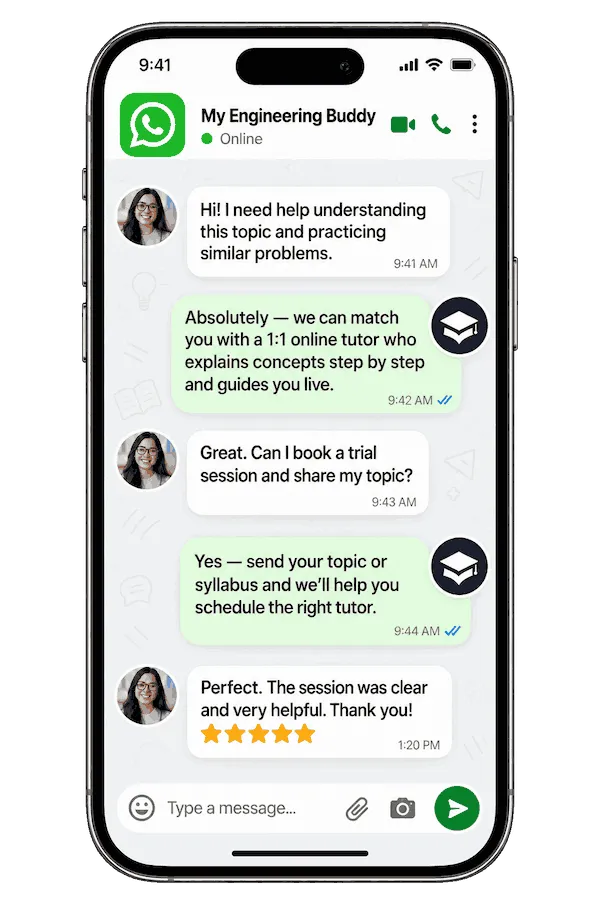
Unlike platforms where you fill out a form and wait, MEB responds in under a minute, 24/7. Tutor match takes under an hour. The $1 trial means you test before you commit. Everything runs over WhatsApp — no logins, no intake forms.
Study Plans (Pick One That Matches Your Goal)
Catch-up (1–3 weeks): for students behind on a simulation project or assignment with a tight submission window — the tutor works through the specific circuit or analysis blocking progress. Exam prep (4–8 weeks): structured sessions covering all ADS simulation types and RF design topics likely to appear in assessments or project reviews. Weekly support: ongoing sessions aligned to your course calendar, covering each new ADS topic as it appears. The tutor maps the exact session sequence after the first diagnostic — not before.
Pricing Guide
ADS tutoring runs $20–$40/hr for most undergraduate and taught-masters topics. Advanced RF design, doctoral-level research support, and specialist PA or EM simulation work goes up to $100/hr depending on tutor depth and timeline pressure.
Rate factors: your level (undergraduate vs graduate), simulation complexity, how close your deadline is, and tutor availability. Rates are confirmed before the first paid session — no surprises.
For students targeting roles at defence contractors, semiconductor firms, or research labs — or working toward professional engineering certification in RF design — tutors with industry backgrounds in ADS are available at higher rates. Share your specific goal and MEB will match the tier to your ambition.
Start with the $1 trial — 30 minutes, no registration, no commitment. WhatsApp MEB for a quick quote.
ADS is one of the most technically specific tools in the RF engineering stack. Generic EE tutors can’t help once you’re inside Momentum or debugging a harmonic balance failure. That specificity is exactly what MEB tutor matching is built for — depth over breadth, every time.
Source: My Engineering Buddy, 2008–2025.
FAQ
Is Advanced Design System (ADS) hard to learn?
ADS has a steep initial learning curve — the interface is not intuitive and simulation errors give minimal guidance. Most students find S-parameter simulation manageable within a few sessions; Momentum EM co-simulation and load-pull characterisation take longer and benefit most from 1:1 instruction.
How many sessions are needed?
It depends on your starting point and your deadline. Students with a single broken simulation and a week to submission typically need 2–3 sessions. Graduate students building an ADS simulation framework for a thesis usually work with a tutor over 8–12 weeks. The diagnostic session sets the plan.
Can you help with ADS homework and assignments?
MEB tutoring is guided learning — you understand the work, then submit it yourself. The tutor walks through your simulation setup, explains where it’s going wrong, and makes sure you can replicate the correct result independently. See our Academic Integrity policy and Why MEB page for full details on what we help with and what we don’t.
Will the tutor match my exact syllabus or exam board?
Yes. Before your first session, share your course outline, the ADS version your institution uses, and the specific simulation type covered. MEB matches tutors to your exact course requirements — whether it’s an undergraduate RF design module or a graduate microwave systems programme.
What happens in the first session?
The tutor reviews your current simulation or project brief, identifies the gaps, and maps a session plan to your deadline. If you bring a broken simulation file, the first session starts by diagnosing it. No generic intro content — the tutor goes straight to your specific problem.
Is online ADS tutoring as effective as in-person?
For simulation-based subjects like ADS, online tutoring is often more practical. Screen sharing your workspace, the tutor annotating schematics via a digital pen-pad, and running the simulation together live on Google Meet replicates the experience of sitting next to an expert — without geography being a constraint.
Can I get ADS help at midnight or on weekends?
Yes. MEB operates 24/7 via WhatsApp. Tutors cover US, UK, Gulf, and Australia time zones, so late-night sessions and weekend slots are standard — not exceptions. Message MEB and a tutor can often be matched within the hour, including off-peak times.
What if I don’t understand the simulation results, not just the setup?
That’s where most ADS students actually get stuck. The tutor doesn’t just fix your simulation controller — they explain what S21, stability circles, or PAE data physically mean and how to interpret them for your specific design goal. Understanding the output is half the session.
Does MEB cover ADS Momentum EM and co-simulation specifically?
Yes. Momentum EM setup, substrate definition, port calibration, and co-simulation with schematic-level components are all covered. These are among the most requested ADS topics at MEB — tutors are verified on these specifically, not just general simulation workflows.
What is the difference between ADS and other RF EDA tools like Cadence Virtuoso?
ADS is optimised for RF/microwave system-level and board-level design, with tight integration between harmonic balance, EM simulation, and system models. Cadence Virtuoso is more commonly used for IC-level analog and mixed-signal design at the transistor level. MEB tutors cover both — the right choice depends on your project scope and institution.
How do I get started?
Start with the $1 trial — 30 minutes of live tutoring or one full simulation problem explained. Three steps: WhatsApp MEB, get matched with a verified ADS tutor (usually within the hour), and start the trial session. No registration, no upfront commitment required.
Can ADS tutoring help with RF filter design and optimisation?
Yes. Filter design — including Chebyshev and Butterworth topologies, bandpass filter optimisation using ADS tuning tools, and verifying performance against insertion loss and return loss specs — is a standard ADS tutoring topic at MEB. Tutors work through filter synthesis from specification to verified simulation output.
Trust & Quality at My Engineering Buddy
Every MEB tutor goes through subject-specific screening before taking a session. For ADS, that means verifying simulation experience beyond introductory schematic entry — tutors demonstrate competence in S-parameter analysis, RF matching, and at least one advanced simulation type (harmonic balance, Momentum EM, or load-pull) through a live demo evaluation. Ongoing session feedback is reviewed after every block. Rated 4.8/5 across 40,000+ verified reviews on Google.
MEB tutoring is guided learning — you understand the work, then submit it yourself. For full details on what we help with and what we don’t, read our Academic Integrity policy and Why MEB.
MEB has served 52,000+ students across the US, UK, Canada, Australia, Gulf, and Europe in 2,800+ subjects since 2008. Within Electrical Engineering, the platform covers ADS alongside subjects including analog circuits, signals and systems, semiconductor devices, and integrated circuits. If your programme uses ADS as the primary simulation environment, there is a tutor on MEB who has worked inside that same environment professionally.
Since 2008, MEB has matched students in electronics engineering, digital signal processing, and RF design with tutors who know the tools — not just the theory. That specificity is what 17 years of subject-matching experience looks like.
Source: My Engineering Buddy, 2008–2025.
Explore Related Subjects
Students studying Advanced Design System (ADS) often also need support in:
- Analog Communication
- Analog Electronics
- Communication Systems
- Electromagnetic Field Theory
- FPGA Design
- Operational Amplifiers
- Transmission Lines and Waveguides
- Wireless Communication
Next Steps
Getting started is straightforward. Share your exam board or course outline, the ADS simulation type you’re working on, and where you’re currently stuck. Share your availability and time zone — US, UK, Gulf, Canada, or Australia. MEB matches you with a verified ADS tutor, usually within 24 hours. The first session opens with a diagnostic so every minute of paid tutoring is directed at your actual gaps.
Before your first session, have ready:
- Your course outline or project brief (or the specific ADS simulation you’re working on)
- A recent homework, simulation file, or result you couldn’t interpret
- Your submission deadline or exam date
The tutor handles the rest. Visit www.myengineeringbuddy.com for more on how MEB works.
WhatsApp to get started or email [email protected].
Reviewed by Subject Expert
This page has been carefully reviewed and validated by our subject expert to ensure accuracy and relevance.