

Hire Verified & Experienced
Mathematica Tutors
Email: [email protected]
4.8/5 40K+ session ratings collected on the MEB platform



Hire The Best Mathematica Tutor
Top Tutors, Top Grades. Without The Stress!


Wolfram Mathematica stumps most students the first time they try to code a symbolic computation — and the second time too. The syntax is unlike anything else, and most courses assume you’ll just figure it out.
Mathematica Tutor Online
Mathematica is a computational software system developed by Wolfram Research, used for symbolic mathematics, numerical computation, data analysis, and visualisation across science, engineering, and graduate research.
MEB connects you with a 1:1 online Mathematica tutor who knows the software from the inside — not just the basics, but notebooks, pattern matching, symbolic solvers, and real project workflows. If you’re searching for a Mathematica tutor near me, online 1:1 sessions deliver the same live interaction, with screen sharing and a digital pen-pad. Our tutors cover statistical software across 2,800+ applied and academic subjects — Mathematica included. One session is often enough to unblock a week of stuck progress.
- 1:1 online sessions tailored to your course, module, or research workflow
- Expert-verified tutors with hands-on Mathematica experience across disciplines
- Flexible time zones — US, UK, Canada, Australia, Gulf
- Structured learning plan built after a diagnostic session
- Guided project support — we explain the logic, you write and run the code
52,000+ students across the US, UK, Canada, Australia, and the Gulf have used MEB since 2008 — including students in statistical software subjects like Mathematica, Stata, and RStudio.
Source: My Engineering Buddy, 2008–2025.
How Much Does a Mathematica Tutor Cost?
Most Mathematica tutoring sessions run $20–$40/hr depending on level and topic complexity. Graduate research, symbolic computing depth, or tight deadlines push rates toward the higher end. Start with the $1 trial — 30 minutes of live tutoring or one full problem explained — before committing to a package.
| Level / Need | Typical Rate | What’s Included |
|---|---|---|
| Standard (undergrad / coursework) | $20–$35/hr | 1:1 sessions, guided project support |
| Advanced / Graduate / Research | $35–$100/hr | Expert tutor, symbolic computing depth |
| $1 Trial | $1 flat | 30 min live session or 1 project question |
Tutor availability tightens at semester end and during dissertation submission periods. Book early if your deadline is within three weeks.
WhatsApp MEB for a quick quote — average response time under 1 minute.
Who This Mathematica Tutoring Is For
Mathematica is used across physics, engineering, data science, economics, and pure mathematics. The students who come to MEB usually aren’t beginners who’ve never opened the software — they’ve opened it, hit a wall, and need someone who can read the error and explain the fix.
- Undergraduates using Mathematica for the first time in a methods or modelling course
- Graduate students running symbolic or numerical computations for a thesis chapter
- Students retaking after a failed first attempt at a computational methods module
- Researchers who know the mathematics but can’t translate it into working Wolfram code
- Students with a project or dissertation submission deadline approaching fast
- Faculty or postdocs preparing Wolfram notebooks for teaching or publication
Students come from programmes at MIT, Caltech, Imperial College London, ETH Zürich, University of Toronto, University of Melbourne, and TU Delft — among others.
At MEB, we’ve found that Mathematica students often know exactly what result they need — they just can’t get the syntax to cooperate. That gap between mathematical understanding and working code is precisely where 1:1 tutoring does its best work.
1:1 Tutoring vs Self-Study vs AI vs YouTube vs Online Courses
Self-study works if you’re disciplined, but Mathematica’s documentation is dense and error messages are rarely self-explanatory. AI tools give fast syntax hints but can’t watch you run a flawed loop and tell you why it returns nothing. YouTube covers the basics well — it stops when your specific notebook breaks. Online courses move at a fixed pace and skip the edge cases your assignment actually tests. With a 1:1 Mathematica tutor online, you get live diagnosis of your exact code, on your exact dataset or problem set, in real time.
Outcomes: What You’ll Be Able To Do in Mathematica
After working with an MEB tutor, students can write clean, readable Wolfram notebooks without copying and adapting code they don’t understand. They can solve symbolic equations and simplify algebraic expressions using Solve, DSolve, and Simplify with confidence. They apply numerical methods — NDSolve, FindRoot, NIntegrate — to real engineering and science problems. They build and present visualisations using Plot, ListPlot, and Manipulate that communicate results clearly. They debug their own code rather than starting from scratch when something breaks.
Based on feedback from 40,000+ sessions collected by MEB from 2022 to 2025, students working 1:1 on Mathematica consistently report faster progress through stuck points, clearer understanding of Wolfram syntax logic, and greater independence when debugging notebooks without tutor support.
Source: MEB session feedback data, 2022–2025.
Try your first session for $1 — 30 minutes of live 1:1 tutoring or one homework question explained in full. No registration. No commitment. WhatsApp MEB now and get matched within the hour.
What We Cover in Mathematica (Topics)

Symbolic and Algebraic Computing
- Algebraic simplification: Simplify, FullSimplify, Factor, Expand
- Equation solving: Solve, NSolve, Reduce, FindInstance
- Calculus: D, Integrate, Limit, Series expansions
- Differential equations: DSolve, NDSolve, boundary and initial value problems
- Linear algebra: Matrix operations, Eigenvalues, Eigenvectors, LinearSolve
- Special functions and transformations: FourierTransform, LaplaceTransform
Recommended references: Wellin’s Programming with Mathematica (4th ed.), Wagon’s Mathematica in Action.
Numerical Methods and Scientific Computing
- Numerical integration and differentiation: NIntegrate, ND
- Root finding: FindRoot, NSolve, Newton’s method implementation
- Optimisation: FindMinimum, FindMaximum, NMinimize, linear and nonlinear
- Interpolation and curve fitting: Interpolation, FindFit, NonlinearModelFit
- Ordinary and partial differential equations: numerical approaches with NDSolve
- Monte Carlo methods and stochastic simulation
Recommended references: Quarteroni et al.’s Numerical Mathematics, Burden & Faires’ Numerical Analysis.
Data Analysis, Visualisation, and Wolfram Notebooks
- Data import and wrangling: Import, Dataset, Query, Association structures
- Statistical analysis: Mean, Variance, Correlation, DistributionFitTest
- 2D and 3D plotting: Plot, ListPlot, ParametricPlot, Plot3D, ContourPlot
- Dynamic interactivity: Manipulate, Dynamic, Slider controls
- Wolfram notebook structure: cells, formatting, CDF export, documentation
- Machine learning functions: Classify, Predict, NetTrain (Wolfram ML)
Recommended references: Mangano’s Mathematica Cookbook, Wolfram’s official ACM Digital Library for peer-reviewed computational research.
Platforms, Tools & Textbooks We Support
Mathematica runs on Windows, macOS, and Linux. MEB tutors work with students on Wolfram Mathematica (all versions from 11 onward), Wolfram Alpha Pro, and Wolfram Cloud notebooks. Sessions use Google Meet with screen sharing so the tutor can see your notebook live. Tutors support course-specific textbooks including Wellin, Wagon, Mangano, and any departmental lab manual your programme uses.
What a Typical Mathematica Session Looks Like
The tutor starts by checking where the previous topic — say, setting up NDSolve for a heat equation problem — was left off. You share your screen and open the notebook you’ve been working in. The tutor watches you run your current code, reads the output or error message, and explains exactly what Mathematica is doing at each evaluation step. Together, you rework the problematic cell — maybe the boundary conditions weren’t specified correctly, or a semicolon was suppressing output you needed to see. The tutor writes a parallel example using a digital pen-pad, you replicate the logic in your own notebook, and by the end of the session you have working code and understand why it works. A specific practice problem is set before you log off.
How MEB Tutors Help You with Mathematica (The Learning Loop)
Diagnose: In the first session, the tutor asks you to open a recent notebook and walks through it with you. They identify whether the issue is syntax, conceptual (you don’t know what the function actually does), or structural (your notebook logic is sound but your data format is wrong).
Explain: The tutor works through a solved example on a digital pen-pad — step by step, showing what each Mathematica function returns and why. No assumed knowledge. No skipped steps.
Practice: You attempt a parallel problem with the tutor watching. They don’t touch your keyboard. You write the code, run it, and interpret the output yourself.
Feedback: The tutor points out exactly where your logic diverged — not just “that’s wrong” but which line, which argument, which assumption caused it. This is where most self-taught Mathematica users stop improving.
Plan: At session end, the tutor notes which functions you’ve mastered and which need reinforcement, sets a specific task for before the next session, and maps the next topic in your sequence.
Sessions run on Google Meet. Your tutor uses a digital pen-pad or iPad with Apple Pencil for live annotation. Before your first session, have your Mathematica notebook open, your assignment brief or problem set ready, and your deadline date noted. The first session covers a diagnostic review and your most urgent stuck point. Whether you need a quick catch-up before a submission, structured support over four to eight weeks, or ongoing help through the semester, the tutor maps the plan after that first diagnostic.
Start with the $1 trial — 30 minutes of live tutoring that also serves as your first diagnostic.
Students consistently tell us that the first session in Mathematica is the one that reframes everything — once you understand how the evaluator works, the syntax starts making sense. Most students don’t need twenty sessions. They need someone to explain the logic once, clearly.
Tutor Match Criteria (How We Pick Your Tutor)
Not every strong mathematician is a strong Mathematica user. MEB matches on specifics.
Subject depth: Tutors are matched to your discipline — physics, engineering, economics, pure mathematics — not just “knows Mathematica.” They’ve used it in the context you’re studying it.
Tools: All tutors work on Google Meet with a digital pen-pad or iPad and Apple Pencil. You see the working in real time.
Time zone: Matched to your region — US, UK, Gulf, Canada, Australia — so sessions happen when you’re actually awake and able to focus.
Goals: Whether your aim is to pass a computational methods exam, complete a dissertation chapter, or get faster at data visualisation, the tutor is briefed on your specific outcome before session one.
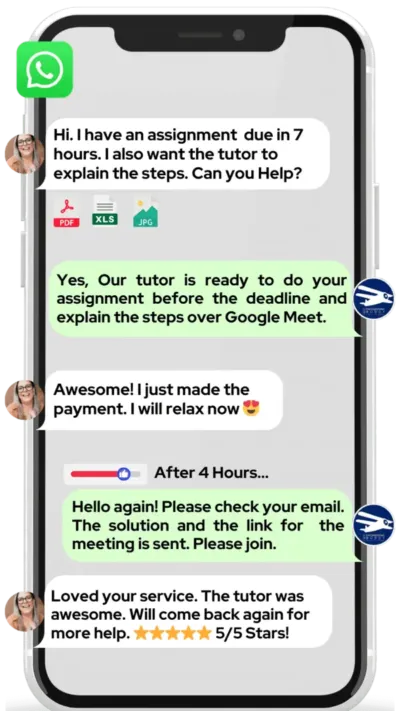
Unlike platforms where you fill out a form and wait, MEB responds in under a minute, 24/7. Tutor match takes under an hour. The $1 trial means you test before you commit. Everything runs over WhatsApp — no logins, no intake forms.
MEB tutors are screened through subject-specific live demos, not just CV review. Every tutor matched to a Mathematica student has demonstrated working knowledge of Wolfram notebooks, symbolic computation, and at least one applied scientific discipline.
Source: My Engineering Buddy internal tutor vetting process, 2008–2025.
Pricing Guide
Mathematica tutoring starts at $20/hr for standard undergraduate coursework. Graduate-level symbolic computing, research notebook support, and dissertation-linked work typically run $50–$100/hr depending on depth and tutor background.
Rate factors: level of study, topic complexity (symbolic algebra vs. machine learning functions), urgency of deadline, and tutor availability. Availability tightens sharply at semester end — especially in May and November.
For students working toward publication, dissertation submission, or programmes at research-intensive universities, tutors with active research computing backgrounds are available at higher rates. Share your specific goal and MEB will match the right tier.
Start with the $1 trial — 30 minutes, no registration, no commitment. WhatsApp MEB for a quick quote.
FAQ
Is Mathematica hard to learn?
Mathematica has an unusual syntax and a steep initial learning curve — especially for students coming from Python or MATLAB. The core logic of symbolic evaluation trips most beginners. One or two focused sessions usually break through the main wall.
How many sessions are typically needed?
Students with a specific stuck point often need two to four sessions. Those building a full workflow for a thesis or project typically work with a tutor over six to twelve sessions across a semester.
Can you help with projects and portfolio work?
MEB provides guided project support — the tutor explains the logic, walks through the approach, and helps you understand each step. You write and run the code yourself. MEB does not complete or submit project work on your behalf. See our Policies page for full details on what we help with and what we don’t.
Will the tutor match my exact syllabus or course?
Yes. Share your course outline, assignment brief, or problem set before the first session and the tutor reviews it in advance. MEB covers Mathematica as used in physics, engineering, economics, data science, and mathematics programmes specifically.
What happens in the first session?
The tutor runs a diagnostic — they ask you to share your current notebook and walk through it together. This identifies whether your issue is syntax, conceptual, or structural. The session then addresses your most urgent problem directly.
Are online sessions as effective as in-person tutoring?
For Mathematica, online is often better — you share your actual screen, the tutor sees your exact notebook and error output, and they annotate live using a digital pen-pad. There’s no whiteboard that doesn’t show your real code.
What is the difference between Mathematica and MATLAB, and can MEB help with both?
Mathematica is built around symbolic computation — it manipulates expressions algebraically. MATLAB is primarily numerical. Many students use both in the same programme. MEB covers EViews, SAS, and other computational tools alongside Mathematica tutoring.
Can I use Mathematica for machine learning, not just maths?
Yes. Wolfram’s built-in machine learning functions — Classify, Predict, NetTrain — are fully supported. Tutors cover Wolfram Neural Net Framework and the Dataset and Query structures used for ML workflows in research computing contexts.
Can I get Mathematica help at midnight or on weekends?
Yes. MEB operates across time zones and WhatsApp response time averages under a minute at any hour. Tutors in your region are matched first, but global coverage means late-night sessions are available seven days a week.
What if I don’t connect with my assigned tutor?
Tell MEB via WhatsApp. A replacement is arranged within hours, no questions asked. The $1 trial is specifically designed to test the fit before you spend more. No commitment locks you to a specific tutor.
How do I get started?
WhatsApp MEB, share your subject, deadline, and what you’re stuck on. MEB matches you with a verified Mathematica tutor — usually within an hour. Your first session starts with a diagnostic, and the $1 trial covers the first 30 minutes.
Trust & Quality at My Engineering Buddy
Every MEB tutor goes through subject-specific vetting — not a general competency test. Mathematica tutors complete a live demo session assessed on their ability to read real student code, diagnose errors in symbolic and numerical workflows, and explain Wolfram evaluation logic clearly. Rated 4.8/5 across 40,000+ verified reviews on Google, MEB has been running since 2008 with 52,000+ students served across the US, UK, Canada, Australia, Gulf, and Europe.
MEB provides guided learning support. All project work is produced and submitted by the student. See our Policies page for details.
MEB covers 2,800+ subjects across statistical software, scientific computing, and quantitative methods — including JASP tutoring, JMP tutoring, and SmartPLS help. Tutors are matched by discipline, not just subject name. The same rigour applied to Mathematica tutor selection applies across every subject on the platform. Read more about how sessions are structured on our tutoring methodology page.
Explore Related Subjects
Students studying Mathematica often also need support in:
Next Steps
Before your first session, have ready: your course outline or assignment brief, a recent problem set or notebook you’ve been stuck on, and your deadline or submission date. The tutor handles the rest.
- Share your course, hardest current topic, and timeline via WhatsApp
- Share your time zone and availability — sessions are matched to your region
- MEB matches you with a verified Mathematica tutor, usually within 24 hours
The first session opens with a diagnostic so no time is wasted on topics you already have under control.
Visit www.myengineeringbuddy.com for more on how MEB works.
WhatsApp to get started or email [email protected].
52,000+ Happy Students From Various Universities






How Much For Private 1:1 Tutoring & Hw Help?
Private 1:1 Tutoring and HW help Cost $20 – 35 per hour* on average.
Reviewed by Subject Expert
This page has been carefully reviewed and validated by our subject expert to ensure accuracy and relevance.

