Hire Verified & Experienced
Aerospace Propulsion Tutors
4.8/5 40K+ session ratings collected on the MEB platform



Hire The Best Aerospace Propulsion Tutor
Top Tutors, Top Grades. Without The Stress!
52,000+ Happy Students From Various Universities






How Much For Private 1:1 Tutoring & Hw Help?
Private 1:1 Tutoring and HW help Cost $20 – 35 per hour* on average.
Thermodynamic cycles, nozzle flows, combustion instability — and your grades are stuck below where they need to be.
Aerospace Propulsion Tutor Online
Aerospace propulsion is the engineering discipline covering the design, analysis, and performance of systems that generate thrust — including gas turbines, rockets, and ramjets. Studied at undergraduate and graduate level, it equips students to model engine cycles, analyze combustion, and evaluate propulsive efficiency across flight regimes.
MEB provides 1:1 online tutoring and homework help in 2800+ advanced subjects, including aerospace propulsion. If you’ve searched for an aerospace propulsion tutor near me and found nothing useful locally, MEB connects you with a verified expert online — matched to your syllabus, your level, and your timeline. Sessions are live, structured, and built around what you actually need to pass or progress.
- 1:1 online sessions tailored to your exact course and syllabus
- Expert verified tutors with aerospace engineering backgrounds
- Flexible scheduling across US, UK, Canada, Australia, and Gulf time zones
- Structured learning plan built after a diagnostic session
- Ethical homework and assignment guidance — you understand the material before you submit
52,000+ students across the US, UK, Canada, Australia, and the Gulf have used MEB since 2008 — across 2,800+ subjects, from AP Calculus to A Level Music Technology to Data Science.
Source: My Engineering Buddy, 2008–2025.
How Much Does an Aerospace Propulsion Tutor Cost?
Most aerospace propulsion tutoring at MEB runs $20–$40/hr for standard undergraduate work. Graduate-level and highly specialized propulsion topics — scramjets, reacting flow, advanced turbomachinery — can reach up to $100/hr depending on tutor expertise. The $1 trial gets you 30 minutes of live 1:1 tutoring or one full homework question explained in detail.
| Level / Need | Typical Rate | What’s Included |
|---|---|---|
| Undergraduate (most courses) | $20–$40/hr | 1:1 sessions, homework guidance |
| Graduate / Advanced Specialist | $40–$100/hr | Expert tutor, niche depth (reacting flows, turbomachinery) |
| $1 Trial | $1 flat | 30 min live session or one full homework question |
Tutor availability tightens significantly around semester finals and project submission periods. Book early if your deadline is within four weeks.
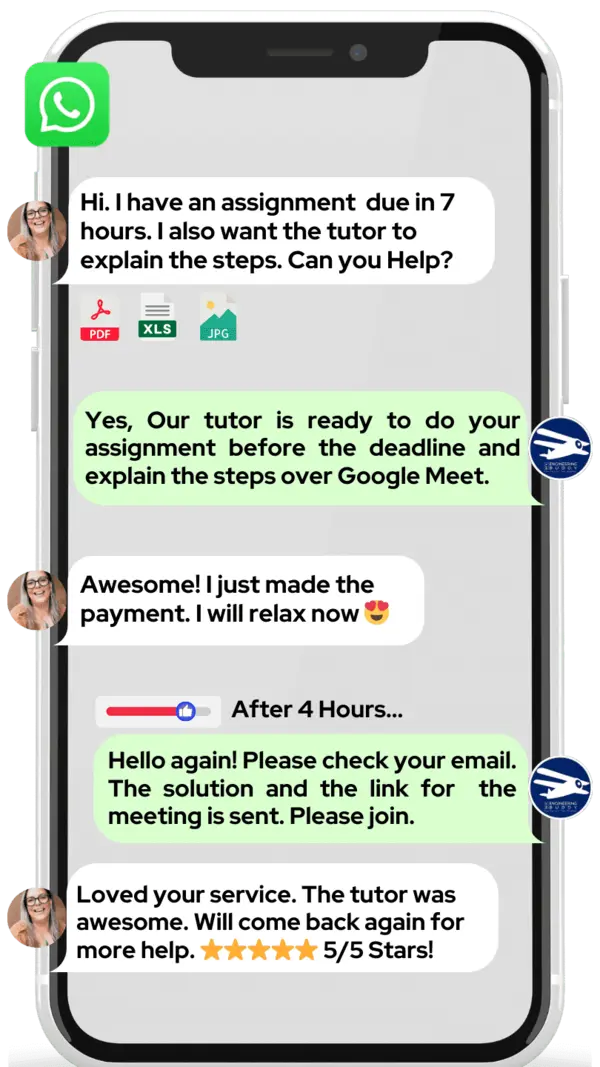
WhatsApp MEB for a quick quote — average response time under 1 minute.
Who This Aerospace Propulsion Tutoring Is For
Aerospace propulsion spans several demanding sub-fields. Students who come to MEB are usually comfortable with the basics but hitting a wall at the point where thermodynamics, fluid mechanics, and combustion all converge at once.
- Undergraduate aerospace or mechanical engineering students covering gas turbine and rocket engine cycles
- Graduate students working through advanced combustion, turbomachinery design, or propulsion system analysis
- Students with a conditional university offer who need to secure a specific grade in their aerospace engineering course this semester
- Students preparing for final exams with gaps in topics like isentropic flow, thrust vectoring, or nozzle design
- Students who need structured homework guidance — understanding the derivations, not just copying answers
- Parents supporting a first or second-year engineering student whose grades have dropped and who needs structured weekly sessions to recover
Students at institutions including MIT, Georgia Tech, Purdue, Imperial College London, Delft University of Technology, UNSW Sydney, and the University of Michigan have worked with MEB tutors on propulsion coursework.
1:1 Tutoring vs Self-Study vs AI Tools
Self-study works for motivated students, but aerospace propulsion has a compounding structure — misunderstanding isentropic relations in week three means combustion efficiency in week seven makes no sense. Without feedback, you repeat the same errors on every problem set. AI tools are fast for definitions and equation lookups, but they cannot watch you work through a Brayton cycle calculation, catch the moment you misapply the stagnation enthalpy assumption, and correct it in real time. For a subject where one wrong sign in a nozzle flow problem cascades into a completely wrong thrust figure, live annotated problem-solving matters. MEB gives you online flexibility with a structured feedback loop calibrated to your exact course — whether that’s a junior propulsion module at a US university or a graduate turbomachinery elective in the UK or Australia.
Outcomes: What You’ll Be Able To Do in Aerospace Propulsion
After structured 1:1 sessions, students consistently report being able to solve complete Brayton and Rankine cycle problems without getting lost mid-derivation, analyze isentropic nozzle flow and correctly apply area-Mach relations, model rocket engine performance using the rocket equation and account for specific impulse variations, explain combustion stability limits and their effect on afterburner design, and apply thrust and propulsive efficiency equations to real engine configurations like turbofans and turbojets. These are not vague improvements in “confidence.” They are specific skills assessed directly in propulsion exams and design projects.
Supporting a student through aerospace propulsion? MEB works directly with parents to set up sessions, track progress, and keep coursework on schedule. WhatsApp MEB — average response time is under a minute, 24/7.
Based on feedback from 40,000+ sessions collected by MEB from 2022 to 2025, 58% of students improved by one full grade after approximately 20 hours of 1:1 tutoring in a single subject. A further 23% achieved at least a half-grade improvement.
Source: MEB session feedback data, 2022–2025.
What We Cover in Aerospace Propulsion (Syllabus / Topics)

Gas Turbine and Jet Propulsion
- Brayton cycle analysis — ideal and real cycle efficiency
- Component performance: compressor, combustor, turbine, nozzle
- Turbofan, turbojet, turboprop — thrust and specific fuel consumption
- Stagnation properties and isentropic flow relations
- Afterburner design and reheat thermodynamics
- Polytropic and isentropic efficiencies in turbomachinery stages
Core texts: Elements of Gas Turbine Propulsion (Mattingly), Gas Turbine Theory (Saravanamuttoo et al.).
Rocket Propulsion
- Tsiolkovsky rocket equation and staging analysis
- Chemical rocket performance — specific impulse, characteristic velocity
- Nozzle design: convergent-divergent geometry, area ratio, exit conditions
- Solid and liquid propellant systems — combustion and feed mechanisms
- Thrust vector control and attitude maneuvers
- Electric propulsion fundamentals — ion thrusters, Hall effect engines
Core texts: Rocket Propulsion Elements (Sutton & Biblarz), Fundamentals of Spacecraft Attitude Determination and Control (Markley & Crassidis) for context on maneuver planning.
Combustion and Reacting Flows
- Stoichiometry, equivalence ratio, and adiabatic flame temperature
- Premixed and diffusion flame structure
- Combustion instability — mechanisms and suppression strategies
- Detonation vs deflagration — Chapman-Jouguet conditions
- Emissions modeling — NOx, CO, unburned hydrocarbons
- Scramjet and ramjet combustion regimes
Core texts: An Introduction to Combustion (Turns), Combustion Engineering (Borman & Ragland).
What a Typical Aerospace Propulsion Session Looks Like
The tutor opens by checking where you left off — usually the previous problem set on compressor maps or isentropic nozzle flow. From there, the session moves into the current sticking point: a student might be struggling to correctly apply the energy equation across a combustor, or getting the sign convention wrong in a turbine work extraction calculation. The tutor works through the problem live on a digital pen-pad, narrating each step, then asks the student to replicate the method on a similar problem while the tutor watches. If a step goes wrong, it gets caught immediately — not two hours later when you’re checking your answer against the back of the book. The session closes with a specific practice problem set and a note of what comes next, typically nozzle design or specific impulse analysis.
How MEB Tutors Help You with Aerospace Propulsion (The Learning Loop)
Diagnose: In the first session, the tutor identifies exactly which part of the propulsion chain is breaking down — whether it’s the thermodynamic fundamentals, the fluid mechanics of nozzle flow, or the application of rocket performance equations to multi-stage systems.
Explain: The tutor works through live examples using a digital pen-pad, building from first principles. No skipping steps. Every isentropic relation, every enthalpy term, every thrust equation gets derived rather than just stated.
Practice: The student attempts a problem while the tutor watches in real time. This is where gaps actually close — not from watching, but from doing with immediate correction available.
Feedback: The tutor goes through each error step by step — not just marking it wrong, but explaining why the assumption failed and what marks would be lost in an exam context.
Plan: After each session, the tutor sets the next topic, identifies which past paper questions to attempt, and tracks progress toward the student’s specific goal — whether that’s a final exam, a design project, or a research milestone.
Sessions run on Google Meet. The tutor uses a digital pen-pad or iPad with Apple Pencil for annotated working. Before your first session, share your course syllabus or module outline and any problem sets you’ve already attempted. The first session is also your diagnostic — so every minute of it counts toward understanding exactly where to focus. Whether you need a quick catch-up before an exam, structured revision over 4–8 weeks, or ongoing weekly support through the semester, the tutor maps the session plan after that first diagnostic.
Start with the $1 trial — 30 minutes of live tutoring that also serves as your first diagnostic.
At MEB, we’ve found that aerospace propulsion students who struggle aren’t usually weak at mathematics — they’ve just never seen the thermodynamic and fluid mechanics threads connected in a single worked problem. One session that links the Brayton cycle to a real turbofan specification tends to unlock weeks of stuck material.
Tutor Match Criteria (How We Pick Your Tutor)
Every aerospace propulsion tutor at MEB is matched to you before the first session. Here’s what that match covers.
Subject depth: Tutors hold degrees in aerospace, mechanical, or aeronautical engineering — many with postgraduate or research backgrounds specifically in propulsion, combustion, or turbomachinery. The match accounts for your exact course level and topic focus, whether that’s undergraduate gas dynamics or graduate reacting flows.
Tools: All sessions run on Google Meet with a digital pen-pad or iPad and Apple Pencil for live annotated working. Screen sharing is used for computational assignments or propulsion simulation software.
Time zone: MEB covers New York, Los Angeles, Chicago, London, Dubai, Toronto, Sydney, Melbourne, and all major US, UK, Gulf, Canadian, Australian, and European time zones — including evenings and weekends.
Learning style: Calibrated from the first session — some students need derivations from scratch, others need exam technique, others need someone to check their reasoning step by step.
Communication: Clear technical English, adapted to your level. A first-year undergraduate and a PhD candidate get very different explanations of combustion instability.
Goals: Exam scores, assignment completion, conceptual depth for research, or preparation for aerospace industry roles — the tutor pitch changes based on what you actually need.
Unlike platforms where you fill out a form and wait, MEB responds in under a minute, 24/7. Tutor match takes under an hour. The $1 trial means you test before you commit. Everything runs over WhatsApp — no logins, no intake forms.
Study Plans (Pick One That Matches Your Goal)
MEB tutors build a specific session sequence after the first diagnostic. For most propulsion students, that falls into one of three shapes: a rapid catch-up over one to three weeks targeting the exact gaps before a final exam; a structured four to eight week revision plan working through gas turbine cycles, rocket performance, and combustion in sequence; or ongoing weekly sessions aligned to your semester timetable, timed to stay ahead of each module’s assessed components. The tutor decides the sequence — you just need to show up with your syllabus and the problem sets you’re stuck on.
Pricing Guide
Aerospace propulsion tutoring at MEB starts at $20/hr for standard undergraduate work. Graduate-level sessions covering advanced combustion, turbomachinery aerodynamics, or reacting flow typically run $40–$70/hr. Rates up to $100/hr apply for highly specialized or PhD-level support.
Rate factors include your course level, topic complexity, how quickly you need sessions, and tutor availability. Availability is tightest in the four weeks before semester finals — if that’s your window, book as early as possible.
For students targeting roles at aerospace firms or admission to graduate propulsion research programs, tutors with industry or research backgrounds in gas turbine development, rocket systems, or propulsion test engineering are available at higher rates — share your specific goal and MEB will match the tier to your ambition.
Start with the $1 trial — 30 minutes, no registration, no commitment. WhatsApp MEB for a quick quote.
Students consistently tell us that the biggest surprise about online aerospace propulsion tutoring is how much faster problems click when someone is watching you work in real time — not reading your finished attempt, but watching you apply the isentropic flow equations line by line.
MEB tutors cover the full propulsion stack — from introductory thermodynamic cycle analysis in a first-year engineering module through to advanced combustion modeling and turbomachinery design at graduate level, across US, UK, Australian, and Gulf university programmes.
Source: My Engineering Buddy, 2008–2025.
FAQ
Is aerospace propulsion hard?
It’s one of the more demanding engineering modules — it draws on thermodynamics, fluid mechanics, and chemistry simultaneously. Most students find combustion and compressible flow the steepest sections. With a tutor working through those intersections step by step, the difficulty becomes manageable rather than overwhelming.
How many sessions are needed?
It depends on your starting point and goal. Students closing a specific exam gap often need six to ten focused sessions. Students wanting semester-long support typically book weekly. The tutor gives a realistic estimate after the first diagnostic session, not before.
Can you help with homework and assignments?
Yes — MEB tutors explain the method, work through similar problems, and guide you to the answer. You do the work and submit it yourself. MEB tutoring is guided learning — you understand the work, then submit it yourself. For full details on what we help with and what we don’t, read our Academic Integrity policy and Why MEB.
Will the tutor match my exact syllabus or exam board?
Yes. MEB matches tutors to your specific university module, textbook, and assessment structure. Share your course outline or syllabus when you first message — the tutor uses it to structure every session and prioritise the topics that carry the most marks.
What happens in the first session?
The tutor runs a short diagnostic — usually a mix of questions and a worked problem — to identify exactly where your understanding breaks down. That shapes the rest of the session and determines the plan for subsequent ones. Nothing is wasted on material you already know.
Is online tutoring as effective as in-person?
For propulsion specifically, the digital pen-pad on Google Meet is often more effective than a physical whiteboard — the tutor can annotate directly on diagrams, engine schematics, and cycle plots while you watch and ask questions. Every session is also recordable for review before exams.
Can I get aerospace propulsion help at midnight or on weekends?
Yes. MEB operates 24/7 across all time zones. If you’re in Dubai revising at 11 pm or in California working through a problem set on Sunday afternoon, tutors are available. WhatsApp MEB and the response typically comes in under a minute.
What if I don’t get on with my assigned tutor?
It happens rarely, but if the match isn’t right, MEB replaces the tutor. No forms, no delay. Message MEB over WhatsApp and a new match is arranged, usually within the hour. The $1 trial exists specifically so you can test the match before committing to paid sessions.
Do you offer group aerospace propulsion sessions?
MEB specializes in 1:1 sessions — that’s the model. Group sessions are not offered. The reason is straightforward: propulsion problems are individual, mistakes are individual, and the correction needs to be individual. A shared session dilutes all three of those by definition.
How do I get started?
Three steps: WhatsApp MEB with your course level and topic, get matched with a verified aerospace propulsion tutor within the hour, then start the $1 trial — 30 minutes of live 1:1 tutoring or one full homework question explained from first principles. No registration required.
Trust & Quality at My Engineering Buddy
Every MEB tutor goes through subject-specific vetting — not a generic screen. For aerospace propulsion, that means verified engineering degrees, a live demo session evaluated by MEB, and ongoing review of session feedback. Rated 4.8/5 across 40,000+ verified reviews on Google. Tutors hold degrees from universities including Imperial College London, Georgia Tech, Delft University of Technology, and MIT, and many have industry experience in propulsion development, gas turbine testing, or rocket systems engineering.
MEB tutoring is guided learning — you understand the work, then submit it yourself. For full details on what we help with and what we don’t, read our Academic Integrity policy and Why MEB.
MEB has served 52,000+ students across the US, UK, Canada, Australia, the Gulf, and Europe in 2,800+ subjects since 2008. Students working on related propulsion coursework have also used MEB for gas dynamics tutoring, compressible flow help, and turbulence modeling tutoring. For more on how MEB structures its sessions, see the tutoring methodology page.
NASA’s propulsion research programmes and aerospace engineering curricula at universities across the US, UK, and Australia consistently identify combustion efficiency and nozzle design as the most tested — and most misunderstood — topics in undergraduate propulsion courses.
Source: NASA Science.
Try your first session for $1 — 30 minutes of live 1:1 tutoring or one homework question explained in full. No registration. No commitment. WhatsApp MEB now and get matched within the hour.
Explore Related Subjects
Students studying aerospace propulsion often also need support in:
- Aerodynamics
- Compressible Flow
- Gas Dynamics
- Missile and Rocket Propulsion
- Computational Fluid Dynamics (CFD)
- Flight Mechanics
- Turbulence Modeling
- Aircraft Performance
Next Steps
Getting started takes less than five minutes.
- Share your exam board or university module name, your hardest topic right now, and your exam or submission date
- Share your time zone and preferred session times — evenings and weekends are available in all regions
- MEB matches you with a verified aerospace propulsion tutor, usually within 24 hours
- Your first session starts with a diagnostic so no time is spent on material you already have covered
Before your first session, have ready:
- Your course syllabus or module outline
- A recent problem set or assignment you struggled with — past paper questions work well
- Your exam or deadline date
The tutor handles the rest. Visit www.myengineeringbuddy.com for more on how the MEB process works.
WhatsApp to get started or email meb@myengineeringbuddy.com.
Reviewed by Subject Expert
This page has been carefully reviewed and validated by our subject expert to ensure accuracy and relevance.